 Jordan Ellis
Port Townsend works best when you treat it as three places sharing one name: a Victorian waterfront downtown built for a railroad boom that never finished, an uptown residential bluff of captains’ houses reached by stairs, and Fort Worden, a 430-plus acre former Army post turned state park two miles north. Plan a day for the waterfront and the wooden boat world at Point Hudson, half a day for Fort Worden’s batteries and beaches, and arrive by the Coupeville ferry or the Hood Canal Bridge with the sailing and tide warnings already understood.
Quick Facts
- Where: Northeastern tip of the Olympic Peninsula, Washington, where Puget Sound meets the Strait of Juan de Fuca.
- Fort Worden: Fort Worden Historical State Park, 200 Battery Way. More than 430 acres, an active U.S. Army post from 1902 to 1953, now a Washington state park. A Discover Pass is required for vehicle parking.
- Park hours: Summer 6:30 a.m. to dusk; winter 8:00 a.m. to dusk, per Washington State Parks.
- Ferry: Washington State Ferries runs Port Townsend to Coupeville (Whidbey Island), a crossing of about 30 minutes. Vehicle reservations are strongly advised, and sailings can be cancelled for tidal conditions.
- Signature event: The Wooden Boat Festival each September, centred on the Northwest Maritime Center and Point Hudson Marina.
- Lodging split: Downtown for waterfront inns and walking to dinner; Uptown for quieter Victorian guesthouses on the bluff.
Why does Port Townsend look like a city that expected to be bigger?
Because it did. In the 1880s and 1890s Port Townsend was a major Puget Sound port of entry, a customs town of banks, warehouses and grand Victorian homes built on the expectation that the transcontinental railroad’s western terminus would arrive and make it the great city of the Sound. The railroad went elsewhere, the boom stopped, and the building stock froze. What other towns demolished, Port Townsend simply kept, which is why its downtown waterfront and its uptown bluff together form one of the best preserved Victorian seaports in the United States.
The paper mill on the bay south of downtown is the counterweight in the skyline: a working industrial plant that has operated on this waterfront for generations and reminds you this is a living port, not a film set. Boatyards, a working marina and commercial fishing sit between the mill and the Victorian blocks, and that mix, heritage on one side and industry on the other, is the honest way to read the town.
What should you do on the waterfront and at Point Hudson?
Water Street is the downtown spine: brick and stone commercial buildings, bookshops, galleries, cafes and the ferry dock at its foot. Walk it end to end once without stopping, then again slowly. At the north end, Point Hudson is the town’s maritime heart, home to the Northwest Maritime Center, the institution behind Port Townsend’s wooden boat culture, with boatbuilding, sailing programmes and the marina where the Wooden Boat Festival takes over each September with hundreds of wooden vessels.
The festival is the town’s defining weekend and books out lodging far ahead; outside festival weeks, Point Hudson is where you watch working boats, arrange sailing and rowing outings, and understand why wooden boat craft survived here when it faded elsewhere. Travellers who like their ports working rather than polished can compare the mood with Bayfield, Wisconsin, the Apostle Islands gateway, another small harbour town where the boats are the point.
How do you visit Fort Worden’s bunkers and beaches?
Fort Worden Historical State Park occupies the bluffs and shoreline north of downtown at 200 Battery Way. Built to guard the entrance to Puget Sound, the fort was an active Army post from 1902 to 1953, part of the coastal defence system that watched Admiralty Inlet. Its concrete gun batteries and mortar pits are cut into Artillery Hill, its parade ground is ringed by officers’ houses, and its shoreline runs for about two miles, ending at the Point Wilson Lighthouse. The fort was designated a National Historic Landmark in 1976.
A practical visit splits in two. Walk Artillery Hill first, with a flashlight or phone light for the darker battery interiors, reading the gun emplacements as a designed landscape of berms, terraces and fields of fire. Then drop to the beach level for the lighthouse, the Marine Science Center on the pier and the long driftwood shore. The park is open year round, from 6:30 a.m. to dusk in summer and 8:00 a.m. to dusk in winter, and vehicle parking requires a Washington Discover Pass. Lodging inside the park, in historic officers’ quarters and other fort buildings, is reservable through Washington State Parks and is the most atmospheric base in town for travellers who prefer dawn beach walks to downtown nightlife.
Downtown or Uptown: where should you sleep?
Downtown sits at sea level along Water Street: historic hotels, inns above the shops, restaurants and bars within a short walk, and the ferry dock at hand for early sailings. It is the right base for a first visit of one or two nights, for travellers without a car, and for anyone whose plan centres on Point Hudson and the waterfront. Its trade-offs are summer street noise and limited parking.
Uptown is the residential bluff above, reached by the town’s public staircases, a grid of Victorian houses, quiet streets, a small commercial corner of its own and most of Port Townsend’s bed and breakfasts. It suits longer stays, travellers who want the captains’-house version of the town, and anyone pairing downtown days with Fort Worden, which lies on the uptown side of town. The honest summary: downtown for energy and walkability, uptown for quiet and architecture, Fort Worden itself for space and shoreline.
How do you get there, and what catches people out?
Two routes dominate. From Whidbey Island, Washington State Ferries sails Port Townsend to Coupeville in about 30 minutes; this route takes vehicle reservations, sells out on summer weekends, and is one of the sailings in the system most exposed to cancellation at extreme low tides, so reserve and check the WSDOT alerts on the day. From Seattle, the usual approach is a ferry to Bainbridge Island or Kingston, then the drive north across the Hood Canal Bridge, roughly an hour from the dock to Port Townsend.
The catches are all in the timing: a missed Coupeville sailing can cost hours, a tide cancellation can strand a tight itinerary, and festival weekends in September compress every road, room and restaurant in town. Build the same buffer you would for any island-adjacent port. For another ferry-served town where the boat schedule shapes the whole visit, see Monhegan Island, Maine, the artists’ island twelve miles out.
Frequently Asked Questions
Do you need a pass for Fort Worden?
Yes, for parking. Fort Worden is a Washington state park and vehicle parking requires a Discover Pass, sold as a day pass or an annual pass through Washington State Parks. Entry on foot or by bicycle does not require the vehicle pass.
When is the Wooden Boat Festival?
Each September, centred on the Northwest Maritime Center and Point Hudson Marina. It is the largest weekend of the year in Port Townsend, and lodging for it should be booked well ahead.
How long is the Port Townsend to Coupeville ferry?
About 30 minutes across Admiralty Inlet. The route accepts vehicle reservations, which are strongly advised in summer, and sailings can be cancelled at extreme low tides, so check Washington State Ferries alerts before driving to the dock.
Is Fort Worden walkable from downtown?
Yes. The park entrance at 200 Battery Way is roughly two miles north of Water Street, an easy cycle or a longer walk, and the park’s beaches, batteries and lighthouse fill half a day once you arrive.
What is the big industrial building on Port Townsend’s waterfront?
The paper mill south of downtown, a working plant that has operated on the bay for generations. It is part of the town’s working-port character alongside the boatyards and marina.
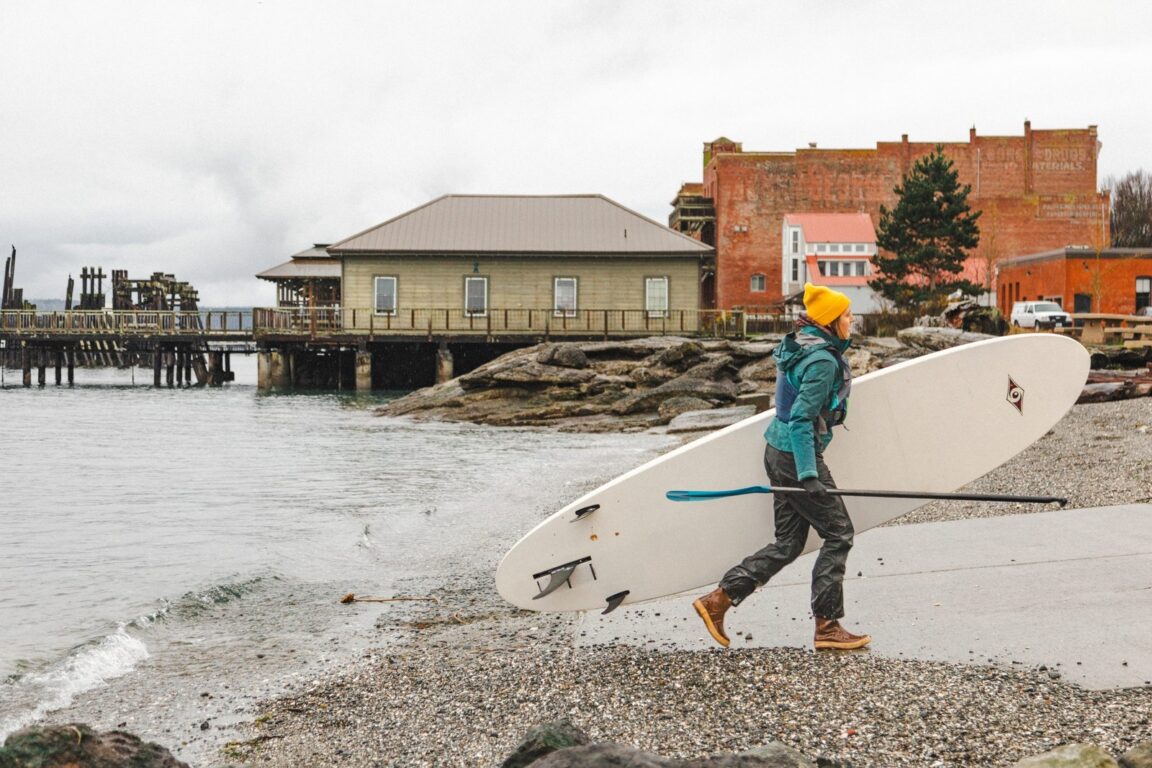
Photo: Port Townsend’s historic waterfront, with the pier and Victorian brick blocks on Admiralty Inlet. Credit: Dan Depew, via enjoypt.com, the City of Port Townsend’s official visitor site.