 Thandiwe Nkosi
Bayfield, Wisconsin is the mainland gateway to the Apostle Islands, and the right way to use it is as a base across seasons rather than a single summer stop: sail and paddle the islands in summer, drive the orchard Fruit Loop in autumn, and treat the famous mainland ice caves as a rare winter bonus that the National Park Service says has been safely accessible on only about 2 percent of days since 2000. Plan the town itself first, with the harbour, the ferry dock and the park headquarters in Bayfield, and the islands, orchards and cliffs will fall into a sensible order.
Quick Facts
- Where: Bayfield, Wisconsin, on the south shore of Lake Superior at the tip of the Bayfield Peninsula
- The park: Apostle Islands National Lakeshore, established 26 September 1970, covering 21 islands and a 12 mile mainland shoreline, about 69,372 acres including submerged land
- Park headquarters: 415 Washington Avenue, Bayfield, in the old Bayfield County Courthouse building
- Islands total: 22 Apostle Islands in the archipelago; Madeline Island, the largest, sits outside the national lakeshore and is reached by ferry from Bayfield
- Lighthouses: The lakeshore holds the largest collection of lighthouses in the National Park System, eight historic towers on six islands
- Summer pattern: Boat cruises, guided kayaking and sailing from Bayfield, plus the Madeline Island ferry and Big Bay State Park
- Autumn pattern: The Bayfield Fruit Loop orchards and berry farms, with apple harvest in September and October and Apple Festival on the first full weekend in October
- Winter reality: Mainland ice caves near Meyers Beach are rarely accessible; check the NPS ice line on (715) 779-3398 extension 3 before travelling for them
- Facts checked: 21 November 2026, against the Bayfield Chamber and Visitor Bureau at bayfield.org and the National Park Service at nps.gov
Why does Bayfield work as a base, not just a dock?
Most Apostle Islands trips start and end in Bayfield whether visitors plan it that way or not. The National Park Service headquarters and visitor contact point is in town, the cruise and kayak outfitters work from the harbour, and the Madeline Island Ferry Line leaves from the Bayfield dock. Sleeping in Bayfield instead of day tripping in means an early sailing or a dawn paddle does not start with a long drive, and an evening back in town can be spent at the Lake Superior Big Top Chautauqua tent shows or the summer Concerts by the Lake in Memorial Park, which the Bayfield Chamber lists on Tuesdays and Thursdays from June to August.
The town also holds the non island half of the trip. The Chamber points first time visitors to Bayfield’s shops and galleries, its maritime and Native culture museums, and a compact waterfront where coffee, breakfast and the ferry queue are all within a short walk. That matters on the days Lake Superior cancels the plan, which happens often enough that a good Bayfield itinerary always needs a town day in reserve.
How should a summer day on the water be sequenced?
Start with the decision between seeing the islands and landing on them. The Chamber’s first timer guidance pairs a guided boat cruise, kayak tour or sailing excursion with the archipelago’s sea caves, historic lighthouses and shorelines. Cruises give the widest view of the 21 island lakeshore in a single outing. Sailing puts the same water at a slower pace, and Bayfield’s harbour identity is built around it, with sailboats filling the marina through the season.
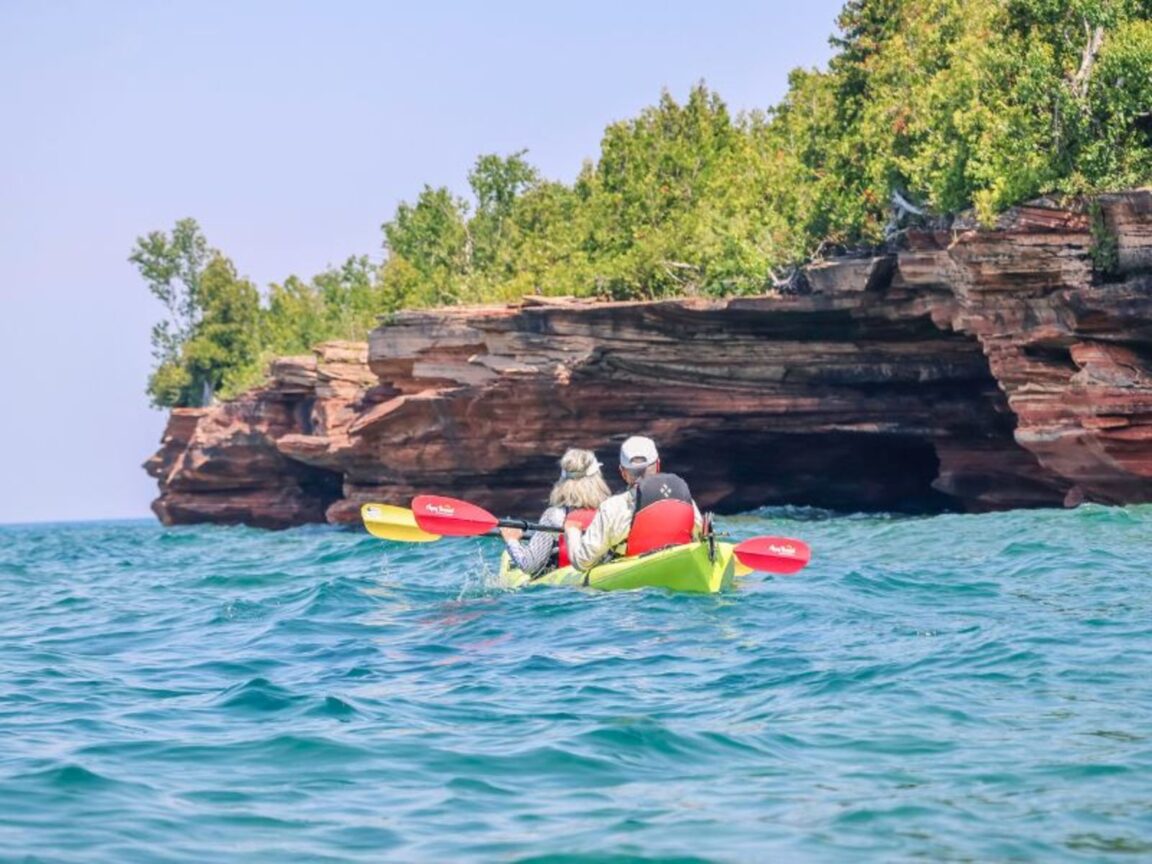
Kayaking is the close up version, aimed at the mainland sea caves near Meyers Beach and the island caves. It is also the version with the strictest safety rules, and it deserves its own planning. Our separate guide to sea kayaking the Apostle Islands’ red cliffs from Meyers Beach covers the launch, the guide rules and the cold water reality in full, and it should be read as a different task from this town guide: that article is about paddling the caves safely, while this one is about using Bayfield well across a whole stay.
The simplest island landing is Madeline Island. Ride the ferry from Bayfield, then rent a bike on arrival and ride about six miles to Big Bay State Park or Big Bay Town Park, as the Chamber suggests, for Lake Superior views and a quieter introduction to island life. Madeline is not part of the national lakeshore, which is exactly why it works as the easy day: it has a village, roads and beaches where the park islands mostly have docks, trails and campsites.
What do the orchards add in autumn?
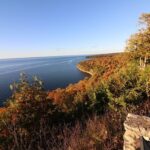
Bayfield’s second season grows on the hill above town. The Bayfield Fruit Loop is a scenic drive through orchards and farms where, in season, visitors can pick their own fruit or buy fresh picked strawberries, cherries and apples, along with farm stand baking and local goods. The Chamber describes the loop as the inland half of a classic Bayfield day: islands in the morning, orchards in the afternoon.
The fruit calendar is staggered, which extends the season well past the last summer cruise. Berries carry the early summer, cherries follow, and apples start to be harvested in September and October, including many heirloom varieties, according to the Chamber’s orchard guide. Pick up the Berry Farm and Orchard Guide with its Fruit Loop map from the Bayfield Chamber and Visitor Bureau before setting out, and check the current orchard report for what is actually ripe that week rather than assuming a variety will be on.
The season peaks with the Bayfield Apple Festival, held on the first full weekend in October over three days to celebrate the town’s agricultural heritage. For a traveller who can only make one autumn trip, that weekend concentrates the orchards, the harvest food and the town at full stretch. For a traveller who dislikes crowds, the weekends either side of it deliver the same Fruit Loop at a calmer pace, with the same lake moderated microclimate that lets fruit thrive this far north.
What is the honest story on the winter ice caves?
The mainland ice caves form along the cliffs and sea caves near Meyers Beach as Lake Superior freezes, when waves splashing against the rock and water seeping between sandstone layers build sculptures of ice. Photographs of them are spectacular, and they are the reason many travellers first hear Bayfield’s name in winter. The National Park Service is unusually blunt about the odds, and any honest guide has to repeat that bluntness.
The caves have only been accessible on 2 percent of all days from 2000 to 2023, and most ice cave events in that period fell in just four years: 2004, 2008, 2009 and 2014. The Park Service notes the last stable access was for one day in 2026, after a brief nine day period in 2015. To open safely, the lake needs sustained low winds to form an unbroken shelf of ice, persistent subzero temperatures, an ice shelf anchored to three land points and extending miles from shore, consistently frozen ground, and thick ice confirmed by auger tests that can support people and emergency vehicles.
Wind and waves can break up seemingly stable ice in hours, and the Park Service warns that a webcam view can be misleading. Staff update the ice caves page, the park Facebook page and the ice line only when conditions allow safe access, so silence means conditions have not changed and remain unfavourable. Build a winter Bayfield trip around snowshoeing the Lakeshore Trail, skiing at nearby Mt. Ashwabay and fat tire biking, all listed by the Park Service as winter alternatives, and treat an ice cave opening as a piece of luck to be seized, never as the promise the trip depends on.
How many nights does Bayfield actually need?
Two nights is the minimum that lets the base logic work: one full day on the water and one day split between Madeline Island, the Lakeshore Trail at Meyers Beach and the town itself. Three nights is better, because it adds either the Fruit Loop in autumn or a weather buffer in summer, and Lake Superior regularly spends that buffer. The Chamber’s own three day first timer pattern follows the same shape: town on day one, islands and the Fruit Loop on day two, then hiking and a beach on day three, with Houghton Falls named as a shorter, family friendly alternative and Bayview Beach, Reiten Beach and Cornucopia among the sandy options.
Travellers combining Bayfield with wider Wisconsin island hopping can pair it with our guide to Washington Island in Door County, the state’s other great ferry served island community, though the two sit hours apart and belong in the same road trip rather than the same weekend.
Frequently Asked Questions
Is Madeline Island part of Apostle Islands National Lakeshore?
No. The national lakeshore covers 21 of the 22 Apostle Islands plus a 12 mile mainland strip. Madeline Island, the largest island, is outside the park and is reached by the Madeline Island Ferry Line from Bayfield, with Big Bay State Park about six miles from the ferry landing at La Pointe.
When is the Bayfield Apple Festival?
On the first full weekend in October. It runs for three days and celebrates the harvest from the orchards on the Bayfield Fruit Loop, where apples are harvested through September and October.
Can I plan a trip around the ice caves?
Not reliably. The National Park Service says the mainland ice caves were accessible on only 2 percent of days from 2000 to 2023. Check the NPS ice caves page and the ice line on (715) 779-3398 extension 3, and plan winter activities such as the Lakeshore Trail and Mt. Ashwabay as the main event.
Where is the Apostle Islands visitor contact point?
Park headquarters is at 415 Washington Avenue in Bayfield, in the old Bayfield County Courthouse building. The park’s non emergency number is (715) 779-3397.
What is the best season to visit Bayfield?
Summer is the fullest season, with cruises, kayaking, sailing and the ferry all running. Autumn is the orchard season and the best alternative, with the Fruit Loop and Apple Festival. Winter is quiet and beautiful but the ice caves are a rare bonus, not a guarantee.
Do I need a car in Bayfield?
A car makes the Fruit Loop, Meyers Beach and the trailheads practical, since they spread along the peninsula beyond walking distance of the harbour. In town itself, the dock, shops, museums and restaurants are walkable.