 Aiko Tanaka
Three days is the right first dose of Door County, and the peninsula itself tells you how to sequence them: one day on the Green Bay side around Peninsula State Park, one day on the Lake Michigan side among the limestone caves and dune parks, and one day running north to the tip, where the Washington Island ferry forces the trip’s best decision. Door County is the slender thumb of Wisconsin between Green Bay and Lake Michigan, with more than 300 miles of shoreline, five state parks and a string of small villages, and it punishes travellers who zigzag. Work shore by shore, save the fish boil for the evening it belongs to, and let the crossings, bay to lake, organise the driving.
Quick Facts
Where: Door County, Wisconsin, the peninsula between Green Bay (west side) and Lake Michigan (east side), entered through Sturgeon Bay and run by Highways 42 and 57.
Shoreline and parks: More than 300 miles of shoreline, five state parks and 21 county parks, per Destination Door County.
Day 1 anchor: Peninsula State Park, 3,776 acres and eight miles of Green Bay shoreline between Fish Creek and Ephraim, with the 60-foot Eagle Tower and its 850-foot accessible ramp.
Park admission: A Wisconsin state park vehicle admission pass is required. Daily passes, at rates effective 19 August 2025, are $13 for Wisconsin-plated vehicles and $16 for out-of-state plates; 12-month passes are $28 and $50.
Signature meal: A traditional fish boil, Lake Michigan whitefish, potatoes and onions cooked over an open fire, finished with the kerosene boil over and cherry pie. Reservations are strongly recommended.
Day 3 decision: The Washington Island Ferry Line from Northport, about 30 minutes each way through Death’s Door. Worth a full day, not a spare hour.
Facts checked: 21 November 2026, against Destination Door County (doorcounty.com), the Wisconsin Department of Natural Resources and the Washington Island Ferry Line information in our linked guide.
Where should you base for three days in Door County?
Base once and drive, rather than moving hotels. The peninsula’s villages line the bay side on Highway 42, Sturgeon Bay, Egg Harbor, Fish Creek, Ephraim and Sister Bay, with Baileys Harbor the main town on the Lake Michigan side. A Fish Creek or Ephraim base puts Peninsula State Park at your door for Day 1, keeps the fish boil walkable on the first night, and leaves both shores within an easy drive. Sturgeon Bay, the county’s working shipbuilding town at the southern end, suits travellers arriving late, since it shortens the first drive and still reaches Fish Creek in well under an hour. What matters most is resisting the urge to sleep in a different village each night: the county rewards slow evenings in one harbour town far more than it rewards mileage.
Day 1: How do you do Peninsula State Park and the bay side?
Give the first day to the bay side and its crown jewel. Peninsula State Park covers 3,776 acres along eight miles of Green Bay shoreline between Fish Creek and Ephraim, and Destination Door County calls it the area’s largest state park. Arrive with your vehicle admission pass sorted, since a pass is required on every motor vehicle stopping in a Wisconsin state park. At the DNR’s current rates, a daily pass costs $13 with Wisconsin plates or $16 with out-of-state plates, and anyone planning to visit several state parks on this trip, as this itinerary does, should price the 12-month pass at $28 or $50 instead.
Eagle Tower, the bluffs and Nicolet Beach
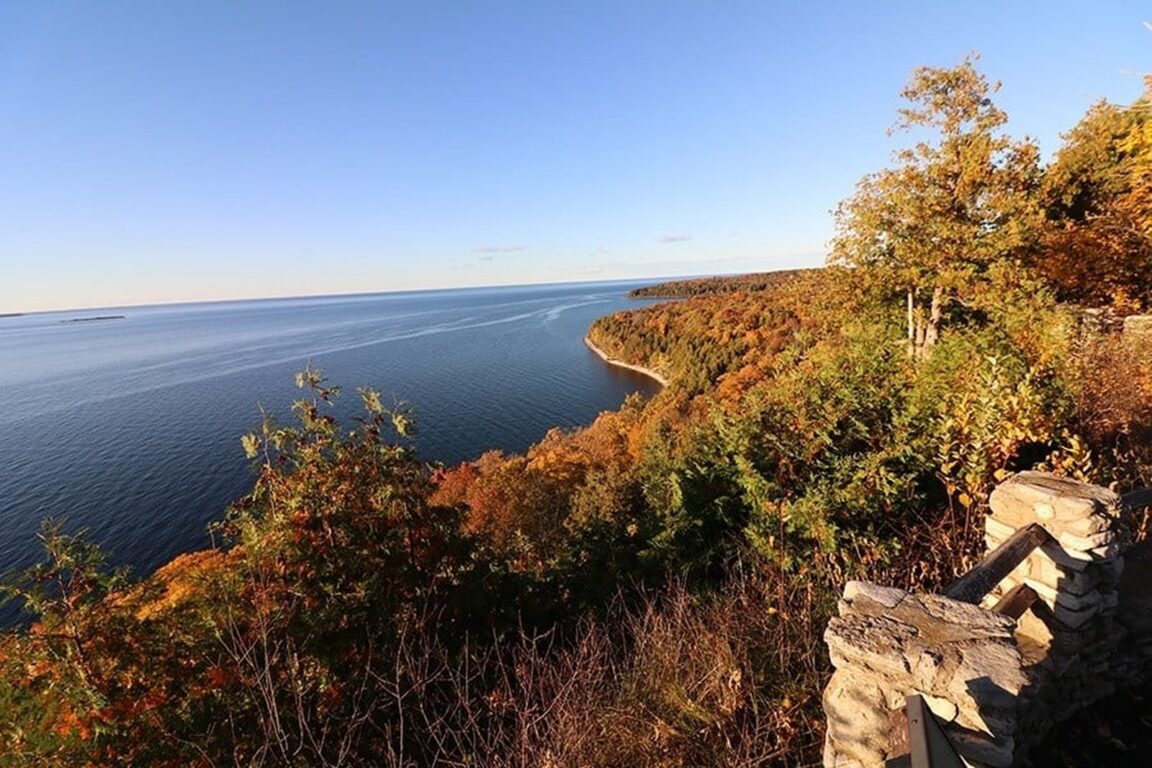
Start at Eagle Tower, the park’s rebuilt lookout. The tower stands 60 feet tall, and its observation deck sits 253 feet above Green Bay, high over the Niagara Escarpment bluff. You can climb the stairs or take the 850-foot, fully accessible canopy ramp that winds up through the forest, an approach that makes this one of the most inclusive big views in the Midwest. From the deck the view runs across the bay’s islands toward the Upper Michigan shoreline, with Ephraim below. Continue along the park’s scenic Skyline Road to Sven’s Bluff and the Eagle Bluff Panorama, tour the Eagle Bluff Light Station in season, walk a stretch of the two-mile Eagle Trail under the escarpment cliffs, and finish the afternoon at Nicolet Beach, the park’s sandy swimming cove. Cyclists can rent in Fish Creek and ride the park’s bike trails between stops.
The fish boil night in Fish Creek
End Day 1 the Door County way, at a fish boil, and book it before you arrive, because reservations are highly recommended and the best-known rooms fill. The tradition, as Destination Door County tells it, arrived with Scandinavian immigrants in the late 1800s, when boiling Lake Michigan whitefish was an economical way to feed crews of lumbermen. It became a tourism staple in 1961, when Lawrence and Annette Wickman began the modern version at The Viking in Ellison Bay and the White Gull Inn in Fish Creek followed with its own recipe. The White Gull, in Fish Creek, remains the classic first-timer’s choice, with Pelletier’s nearby as the alternative.
The mechanics are the show. Salted water comes to the boil over an open fire in a large kettle, potatoes go in first, then onions, then the whitefish last. As the fish finishes, its oils rise to the surface, and the boil master throws kerosene on the fire. The flames leap, the pot boils over, the oils spill away, and dinner is served clean: whitefish, potatoes and onions with melted butter, lemon, coleslaw and bread, and a slice of Door County cherry pie to finish. Arrive early enough to stand around the fire for the whole performance, because the storytelling is half the meal.
Day 2: What does the Lake Michigan side do differently?
Cross the peninsula on Day 2 and the mood changes. The bay side is sheltered and sunset-facing; the lake side is wilder, colder and built on limestone. Drive over to Baileys Harbor and start at Cave Point County Park, a 19-acre county park where Lake Michigan has carved underwater caves into the limestone cliffs. A half-mile cliff-top trail runs above the blowholes and ledges, and on a windy day the lake booms into the caves below. Cave Point adjoins Whitefish Dunes State Park, where the boardwalk climbs toward Old Baldy, at 93 feet the highest sand dune in Wisconsin, with views over the lake and inland Clark Lake.
Cana Island Lighthouse and the causeway crossing
North of Baileys Harbor, Cana Island is the lake side’s signature sight, a small island reached by walking a sandy causeway at low water or riding the tractor shuttle when the lake is up. Its lighthouse has guided ships since 1869. The tower stands 89 feet tall, and the keeper’s house, oil house and tower are open for tours from May to October. The climb is 97 spiral steps to the gallery deck and a full-circle view of Lake Michigan and the peninsula. Because the season runs May to October, late autumn and winter travellers should check before driving out: the grounds and exterior make the trip in most months, but the tower climb is a seasonal promise, not a year-round one.
Fill the rest of Day 2 at lake-side pace. Baileys Harbor itself is the quiet side’s harbour town, good for a brewery stop and a waterfront walk, and the drive back across the peninsula in the late afternoon, farmland and orchard country between the shores, is part of the county’s pleasure. If the light holds, detour to Newport State Park, the wilderness park near the peninsula’s northeast end that Destination Door County singles out for its dark skies, and stay after dusk if your trip falls in the stargazing season.
Day 3: Should you take the Washington Island ferry?
Day 3 runs north, through Sister Bay and Ellison Bay to Gills Rock and the end of Highway 42 at Northport. The decision waiting there is the trip’s biggest: board the Washington Island Ferry Line, or keep the day on the mainland. The honest answer is that Washington Island deserves the whole day. The crossing takes about 30 minutes each way through Death’s Door, the strait between the peninsula tip and the island whose French name, Porte des Morts, gave Door County its name, and the island beyond it runs on lavender farms, a replica Norwegian stavkirke, the stone shore of Schoolhouse Beach and a famous shot of bitters at Nelsen’s Hall. Our full guide, Washington Island, Wisconsin: Through Death’s Door to Lavender Fields, a Viking Stavkirke and Bitters at Nelsen’s Hall, plans that day in detail, including the current ferry pattern. Take the car on the ferry, catch an early boat, and treat the mainland’s northern villages as the drive home.
If the ferry does not fit, Day 3 still works on the mainland’s northern tier. Ellison Bay offers the bluff-top views at Ellison Bay Bluff County Park and Door Bluff Headlands, among the northernmost Green Bay lookouts in the county, and Gills Rock is the old fishing village at the highway’s end, with its maritime museum and the passenger ferry dock for Rock Island beyond Washington Island. Sister Bay, on the way back south, is the liveliest stop for lunch, with its big marina park and the famous goats grazing the grass roof at Al Johnson’s Swedish Restaurant. Either version of Day 3 ends the trip pointing the right way: the county seen whole, both shores, tip to base.
How does this itinerary compare with other Great Lakes park trips?
Door County’s three-day rhythm, one anchor park, one wild shore, one island decision, transfers well to the region’s other park peninsulas. Travellers extending a Wisconsin trip north can pair this itinerary with sea kayaking the Apostle Islands’ red cliffs out of Bayfield, where the same Lake Superior weather discipline applies, and those crossing to Michigan will find the base-town logic familiar from choosing bases for Olympic National Park, another peninsula where sleeping in the wrong town costs hours of driving. In Door County the distances are kinder, but the principle is identical: pick the shore, then the day, then the sights, in that order.
When is the best time for three days in Door County?
The county’s main season runs from late spring through the autumn colour, and the fixed points of this itinerary explain why. Cana Island’s tours run May to October, fish boils run their full schedules in the summer and early autumn and thin out as the season closes, and Eagle Tower and the state parks reward the long days of June through September. Autumn brings the orchard harvest and the fall colour that Destination Door County promotes from lookouts like Eagle Tower, at the price of shorter days and reduced hours. Winter is a real but different trip, of ice, quiet villages and cross-country skiing, and several stops in this itinerary simply close. Whatever the season, check opening hours and fish boil nights again in the week of travel, because in a county of small family businesses, schedules are seasonal promises rather than guarantees.
Frequently Asked Questions
How many days do you need in Door County?
Three days is the honest minimum for a first visit. It allows one day for Peninsula State Park and the bay side, one for the Lake Michigan shore, and one for the northern peninsula and the Washington Island decision, without spending the trip in the car.
Do you need a pass for Peninsula State Park?
Yes. A Wisconsin state park vehicle admission pass is required on motor vehicles stopping in state parks. Daily passes are $13 for Wisconsin-plated vehicles and $16 for out-of-state plates, and 12-month passes are $28 and $50, at rates effective 19 August 2025.
What happens at a Door County fish boil?
Locally caught Lake Michigan whitefish is boiled over an open fire with potatoes and onions. When the fish oils rise, the boil master throws kerosene on the fire, the pot boils over in a burst of flame, and the fish is served with melted butter, lemon, coleslaw, bread and cherry pie. Book ahead, since reservations are highly recommended.
Is Washington Island worth a full day?
Yes. The ferry from Northport takes about 30 minutes each way, and the island’s lavender farms, stavkirke, Schoolhouse Beach and Nelsen’s Hall fill a day easily. Take the car on the ferry and start early rather than squeezing the island into an afternoon.
Can you climb Cana Island Lighthouse?
In season, yes. The keeper’s house, oil house and tower are open for tours from May to October, and the tower climb is 97 steps to the gallery deck of the 89-foot lighthouse. Outside that season, check ahead, since the climb may be closed even when the island is reachable.
Is Eagle Tower accessible?
Yes. Alongside its stairs, Eagle Tower has an 850-foot, fully accessible canopy ramp that winds through the forest to the observation deck, 253 feet above Green Bay.
Facts checked 21 November 2026 against Destination Door County, the Wisconsin DNR and the Washington Island Ferry Line information in the linked guide. Opening hours and fish boil schedules are seasonal, so confirm in the week of travel. Featured image: the view from Sven’s Bluff in Peninsula State Park, looking over Green Bay in autumn colour, Door County, Wisconsin. Photo: Destination Door County (doorcounty.com), the county’s official visitor authority, used with credit.