 LeVar Thomas
The South Rim of the Grand Canyon is the rare great landscape that genuinely works with children, provided the day is built the family way: a Junior Ranger booklet picked up early, short paved stretches of the Rim Trail linked by the free shuttle buses, and honest expectations about the mule rides, which no child under 9 can take. The rim sits at about 7,000 feet, the South Rim is open all year around the clock, and almost everything a family needs, viewpoints with railings, visitor centers, ranger programs and ice cream in the historic village, sits within the first two and a half miles of rim path east and west of the visitor center.
Quick Facts
Where: South Rim, Grand Canyon National Park, Arizona, entered by the South Entrance near Tusayan
Open: The South Rim is open all year, 24 hours a day
Elevation: About 7,000 feet (2,100 m) at the rim, so pace children and push water
Entrance: Standard pass $35 per private vehicle, $30 per motorcycle, $20 per person on foot or bicycle, each valid 7 days (National Park Service, checked November 21, 2026)
Junior Ranger: Free booklet for ages 4 and up; Raven ages 4 to 7, Coyote ages 8 to 10, Scorpion ages 11 and up
Rim Trail: About 13 miles (21 km) from the South Kaibab Trailhead to Hermits Rest, mostly paved; the family core is Mather Point to the historic village, 2.5 miles
Mule rides: Riders must be at least 9 years old, at least 57 inches (4 feet 9 inches) tall, and under 200 or 225 pounds fully dressed depending on the trip
Getting around: Free shuttle buses on the Village (Blue), Kaibab Rim (Orange) and Hermit Road (Red, March to November) routes; strollers must be collapsed on board
Current note: The National Park Service advised in November 2026 that overnight lodging was suspended under Stage 4 water restrictions, with dry camping still available. Recheck the park alerts page before booking
Where should a family start at the South Rim?
Start at the Grand Canyon Visitor Center near Mather Point, and do three things before the first viewpoint. Pick up the Junior Ranger booklet, because it structures the whole day. Watch the park film, Grand Canyon: A Journey of Wonder, because it counts toward the badge and settles excited children into the scale of what they are about to see. Then walk the few minutes to Mather Point itself, the classic first view, close to the visitor center and, as the park itself notes, busy even at daybreak. Going early is the single easiest upgrade a family can make: the light is better, the rim path is quiet, and children meet the canyon before they meet the crowds.
From Mather Point the day naturally flows west along the Rim Trail toward the Yavapai Geology Museum and the historic village. That direction is deliberate. The trail is paved, the views are constant, the shuttle can rescue tired legs at almost any point, and the village at the end holds the lodges, the Bright Angel Trailhead, Kolb Studio and the best food options on the rim. Families choosing where to sleep should read our separate guide to basing for a cliff-dwelling park at Mesa Verde for the same inside-the-park versus gateway-town logic, and our explainer on which national parks still require timed entry reservations before assuming the Grand Canyon needs one. It does not require a timed entry reservation; the entrance pass is the ticket.
How does the Junior Ranger program work, by age?
The South Rim Junior Ranger booklet is written for ages 4 and up and splits into three groups, each with its own animal symbol. Raven covers ages 4 to 7, Coyote ages 8 to 10, and Scorpion ages 11 and up. To earn the badge, a child completes three steps. First, either attend a ranger program or watch the park film. Second, complete four activities in their own age group inside the booklet, which range from sensing the rim forest and spotting wildlife to reading the rock layers as a timeline. Third, bring the finished booklet back to be reviewed with a ranger or staff member and receive the badge and certificate.
Booklets are available at the Grand Canyon Visitor Center, Verkamp’s Visitor Center and the Tusayan Museum, and completed booklets can be returned to those same desks. The practical family advice is timing. Collect the booklet on arrival, not at the end of the day, because the activities are place-based: the Trail of Time’s rock samples, the geology museum’s exhibits and the rim viewpoints are the homework. Ranger programs run daily and are free, and the park’s pocket map notes special programs for children ages 6 to 14 in summer. Budget one to three hours spread across the day rather than a single block, and the badge ceremony at the visitor center becomes the natural full stop before dinner.
Which parts of the Rim Trail are easy with children and strollers?
The Rim Trail stretches roughly 13 miles (21 km) along the southern rim from the South Kaibab Trailhead in the east to Hermits Rest in the west, and it is mostly paved. Nobody expects a family to walk all of it. The park’s own breakdown gives the useful pieces. Mather Point to the Yavapai Geology Museum is 0.7 miles one way, paved with short sections of grade, and takes 15 to 30 minutes at adult pace. Mather Point to the Grand Canyon Historic Village is 2.5 miles one way, paved, largely downhill heading west, and reckoned at 45 minutes to 2 hours, which with children, viewpoint stops and the Trail of Time means a full, satisfying morning.
The Trail of Time is the section families should not skip. Overlapping the Rim Trail between the Yavapai Geology Museum and Verkamp’s Visitor Center, it turns the walk into a geology lesson at child height: every metre walked represents a million years of canyon history, with brass markers and real rock samples children can touch, ending at the oldest rock, the Elves Chasm Gneiss at 1,840 million years. For strollers, the honest picture is this: the village-side sections are paved and manageable, shuttle buses require strollers to be collapsed before boarding and do not take oversized strollers, and the Hermit Road stretch west of the village is a mix of dirt and paved path where only the Monument Creek Vista to Pima Point section is paved and accessible. Walk one way and ride back. The free shuttles are frequent, they stop at the viewpoints along the trail, and a bail-out bus converts a meltdown into a rest with a view. Carry water even on the rim: the park warns there is no water on the Rim Trail west of Bright Angel Lodge, and at 7,000 feet children dehydrate faster than they do at home.
What are the real rules for the mule rides?
The mules are the South Rim’s most famous family promise and its most common family disappointment, because the rules are strict and non-negotiable. South Rim mule trips are offered year-round through Xanterra, the park concessioner, and the National Park Service lists the rider restrictions plainly. Every rider must be at least 9 years of age, at least 57 inches tall (4 feet 9 inches), able to understand instructions in English, and weigh less than 200 pounds, or 225 pounds fully dressed, depending on the trip. Children under 18 must be accompanied by a parent or guardian. Riders are weighed and measured, and there are no exceptions at the corral.
Two different products hide inside the phrase mule ride. The rim ride, sold as the Canyon Vistas ride, stays on top, following the rim east from the village for about three hours in total with roughly two hours in the saddle, and it is the right ambition for a family whose children clear the age and height bar. The below-rim rides descend the Bright Angel Trail to Phantom Ranch at the canyon bottom, an overnight commitment booked far ahead; reservations for Phantom Ranch trips run through an online lottery, other South Rim rides can be booked up to 15 months in advance, and the park warns they fill early. A waiting list exists only for day-before cancellations, through the Bright Angel Lodge transportation desk, and the park calls the chances slim. Plan the family version accordingly: if your youngest is 7, the mules are a viewpoint, not a ride, this trip. Watch them leave from the corral near Bright Angel Lodge, walk the rim instead, and let the Junior Ranger badge be the earned souvenir.
How do you keep children safe and happy at the rim?
The park’s safety guidance is short and worth following to the letter. Keep at least six feet (2 metres) from the edge where there is no railing, hold on to children near the rim, never climb over barriers, and never throw anything over the edge. Add the altitude rules: the rim is at about 7,000 feet, the climate is dry, and even an easy rim walk can leave a child dehydrated and sunburnt, so water, snacks, hats and sunscreen are equipment, not extras. Summer rim temperatures can pass 100 degrees Fahrenheit (38 Celsius), and late-summer thunderstorms bring lightning to the exposed rim, where the park’s rule is simple: if it roars, go indoors. Finally, resist the descent temptation. The park is blunt that there are no easy trails into or out of the Grand Canyon. A few hundred metres down the Bright Angel Trail to the first tunnel gives older children a taste of below-rim scale; treat that as a there-and-back taster with water in hand, not the start of a hike.
Frequently Asked Questions
What age is the Grand Canyon Junior Ranger program for?
The South Rim booklet is for ages 4 and up, in three groups: Raven for ages 4 to 7, Coyote for ages 8 to 10 and Scorpion for ages 11 and up. Children complete four activities in their group, attend a ranger program or watch the park film, then return the booklet to the Grand Canyon Visitor Center, Verkamp’s Visitor Center or the Tusayan Museum to receive the badge.
How long is the Rim Trail, and which part is best for families?
The full Rim Trail runs about 13 miles (21 km) from the South Kaibab Trailhead to Hermits Rest and is mostly paved. The best family section is Mather Point to the historic village, 2.5 miles one way, passing the Yavapai Geology Museum and the Trail of Time, with free shuttle buses to ride back.
Can children ride the Grand Canyon mules?
Only from age 9. Riders must also be at least 57 inches (4 feet 9 inches) tall, weigh less than 200 or 225 pounds fully dressed depending on the trip, and understand instructions in English. Children under 18 must ride with a parent or guardian. The rim ride stays on top; Phantom Ranch rides are booked by lottery far in advance.
How much does it cost to enter Grand Canyon National Park?
The standard entrance pass, checked on the National Park Service site on November 21, 2026, is $35 for a private vehicle and all its passengers, $30 for a motorcycle and $20 per person arriving on foot or by bicycle, each valid for 7 days and covering the South Rim. The park annual pass is $70.
Are the South Rim shuttle buses free, and can we take a stroller?
Yes, the shuttle buses are free and included with entrance. Strollers must be collapsed before entering the bus, oversized strollers do not fit, and baby back carriers must be removed when seated, per the park’s shuttle rules.
Is the South Rim open in winter?
Yes. The South Rim is open all year, 24 hours a day, unlike the North Rim, which is seasonal and was heavily affected by the Dragon Bravo Fire. Winter rim trails can be icy, so pack traction and layers, and check the park’s current conditions and alerts pages before you travel.
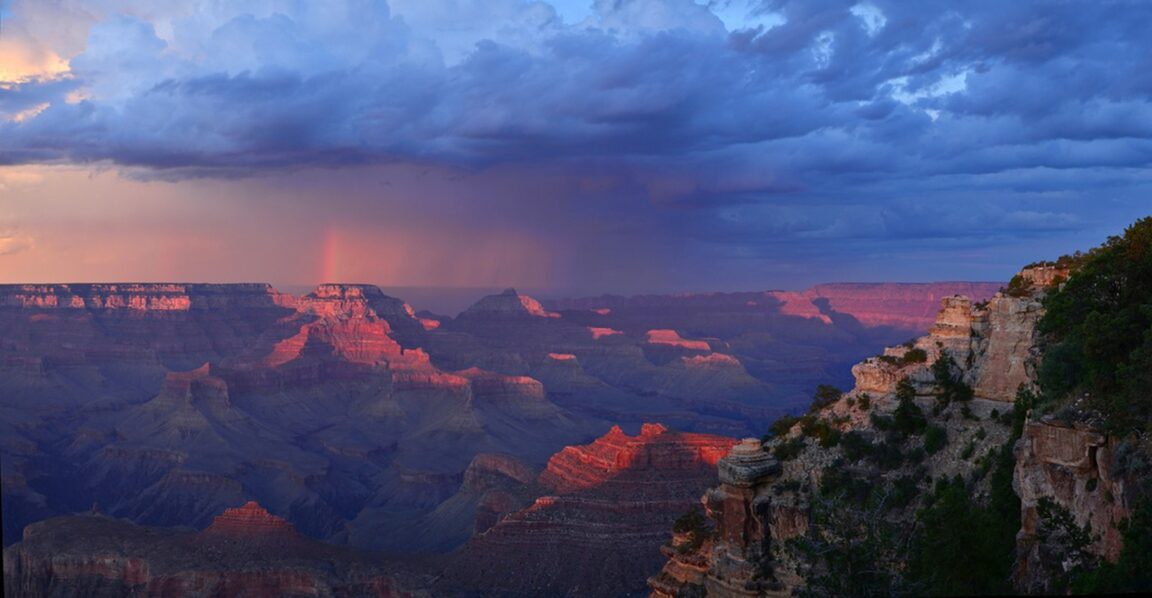
Featured image: Mather Point on the South Rim of the Grand Canyon under a stormy sunset. Photo by the National Park Service (NPS Photo), via nps.gov, used with credit.