 Sofia Rossi
La Posada is the rare Route 66 hotel that rewards arriving by train exactly as its architect intended: Amtrak’s Southwest Chief still stops at the platform beside the hotel, the lobby doubles as Winslow’s waiting room, and the building itself, opened in 1930 and designed down to the china by Mary Colter, is widely considered her masterpiece and the last great Fred Harvey railroad hotel built on the Santa Fe line.
Quick Facts
Where: 303 East Second Street (Route 66), Winslow, Arizona 86047, beside the Santa Fe tracks and the Winslow Amtrak station.
Opened: 1930, as the crown jewel of the Fred Harvey hotels; closed in 1957, bought and restored from 1997 by Allan Affeldt and artist Tina Mion, and reopened as a hotel the same year.
Rooms: 54 individually decorated rooms on the hotel’s own listing, many named for the famous guests of the Harvey era, with garden, grove and trackside outlooks.
Dining: The Turquoise Room, serving regional contemporary Southwestern cuisine, plus the Martini Lounge.
Good to know: There is no elevator, and some room types sit on the second floor, so the room category matters for step-free access. Prices checked on the hotel’s own site on 21 November 2026; rates vary by room and season.
Why is La Posada called Mary Colter’s masterpiece?
Mary Elizabeth Jane Colter worked for the Fred Harvey Company for decades and designed buildings across the Southwest, including landmarks at the Grand Canyon. At La Posada she had something she rarely got elsewhere: total control. She designed the building, selected the furnishings and planned the landscape, shaping the hotel as a rambling hacienda that might have grown over generations rather than opened all at once. The result is a poured concrete complex of interlocking wings, arches of several kinds, hand painted beams, tin chandeliers and gardens that unfold room by room, so that walking the corridors feels like walking through a small, very deliberate village.
The hotel’s own site notes that Colter considered La Posada her finest work, and the restoration has protected that judgement. Drop ceilings installed during the building’s office years preserved hand painted decoration in the former ballroom, and the public rooms today are hung with art, including the work of Tina Mion, whose studio and museum sit inside the hotel. Travellers who know Colter only from the canyon rim get the fullest version of her here, because this is the one place she designed everything.
What happened to La Posada between 1957 and 1997?
The honest answer is: nearly everything bad that can happen to a great hotel short of demolition. La Posada closed to guests in 1957 as car travel replaced the trains, its furnishings were sold off, and the Santa Fe Railway gutted large portions of the interior to make offices, filling archways and chopping grand rooms into small ones. Winslow was a control point for train operations, so the building stayed in hard daily use while its identity faded. By the early 1990s the railway planned to vacate, demolition loomed, and the National Trust for Historic Preservation placed La Posada on its 1994 list of America’s most endangered historic places.
That listing changed the story. Allan Affeldt, hearing of the building through the Trust’s coverage, spent three years negotiating with a railroad that had never put the property on the market. In 1997 he and Tina Mion bought the building and its grounds, took out personal loans, moved in, and reopened five tower rooms to paying guests late that year while restoration continued around them. The Turquoise Room followed in 2000, returned to the space of the original Harvey House restaurant. The restoration is still described by the owners as ongoing, which suits a building this layered: it is a working hotel that is also a long act of repair.
What are the rooms like, and which should you choose?
The hotel lists 54 rooms, no two alike, decorated with handwoven rugs, Talavera tile and Southwestern art, with many bathrooms keeping their original black and white tile. Categories run from king rooms in the historic section to rooms with two beds in the west wing and tower, king balcony rooms above the Cottonwood Grove, king patio rooms opening onto the gardens, and deluxe rooms, some with fireplaces and sitting areas. An accessible king room offers a roll in shower at ground level.
The real choice is outlook. Garden and grove rooms are the quiet, green version of La Posada, all cottonwoods and sculpture. Trackside rooms are the railfan version: freight traffic on the Santa Fe main line is a living part of the property, and many guests specifically ask to face the railway. Light sleepers should say so when booking and take a garden room. Everyone should note the absence of an elevator before choosing a second floor balcony room.
Is the Turquoise Room worth planning a day around?
Yes, and many travellers do exactly that, driving in from Flagstaff or the Petrified Forest purely for a meal. The Turquoise Room serves what the hotel calls regional contemporary Southwestern cuisine, built on ingredients such as pinon nuts, squash, beans and corn, the three sisters of Southwestern cooking. Signature dishes long associated with the room include its sweet corn and black bean soup and churro lamb, and the kitchen revives Fred Harvey traditions such as the seasonal Fred Harvey pie, often made with quince and apples grown on the grounds. Hopi and Navajo specialities, including piki bread, appear as well, a reminder that the Harvey Houses were always a meeting point of cultures along the line.
The room looks south over the railway, so lunch comes with trains. The Martini Lounge covers the evening, with a Route 66 cocktail list in a space styled on the hotel’s early days. Book dinner ahead in busy seasons; this is, by broad local consensus repeated on the hotel’s own pages, the finest restaurant in the Four Corners region, and Winslow is not so large that a second comparable option waits nearby.
How does arriving by train actually work?
Better than anywhere else on Route 66. The Winslow station sits within the La Posada complex: Amtrak’s own station guide explains that passengers are welcome to wait in the hotel lobby, and the old depot building has been restored as the Route 66 Art Museum. The Southwest Chief, Amtrak’s Chicago to Los Angeles flagship, serves Winslow daily in each direction, so a traveller can step off the train and be at the front desk in moments, with no rental car and no transfer. It is the journey the building was designed for in 1930, still functioning.
Drivers are equally well placed. La Posada stands on old Route 66 in the heart of Winslow, walking distance from the historic downtown and the Standin’ on the Corner Park, and Interstate 40 passes just north of town. Winslow also works as a base: the Petrified Forest and Painted Desert lie east, Meteor Crater west, and Flagstaff under an hour away. For a wider northern Arizona loop, pair a night here with the Flagstaff volcano loop of Sunset Crater, Wupatki and Walnut Canyon, and pack for the high desert’s temperature swings with our desert national parks road trip packing guide.
What else is there to do on the property?
Treat the hotel as a small cultural campus. The Affeldt Mion Museum occupies the restored depot, the sunken garden and Cottonwood Grove are original to the grounds and have been restored, and a sculpture garden shows work by artists including Dan Lutzick. Tina Mion’s paintings fill walls and hallways, and her studio is on the second floor. Gardens grow some of the kitchen’s produce in season. Twelve acres of grounds, by the owners’ account, give the place its resting place feel: La Posada translates, simply, as the resting place, and the name earns itself by the second hour.
Frequently Asked Questions
When did La Posada open, and who designed it?
It opened in 1930, designed by Mary Colter for the Fred Harvey Company and the Santa Fe Railway. Colter designed the building, furnishings and landscaping, and considered it her masterpiece.
Can you still arrive at La Posada by train?
Yes. Amtrak’s Southwest Chief stops at Winslow daily, the station is part of the hotel complex, and Amtrak directs waiting passengers to the hotel lobby.
How many rooms does La Posada have?
The hotel lists 54 rooms, each individually decorated and many named for celebrated guests of the Harvey era, from garden level patio rooms to second floor balcony rooms.
Is La Posada suitable for guests who cannot manage stairs?
Partly. The hotel has no elevator, but common areas are accessible and there are ground level rooms, including an accessible king with a roll in shower. Confirm the exact room when booking.
Do you need to stay overnight to eat at the Turquoise Room?
No. The restaurant serves non residents and is a destination in its own right, but reservations are wise for dinner, especially in peak Route 66 season.
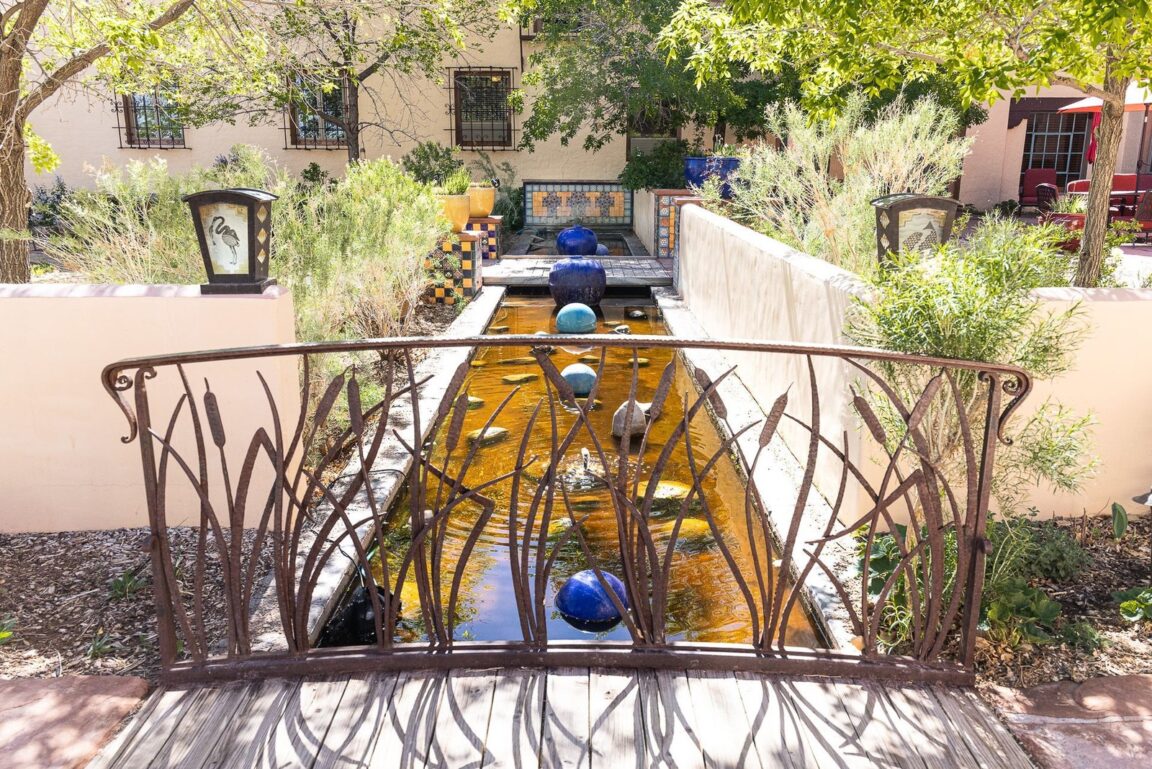
Featured image: the garden water feature and cattail ironwork gate at La Posada, Winslow. Photo: La Posada Hotel, via the property’s own official website (laposada.org), used with credit.