 Lucas Meyer
One bag can handle a Utah and Arizona desert parks loop in spring, but only if it is packed as a system rather than a suitcase: a layer stack that covers a frosty dawn at canyon rim altitude and a hot noon on the valley floor, water carried to the National Park Service’s desert numbers rather than to optimism, and dust-proofing for boots, cameras and everything with a zip. The loop this kit is built for runs through Zion, Bryce Canyon, Capitol Reef, Arches and Canyonlands in Utah, then south to the Grand Canyon, Petrified Forest and Saguaro in Arizona. Pack for the coldest trailhead and the hottest wash on that circuit, and every park in between is covered.
Quick Facts
- The kit: One checked-size duffel or rolling case for the car, one daypack that never leaves your side, and a layer system, not separate outfits per park.
- Water rule: At least one gallon per person per day for drinking on desert hiking days, per National Park Service guidance at Zion and Arches, plus a two-gallon per person reserve carried in the vehicle.
- On-trail carry: The NPS at Arches advises 2 to 3 litres per person for front-country hikes and 4 litres or more for backcountry.
- Temperature problem: Spring days can swing from below freezing at high rim trailheads at dawn to hot sun at canyon floor by noon.
- Hiking window: The NPS advises avoiding strenuous hiking in the heat of the day; at Arches it names 10 a.m. to 5 p.m. as the period to keep for short, shaded or indoor stops.
- Dust rule: Anything electronic or optical rides in a sealed bag inside the pack, because desert dust and sand find every unsealed zip.
- Facts checked: November 21, 2026, against National Park Service safety pages.
Why does one loop need four climates of clothing?
Because altitude does the work of latitude on this circuit. Bryce Canyon and the Grand Canyon’s rims sit at high elevation, where a spring dawn can start below freezing with wind on top of it. Zion Canyon and the Arches and Canyonlands trails sit lower, in open desert where the NPS warns that summer-style heat, lack of shade and elevation combine to raise dehydration risk, and where spring noon sun already demands summer behaviour. Saguaro, down by Tucson, is the warm end of the loop, true low desert. And every park adds the fourth climate: the inside of a wash or slot canyon in a weather change, where shade, wind and wet rock can cut the felt temperature fast. The NPS makes the same point on its Arches safety page in one line: bring or dress in layers to adapt to changing conditions, and have rain gear just in case. A loop kit is therefore built in layers that combine, not in outfits that compete for space. Our Iceland winter packing guide uses the same layer logic at the cold extreme; this kit applies it across a forty-degree daily swing.
The layer system, piece by piece
Base and mid layers
Start with two merino or synthetic base-layer tops, one short-sleeved for warm trail days and one long-sleeved for dawn starts, and rotate them so one is always dry. Add a grid fleece or light insulated mid layer: this is the piece that makes a frosty viewpoint comfortable and that comes off by nine in the morning. Legs follow the same pattern: hiking trousers that shed dust and dry overnight, plus a pair of thermal leggings that turn them into a cold-morning system at Bryce or on the South Rim.
The shell and the warm hat problem
A lightweight waterproof shell earns its space three ways on this loop: wind at exposed rims, spring rain, and the cold-air drainage that fills canyons after sunset. Pair it with a warm hat and light gloves, which weigh almost nothing and are the difference between enjoying a sunrise and enduring it, and a sun hat with a brim for the other twelve hours of the day. Two hats on a desert trip sounds like a contradiction until the first dawn at altitude.
Footwear: boots, camp shoes and dust
Bring one pair of broken-in hiking boots with real tread: the NPS specifically warns that sandstone is slippery when wet or sandy and that new boots should never be broken in on backcountry trails. Add light camp shoes so the boots can air and be shaken out each evening. Desert dust management for footwear is simple and nightly: boots stay outside the tent or in the vehicle’s footwell, are shaken and tapped sole-to-sole every evening, and socks rotate through a sealed bag so grit never migrates into the clean set. A small brush in the kit keeps grit out of boot linings and pack zips alike.
Water: the numbers that govern the whole kit
Water is the heaviest thing you will carry and the only part of this kit where the official guidance should be followed to the litre. The NPS guidance for these parks converges on one baseline: at least one gallon of water per person per day for desert hiking, drunk steadily rather than saved. For individual hikes, the Arches page gives the working numbers: carry at least 2 to 3 litres per person for front-country hikes, and 4 litres or more for backcountry routes, drinking when thirsty and treating the halfway point of your water as the halfway point of your hike. Refill points are at infrastructure, not on trails: at Arches, water is available at the visitor center and the Devils Garden Campground, and the pattern across the loop is the same, visitor centers, campgrounds and lodges. So the vehicle carries the reserve: two gallons per person in the car, in hard bottles that can be frozen the night before a big hike, plus the NPS’s standing advice to keep extra water in the vehicle in case of a breakdown and to stay with the vehicle if it is disabled. Add electrolytes or salty snacks, which the NPS pairs with hydration explicitly, because desert sweat removes salt as well as water, and eat as deliberately as you drink. If you are building desert skills park by park, our Isle Royale first-timer guide shows the same carry-your-water discipline in a very different landscape, and our one-bag packing method is the system this kit’s organisation borrows from.
Sun, heat and the shape of a desert day
Pack the day around the sun, not around the map. The NPS advice at Arches is to be summer smart and get an early start, planning activities for the cooler parts of the day and avoiding the period between 10 a.m. and 5 p.m. when the sun is strongest; at the Grand Canyon the equivalent summer window is 10 a.m. to 4 p.m. In spring the penalty is smaller but the structure still works: hike at dawn, drive or visit the visitor center at midday, hike again in the evening. The kit that supports it is unglamorous: sunscreen applied before the trailhead, lip balm, sunglasses with a retainer, a wide-brim hat, and light long sleeves that shade better than bare skin in dry heat. Learn the two illnesses the NPS distinguishes, because the response differs. Heat exhaustion brings fatigue, nausea, headache, cramps and cool, clammy skin: stop, rest in shade, drink water with electrolytes, eat, and cool off. Heat stroke, with hot, flushed or dry skin, a rapid pulse and confusion, is an emergency: cool the person immediately and get help.
Dust-proofing cameras and electronics
Desert dust is fine, abrasive and patient, and a spring wind day on the Colorado Plateau will put it inside any bag left casually open. The system that works: the camera lives in a sealed dry bag or a gallon zip bag inside the daypack, comes out only to shoot, and goes back before you walk on. Lens changes happen inside the vehicle, never on a windy rim. A rocket blower, not a cloth, is the first tool for dust on glass, because wiping grit across a lens is how coatings get scratched. Phones and power banks ride in their own sealed pouch, charging cables in another, and every zip on the pack gets a weekly brush-out. Keep the whole electronics set in one place in the car, in a hard case or a lidded box, so a washboard dirt road to a trailhead does not shake connectors loose across the luggage.
Weather beyond heat: floods, storms and cold snaps
The same NPS pages that warn about heat warn about its opposite numbers. Monsoon-pattern storms can bring heavy rain, flooding, lightning, wind and hail, and flash floods can arrive under a sunny sky from rain miles away: the Arches guidance is to watch for a surge, a change in water colour or a sound of rushing water, and to move to higher ground, never trying to cross a flooded wash, because six inches of moving water can knock a person off their feet. Lightning rules are equally plain: hear thunder, seek shelter, ideally a vehicle or a building, and wait thirty minutes after the last thunder. This is why the kit keeps the shell and the warm layer in the daypack even on a clear dawn, and why the loop plan should never put a narrow canyon hike on a day with storms anywhere in the forecast area. Check each park’s alerts and conditions page the night before, and download maps for offline use before you leave signal, as the NPS advises, with a paper map as the backup that cannot run out of battery.
The full kit list, in packing order
Clothing: two base tops, one mid layer, one shell, hiking trousers, thermal leggings, three sets of hiking socks in a sealed bag, underwear, warm hat, sun hat, light gloves, sleep layer. Footwear: broken-in boots, camp shoes, small brush. Water and food: daypack reservoir or bottles for 3 to 4 litres, two gallons per person of vehicle reserve in hard bottles, electrolytes, salty trail food, plus a cooler for the car. Sun and health: sunscreen, lip balm, sunglasses, basic first aid, blister care, any personal medication carried in the daypack, never in the vehicle. Navigation and safety: downloaded offline maps, paper park maps, headlamp, whistle, sun shelter for a vehicle breakdown. Electronics: camera in a sealed bag, blower, phone and power bank in a sealed pouch, cables together, hard case for the car. Everything on that list has a job at one of the loop’s four climates, and nothing on it is decorative, which is what makes one bag enough.
Frequently Asked Questions
How much water should I carry on a desert park hike?
Follow the National Park Service numbers: at least 2 to 3 litres per person for front-country hikes and 4 litres or more for backcountry, within a day total of at least one gallon per person. Turn around when half your water is gone.
What should the car carry that the pack does not?
The water reserve, two gallons per person, plus the cooler, the hard case for electronics, spare layers and the camp shoes. The NPS advises keeping extra water in the vehicle and staying with it if it breaks down.
How do I dress for a day that starts below freezing and ends hot?
In layers: base layer, mid layer and shell for the dawn trailhead, stripped in stages as the day warms, with a warm hat for sunrise and a brimmed sun hat for noon. The NPS recommends exactly this layering approach for desert parks’ changing conditions.
How do I protect a camera from desert dust?
Keep it in a sealed bag inside the pack, change lenses only inside the vehicle, and clean glass with a blower before any cloth touches it. Brush grit out of zips and boot linings nightly.
When is the dangerous part of a spring desert day?
Midday sun is the standing risk: the NPS advises avoiding strenuous activity in the strongest sun, roughly 10 a.m. to 5 p.m. at Arches. The sudden risks are flash floods and lightning, which can arrive under locally clear skies.
Can one bag really cover both Utah and Arizona parks?
Yes, because the variation on the loop is altitude and hour, not kind. A layer system, one pair of broken-in boots and the NPS water numbers cover Zion’s canyon floor, Bryce’s rim and Saguaro’s low desert in a single kit.
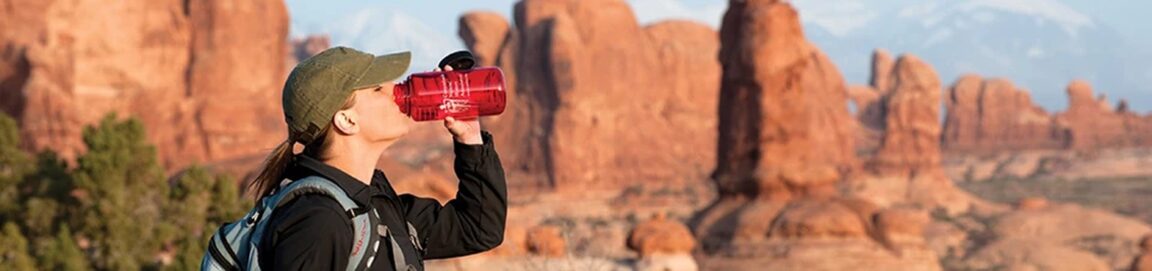
Sources checked November 21, 2026: National Park Service safety guidance for Arches and the Utah and Arizona desert parks (nps.gov), for water quantities, refill points, heat windows, layering, flash flood and lightning rules. Photo: a hiker drinking water against the red rock of Arches National Park, NPS photo by Neal Herbert, via the National Park Service.