 Maya Chen
Shinta Mani Wild earns its price, or does not, on two things: arrival and purpose. Guests reach the camp in Cambodia’s South Cardamom National Park by a 400 metre zipline over the forest canopy and the Tmor Rung River, landing at the Landing Zone Bar, and the rate that follows, from around 2,500 US dollars per tent per night with a three night minimum, funds the Wildlife Alliance ranger station that patrols the surrounding forest against poachers and loggers. Everything else, the 15 Bill Bensley designed tents along 1.5 kilometres of river and waterfalls, the unlimited spa, the private guided everything, sits downstream of those two facts. Travellers who want the zipline and the patrol get a camp found nowhere else; travellers who want a conventional luxury resort with a jungle view should spend the money elsewhere.
Quick Facts
- Where: Shinta Mani Wild, a Bensley Collection camp in the South Cardamom National Park, Cambodia, spread over about 800 acres of private nature sanctuary
- Tents: 15 in total, 14 one bedroom tents of about 100 square metres and one two bedroom tent of about 140 square metres, set along 1.5 kilometres of river and waterfalls
- Arrival: By 400 metre zipline over the canopy, river and waterfalls into the Landing Zone Bar; a road arrival exists for guests who decline the flight
- Rate model: All inclusive, published starting rates from around 2,500 US dollars per tent per night for two guests, plus taxes and service charge; minimum stay three nights; minimum guest age 10 years
- Included: All food and beverages, private guided activities and excursions, unlimited spa treatments, a personal Bensley Adventure Butler, and land transfers from Phnom Penh or Sihanoukville airports; helicopter transfers cost extra
- Conservation: The camp funds a Wildlife Alliance ranger station on site; guests may join anti poaching patrols by motorbike, typically two to six hours
- Designer: Bill Bensley, who conceived the tents as a 1960s royal safari, inspired by Jacqueline Kennedy’s 1967 travels in Cambodia
- Facts checked: November 21, 2026, against the property’s official site, shintamani.com
How does the zipline arrival actually work?
It is the front door, not an activity. Guests transferring in from Phnom Penh or Sihanoukville are brought to the zipline tower at the edge of the property, harnessed, and flown 400 metres above the forest canopy, across the river and its waterfalls, to a landing at the camp’s Landing Zone Bar, where the general manager and the guest’s Bensley Adventure Butler are waiting. The property’s own materials describe the flight exactly that way, and the official Shinta Mani Wild page leads with it for a reason: the zipline is both transport and thesis, a statement that the camp begins where the road ends. Sunrise yoga sessions are held on top of the seven storey zipline tower, with the flight down to breakfast at Headquarters as the second half of the ritual.
Two practical notes matter more than the thrill. First, the zipline is optional in the only sense that counts: guests who cannot or do not want to fly are driven in, and luggage travels by road regardless. Second, the arrival sets the camp’s geography in the mind correctly. Wild is strung out along the river rather than gathered around a lobby, and the flight over the canopy shows the whole estate, tents, falls and forest, in one pass. Travellers comparing Cambodia’s two great splurges should note how different the proposition is from the marine one in our Song Saa Private Island guide: Song Saa sells rest, Wild sells participation.
What is the anti poaching patrol, and can guests really join it?
Yes, and it is the experience the camp was built to create. Shinta Mani Wild exists because its founders bought this tract of Cardamom forest to keep it from being logged and poached, and the camp funds a dedicated Wildlife Alliance ranger station inside the property. Wildlife Alliance is a Cambodian conservation NGO whose armed rangers patrol for poaching, logging and other illegal activity in one of Asia’s most biodiverse forests, home to Malayan sun bears, pangolins, clouded leopards and pileated gibbons. The rangers seize snares, which can kill almost any animal that steps into one, confiscate homemade guns and chainsaws, and clear illegal camps.
Guests join that work rather than watch a presentation about it: a patrol runs two to six hours by motorbike, depending on stamina, checking camera traps, cutting snares and following the rangers’ daily routes. It is muddy, serious and deliberately unglamorous, and the camp is honest that a patrol may find dead wildlife as well as release live animals. For travellers who have done conventional safaris, this is the closest equivalent in Southeast Asia to paying for conservation with your presence rather than your donation, because the room revenue is what keeps the ranger station funded. Guests who prefer their conservation gentler get the same forest at lower intensity: camera trapping with the naturalists, butterfly walks in a sanctuary that counts more than 140 species, foraging outings with the chefs and birdwatching by pontoon boat on the estuary backwaters.
What does the all inclusive rate actually cover?
More than most all inclusive rates, and the inclusions are the honest way to judge the price. The published rate structure, checked on the property’s official channels on November 21, 2026, starts from around 2,500 US dollars per tent per night based on two guests, plus service charge and government taxes, with a three night minimum stay and a minimum guest age of 10. Against that headline, the rate includes all food and beverages, including alcoholic drinks; all private guided activities and excursions, so the patrol, the kayaking, the mountain biking and the waterfall swimming carry no per activity charge; unlimited treatments at the Khmer Tonics Spa; the services of a personal Bensley Adventure Butler who builds each day; and round trip land transfers from Phnom Penh or Sihanoukville airports. Helicopter transfers are the notable extra, priced separately.
The arithmetic that follows is unforgiving but clarifying. Three nights, the minimum, puts a couple at roughly 7,500 dollars before taxes for a stay in which almost nothing else can be spent. Compared line by line with a conventional luxury resort, where spa days, private guiding and premium drinks accumulate, the gap narrows; compared with any other Cambodian hotel, it does not close. The camp knows this and leans into the one justification that cannot be replicated: the money visibly funds rangers, forest and a staff drawn heavily from the local community. Entry formalities for Cambodia itself are separate from the rate, and our Cambodia e Arrival app explainer covers the digital arrival process that now applies at Cambodian airports.
What are the tents like, and how should the days be spent?
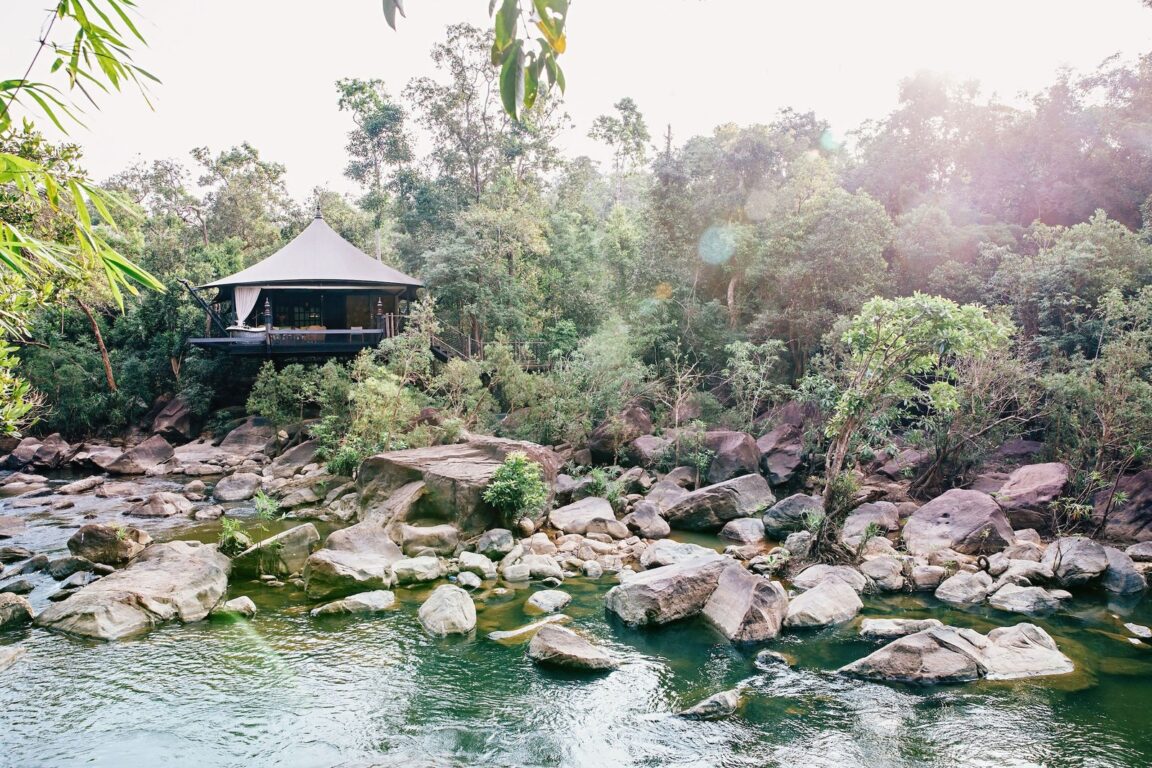
The 15 tents sit on stilts along the river, each positioned over seven years of planning to minimise intervention in the valley, and each individually designed. Fourteen are one bedroom tents of about 100 square metres; the fifteenth, the two bedroom Wildlife Alliance Tent, runs to about 140 square metres. The design language is Bensley’s imagined version of a luxury safari in 1960s Cambodia, travelling with Jacqueline Kennedy, who toured the kingdom with King Sihanouk in 1967: one waterfall tent is dedicated to the First Lady, others carry names like the Cambodian Royalty Tent and the Bohemian Tent. Interiors pair canvas and dark Khmer wood with antiques, and the signature furniture piece is the outdoor bathtub on each tent’s deck, positioned over the rushing water, with the sides of the tent folding away so the room opens completely to the river.
Days organise themselves around water and forest. The river offers kayaking, swimming in the natural pool the camp calls the Cistern, and waterfall time; the forest offers guided hikes from riverside ambles to full day treks into the Cardamom interior, mountain bike trails and the patrol. Headquarters is the dining centre, where the kitchen works heavily with foraged and local ingredients, and the Landing Zone Bar holds the social evening. Three nights is a workable minimum rather than a marketing device: one day for the river, one for the patrol, one unscripted. Travellers routing onward through Cambodia’s northwest can extend the trip with the river town covered in our Battambang guide, a deliberate change of pace from the Cardamoms.
Frequently Asked Questions
How much does Shinta Mani Wild cost per night?
Published starting rates run from around 2,500 US dollars per tent per night for two guests, plus service charge and government taxes, checked on November 21, 2026. A minimum stay of three nights applies, so the entry point for a stay is roughly 7,500 dollars before taxes. The rate is all inclusive: food and drink, private guided activities, unlimited spa treatments, a personal butler and land transfers from Phnom Penh or Sihanoukville airports.
Do you have to arrive by zipline at Shinta Mani Wild?
No. The 400 metre zipline over the canopy and river to the Landing Zone Bar is the signature arrival and most guests take it, but a road arrival is available for anyone who prefers it, and luggage is transferred by road in all cases. The zipline tower also hosts sunrise yoga, with a flight down to breakfast afterwards.
Can guests really join the anti poaching patrol?
Yes. The camp funds an on site Wildlife Alliance ranger station, and guests can join the rangers on motorbike patrols lasting two to six hours, cutting snares, checking camera traps and surveying the forest. The patrols are real conservation work in difficult conditions, not a staged activity, and the camp sets a minimum guest age of 10 for the property as a whole.
How many tents does Shinta Mani Wild have?
Fifteen: 14 one bedroom tents of about 100 square metres and one two bedroom tent of about 140 square metres, designed by Bill Bensley and set on stilts along 1.5 kilometres of river and waterfalls. Named tents include the First Lady Jackie Kennedy Tent and the two bedroom Wildlife Alliance Tent.
What is included in the Shinta Mani Wild rate?
All food and beverages, all private guided activities and excursions, unlimited Khmer Tonics Spa treatments, a personal Bensley Adventure Butler, and round trip land transfers from Phnom Penh or Sihanoukville airports. Helicopter transfers are charged separately. There is no per activity billing inside the stay.
When is the best time to visit Shinta Mani Wild?
The drier months from November to April give the easiest trekking, the clearest river swimming and the most reliable zipline conditions. The wet season, roughly May to October, turns the waterfalls and rapids to full power and the forest to its greenest, at the cost of mud on the trails and more demanding patrol conditions. The camp operates year round.
Featured image: A Shinta Mani Wild tent on stilts above the rocky Tmor Rung River, its conical canvas roof and open deck set in Cardamom rainforest. Photo from Shinta Mani, the property’s official site (shintamani.com), used with credit.