 River Callahan
Battambang is Cambodia’s calm second city: a French colonial riverfront town on the Sangker River where the headline experiences are a bamboo train rattling through rice country, a limestone hill with temples and a terrible history told straight, and, at dusk, millions of bats pouring out of a cave in a ribbon that can run for half an hour or more. It sits in the country’s rice bowl province, a few hours west of Siem Reap, and it rewards travellers who want Cambodia beyond Angkor: slower, agricultural, artistic and honest about its past. Give it two nights. One night reduces it to a checklist; two let the river town set the pace.
Quick Facts
- Where: Northwestern Cambodia, on the Sangker River, capital of Battambang Province, the country’s leading rice producing region
- Signature ride: The bamboo train, called the norry, a motorised bamboo platform running on a single rail line through the countryside
- Signature sight: The bat exodus at Phnom Sampov, where millions of wrinkle-lipped bats stream out at dusk for 30 minutes or longer
- Hard history: The Killing Caves of Phnom Sampov, a Khmer Rouge execution site from 1975 to 1979, now a memorial with a glass stupa of victims remains
- In town: French colonial shophouses and the Governor’s Residence along the riverfront, plus a strong contemporary arts scene
- Temple detour: Phnom Banan, an 11th century hilltop temple reached by a climb of more than 350 steps
- How long: Two nights, with Phnom Sampov timed as a late afternoon and dusk trip
- Angkor pairing: Most visitors arrive from Siem Reap; plan the temple days with our Angkor Wat visitor guide
The river town itself
Battambang’s centre is a grid of low colonial era streets along the west bank of the Sangker, and its charm is cumulative rather than monumental: yellow washed shophouses, the art deco central market, Psar Nat, small cafes in restored buildings, and the French Governor’s Residence, the grandest colonial building in town, facing gardens near the river. The city is often described as Cambodia’s second or third largest, but its centre feels like a provincial town, because it is one: the capital of a farming province, busy in the morning, quiet by nine at night.
It is also Cambodia’s arts town. Battambang has produced a disproportionate share of the country’s modern artists, a story rooted in its art schools and in Phare Ponleu Selpak, the arts organisation founded here whose circus and visual arts programmes train young Cambodians; its graduates perform the famous Phare circus in Siem Reap. Galleries and studio spaces around the centre make an easy, rewarding hour between bigger excursions. Walk the riverfront streets in the early morning and again at dusk, when food stalls set up and the bridges light up, and you have the town’s rhythm.
The bamboo train: ingenious, simple, still running
The norry, the bamboo train, is exactly what the name promises: a frame of bamboo slats, about three metres long, set on two sets of wheels and powered by a small motor, carrying passengers down a single track at speeds that feel faster than they are, through rice fields, villages and over low bridges. It was born of necessity after the Khmer Rouge years, when locals needed transport on a damaged railway and built it from what they had.
Two things have changed in recent years and are worth knowing. First, the original line near the old station was affected when Cambodia’s railways were restored to regular service, and the main tourist norry operation now runs on a dedicated stretch near Phnom Banan, south of the city, set up for visitors. Second, the famous meet-on-the-track ritual survives in spirit: on a single line, one platform gives way to another, and the lightest load is lifted off the rails and reassembled, a piece of choreography that is half the fun. It is a short ride, not a journey, and it is best treated as what it is, a joyful piece of living folk engineering, ideally combined with Phnom Banan on the same southern loop.
Phnom Sampov: temples, killing caves and the bats
About 12 to 15 kilometres southwest of the city, a limestone hill rises from the flat rice plain like a beached ship; its name, Phnom Sampov, or Sampeau, means ship hill. The hill holds the whole Battambang story in one afternoon, which is why every visitor ends up here, and why it should be done in the right order and the right frame of mind.
At the top are pagodas and viewpoints over an ocean of green paddy. Halfway down are the Killing Caves. During the Khmer Rouge regime, between 1975 and 1979, prisoners were killed at the rim of a natural skylight shaft in the cave and their bodies thrown in; estimates commonly cited locally put the dead here at more than 10,000. Today a large glass memorial stupa in the cave holds skulls and bones of victims, and a golden reclining Buddha lies nearby. This is not a sight to rush or to photograph carelessly. Go with a local guide, listen, keep voices down, dress respectfully and treat the memorial as a grave, because it is one. Cambodia asks visitors to learn this history, at Tuol Sleng and Choeung Ek in Phnom Penh and at smaller sites like this one, and Battambang’s version is the more intimate and, for many, the more affecting.
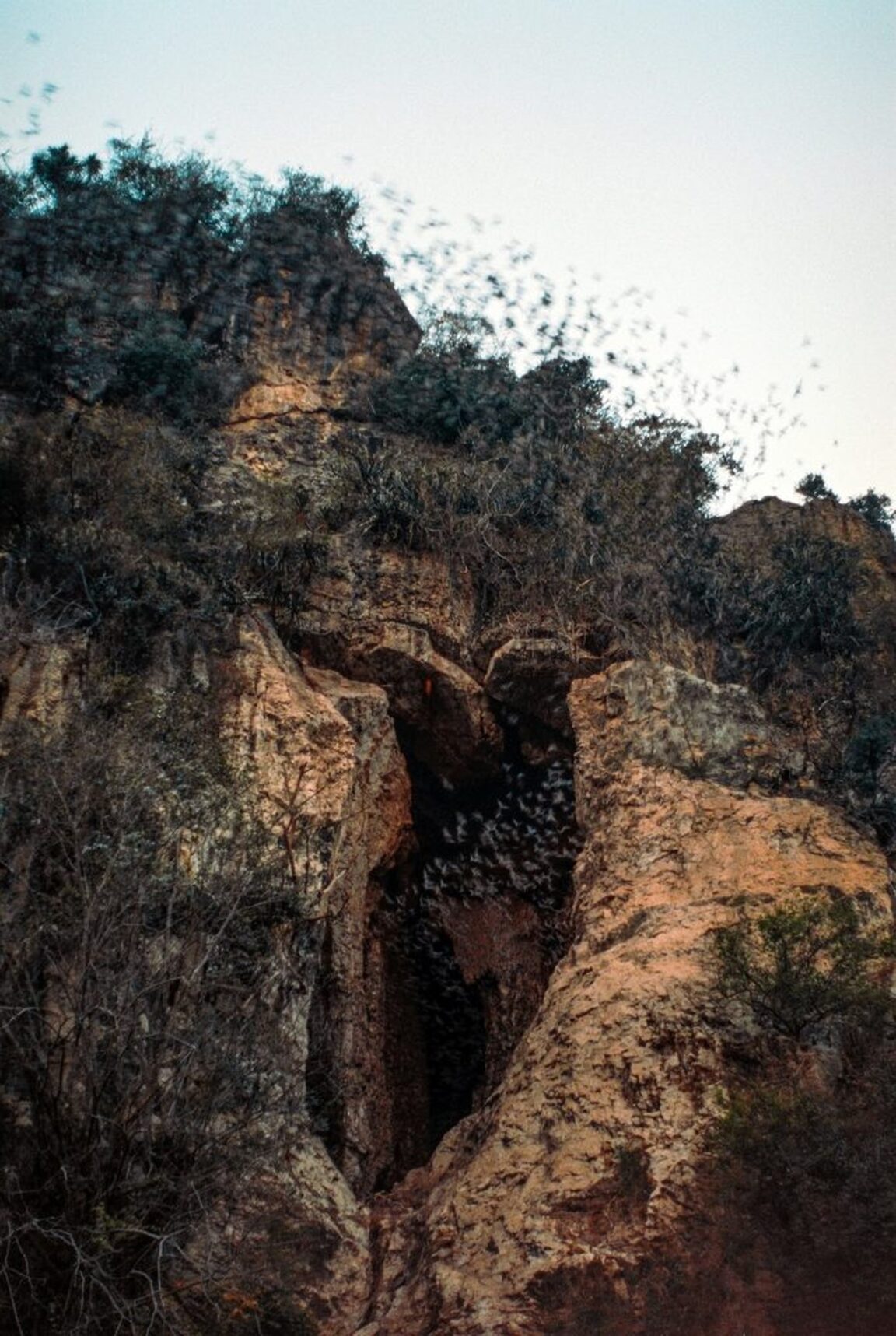
Then, at the foot of the same hill, the day turns. The bat cave at Phnom Sampov is home to millions of wrinkle-lipped free-tailed bats, and at dusk, usually around half past five to six depending on the season, they leave. Not in a burst but in a continuous, undulating stream that pours from the cave mouth and ribbons across the sky towards the rice fields, lasting 30 to 45 minutes and sometimes longer. Roadside cafes at the base exist precisely for this: order a drink, sit down before sunset, and watch one of the great wildlife spectacles of Southeast Asia, performed nightly, free, above a farming plain. Arrive at least half an hour early; the exodus starts on the bats schedule, not yours.
Phnom Banan and the southern loop
South of the city, Phnom Banan pairs naturally with the bamboo train. An 11th century temple, older than much of Angkor’s surviving stone, crowns a hill reached by a steep stair climb of more than 350 steps, flanked by nagas. Five towers remain in part, the carvings are worn and lovely, and the view from the top, over the Sangker plain and a small lake, explains the temple’s placement better than any panel. Go in the morning if you can; the steps in midday heat are a negotiation. Caves at the hill’s base and fruit bat trees nearby round out the stop.
How to plan your days
Day one: arrive, settle, walk the colonial centre and riverfront, galleries and the Governor’s Residence, market at Psar Nat, dinner in the old streets. Day two: Phnom Banan and the bamboo train in the morning, rest through the heat, then out to Phnom Sampov by mid afternoon for the hilltop and the Killing Caves in daylight, finishing at the bat cave cafes for dusk. Transport is by tuk tuk for almost everything; agree the full loop price before setting off. Practical entry formalities for Cambodia have changed recently, so check our explainer on Cambodia’s e-Arrival app before you fly. From Battambang, most travellers return to Siem Reap or continue to Phnom Penh; both are half day road journeys, and the capital adds the national museums and the genocide memorials that complete the history this town introduces.
Frequently Asked Questions
Is the bamboo train still running in Battambang?
Yes. The norry operates for visitors on a dedicated line near Phnom Banan, south of the city, after the restoration of regular rail services changed the original route. Expect a short, fast, rattling ride through rice country rather than a long journey.
What time do the bats leave the cave at Phnom Sampov?
At dusk, typically around 5:30 to 6:00 pm depending on the season, and the stream of bats can continue for 30 to 45 minutes. Arrive at the cafes at the base of the hill at least 30 minutes before sunset to be seated and settled.
How should you visit the Killing Caves respectfully?
Go with a local guide, dress modestly, keep your voice down and treat the glass memorial stupa, which holds victims remains, as a grave. Photography should be restrained and never performative. The Khmer Rouge killed more than 10,000 people at this site between 1975 and 1979.
How many days do you need in Battambang?
Two nights is the right amount for most travellers: one day for the town, its galleries and riverfront, and one for the Phnom Banan and bamboo train loop plus the Phnom Sampov afternoon and bat exodus.
How far is Battambang from Siem Reap?
Roughly 170 kilometres by road, usually around three hours by taxi or bus depending on conditions. Many travellers visit Battambang as the second stop after Angkor, or on the way between Siem Reap and Phnom Penh.