 Camille Baptiste
The story of Opatija is written along a single path. The Lungomare, the 12 kilometre seaside promenade that runs from the fishing village of Volosko through Opatija to Lovran, passes almost every building that matters in the town history: Villa Angiolina, where Croatian tourism began in 1844, the Hotel Kvarner, the first purpose built resort hotel on this coast, the church of St. James that gave the town its name, and the villa gardens of the Habsburg winter resort that followed. Walk it south to Lovran in the morning and back through Volosko for fish in the evening, and you have read the town in order.
Quick Facts
- Setting: Opatija, Kvarner Gulf, northern Adriatic coast, Croatia
- Lungomare length: About 12 km, Volosko to Lovran, officially the Franz Joseph I Promenade
- Built: In phases, northern section completed 1889, southern section to Lovran completed around 1911
- Tourism begins: Villa Angiolina built 1844 by the Rijeka merchant Iginio Scarpa
- Health resort status: Opatija declared an official climatic health resort in 1889
- Hotel Kvarner: Opened 1884, the first purpose built resort hotel of the Opatija Riviera
- Volosko: Historic fishing and shipbuilding village at the northern end, now known for its fish restaurants
How did a fishing village become the Habsburg winter riviera?
Opatija takes its name from an abbey: opatija is the Croatian word for abbey, and the Benedictine abbey of St. James, whose small church still stands by the shore, anchored a modest fishing settlement for centuries. The transformation began in 1844, when Iginio Scarpa, a wealthy merchant from nearby Rijeka, built Villa Angiolina as a summer residence and spent the following years planting its park with exotic species from around the world, including the Japanese camellia that later became the symbol of Opatija tourism. Scarpa entertained well connected guests, word travelled to Vienna, and the railway age did the rest. In 1884 the Hotel Kvarner rose as the first purpose built grand hotel on the eastern Adriatic, and in 1889 the Austrian authorities formally declared Opatija a climatic health resort, the first on this coast. Winter seasons followed in which the town filled with Central European aristocracy, industrialists and artists. Composers Gustav Mahler and Giacomo Puccini and the writer Anton Chekhov were among the visitors drawn by the mild winters, the sea air and the social season. The grand villas and hotels that line the shore today are the architecture of those decades.
Why was the Lungomare built, and in what order should you walk it?
The promenade was health infrastructure before it was a pleasure walk. The local scenic improvement society, the Abbazianer Verschonerungsverein, promoted a level, sheltered seaside path along which the resort doctors could prescribe the era defining cure: measured walking in sea air. The first, northern phase, from Volosko toward the Slatina beach in Opatija, was completed in 1889, the same year as the health resort declaration. The southern extension, linking Opatija through Icici and Ika to Lovran, was completed around 1911 under the driving effort of the physician Julius Hortenau. The result, renamed for Emperor Franz Joseph I, is a paved, largely level 12 kilometre path cut along the rocky shore, lit along its length, and passing the resort entire cast of buildings in sequence. Walk it as the history reads. Start in Volosko, the older maritime village, and walk south through the villa shore into central Opatija for Villa Angiolina, its park and the Croatian Museum of Tourism now housed inside it. Continue past St. James church and the Maiden with the Seagull statue, the town symbol, and on to Lovran, about 5 km from central Opatija, a walk of roughly 90 minutes at an easy pace. The full Volosko to Lovran line makes a satisfying half day with stops; the Opatija to Lovran half is the section most visitors choose.
What do the villa gardens add to the story?
Opatija parks are considered among the most significant works of park architecture in Croatia, and they are not decoration. The resort sold climate, and its gardens were the product made visible: sheltered, fragrant, subtropical planting thriving outdoors on the northern Adriatic in winter. Park Angiolina, laid out around Scarpa villa from 1845 onward, and the neighbouring St. James Park carry palms, magnolias, cedars, bamboo and the famous camellias through the coldest months, protected by the Ucka mountain wall behind the town, which breaks the cold bora wind. The Carmen Sylva woodland promenade, the Lungomare inland twin, climbs through laurel and chestnut forest above the shore and was laid out for the same prescribed walking cure in shade. Reading the town through its gardens explains its prices and its pace even now: Opatija was built for lingering, in winter, by people who measured a holiday in weeks rather than days. The same Habsburg era layering rewards walkers further down this coast, in Rovinj old town beyond the famous sight and in the island gateway history of Murter and the Kornati Gate.
Why does the walk end with fish in Volosko?
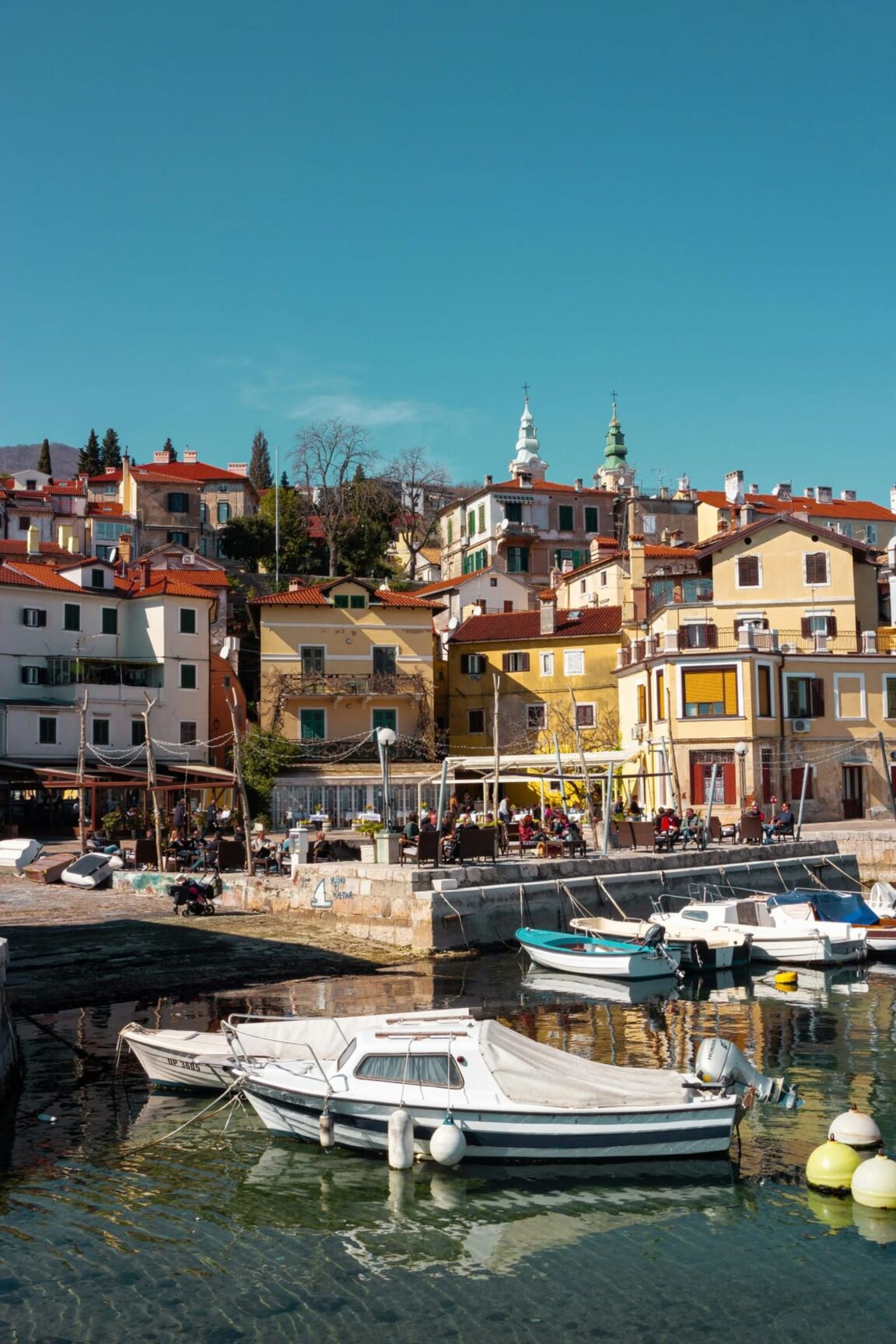
Because Volosko is the part of the riviera that never stopped being a working village. In the eighteenth century it was a significant centre of shipping and shipbuilding, with a steamship line linking Rijeka, Volosko and Opatija from 1884, before the larger ports took its trade. Its small harbour, tight lanes and painted houses now hold some of the most respected fish restaurants on the Kvarner coast, the kind of places where the menu follows the boats. It is also a place of science as well as fish: the geophysicist Andrija Mohorovicic, who discovered the boundary between the earth crust and mantle that bears his name, was born in Volosko in 1857. Ending the Lungomare day here, at a harbour table as the light goes, closes the historical circuit properly: abbey village, merchant villa, imperial resort, and back to the fishing port that was here before all of it.
When should you walk the Lungomare?
The path is a year round proposition, which was the original point. Winter, the season the resort was built for, brings the clearest air, the emptiest path and the camellias in flower. Spring and autumn suit the full 12 kilometre line, with Lovran chestnut festival, the Marunada, filling three October weekends in and around Lovran with roasted maruni chestnuts, the large local variety once exported to Vienna and Berlin. Summer adds swimming from the bathing platforms and coves along the path, at the price of crowds and heat that argue for early morning and evening walks. There is no ticket and no gate: the Lungomare is a public promenade, open at all hours, and its history is free to anyone willing to walk it slowly.
How do you read the buildings as you walk?
The promenade is an open air catalogue of the resort styles, and reading it is easier than it looks. The earliest grand buildings, the Kvarner and Villa Angiolina among them, wear the classical restraint of the mid nineteenth century. The villas that followed in the 1890s and 1900s turn to historicist and secession ornament, with loggias, towers and winter gardens angled for sun and sea views, because a winter resort sold light as much as air. Between them sit the working pieces of the cure landscape: bathing establishments, gazebos, sheltered benches and the parks, all spaced at a strolling rhythm along the shore. Once that pattern clicks, the walk stops being a row of pretty facades and becomes what it was designed to be, a measured dose of scenery, prescribed daily. Allow time for the small detours the path keeps offering: a coffee on a hotel terrace, a swim platform in summer, the Walk of Fame stars near Slatina, and the harbour at Lovran at the southern end, where the old town lanes climb away from the water and the chestnut woods begin.
Frequently Asked Questions
How long is the Lungomare and how long does it take to walk?
About 12 km from Volosko to Lovran. The most popular section, central Opatija to Lovran, is about 5 km and takes roughly 90 minutes one way at an easy pace. The full line with stops makes a half day.
When was the Lungomare built?
In phases. The northern section from Volosko was completed in 1889, and the southern section reaching Lovran was completed around 1911. It is officially named the Franz Joseph I Promenade.
What was the first building of Opatija tourism?
Villa Angiolina, built in 1844 by the Rijeka merchant Iginio Scarpa. Its park began the town garden tradition, and the villa now houses the Croatian Museum of Tourism.
Why is Opatija called a health resort?
It was formally declared a climatic health resort in 1889, the first on the Croatian coast, and its promenades and parks were built to support the prescribed walking cures of the era.
What is Volosko known for?
A historic fishing and shipbuilding village at the northern end of the Lungomare, now best known for its harbour fish restaurants. It is about a 25 minute walk north of central Opatija along the promenade.
Is the Lungomare free?
Yes. It is a public seaside promenade, open at all hours with no ticket or entry fee.
Sources checked 16 November 2026: Kvarner Tourist Board and Opatija tourism material on the Lungomare phases and dates, Villa Angiolina and the Croatian Museum of Tourism, and Lovran Marunada festival information.