 Hana Kim
Beyond the famous sight in Rovinj, the postcard view of St Euphemia’s tower over the rooftops, the old town rewards the traveller who goes small and goes south. Small is the House of Batana, a two room ecomuseum on the harbour edge that explains the flat bottomed fishing boat the whole town was built around, for 5 euros and about half an hour of your day. South is Lone Bay and the Golden Cape forest park, where a rented bicycle turns the afternoon into shaded pine paths and clear rocky coves. Do the tower first for the view, the Batana house for the understanding, and the Lone Bay ride for the swim, and Rovinj stops being a photograph and becomes a place.
Quick Facts
- Where: Rovinj old town, Istria, Croatia, a car free former island peninsula on the western Istrian coast; Pula airport is about 30 minutes away by car
- The famous sight: The Church of St Euphemia, built in 1736, with a 60 metre bell tower modelled on St Mark’s in Venice and built between 1654 and 1680, topped by a copper statue of the saint that turns as a wind vane
- The beyond sight museum: The House of Batana ecomuseum, Obala Pina Budicina 2, on the waterfront south of the fishing harbour
- Batana prices: Adults 5 euros, pupils, students and pensioners 4 euros, adult groups of 10 or more 3 euros, school groups 2.50 euros, per the museum’s official site
- Batana hours: January, February and December 10 am to 3 pm, closed Saturday and Sunday; March, April, October and November 10 am to 4 pm, closed Sunday; May and September 10 am to 1 pm and 6 pm to 9 pm, closed Sunday; June to August 10 am to 1 pm and 7 pm to 11 pm, closed Sunday
- Batana boat rides: In summer, traditional boatmen row visitors from the Mali Mol, the Small Pier, on Tuesday, Thursday and Saturday evenings at 7 pm, June to September; book through the museum or batana.org
- The cycling: Lone Bay sits at the northern edge of the Golden Cape (Zlatni Rt) forest park, a short ride south of the old town through the hotel zone; bike rental shops operate in the town centre
- Old town warning: The lanes are steep, the cobbles are polished smooth, and the old town is genuinely challenging for visitors with mobility difficulties; the waterfront edges are the accessible ground
First, the famous sight done properly: St Euphemia’s tower
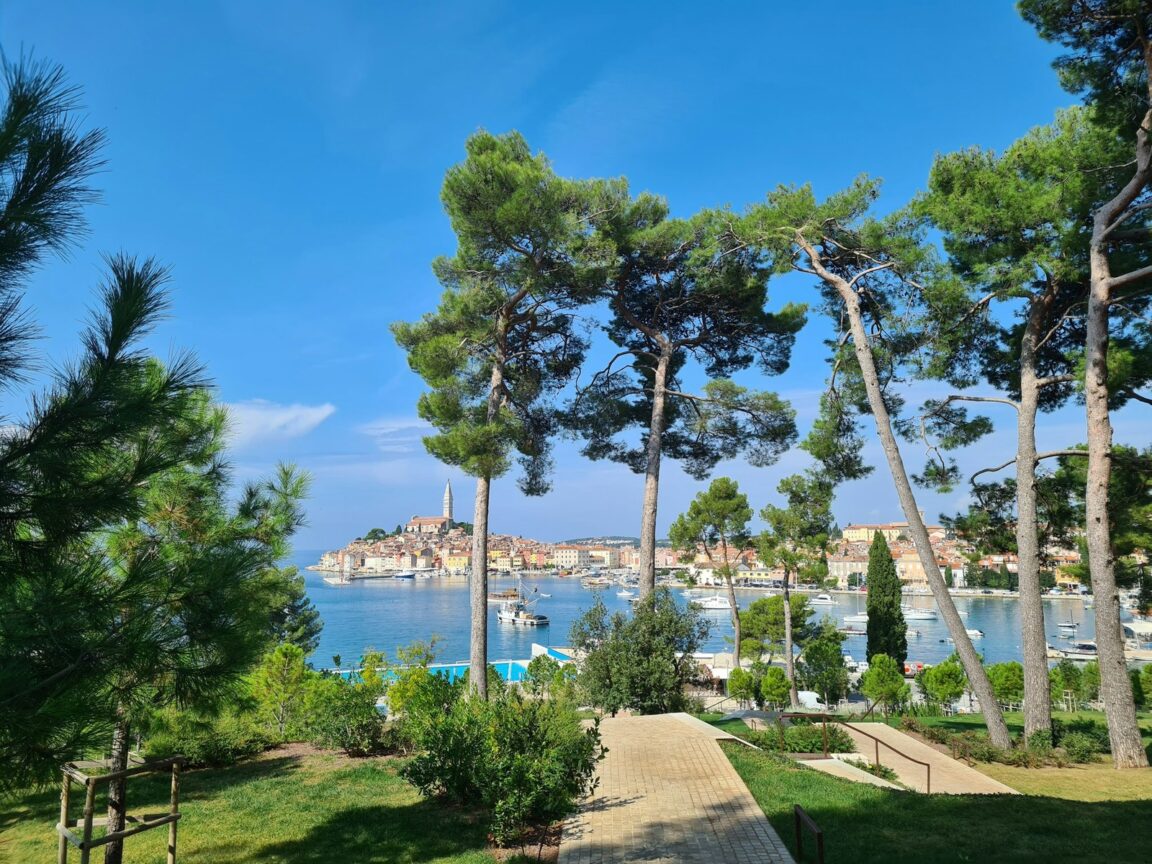
Every Rovinj day starts with the climb, so do it while the lanes are cool. The old town rises through cobbled streets, Grisia the most famous, lined with artists’ studios and small galleries, to the Church of St Euphemia at the summit. The church was built in 1736 over older early Christian structures, holds the saint’s relics in a Roman sarcophagus from the sixth century adapted in the 15th, and keeps Gothic statues and 16th and 17th century paintings inside. The bell tower beside it, 60 metres high and built between 1654 and 1680 to the plans of Antonio Manopola in deliberate imitation of St Mark’s campanile in Venice, carries the copper statue of St Euphemia that serves as the town’s wind vane and appears in every photograph, including the one above, taken from across the harbour in Lone Bay’s direction.
Climb the tower. The usual objection to tower views, that the landmark is missing from them, does not apply here, because what the top gives you is the working town: the harbour, the fishing fleet, the red roofs stepping down to the water and the offshore islands. Then walk down slowly. Rovinj was founded as a village on a small island, walled against pirates, and only later joined to the mainland, which is why the old town keeps its tight oval shape and why its houses still show laundry at the windows and cats at the doors. It is a lived in town, not a museum set, and the lanes repay an unhurried hour more than any single doorway.
The beyond sight: the House of Batana
On the western edge of the old town, at Obala Pina Budicina 2, two minutes from the Balbi Arch, sits the museum most visitors walk straight past: the House of Batana, the interpretation centre of the Batana Ecomuseum, opened in 2004 inside a late 17th century coastal house. The batana is Rovinj’s traditional flat bottomed wooden fishing boat, and the museum, about 100 square metres across three gallery spaces, covers its construction, the fishing traditions built on it and the dialect rich culture of the town’s fishing families, with a restored batana at its centre. UNESCO has recognised the batana and its associated traditions on its intangible heritage registers, and the ecomuseum was built from the ground up by the local community rather than imposed on it, which you can feel in the rooms.
Practically, it is the easiest good decision in Rovinj: 5 euros for adults, 4 euros for students and pensioners, 20 to 30 minutes for the exhibition, and hours that bend around the Mediterranean day, mornings and late evenings in summer, when it stays open to 11 pm, and a short 10 am to 3 pm weekday pattern in deep winter. It is closed on Sundays in every season, which catches people out. The ecomuseum is bigger than its house: it includes the Spacio Matika wine cellar for tastings and singing, the small shipyard where batanas are built and restored, the annual regattas, and, best of all in summer, the evening batana rides, when boatmen row visitors out from the Mali Mol at 7 pm on Tuesdays, Thursdays and Saturdays under lanterns. Book the ride at the museum reception or through batana.org, and time it for sunset. Travellers building a Croatian old town route will find the same go beyond the postcard logic in our guide to Murter and the Kornati gate beyond the famous sight, where the shipwrights’ town of Betina plays Rovinj’s role further south.
The afternoon: cycling to Lone Bay and the Golden Cape
South of the old town, past the hotel zone, the coast opens into the Golden Cape, Zlatni Rt, a protected forest park of pine and Mediterranean scrub threaded with walking and cycling paths and a string of rocky coves. Lone Bay, at the park’s northern edge below the hotels, is the first and easiest of its swimming spots: clear water over rock and shingle, a view straight back to the old town and St Euphemia’s tower, and shade within a few steps of the water, which in Istria is the difference between a swim stop and a base for the whole afternoon. The beaches here are rocky rather than sandy, as they are all along this coast, so water shoes earn their space in the bag.
Rent the bikes in the town centre, where rental shops serve exactly this ride, and treat the route as the day’s second activity rather than transport: old town edge, harbour promenade, hotel zone, then the park paths, where the riding is flat, shaded and shared with walkers. Ride out in the late afternoon if the day is hot, swim at Lone Bay as the light softens, and roll back for dinner as the waterfront restaurants open. Cyclists who want more can continue deeper into the Golden Cape coves or north toward the Lim Channel viewpoints on a longer day. The pattern, one sight in the morning, one small museum, one ride and swim, is the same discipline that makes our Bamberg Bergstadt lanes guide work in Germany’s great preserved old town.
What should you skip, and when should you come?
Skip Rovinj at the peak of August if you have any choice: the old town lanes are narrow, the heat sits in them, and the town’s considerable summer crowds compress exactly the streets this guide sends you down. May, June, September and October are the connoisseur’s months, warm enough to swim at Lone Bay, quiet enough to hear the town. Skip, too, any attempt to do the Batana house on a Sunday, when it is closed in every season, and do not leave the evening batana ride to chance in July and August; it runs only three evenings a week and books through the museum. What needs no booking at all is the old town itself, which is free, car free and best before 10 am and after 6 pm, when the day boats and day trippers thin out and the residents take their streets back.
Frequently Asked Questions
How much does the House of Batana cost and when is it open?
Adults pay 5 euros, pupils, students and pensioners 4 euros, adult groups of 10 or more 3 euros and school groups 2.50 euros, per the museum’s official site. Hours change by season: in June to August it opens 10 am to 1 pm and 7 pm to 11 pm, in winter 10 am to 3 pm on weekdays only, and it is closed on Sundays all year.
How long do you need at the Batana museum?
About 20 to 30 minutes for the exhibition itself, which covers the batana’s construction, Rovinj’s fishing traditions and the ecomuseum story. Allow longer if you add the souvenir shop or book the evening batana boat ride, which leaves from the Mali Mol at 7 pm on Tuesdays, Thursdays and Saturdays from June to September.
Can you climb the St Euphemia bell tower?
Yes, and you should: the 60 metre tower, built between 1654 and 1680 in imitation of St Mark’s in Venice, gives the classic view over the harbour, the red roofs and the offshore islands. The church below it, built in 1736, holds St Euphemia’s relics in a sixth century Roman sarcophagus.
Is Lone Bay good for swimming?
Yes, in the Istrian way: clear water over rock and shingle at the edge of the Golden Cape forest park, with pine shade a few steps back and the old town view across the water. Bring water shoes. It is a short, flat cycle ride south of the old town through the hotel zone.
Is Rovinj old town accessible?
Only partly, and honesty matters here: the old town’s steep lanes, stairs and polished cobbles are genuinely difficult for visitors with mobility limitations. The harbour waterfront and the edges of the old town are level and accessible, and the Batana house sits on that waterfront ground.
When is the best time to visit Rovinj?
May, June, September and October: swimmable sea, open museums on their shoulder season hours, and the old town lanes at a human density. July and August bring the heat and the crowds; winter brings short Batana hours and a quiet, local town that rewards a different kind of trip.
Facts checked 16 November 2026 against the House of Batana’s official site batana.org (working times and prices), Visit Rovinj’s Casa della Batana guide, the parish of Rovinj’s St Euphemia listing and Adventurous Kate’s Rovinj guide updated July 2026. Featured image: Rovinj old town and St Euphemia’s tower across the harbour, seen through the pines from the Lone Bay side. Photo by Vlado Sestan on Unsplash, Unsplash License, via Adventurous Kate.