 Hana Kim
Eat in Quy Nhon in this order: banh xeo tom nhay first, seafood by weight second, and the noodle soups in between. The dish that defines this south central coast city is the jumping shrimp pancake, a small, crisp rice flour pancake cooked with shrimp so fresh the name claims they are still jumping, served open, cut up and rolled in rice paper with herbs. Around it sits a complete local circuit: bun cha ca and banh canh cha ca fish cake soups for breakfast, wharf side seafood priced per kilo for dinner, and Binh Dinh specialties such as banh it la gai and tre that barely appear outside the province. The sightseeing that frames the eating is compact: Ky Co beach about 23 km north east of the center, Eo Gio headland about 19 km away beside it, and the Cham towers, Thap Doi in town and Banh It about 20 km out, so no meal ever needs to compete with a long transfer. Plan two to three days, eat the pancake on day one, and let the rest of this guide sequence the stops between.
Quick Facts
- Signature dish: Banh xeo tom nhay, jumping shrimp pancakes, smaller and crisper than the southern banh xeo, rolled in rice paper with herbs and garlic chili dip
- Breakfast soups: Bun cha ca (fish cake vermicelli soup) and banh canh cha ca (thick noodle fish cake soup), plus bun sua with jellyfish
- Seafood rule: Seafood is priced by weight at wharf side and beach restaurants; agree the per kilo price before anything is weighed or cooked
- Food street: Ngo Van So street fills with stalls and small eateries from about 6 p.m. onward
- Beach day pairing: Ky Co, about 23 km and 35 minutes from the center; Eo Gio, about 19 km and 25 minutes, on the same Nhon Ly peninsula trip
- Heritage pairing: Thap Doi Twin Towers in the city, late 12th century, larger tower about 25 m; Banh It towers about 20 km north west
- Getting in: Phu Cat Airport (UIH) about 32 km from the center; main line trains stop at Dieu Tri, about 11 km west
- Best window: February to August is the drier season; October and November are the wettest months by a wide margin
What is banh xeo tom nhay, and where should you eat it?
Banh xeo tom nhay is the Quy Nhon version of the Vietnamese savory pancake, and the differences matter. The pancake is smaller than the big southern banh xeo, cooked in a small pan until the rice flour and turmeric batter turns lacy and crisp, and filled with whole small shrimp, bean sprouts and onion. The name means jumping shrimp, a reference to shrimp fresh enough to still be lively when they hit the pan, which is the entire point in a fishing port. It arrives open rather than folded, and the local way to eat it is to cut it into pieces, wrap each piece in rice paper with herbs, cucumber and sometimes green mango or pineapple, and dip it in a garlic chili fish sauce.
Order it where the pans never cool down. Long running local names that recur across Quy Nhon food guides include Gia Vy and Ong Hung on Dien Hong street, and Cay Me and Ba Nam in the My Cang area, all cooking the small pancake format rather than a generic banh xeo. Go at lunch or early evening, order two pancakes per person as a starting point, and treat the wrapping as part of the dish rather than an optional extra. If only one specialty makes the trip, it should be this one; it is the plate that separates Quy Nhon from every other beach city on this coast. For the wider central Vietnam food context before or after, our 2 days in Hoi An itinerary covers the lantern town an easy hop north, where the signature plates change completely.
How do the fish cake soups fit the day?
Quy Nhon eats soup in the morning, and the fish is the reason. Bun cha ca pairs rice vermicelli with springy fish cakes, made from fresh mackerel, barracuda or ponyfish, in a light, peppery fish broth. Banh canh cha ca uses thick tapioca or rice noodles in a clearer broth with the same fish cakes, and bun sua swaps in crunchy jellyfish for a tangier bowl. Bun Ca Ngoc Lien on Nguyen Hue is one of the addresses local guides repeat for bun cha ca, but the honest rule in Quy Nhon is that any busy morning shop with fish cakes made on site will serve a good bowl; turnover matters more than signage.
Sequence them like this. Soup for breakfast near the center, the beach or towers through the middle of the day, pancakes at lunch or as the first dinner course, and the heavy seafood meal last, when the boats have come in and the tanks are fullest. A second regional bowl worth hunting is bun tom Chau Truc, also called bun ram, built on small brackish water crustaceans from Chau Truc Lagoon, and banh hoi chao long, steamed rice vermicelli sheets with pork offal and porridge, which is a Binh Dinh breakfast that visitors rarely order and locals rate highly.
Where does the Ky Co boat day meet lunch?
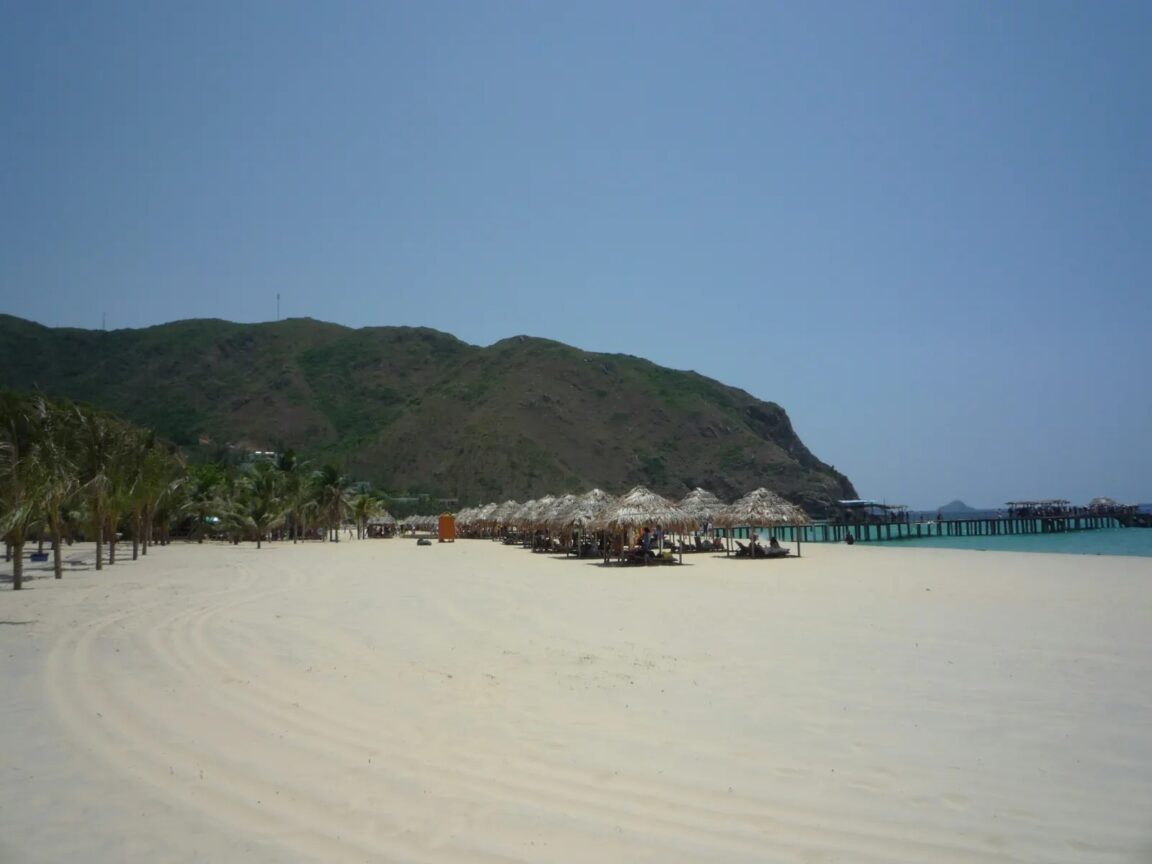
Ky Co and Eo Gio sit on the Phuong Mai peninsula near Nhon Ly fishing village, across the Thi Nai bridge from the city. Eo Gio, the wind strait, is a rocky headland with a cliff path above the surf, reached in about 25 minutes; Ky Co is a sheltered cove of pale sand and clear, layered blue water about 35 minutes out, reached by a short boat ride from Nhon Ly or by the steep road and shuttle down to the sand. Reported entry and transfer prices vary by operator and season, commonly quoted in a band from about 100,000 to 150,000 dong for entry with boat and meal bundles running higher, so confirm the full price, including the return boat, before you board.
Lunch on this day belongs in Nhon Ly. The village restaurants cook what the basket boats land: grilled squid, steamed crab, tamarind crab, grilled oysters and whole fish, priced by weight. This is the meal to apply the per kilo rule to most carefully, because the setting is casual and the billing is not. Agree the price per kilo, watch the weighing, and confirm whether cooking is included. Then swim at Ky Co in the morning calm if you can, because boats can pause when afternoon wind and rough seas pick up, a pattern that is common from September to December. Riders connecting this coast with the imperial city can use our Hue imperial citadel and tombs guide for the next stop north, where the food turns royal and the pancakes disappear.
What do the Cham towers add between meals?
Quy Nhon was once Vijaya, a capital of the Champa kingdom, and the towers are the evidence still standing in the middle of the modern city. Thap Doi, the Twin Towers, stands about 3 km from the center: two brick towers from the late 12th century, the larger about 25 m tall and the smaller about 23 m, with carved dancers and animal figures around the cornices and brickwork bonded so tightly that how the Cham builders did it is still debated. Entry is small, the visit is under an hour, and it fits neatly before lunch. Banh It, about 20 km north west, is the bigger excursion: four towers on a hilltop with views over the river plain, dating to the 11th and 12th centuries, and worth the ride if towers are your thing. Local counts put eight Cham tower complexes in the province, with more at Duong Long, whose central tower at about 39 m is described as the tallest surviving Cham tower.
Eat around them rather than after them. A workable heritage day is Thap Doi early, banh canh or bun cha ca back in the center, Banh It in the cooler part of the afternoon, and Ngo Van So street after 6 p.m. for the stall circuit: banh beo cups with shrimp floss and peanut, sea snails and shellfish grilled or steamed with lemongrass and chili, and che desserts including longan and lotus seed sweet soup. Finish with the two take home specialties: banh it la gai, a dark, chewy sticky rice cake made with ramie leaf and filled with mung bean or coconut, named for the Banh It towers, and tre, fermented pork seasoned with sesame, galangal, garlic and chili and sold wrapped like a small straw bundle. Both travel well and both are genuinely provincial, which is more than most souvenir food can claim.
Frequently Asked Questions
What food is Quy Nhon most famous for?
Banh xeo tom nhay, the jumping shrimp pancake, is the signature dish, followed by fish cake noodle soups such as bun cha ca and fresh seafood sold by weight. All three are Binh Dinh specialties rooted in the local fishing fleet.
How many days do you need in Quy Nhon?
Two days cover Thap Doi, the city beach promenade and the main dishes. Three days add the Ky Co and Eo Gio peninsula day and Banh It towers at a comfortable pace, which is the version this guide recommends.
When is the best time to visit Quy Nhon?
February to August is the drier window, with February to April averaging under about 35 mm of rain a month at the Quy Nhon station. October and November are the wettest months, and boat trips to Ky Co are the first thing rough weather cancels.
How do you reach Ky Co beach?
Drive about 23 km to Nhon Ly village, roughly 35 minutes from the center, then take a short boat to the cove or the road and shuttle down to the sand. Go in the morning for calmer water and agree the full return price before boarding.
How do you avoid overpaying for seafood in Quy Nhon?
Seafood is priced per kilo, not per dish. Confirm the per kilo rate, watch your seafood being weighed, and ask whether cooking and sauces are included before the kitchen starts. The practice is normal and expected at wharf side stalls.
How do you get to Quy Nhon?
Fly to Phu Cat Airport, about 32 km from the center, take a main line train to Dieu Tri station about 11 km west of town, or ride a long distance bus to the city bus station. In town, Grab cars and motorbikes, taxis and rented motorbikes cover the short distances.
Photo: Ky Co beach near Quy Nhon, with straw shelters, palms and the boat pier under the headland. Photo by Jamie Trinh on Unsplash, Unsplash License. Facts checked 16 November 2026 against Vietnam tourism and local guide sources, Quy Nhon climate records and operator information; prices and boat operations change with season and weather, so confirm on the day.