 Maya Chen
Hue is the imperial overnight that central Vietnam itineraries too often skip, and it should not be: the Nguyen dynasty’s capital holds a vast walled Citadel with the Imperial City and the Forbidden Purple City inside it, a circuit of royal tombs in the hills along the Perfume River, and a slower, rainier, more scholarly pace than the beach towns to its south. Tickets are simple and cheap by international standards: 200,000 dong for the Imperial City, 150,000 dong for each of the three great tombs, or a combined ticket at 530,000 dong covering all four sites over two days. Give Hue two nights, walk the Citadel on the first morning, and drive the tombs circuit on the second day.
Quick Facts
- Heritage status: Complex of Hue Monuments, UNESCO World Heritage Site since 1993
- Imperial City ticket: 200,000 dong per adult; children aged 7 to 12 pay 40,000 dong; under 7s are free
- Royal tomb tickets: 150,000 dong per adult for each of the Tu Duc, Khai Dinh and Minh Mang tombs; children 7 to 12 pay 30,000 dong
- Combined ticket: 530,000 dong for the Imperial City plus all three great tombs, valid over two days; a 420,000 dong version covers the Citadel plus any two tombs
- Opening hours: In the summer season, mid March to mid October, sites open about 6.30am to 5.30pm or later; in winter, mid October to mid March, about 7am to 5.30pm, with ticket sales ending around 30 minutes before closing; exact times vary by source, so arrive early rather than late
- The layout: The Citadel on the north bank of the Perfume River holds the Imperial City, which holds the Forbidden Purple City
- The tombs: Seven royal tombs open to visitors in the hills south and west of the city; the big three are Tu Duc, Khai Dinh and Minh Mang, 6 to 14 kilometres out
- The stay: Two nights; one day for the Citadel, one for the tombs and Thien Mu Pagoda
What are you actually entering at the Citadel?
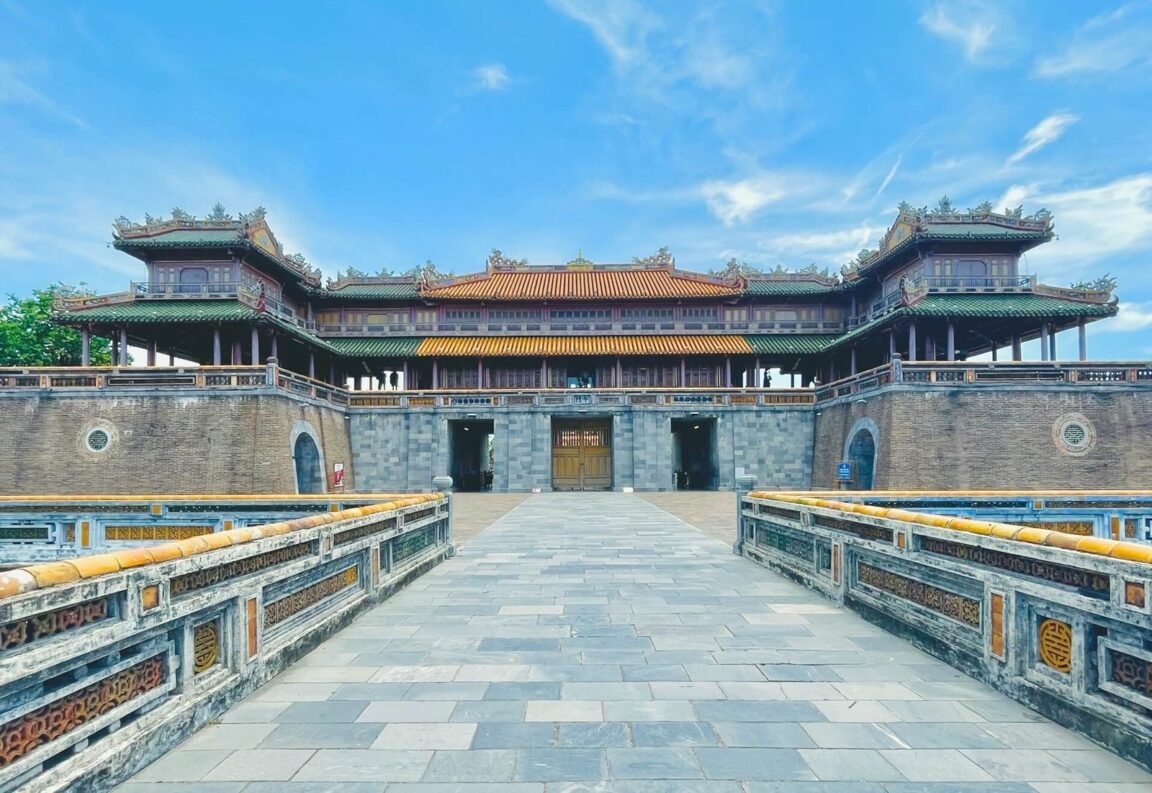
Three enclosures, one inside the next. The outer Citadel is a Vauban style fortress of brick ramparts and moats, roughly 10 kilometres around, built from 1804 under Emperor Gia Long, founder of the Nguyen dynasty that ruled Vietnam from Hue from 1802 to 1945. Inside it sits the Imperial City, the walled seat of government, entered through the Ngo Mon gate beneath its five phoenix watchtower, where the changing of the guard is still staged in the morning. Inside that, in turn, stood the Forbidden Purple City, reserved for the emperor and his household, and largely destroyed in the fighting of 1947 and, most severely, the 1968 Tet Offensive battle for Hue.
That layered survival is what a visit feels like. The Thai Hoa Palace, the throne hall, stands restored in full lacquer and gold; the Hall of the Mandarins, the royal theatre, temples and pavilions survive or have been rebuilt across a huge, green, partly empty enclosure, where whole districts of the Purple City are now lawns and lakes between foundations. UNESCO inscribed the Complex of Hue Monuments in 1993, recognising the capital’s planning and architecture as an outstanding example of a late feudal eastern capital. Allow at least two and a half to three hours, enter at Ngo Mon in the morning before the tour groups, and work outward from the throne hall rather than drifting: the site is big enough, at well over a square kilometre of enclosures, to punish a planless visit. Shoulders and knees should be covered inside the active temples and ancestor altars.
Which royal tombs should you choose?
Seven Nguyen emperors’ tombs are open to visitors, spread along the Perfume River hills, but three carry most visits, and the combined ticket is built around them. They are three very different buildings, which is the point of seeing all three.
Khai Dinh, the extravagant one
The tomb of Khai Dinh, built between 1920 and 1931 on the slope of Chau Chu mountain about 10 kilometres from the centre, is the last, smallest and most ornate: a steep stairway of dragons, a courtyard of stone mandarins and elephants, and an interior blazing with mosaic work in porcelain, glass and stone. It divides opinion, concrete and Indochinese European fusion against every classical rule, and it is unforgettable either way. Allow one to one and a half hours.
Tu Duc, the poet’s garden
Tu Duc built his tomb as a retreat during his own lifetime, about 7 kilometres out, and it reads as a landscaped garden estate: a lake with a pavilion, pine woods, and the emperor’s poems inscribed in stone, the largest collection of his verse anywhere. It is the most atmospheric of the three and the one that rewards slowness, at one and a half to two hours.
Minh Mang, the harmonious one
Minh Mang’s tomb, begun in 1840 and completed in 1843 under his successor, about 12 kilometres from the centre, is usually judged the most balanced: some 40 structures arranged along a central axis of about 700 metres, through courtyards, gates and bridges between two lakes. It is the quietest of the big three and the best walk. Allow one to two hours. The tombs are separate sites, each with its own gate and ticket check, so the circuit needs transport: a hired car with driver, a motorbike taxi, or a rented scooter, with the combined ticket’s two day validity letting you split the circuit if the heat or the rain argues for it.
How do the tickets and hours work in practice?
Hue’s monument fees are set by provincial resolution, and the schedule in force for 2026 prices the Imperial City at 200,000 dong per adult and each great tomb at 150,000 dong. The arithmetic favours the bundle: bought separately, the Citadel plus the three tombs cost 650,000 dong, against 530,000 dong for the four site combined ticket valid over two days, and the three site version, Citadel plus any two tombs, costs 420,000 dong. Children aged 7 to 12 pay reduced rates, 40,000 dong at the Citadel and 30,000 dong at the tombs, and under 7s enter free. Tickets are sold at each site and through the Hue Monuments Conservation Centre’s online system.
Hours run on a seasonal split. In the summer season, from mid March to mid October, the monuments open early, about 6.30am, and close in the early evening; in winter, from mid October to mid March, opening moves to about 7am with closing around 5 to 5.30pm, and ticket sales stop roughly 30 minutes before closing. Published closing times vary slightly between sources, so plan on the conservative version: be inside your last site well before 5pm in winter. There is no regular paid night opening; the Citadel opens at night only for festival and holiday events. Round out the second day with Thien Mu Pagoda, the seven storey tower on the river west of the Citadel that is Hue’s emblem, and a Perfume River boat ride back toward town. Travellers routing the centre of Vietnam can pair Hue with the lantern town to the south in our 2 days in Hoi An itinerary, and with the bay at the country’s other end in our guide to kayaking Ha Long Bay, and the three together make the classic north to south heritage spine.
Frequently Asked Questions
How much are Hue’s monument tickets in 2026?
The Imperial City costs 200,000 dong per adult, and the Tu Duc, Khai Dinh and Minh Mang tombs cost 150,000 dong each. The combined ticket covering the Citadel and all three tombs costs 530,000 dong and is valid over two days; a Citadel plus two tombs version costs 420,000 dong. Children aged 7 to 12 pay 40,000 dong at the Citadel and 30,000 dong at a tomb, and under 7s are free.
Which tomb is best if you only have time for one?
Khai Dinh for spectacle, Tu Duc for atmosphere. Khai Dinh’s mosaic interior is unlike anything else in Vietnam and takes the least time. Tu Duc’s lakeside garden estate is the most beautiful setting but deserves a longer, slower visit. Minh Mang is the connoisseur’s choice and the best walk of the three.
How long do you need inside the Imperial City?
At least two and a half hours, and three is better. The enclosures cover a very large area, the surviving palaces and temples are spread across it, and the distances between gates are real walking. Enter through Ngo Mon in the morning and work outward from the Thai Hoa Palace.
Is Hue worth an overnight, or a day trip from Da Nang or Hoi An?
Stay overnight, ideally two nights. A day trip compresses the Citadel into its busiest hours and forces a choice among the tombs. Two nights give you a Citadel morning, a full tombs circuit, Thien Mu Pagoda and an evening on the Perfume River, which is the visit Hue deserves.
When is the best time to visit Hue?
The drier months from about February to August suit the Citadel and tombs best, with early starts against the summer heat. Hue is famously rainy in the central Vietnam wet season, roughly October to December, when the Perfume River runs high and touring needs flexibility. The monuments open year round on the seasonal hours described above.
Facts checked 14 November 2026 against the Hue Monuments Conservation Centre fee schedule as reported for 2026 and UNESCO’s listing for the Complex of Hue Monuments. Opening times vary slightly between published sources; the conservative hours are given in the text. Featured image: The Ngo Mon gate of the Imperial City, Hue, Vietnam. Photo by lovebylouis on Unsplash, Unsplash License, via a verbatim hosted copy served by Newt.