 Priya Nair
Galle Fort is a living town inside 17th century ramparts, and the ramparts are its promenade: entry to the fort, its streets and its walls is free, the walls are open around the clock, and a full circuit of roughly 2 to 3 kilometres passes bastion after bastion above the Indian Ocean to the white lighthouse at the southern point. About 3,000 people live and work inside the walls, which UNESCO inscribed in 1988 as the best preserved fortified city built by Europeans in South and Southeast Asia. Sleep inside the fort if you can. The rampart walk at dawn and again at sunset, with the day coaches gone, is the experience the whole south coast organises itself around.
Quick Facts
- Heritage status: Old Town of Galle and its Fortifications, UNESCO World Heritage Site since 1988
- Entry: Free. The fort is a public, lived in town; its streets and ramparts are open 24 hours
- The rampart walk: Roughly 2 to 3 kilometres around the peninsula, passing the Sun, Moon and Star bastions and Flag Rock; allow one to two hours
- The lighthouse: Galle Lighthouse on Point Utrecht Bastion, first lit in 1848 and rebuilt in 1939, still operational and viewable from outside only
- Size and life: A fortified town of about 36 hectares with roughly 3,000 residents, schools, courts, churches and a cricket ground inside the walls
- Getting there: About 120 kilometres south of Colombo, roughly two hours by the Southern Expressway and on the coastal railway
- Best season: December to April on the south coast; walk the walls early morning or from mid afternoon toward sunset
- The stay: One to two nights inside the fort beats a day trip from the beach resorts
Why is Galle Fort a town and not a museum?
Most colonial forts in Asia are ruins or ticketed monuments. Galle is neither. The Portuguese first fortified this rocky promontory in 1588, the Dutch East India Company rebuilt it comprehensively after taking it in 1640, and the British adapted it after them, adding the lighthouse and the newer gate. Through every change of flag the town inside kept being a town: merchants, officials, soldiers and families lived within the walls, and their descendants and successors still do. UNESCO’s 1988 inscription recognised exactly that continuity, a fortified city that illustrates the interaction of European architecture and South Asian traditions and never stopped being inhabited.
The practical consequence for a visitor is freedom. There is no gate ticket, no closing hour and no prescribed route, because you are walking a neighbourhood. The fort’s defences also proved themselves in the hardest possible way: when the Indian Ocean tsunami struck in 2004, the massive Dutch sea walls shielded the old town, and the fort emerged with far less damage than the modern city outside. Treat the place accordingly, as somewhere people live: the churches hold services, the courts sit, children cycle to school along the ramparts, and the famous sunset crowd shares the walls with all of it.
How should you walk the ramparts?
Walk the full circuit once, slowly, and let it teach you the fort’s geography. Enter by the Main Gate on the northern, landward side, where the walls are thickest and the moat logic of the Dutch defences is clearest, then climb to the wall top and work around the peninsula. The circuit runs for roughly 2 to 3 kilometres along the top of the walls, past a sequence of named bastions, Sun, Moon and Star among them, each giving a different angle over the harbour, the town’s red roofs or the open ocean.
The southern stretch is the celebrated one. Flag Rock, near the fort’s southern tip, was once used to signal approaching ships and is now the sunset grandstand, where locals gather and, on calm days, cliff divers perform for the crowd. From there the wall leads to the lighthouse point and around to the western walls, where the Rampart Street section gives the classic late afternoon composition: grass topped walls, the ocean below, and the town’s rooftops behind you. Walk it twice if your stay allows, once in the early morning, when the walls belong to fishermen, joggers and schoolchildren, and once from about an hour before sunset. Midday on the exposed walls is hot, bright and comparatively empty for a reason.
What should you see inside the walls?
The lighthouse and Point Utrecht Bastion
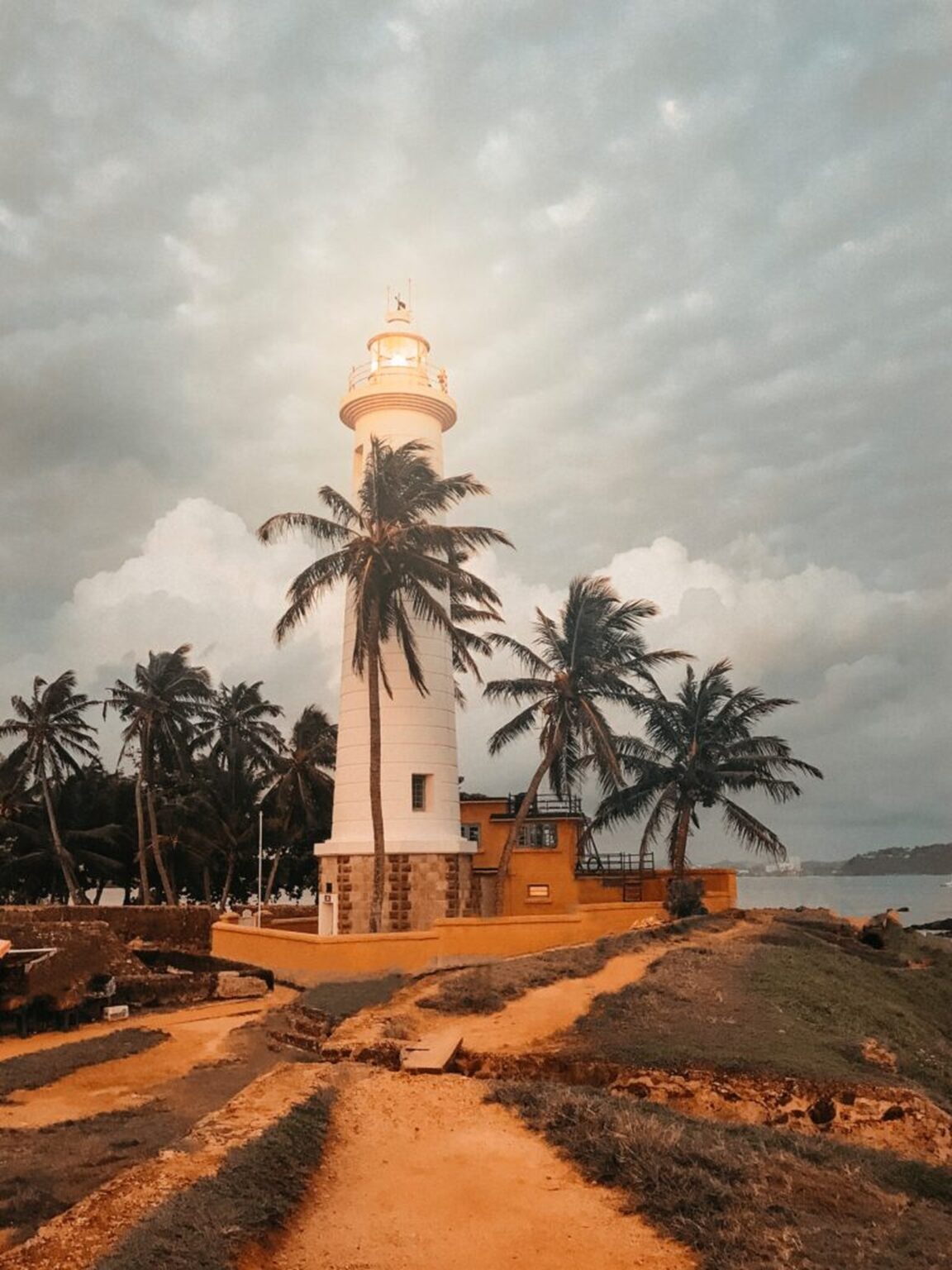
The white lighthouse at the fort’s southeastern point is Galle’s postcard: a light has guided ships into the harbour from this area since the first British built tower of 1848, and the current masonry tower dates from 1939, rebuilt after the original was destroyed by fire. At about 26.5 metres it remains an active aid to navigation operated by the Sri Lanka Ports Authority, so the interior is closed and the correct visit is from the ramparts and the small beach below it. Anyone near the entrance offering paid access inside is selling something that does not exist.
Churches, the Old Dutch Hospital and the cricket ground
Inside the grid, the Dutch Reformed Church, with its memorial floor stones, and the Anglican All Saints Church mark the two colonial congregations, while mosques and the town’s other faiths fill out the living mix UNESCO valued. The Old Dutch Hospital, a long colonnaded building near the lighthouse point, now works as a dining and shopping courtyard and is the easiest heritage interior to enjoy without a ticket. Small museums inside the fort, including the National Museum of Galle and the maritime collection, charge modest fees in the hundreds of rupees and keep daytime hours, commonly 9am to 5pm and closed on Fridays and public holidays in the museum’s case; confirm on the day. And then there is the view that explains Galle to cricket lovers worldwide: Galle International Stadium sits just outside the fort’s northern walls, its pitch framed by the ramparts and the sea, one of the most photographed grounds in world cricket.
How does Galle fit a south coast trip?
Galle is the cultural anchor of Sri Lanka’s south coast and pairs naturally with the beach towns east of it. The surf and yoga base of Weligama, covered in our guide to surf and yoga in Weligama, is a short ride away, and the same coast continues to Mirissa’s whale watching boats and the stilt fishing villages between. Give Galle its own nights rather than folding it into a beach day trip: the fort’s best hours, dawn on the walls and the sunset circuit, are precisely the hours day visitors miss. From Colombo, the Southern Expressway makes the drive roughly two hours in good conditions, and the coastal railway from Colombo Fort is slower and prettier, running along the ocean for much of the route. Within the fort, everything is walkable; the grid is small, flat and shaded in the mornings, and the only transport decision is which gate to start from. Travellers extending the trip across the strait into southern India will find the same verify it first approach in our guide to Ayurveda retreats in Kerala, the region’s other great heritage and wellness circuit.
Frequently Asked Questions
Do you have to pay to enter Galle Fort?
No. Entry to the fort, its streets and its ramparts is free and open around the clock, because the fort is a living town rather than a ticketed monument. Only specific attractions inside, such as the museums, charge modest separate fees.
Can you go inside Galle Lighthouse?
No. The lighthouse is an active aid to navigation run by the Sri Lanka Ports Authority, and its interior is closed to visitors. View and photograph it from the ramparts at Point Utrecht Bastion and from the beach below, which is where the classic images are taken anyway.
How long does the rampart walk take?
The full circuit is roughly 2 to 3 kilometres and takes one to two hours at a sightseeing pace, including bastion stops. The southern section, from Flag Rock to the lighthouse, is the most popular; walk early in the morning or in the last two hours of the day to avoid the midday heat on the exposed walls.
When is the best time to visit Galle?
December to April is the south coast’s dry season and the reliable window for rampart sunsets. Within any day, early morning before 10am and late afternoon from about 3pm give the best light and the most comfortable walking. The fort is worth visiting year round, but the southwest monsoon months bring rougher seas and more rain.
Is Galle Fort worth staying in overnight?
Yes, and it changes the visit. Staying inside the walls gives you the ramparts at dawn, the town’s cafes before the day coaches arrive, and the sunset circuit without a transfer afterwards. One night is the minimum; two allow a museum morning and a slower circuit of the walls.
Facts checked 14 November 2026 against UNESCO’s listing for the Old Town of Galle and its Fortifications and current visitor guidance for the fort, lighthouse and museums. Museum hours and fees change; confirm on the day. Featured image: Galle Lighthouse above the fort walls, Galle, Sri Lanka. Photo by Shainee Fernando on Unsplash, Unsplash License, via a verbatim hosted copy on Sri Lankan Riders.