 Camille Baptiste
Gozo deserves nights, not just a day trip, because Malta’s sister island runs on a slower rhythm that a single afternoon cannot sample: a fortified Citadel above the capital Victoria that you can have almost to yourself at opening and again at dusk, the red sand sweep of Ramla Bay, Neolithic temples older than the pyramids, and villages where the evening belongs to residents. The crossing is easy, 25 minutes by car ferry from Cirkewwa or about 45 minutes by fast ferry from Valletta, and every bus on the island radiates from Victoria. Come for two nights if you can, one full day at the very least, and let the ferry timetable, not a tour coach, set your pace.
Quick Facts
- Where: The second island of the Maltese archipelago, northwest of Malta island
- Car ferry: Gozo Channel Line, Cirkewwa to Mgarr, about 25 minutes, running 24 hours a day; foot passengers pay 4.65 euros return, charged on the return leg from Gozo; a car and driver pay 15.70 euros return
- Fast ferry: Gozo Highspeed, Valletta to Mgarr, about 45 minutes, foot passengers only, from about 7.50 euros one way; first to cancel in rough weather
- Capital: Victoria, also called Rabat, crowned by the Cittadella
- The beach: Ramla Bay, the island’s red sand beach below Xaghra
- The ancient site: Ggantija temples at Xaghra, a UNESCO World Heritage Site; adult entry most recently listed at 10 euros
- Getting around: Buses radiate from Victoria; route 301 links Mgarr harbour with Victoria and is timed to the ferries
- The stay: Two nights for the full island; one long day for the Citadel, Ggantija and one bay
How does the ferry rhythm shape a Gozo stay?
There are exactly two scheduled ways across the channel, and choosing between them is the first real decision of a Gozo trip. The Gozo Channel ferry from Cirkewwa, at Malta’s northern tip, is the island’s lifeline: a 25 minute crossing to Mgarr that runs 24 hours a day, every day of the year, carrying cars and foot passengers, with sailings roughly every 45 minutes in high season and longer gaps overnight. Foot passengers pay 4.65 euros return and, the detail that catches people out, you pay on the Gozo side, on the return leg only. A car and driver pay 15.70 euros return. No booking is needed for foot passengers, though summer weekend car queues can stretch long.
The alternative is the Gozo Highspeed fast ferry from Valletta’s Grand Harbour to Mgarr, about 45 minutes, foot passengers only, from about 7.50 euros one way. For anyone based in the capital it removes the long bus ride to Cirkewwa entirely. Its weakness is weather: the catamarans feel a strong northerly first and cancel before the big Channel ships do, which is why the Cirkewwa boat remains the fallback that always sails. Note for future planning that Gozo Channel has announced fare changes from 1 January 2027, with the adult foot passenger return set to rise; the figures above are the fares in force now. Travellers starting from the capital can set this crossing against the city time in our Valletta travel guide, which explains why the capital itself also rewards an overnight rather than a day trip.
What is inside the Cittadella?
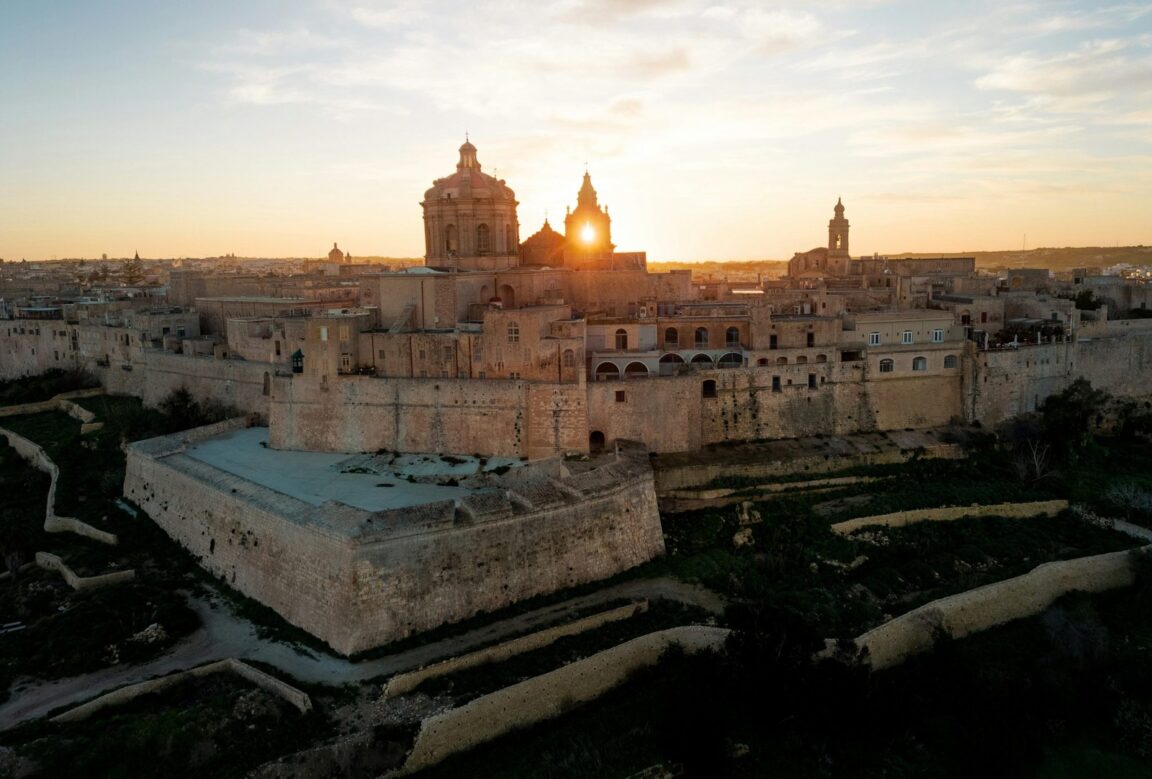
Victoria, the island’s small capital, is dominated by the Cittadella, a fortified hilltop enclosure whose medieval and early modern walls wrap a miniature city of churches, museums and lanes. The streets and ramparts are open and free to wander, and the walk up through the gate to the bastions is the essential Gozo orientation: from the walls the whole island unrolls, terraced fields, village church domes, the sea on every side. Inside, the Cathedral of the Assumption anchors the little piazza, and a cluster of small museums, covering archaeology, folklore and the old prison, fills a unhurried hour or two; individual museum tickets are modest and hours vary by season, so check on the day.
Timing is the Cittadella’s secret. Day trip groups arrive late morning and leave by mid afternoon. A traveller sleeping on Gozo walks the walls at opening, when the stone is cool and the lanes are empty, and returns at dusk, when the fortifications turn amber and the cathedral square belongs to Victoria again. That double visit, morning and evening, is impossible from a Malta day trip and is the single strongest argument for staying over.
What else fills a Gozo day?
Ggantija, the giants’ temples
At Xaghra, the Ggantija temples are among the oldest free standing stone structures on earth, raised in the Neolithic and inscribed by UNESCO as part of the Megalithic Temples of Malta. Two temple units share an outer wall of massive limestone blocks, and the scale, some stones metres across, still argues with the old legend that giants built them. Heritage Malta most recently listed adult entry at 10 euros, with concessions for seniors, students and children; allow 45 to 60 minutes, and pair the visit with Ramla Bay, a short drive below the same plateau.
Ramla Bay and the coast
Ramla Bay is Gozo’s main sandy beach, a wide crescent of red orange sand, beautiful precisely because it is not white. It is free, reached by bus from Victoria, with summer kiosks and sunbeds for hire, and it swims as well as it photographs. Build the coast around it: the salt pans cut into the limestone near Marsalforn, the inland sea and collapsed Azure Window site at Dwejra, and the fjord like inlet of Xlendi for an evening swim and dinner. Each is a short hop by bus or car, and none needs more than an hour or two, which is the Gozo pattern: small distances, slow stops.
How do you get around, and where do you base?
Gozo’s bus network, some fifteen routes, radiates from Victoria, and the hub logic makes the capital the natural base. Route 301 links Mgarr harbour to Victoria about every 30 minutes and is timed to meet the ferries, so the arrival leg is painless. Single tickets cost 2.00 euros in winter and 2.50 euros in summer and stay valid for two hours with transfers. Buses are workable but infrequent by city standards; travellers with one day and a list often hire a car at Mgarr or book a jeep tour, while travellers with two nights find the bus plus walking rhythm part of the island’s point. Stay in Victoria for the Citadel evenings and the bus hub, or in a village farmhouse or the seaside settlements of Marsalforn and Xlendi for a quieter, swim first stay. Island hoppers comparing Mediterranean ferry systems will recognise the bus system logic from our guide to the Aeolian Islands, Sicily’s volcanic archipelago by ferry, where the boats play the same organising role one sea to the east.
Frequently Asked Questions
Is Gozo worth more than a day trip?
Yes. A day trip covers the Cittadella, Ggantija and one bay at group pace. Two nights add the Citadel at opening and dusk, a full Ramla Bay session, Dwejra and Xlendi, and the village evenings that are the island’s real character. The ferry is short enough that staying over costs nothing in transit.
Which ferry should you take to Gozo?
From northern Malta or with a car, the Gozo Channel ferry from Cirkewwa: 25 minutes, 24 hours a day, 4.65 euros return for foot passengers, paid on the return leg. From Valletta on foot, the Gozo Highspeed fast ferry: about 45 minutes from the Grand Harbour, from about 7.50 euros one way, but it cancels first in rough weather.
Do you pay for the Gozo ferry on the way out?
On the Gozo Channel service, no. You board at Cirkewwa without paying and buy the return ticket at Mgarr when leaving Gozo. The return fare covers the round trip. The Valletta fast ferry is ticketed normally, per leg or as a return, before boarding.
How long do you need at the Cittadella?
Allow two hours for the walls, the cathedral square and one or two of the small museums, and return at a different hour if you are staying over. The rampart walk itself takes under an hour; it is the views and the lanes that stretch the visit.
When is the best time to visit Gozo?
Spring and autumn, when the sea is swimmable, the fields are green or golden rather than scorched, and the ferry and bus systems run full timetables without August pressure. Winter is mild and very quiet, with the caveat that strong northerly weather can disrupt the fast ferry and occasionally delay sailings.
Facts checked 14 November 2026 against Gozo Channel and Gozo Highspeed published fares and crossing times, Malta Public Transport fares, and Heritage Malta listing information for Ggantija. Announced Gozo Channel fare changes from 1 January 2027 are noted in the text; all other figures are the fares in force at checking. Featured image: The Cittadella of Victoria above Gozo at sunset, Malta. Photo by Joshua Kettle on Unsplash, Unsplash License, via a verbatim hosted copy on Frank Salt Real Estate.