 Elena Vasquez
Run Hue imperial tomb route with kids in this order: Tu Duc first while everyone is fresh, Thien Mu Pagoda by dragon boat as the midday reset, and Khai Dinh last as the short, spectacular finale, all on one combination ticket that covers the Citadel and the tombs over two days. The numbers that make it work are simple. Each major tomb costs 150,000 dong for adults and 30,000 dong for children ages 7 to 12, the Citadel costs 200,000 and 40,000, and the combination of the Citadel plus three tombs runs from 530,000 dong with two days of validity (Hue Monuments Conservation Centre). Tu Duc is the green, park like tomb where children can actually roam, Khai Dinh is the smallest tomb and the quickest win, and Thien Mu, the seven storey pagoda on the Perfume River, is free. Nap proofing comes from the shape of the day, not from skipping sights: one big tomb in the morning, water and shade at midday, one compact tomb in the afternoon, and nothing scheduled after about 4 p.m.
Quick Facts
- Tickets: Each major tomb (Tu Duc, Minh Mang, Khai Dinh) 150,000 dong adults, 30,000 dong ages 7 to 12; Imperial City 200,000 dong adults, 40,000 dong children; Citadel plus two tombs combination 420,000 dong; Citadel plus three tombs from 530,000 dong, valid 2 days (Hue Monuments Conservation Centre)
- Hours: Tomb and Citadel sites generally open about 8 a.m. to 5.30 p.m.; start early to beat both heat and tour groups
- Order that works: Tu Duc in the morning, Thien Mu Pagoda by dragon boat at midday, Khai Dinh in the afternoon
- Tu Duc: The largest and greenest tomb complex, built during the emperor lifetime about 7 km from the center, with a lake, pavilions and pine shade
- Khai Dinh: The smallest tomb, 11 years in the building, concrete and mosaic in an East meets West style, with 12 stone guards at the courtyard; compact enough for tired legs
- Free anchor: Thien Mu Pagoda on Ha Khe Hill above the Perfume River, founded 1601, seven storey Phuoc Duyen tower 21 m tall built 1844, no entry fee
- Distances: The main tombs sit in an arc about 7 to 12 km south and west of the Citadel; hire a car and driver for the day or use Grab between sites
- Nap rule: Nothing ticketed after the afternoon tomb; the combination ticket second day absorbs anything the nap displaces
Why Tu Duc first, and what makes it the easy win?
Tu Duc is the tomb to spend your best energy on, because it is the one built for wandering. The emperor designed it during his own lifetime as a retreat as much as a burial place, and the complex spreads through pine woods around a lake, with pavilions, a theater, temples and the tomb itself separated by paths and water. For children that layout is the whole game: there is room to move, shade to stop in, fish and open lawns to reset attention, and no single staircase or hall that the visit stands or falls on. Arrive near opening at about 8 a.m., when the light is on the lake and the big tour groups are still at the Citadel, and give it a full two hours without watching the clock.
Practically, Tu Duc sits about 7 km from the center, an easy drive that can anchor a hired car day. Bring water and hats even for the morning, because the shade is real but broken, and let children lead the route between the lake pavilions and the tomb court rather than marching the full official circuit. Families doing the wider imperial city should read our Hue imperial citadel and tombs guide alongside this one; it covers the Citadel in the depth this family route deliberately leaves for day two of the combination ticket.
How does the dragon boat to Thien Mu reset the day?
Midday in Hue is hot, bright and nap adjacent, so put the children on water. Dragon boats run the Perfume River between the city piers and Thien Mu Pagoda, about 20 to 30 minutes each way depending on the boat, and the ride itself does the resetting: breeze, river traffic, and nothing to climb. Thien Mu stands on Ha Khe Hill on the north bank about 5 km from the Citadel. Founded in 1601, it is the oldest pagoda in the city, and its Phuoc Duyen tower, seven storeys and 21 m of brick built in 1844, is the unofficial symbol of Hue. Entry is free, the grounds are shaded and level by tomb standards, and the visit naturally runs 30 to 45 minutes, which is exactly the size of a midday stop.
Two family details matter here. Part of the pagoda complex closes over the monks lunch period, roughly 11.30 a.m. to 2 p.m. in some schedules, so time the boat to arrive before or after that window, and dress children in clothes that cover shoulders and knees, as at any active pagoda. Lunch belongs either before the boat at a city restaurant or after it near the pagoda road, and if a nap is going to happen, the car ride back into town after Thien Mu is the place to let it. That is the nap proofing principle in action: the schedule contains a natural sleep window instead of fighting for one.
Why is Khai Dinh the right last tomb?
Because it is small, dense and unmistakably different, and tired children can still win it. Khai Dinh took 11 years to build, the longest of the Nguyen tombs, and it is the most compact of the majors, a steep, dark, concrete and steel construction that mixes Vietnamese, French and other European elements in a way no other tomb attempts. The courtyard holds 12 stone guards, the interior erupts in ceramic and glass mosaic, and the whole visit can be done well in 45 minutes to an hour. After Tu Duc green sprawl, the contrast lands even for young children: this is the tomb that looks like a treasure room.
The one cost is the climb, a long flight of steps up the hillside, so take it in stages and treat the guard courtyard as the halfway reward. Go in the later afternoon when the heat has eased and the tour buses have thinned, and keep the exit simple: straight back to the hotel, pool or an early dinner. If the day has gone sideways and one tomb must drop, drop Minh Mang from the plan rather than Khai Dinh; Minh Mang is beautiful, formal and symmetrical, but it is the most adult of the three in pacing, and the combination ticket leaves it available on day two alongside the Citadel if energy returns. Families continuing south can pair Hue with our 2 days in Hoi An itinerary, where the old town rewards exactly the same early start, long lunch, late afternoon pattern.
What does the family logistics layer look like?
Buy the combination ticket once and stop thinking about money at gates: the Citadel plus three tombs option from 530,000 dong for adults, valid over two days, removes every per site decision and quietly covers the day two Citadel visit that this route assumes. Children ages 7 to 12 pay the child rate of 30,000 dong per tomb and 40,000 at the Citadel. Hire a car and driver for the tomb day rather than stringing together taxis, because the tombs sit in an arc 7 to 12 km out of town and the car doubles as the nap capsule, the water store and the rain plan. Carry small dong notes for the boat and for parking and drinks at the gates.
Heat is the real opponent, not distance. Sites open from about 8 a.m., so the front loaded morning at Tu Duc is also the coolest touring of the day; by the Khai Dinh climb in late afternoon the temperature is falling again. Rain, common in Hue from September to December, hits this route gently: Tu Duc paths get slick but stay walkable, the boat still runs in light rain, and Khai Dinh is the most indoor of the tombs. Build the second combination ticket day as Citadel in the morning and Minh Mang only if the first day went well, and keep one completely unscheduled afternoon in Hue. The tombs have waited since the 19th century; they can wait out one nap.
Frequently Asked Questions
How much do the Hue tombs cost for a family?
Each major tomb is 150,000 dong per adult and 30,000 dong per child ages 7 to 12, and the Imperial City is 200,000 and 40,000 dong. The combination covering the Citadel and three tombs starts at 530,000 dong per adult and is valid for 2 days, which is the best value for this route (Hue Monuments Conservation Centre).
Which Hue tomb is best for children?
Tu Duc, because its lake, pavilions and pine shade let children move and pause instead of following a single formal axis. Khai Dinh is the best second tomb for kids: compact, visually dramatic and finishable in under an hour.
How long does the tomb route take?
One full but unhurried day for Tu Duc, Thien Mu and Khai Dinh with a hired car, roughly 8 a.m. to 4 p.m. including the boat ride and lunch. The Citadel and Minh Mang fit the second day covered by the combination ticket.
Is Thien Mu Pagoda free?
Yes, entry to Thien Mu Pagoda is free. It is an active pagoda, so dress modestly, and note that parts of the complex close over the monks midday break, roughly 11.30 a.m. to 2 p.m.; the dragon boat ride from the city takes about 20 to 30 minutes.
Do you need a driver for the Hue tombs?
A hired car and driver for the day is the easiest family option, since the tombs sit 7 to 12 km from the center in different directions. Grab cars between sites also work, but the dedicated car gives you storage, water and a nap friendly ride on demand.
When is the best time of year for the Hue tomb route with kids?
February to April brings the mildest weather, warm without the peak heat or the autumn rains. Hue wettest months run from about September to December, when the route still works but needs the rain adjustments described above.
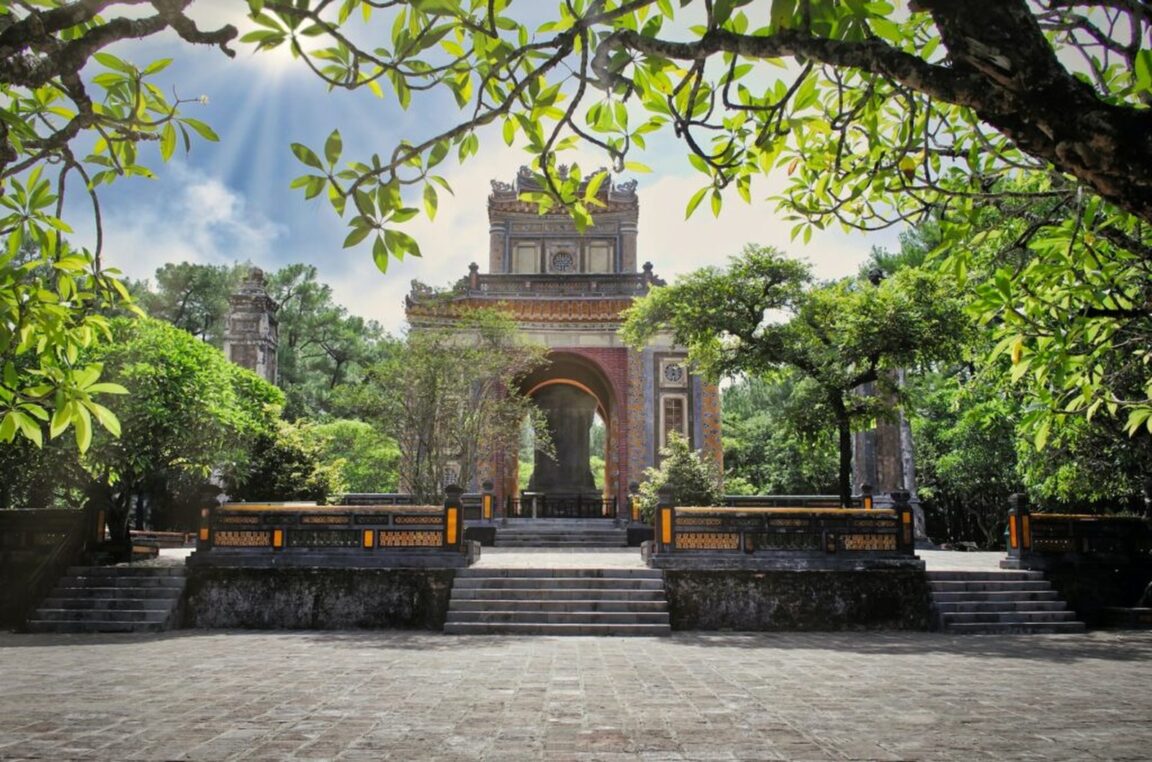
Photo: A royal tomb pavilion at Hue, framed by frangipani trees, on the imperial tomb route along the Perfume River. Photo by Gian Reto Tarnutzer on Unsplash, Unsplash License. Facts checked 16 November 2026 against Hue Monuments Conservation Centre ticket prices and site information; prices, hours and boat operations change, so confirm before you travel.