 LeVar Thomas
Bukhara is the Silk Road city to slow down for: a UNESCO listed historic centre, inscribed in 1993, where a 45.6 metre brick minaret built in 1127 still marks the skyline, covered trading domes still sell carpets and ceramics, and the day naturally ends beside the still water of Lyab-i Hauz as the light turns gold on the madrasa facades. Give it at least two full days. One day covers the headline monuments in a rush. Two days let the city do what it has done for travellers for centuries, which is to move at caravan pace, in shade, with tea appearing at exactly the right moments.
Quick Facts
- Where: Bukhara Region, south central Uzbekistan, west of Samarkand on the Zarafshan river plain
- UNESCO status: Historic Centre of Bukhara, inscribed on the World Heritage List in 1993
- Signature sight: The Kalyan Minaret, built in 1127, 45.6 metres tall, part of the Po-i-Kalyan complex
- Oldest layers: The Ark fortress site has occupation layers reaching back to at least the 4th century AD
- Evening centre: Lyab-i Hauz, the surviving great pool, ringed by madrasas and mulberry trees
- Do not miss: The three trading domes, the Samanid Mausoleum and a plov lunch
- How long: Two days minimum, three if Samarkand is not also on the route
- Entry planning: Many nationalities now enter Uzbekistan visa free for set periods; check the current rule for your passport before booking, and see our explainer on Uzbekistan’s visa free entry change for US citizens
Why Bukhara feels different from Samarkand
Samarkand dazzles with scale. Bukhara works differently. Its monuments are woven into a living old town of mud brick lanes, courtyard houses and neighbourhood mosques, so the history is not fenced off in a monumental zone but wrapped around daily life. UNESCO describes Bukhara as the most complete and unspoiled example of a medieval Central Asian town to have preserved its urban fabric, with around 140 protected historic monuments in the centre. That completeness is the point. A morning walk passes a 10th century mausoleum, a working mosque, a school, a bakery and a silk workshop without ever leaving streets that traders walked when the city was one of the great exchange points between China, Persia and the steppe.
The city also rewards a second look at ground level. Look for the carved wooden doors, the domed roofs of bathhouses, and the way every major building is oriented to catch or avoid the desert sun. Bukhara sits at the edge of the Kyzyl Kum desert, and its architecture is climate engineering as much as decoration: thick walls, shaded arcades, deep iwans and those famous domes, which shed heat and echo beautifully.
The Kalyan Minaret and the Po-i-Kalyan complex
Start at Po-i-Kalyan, the ensemble everyone photographs and nobody regrets seeing first. The Kalyan Minaret, commissioned by the Karakhanid ruler Arslan Khan and completed in 1127, rises 45.6 metres in tapering bands of patterned baked brick, each band different, with a lantern gallery at the top. It served as a call to prayer tower, a watchtower and a landmark for caravans crossing the flat desert, visible long before the city walls. Climbing it is not currently permitted for general visitors, so give it time from the square instead, where the full geometry reads best.
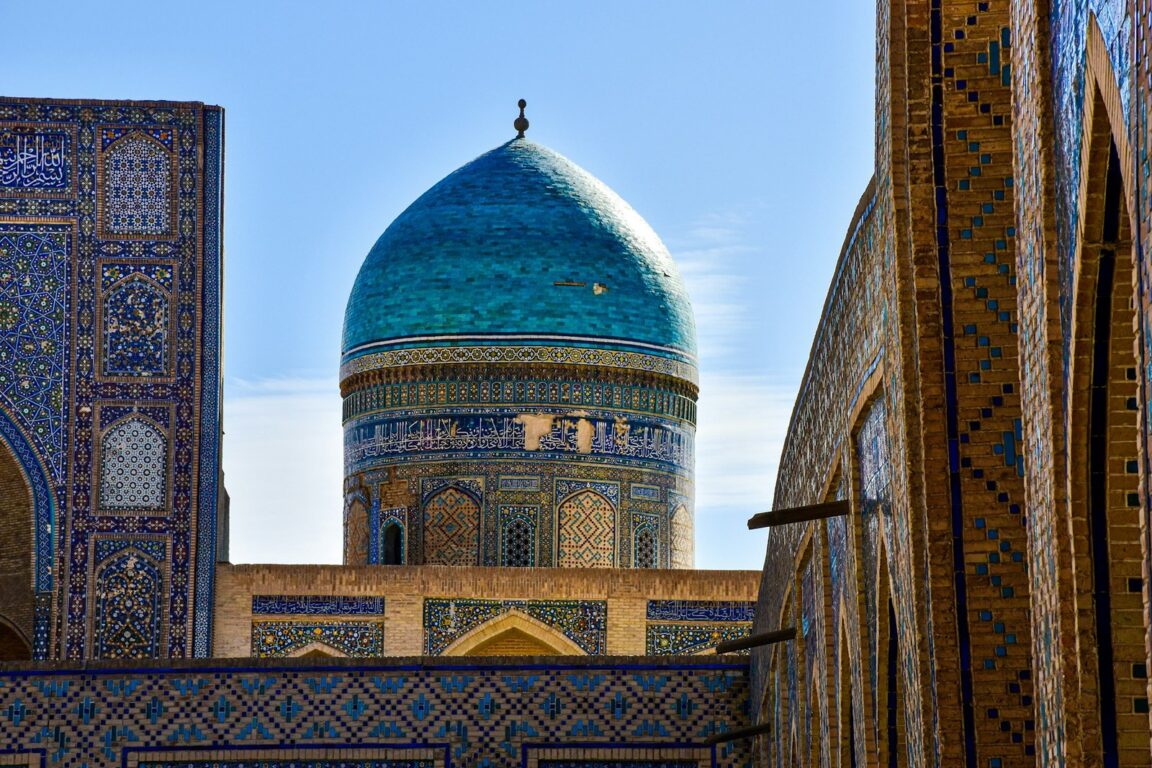
Beside it, the Kalyan Mosque is one of the largest mosques in Central Asia, traditionally said to hold up to 10,000 worshippers, its courtyard roofed edges carried on hundreds of domed bays, 288 by the usual count. Facing it across the square, the Mir-i-Arab Madrasa, with its twin turquoise domes, is still a working religious school, which is why visitors admire it from outside. Come twice if you can: once in the morning for the brickwork detail, and once near sunset, when the whole ensemble turns the colour of honey and the square fills with families.
The trading domes: shopping as the city was designed
Bukhara’s covered bazaars are not a tourist add-on. They are the city’s original commercial infrastructure, built in the 16th century at the crossroads of trade routes, where domed halls kept goods and merchants cool. Three main domes survive in use. Toqi Zargaron, the jewellers dome, stands near Po-i-Kalyan. Toqi Telpak Furushon offers hats, scarves and ceramics. Toqi Sarrafon, the money changers dome, sits near Lyab-i Hauz and once handled currency exchange for half a continent.
Today the stalls sell ikat silk, suzani embroidery, ceramics from Gijduvan, miniature paintings, spices and knives from Chust. Bargaining is expected and unhurried; a first price is an opening, not a verdict. Quality varies enormously within a single dome, so handle pieces, check stitching and seams, and compare two or three stalls before buying anything expensive. For a sense of how Bukhara fits a wider Central Asia route, pair it with our guide to Almaty, Kazakhstan, the region’s other great caravan crossroads turned modern city.
The Ark: the fortress that ruled the city
At the western edge of the old centre, the Ark is Bukhara’s citadel, a vast sloping walled fortress on an artificial mound. The site is the oldest in the city, with layers reaching back at least to the 4th century AD, and it served as the fortified residence of Bukhara’s rulers until 1920, when Red Army forces bombarded it during the fall of the emirate. Much was ruined, but the entrance portal, coronation hall and mosque survive, along with museum rooms covering the emirate period.
Walk up the ramp slowly. The view back across the rooftops to the Kalyan Minaret is one of the best orientation points in the city, and it makes Bukhara’s layout suddenly legible: fortress, monumental centre, trading domes, pool, and the dense residential quarters spreading between them. Opposite the Ark, the Bolo Hauz Mosque, with its slender painted wooden columns reflected in its own pool, is the emir’s former Friday mosque and one of the most graceful buildings in the city.
Lyab-i Hauz and the evening rhythm
If Po-i-Kalyan is Bukhara’s monument, Lyab-i Hauz is its living room. The name means by the pool, and the pool in question, built in the 17th century, is one of the few great hauzes to survive; most were filled in during the Soviet era on public health grounds. Around it stand the Kukeldash Madrasa, among the largest in Central Asia, and the Nadir Devanbegi Madrasa, built in 1622 as a caravanserai and famously converted to a madrasa after the khan addressed it as one at its opening.
The practical advice is simple: be here at dusk. Cafes set tables under the ancient mulberry trees, children feed the ducks, chess games start, and the madrasa facades light up. Order tea, then order plov if you have not yet had it that day. Bukhara evenings are not nightlife in the club sense. They are better than that: slow, sociable and outdoors.
Plov and what to eat
The board title ends with plov for a reason. Uzbekistan’s signature dish of rice, carrots, onions, oil and meat, cooked in a great kazan cauldron, is a lunch institution; plov centres serve it from late morning and often sell out by mid afternoon, so plan it as lunch, never dinner. Bukhara’s version tends to be richer and darker than Tashkent’s, with local yellow carrots at its heart. Beyond plov, look for shashlik skewers, lagman noodles, samsa pastries from clay tandoor ovens, and non, the round stamped bread sold hot from bakeries all over the old town. Green tea accompanies everything, poured small and often.
The quieter sights worth the walk
Two outliers deserve the short walks they require. The Samanid Mausoleum, in a park west of the Ark, dates from the late 9th to 10th century and is one of the oldest surviving monuments of Islamic architecture in Central Asia, its baked brick walls woven into patterns that shift with the sun. It is small, perfect and unlike anything else in the city. East of the centre, Chor Minor, built in 1807, is a gatehouse topped with four turquoise capped towers, charming, eccentric and a good excuse to explore the residential lanes most visitors never enter.
How to plan your days
Day one: Po-i-Kalyan in the morning, the trading domes before lunch, plov, a rest in the heat of the day, then the Ark and Bolo Hauz in the late afternoon and Lyab-i Hauz at dusk. Day two: the Samanid Mausoleum and Chor Minor, a workshop or museum in the morning, the domes again for serious shopping, and a second evening by the pool. Bukhara is compact enough to walk almost everywhere in the centre, and walking is the point; the lanes between the monuments are half the experience. High speed Afrosiyob trains link Bukhara with Samarkand and Tashkent, making it an easy middle stop on the classic Silk Road triangle with Khiva.
Frequently Asked Questions
How many days do you need in Bukhara?
Two full days is the honest minimum. One day covers Po-i-Kalyan, the domes, the Ark and Lyab-i Hauz at a push, but leaves no time for the Samanid Mausoleum, Chor Minor or simply sitting by the pool, which is where the city reveals itself.
Can you climb the Kalyan Minaret?
No. Climbing the minaret is not currently permitted for general visitors. The best views of it are from the Po-i-Kalyan square, and the best views over the city are from the Ark fortress ramparts.
When is the best time of year to visit Bukhara?
Spring and autumn are the comfortable seasons, when days are warm and evenings cool. Summer brings serious desert heat, so sightseeing shifts to early mornings and evenings, with long shaded lunches in between.
What should you buy in the trading domes?
Ikat silk scarves, suzani embroidery, Gijduvan ceramics and miniature paintings are the classic buys. Compare several stalls, check workmanship closely and bargain politely; the domes reward patience.
Is Bukhara walkable?
Yes. The historic centre is compact and flat, and nearly every sight in this guide sits within an easy walk of Lyab-i Hauz. Comfortable shoes matter more than transport.