 Kwame Mensah
Luderitz is the Namibian coast at its most improbable: a German colonial port town of pastel art nouveau facades wedged between the Namib Desert and the cold Atlantic, 10 kilometres from Kolmanskop, the abandoned diamond town where dunes now pour through ballroom windows. Come for the ghost town, stay for the town itself, and build the trip around two practical rules. Kolmanskop is inside the restricted diamond area, so every visitor needs a permit, and photographers who want the empty early light pay for a separate photography permit that allows access outside standard hours. Confirm current fees and hours locally before you go, because they change.
Quick Facts
- Where: Southern Namibia, on the Atlantic coast at the edge of the Namib Desert and the former Sperrgebiet restricted diamond area
- Headline excursion: Kolmanskop ghost town, about 10 kilometres inland from Luderitz
- Kolmanskop timeline: Diamond found in 1908, town flourished, then abandoned, with the last residents leaving in 1956
- Access rule: Permit required for Kolmanskop; a separate photography permit gives access from sunrise to sunset
- In town: German colonial and art nouveau streets, the Felsenkirche church on Diamond Hill and the Goerke Haus
- Wildlife detour: The feral desert horses of the Garub pan, west of Aus on the road in
- How long: Two nights minimum, so Kolmanskop can be done in good morning light without rushing the drive
- Driving context: Long desert distances rule Namibia trips; plan fuel and daylight using our Namibia self drive packing guide
A port the desert tried to keep secret
Luderitz exists because of a sheltered bay on an otherwise brutal coast, and it grew because of what was found in the sand behind it. When railway worker Zacharias Lewala picked up a diamond near Kolmanskop in 1908, the German colonial administration declared the surrounding desert the Sperrgebiet, a forbidden zone, and a diamond rush built both the town at Kolmanskop and much of the Luderitz that visitors see today. The rush money is still readable in the streetscape: steep gabled houses, bay windows and the Goerke Haus, a diamond magnate’s villa on Diamond Hill, all built to face down the wind with European confidence in a place that regularly sandblasts paint.
The wind is part of the destination. Luderitz is famous for it, especially in the afternoons, and it shapes every plan: mornings for excursions and photography, afternoons for museums, cafes and the harbour. The town is small enough to walk, with a working fishing port, flamingos on the lagoon shallows, and boat trips out to see the African penguin colony on Halifax Island.
Kolmanskop: the town the dunes are eating
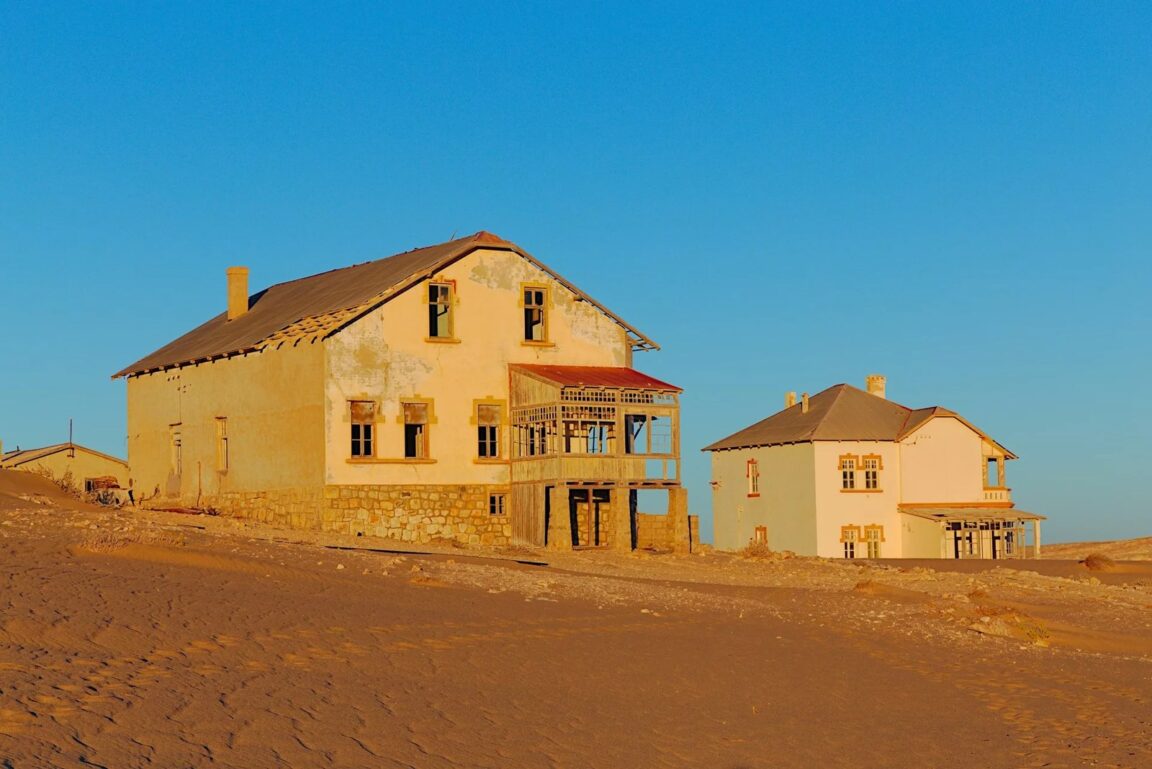
Kolmanskop is the reason most travellers come, and it earns the trip. In its brief prime the town had a hospital, a ballroom, a school, a casino, an ice factory and, famously, the first X-ray station in the southern hemisphere, installed as much to catch diamond smugglers as to treat patients. Around 1,200 people lived here at its height, in substantial German style houses with skittle alleys and a tram line, in the middle of one of the driest deserts on earth.
Then richer diamond fields were found further south near Oranjemund, the centre of gravity moved, and the town emptied, finally abandoned in 1956. Since then the Namib has been moving back in, one dune at a time. Sand pours through doorways, fills corridors to the waist and buries staircases, while paint peels in colours that photographers cross oceans for. The site is managed as a tourist attraction by Namdeb, the diamond company, and guided tours run in the mornings; independent wandering within the permitted area is the real pleasure once the tour has given you the story.
Permits and photography: read this before you drive out
Kolmanskop sits inside the restricted diamond area, so nobody simply walks in. Standard permits are sold in Luderitz, including through local tour offices, and at the gate; guided tours are included in the standard morning visiting pattern. Photographers should know about the second tier: a photography permit, bought in advance, allows entry from sunrise to sunset, which means empty rooms, long shadows and the dunes lit from the side instead of overhead. Published fees differ between sources and change over time, so treat any figure you read, including in older guides, as indicative only and confirm the current standard and photography permit prices in Luderitz the day before. Tripods and commercial shoots are separate matters again; commercial work needs its own permission.
One more honesty note: brown hyenas den around the town and their tracks cross the sand overnight, snakes shelter in shaded corners, and the buildings are fragile. Stay off unstable structures, watch where you put your hands and feet, and leave every artefact exactly where it lies.
The town itself: a slow afternoon circuit
Back in Luderitz, give the streets their own half day. Start at the Felsenkirche, the church on the rock on Diamond Hill, built in 1912, whose stained glass and hilltop position make it the town’s emblem, then walk down through the colonial streets to the waterfront. The Goerke Haus, completed in 1911 for diamond company manager Hans Goerke, is the grandest of the merchant houses and opens for visits on set days. The old railway station, the Woermann Haus with its tower, and the bright facades along Bismarck Street fill in the picture of a town built fast, rich and far from home.
Pair the history with the harbour: Luderitz is a working fishing and oyster town, and its seafood, especially rock lobster in season and oysters, is a genuine highlight rather than a consolation prize. Boat trips run to Halifax Island for the penguins and to Diaz Point, where the Portuguese navigator Bartolomeu Dias erected a stone cross in 1488, with a replica standing on the windy headland today. Our guide to Swakopmund, Namibia’s other German era coastal town, makes the natural companion read, and the two towns bookend a southern Namibia loop well.
The wild horses of Garub and the road in
Almost every visitor arrives by road from Aus, and the drive holds one of Namibia’s strangest sights. At the Garub pan, roughly 20 kilometres west of Aus beside the B4, a herd of feral desert horses, usually numbered at somewhere between 100 and 200 animals, survives around an artificial waterhole maintained for them, with a viewing shelter set back from the pan. Their origins are debated, with the most common account tracing them to German colonial era stock and a stud farm abandoned during the First World War. Whatever the truth, they have adapted to the desert over a century, and seeing horses standing in that emptiness, with the dunes behind them, is one of the signature images of the south.
Stop, but manage expectations: the horses come to water on their own schedule, mornings and late afternoons are the best bets, and a telephoto lens earns its weight here. From Garub the road runs on through pure desert to Kolmanskop and Luderitz, so the horses, the ghost town and the coast form one clean line of travel with no backtracking.
How to plan your days
Day one: arrive via Aus and Garub, walk the town in the late afternoon, seafood dinner. Day two: Kolmanskop first thing, on a photography permit if images matter to you or with the morning tour if they do not, then the town circuit and a harbour boat trip if the wind allows. A third day buys a Diaz Point drive and a slower pace. Windhoek, the usual gateway, is a full day’s drive or a short flight away; our Windhoek travel guide covers the capital end of the journey. Book Kolmanskop permits and any photography access before you commit to dawn timings, and never schedule the ghost town for a departure afternoon: the light, the wind and the distances all argue for a morning.
Frequently Asked Questions
Do you need a permit for Kolmanskop?
Yes. Kolmanskop lies inside the restricted diamond area, the Sperrgebiet, and every visitor needs a permit. Standard permits are sold in Luderitz and at the gate. A separate photography permit, arranged in advance, allows access from sunrise to sunset.
How much are Kolmanskop permits?
Fees are revised over time and published figures vary between sources, so confirm the current standard and photography permit prices locally in Luderitz before you visit rather than budgeting from an old guide or blog post.
How far is Kolmanskop from Luderitz?
About 10 kilometres inland, roughly a 15 minute drive on the B4. It is an easy morning excursion from town, which is why staying in Luderitz rather than day tripping from further afield is the right call.
When was Kolmanskop abandoned?
The town declined after richer diamond fields were developed further south, and the last residents left in 1956. The hospital had already closed and moved to Luderitz in the 1940s as the population drained away.
Can you see the wild horses at Garub year round?
The herd lives at the pan year round and a waterhole is maintained for them, but sightings are never guaranteed. Early morning and late afternoon visits give the best odds.