 Elena Vasquez
Trogir is the easiest UNESCO old town in Croatia to add to a trip and one of the hardest to leave after an hour: a complete medieval town on a small island, roughly 500 metres long, listed by UNESCO in 1997, sitting about 27 kilometres west of Split and only a few minutes from Split Airport. Its cathedral portal, carved by Master Radovan in 1240, is considered the finest Romanesque sculpture in Croatia, its Venetian fortress guards the western tip, and unlike a museum town it still has residents, markets, laundry lines and marina life woven through the lanes. Stay overnight if you can. Day trippers see the stones; overnight guests get the evenings, when the riva belongs to the town again.
Quick Facts
- Where: Dalmatian coast, Croatia, on a small island between the mainland and the larger island of Ciovo, joined by bridges
- UNESCO status: Historic City of Trogir, inscribed on the World Heritage List in 1997 for its remarkable urban continuity
- Signature sight: The Radovan Portal of the Cathedral of St Lawrence, carved and signed by Master Radovan in 1240
- Fortress: Kamerlengo Fortress, built by Venice in the 15th century at the western end of the island
- Distances: About 27 kilometres from Split, and roughly 5 to 7 kilometres from Split Airport
- Old town entry: Free; you simply walk across the bridge. Individual sights charge their own entry
- How long: A full day covers it; one night is better
- Island pairing: Trogir combines naturally with Hvar; see our archive guide to the Isle of Hvar on the Dalmatian coast
A museum with residents: what UNESCO actually listed
UNESCO’s wording for Trogir is worth understanding, because it explains the town’s feel. The listing praises a remarkable example of urban continuity: the street plan of a Hellenistic founded settlement, Tragurion, still readable beneath Romanesque churches, Gothic and Renaissance palaces and Baroque facades, each era building inside the last one’s footprint rather than replacing it. The result is an old town that was never frozen. Families live above 13th century arcades, children cross a main square laid out in antiquity, and the morning market operates in the shadow of walls that have been repaired, adapted and inhabited for more than two thousand years.
That lived-in quality is the honest difference between Trogir and Croatia’s more polished showpieces. It is smaller than Split and far smaller than Dubrovnik, its lanes are genuinely residential once you step two streets back from the waterfront, and its scale means the whole historic core can be walked end to end in about ten minutes, then rewalked slowly for a day.
The cathedral and the Radovan Portal
The Cathedral of St Lawrence stands on the main square, on the site of a church destroyed in the medieval period, and its construction ran from the 13th century across roughly three hundred years, which is why Romanesque, Gothic and Renaissance work stacks up in a single building. None of it outshines the west door. The Radovan Portal, carved in 1240 and signed by its maker, Master Radovan, frames the entrance with Adam and Eve standing on lions, stacked columns of saints and apostles, scenes of daily medieval life, hunting, farming and the months of the year, all in stone that still reads clearly after nearly eight centuries.
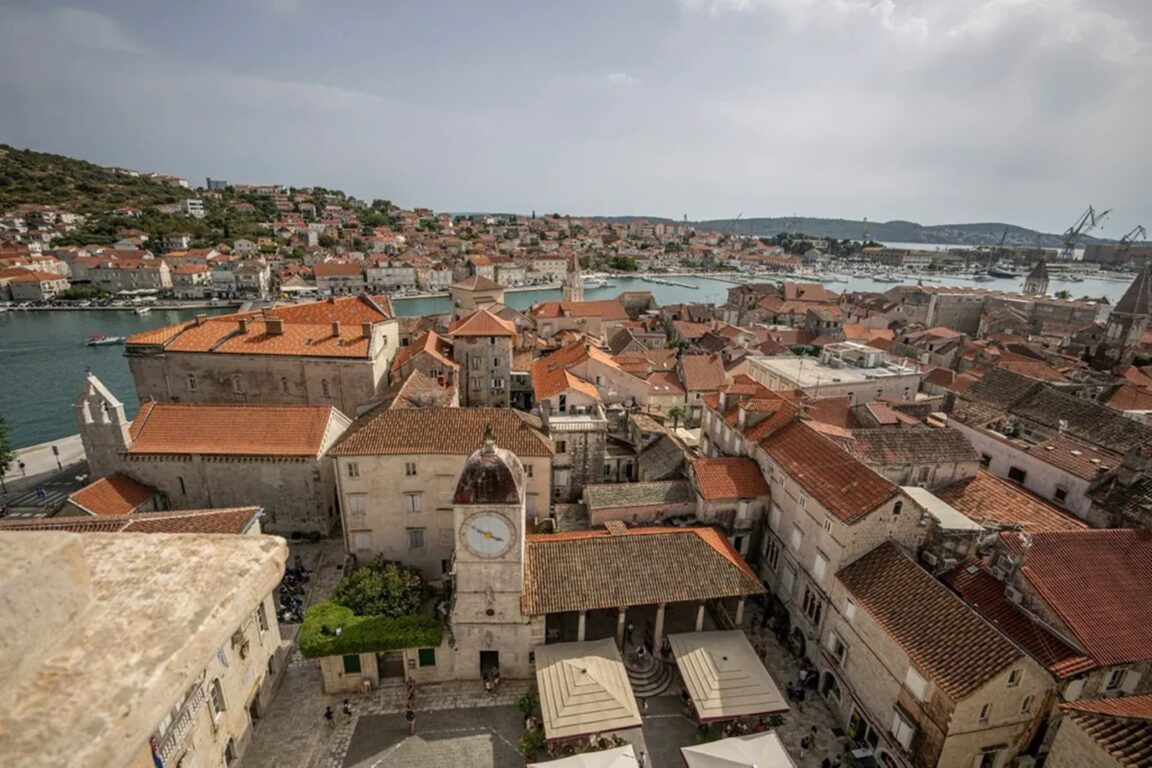
Give the portal ten unhurried minutes before going inside; it is a sermon, a calendar and a social history in one doorway. Inside, look for the Renaissance Chapel of St John of Trogir, the town’s patron, and the treasury. Then climb the bell tower, about 47 metres high, in its stages of Romanesque, Gothic and Renaissance construction, for the definitive view: red roofs, the Ciovo channel, the marina and the mainland hills in one turn.
Kamerlengo Fortress and the riva
At the western tip of the island, Kamerlengo Fortress was built by the Republic of Venice after it took Trogir in 1420, named for the camerlengo, the Venetian financial official. Its great polygonal tower and sea walls were a statement as much as a defence: Venice intended to stay, and did, for nearly four centuries until 1797. Today the fortress is climbed for views rather than defence, across the harbour to Ciovo and back along the whole waterfront, and in summer its courtyard hosts open air concerts and cinema, one of the best settings for an evening event anywhere on this coast.
The walk there along the riva, the palm lined waterfront promenade, is Trogir’s daily theatre: fishing boats, excursion boats, superyachts in high summer, cafe tables and the evening stroll. The smaller Fortress of St Mark at the other end of the waterfront and the gloriette built in the Napoleonic era complete the circuit.
The lanes, palaces and loggia
Between the cathedral and the fortress, the grid does the work. On the main square, the town loggia and clock tower face the cathedral; the loggia’s reliefs include work attributed to the Renaissance sculptor Nikola Firentinac. Opposite the cathedral stands the Cipiko Palace, a Venetian Gothic complex of two palaces joined across the street, home to a humanist family whose library and circle made Trogir a small Renaissance intellectual centre. The land gate, topped by the town’s patron saint, the north gate, the Benedictine convent of St Nicholas with its Greek Kairos relief, a 4th century BC carving of the god of the opportune moment, and a dozen small churches fill the gaps between cafes.
None of this needs a route. The island is too small to get lost in for long, and the correct technique is to wander, double back, and take coffee whenever a square opens up. If you enjoy small UNESCO towns that reward exactly this pace, our guide to Cesky Krumlov in Czechia is the Central European counterpart.
Beaches, Ciovo and using Trogir as a base
Cross the bridge to Ciovo and the town turns into a small resort coast: Okrug Gornji’s long beach strip, known locally as Copacabana, is the busy option, while the coves further along the island’s south coast are quieter. Boats run from the riva to the Blue Lagoon between Ciovo and the Drvenik islands for swimming days. As a base, Trogir has a real strategic argument: it is closer to Split Airport than Split itself, it has the marina and excursion boats, Krka National Park and Sibenik are easy drives north, and Split’s Diocletian Palace is under an hour by bus or boat for a day trip, letting you sleep somewhere calmer and cheaper than the palace district in peak season.
The trade-off is nightlife and choice. Trogir evenings are promenade, dinner and a concert in the fortress, not clubs, and the restaurant scene, while strong on Dalmatian classics, grilled fish, peka dishes cooked under an iron bell, black risotto and local Trogir rafioli pastries, is compact. For many travellers that is precisely the appeal.
How to plan your visit
Arrive, cross the bridge and do the cathedral and portal first, while your eye is fresh, then the loggia and Cipiko Palace on the same square. Lunch in the lanes. Kamerlengo and the riva in the late afternoon, when the light is on the stone and the heat is off it, then stay for the evening if you possibly can; the town changes character completely after the day boats leave. If Trogir is a first or last night near the airport, it still works: the transfer is short enough that a half day here beats an airport hotel by a distance no star rating can close.
Frequently Asked Questions
Is Trogir a UNESCO World Heritage Site?
Yes. The Historic City of Trogir was inscribed in 1997, recognised as a remarkable example of urban continuity, with a Hellenistic street plan still visible beneath its Romanesque, Gothic, Renaissance and Baroque buildings.
How far is Trogir from Split and Split Airport?
About 27 kilometres west of Split, roughly 30 to 40 minutes by road. Split Airport is much closer, around 5 to 7 kilometres away, which makes Trogir an ideal first or last night of a Dalmatian trip.
What is the Radovan Portal?
The west portal of the Cathedral of St Lawrence, carved and signed by Master Radovan in 1240. Its sculptures of Adam and Eve, saints, and scenes of medieval daily life make it the most celebrated piece of Romanesque sculpture in Croatia.
How long do you need in Trogir?
The sights fit into one full day, but one overnight stay is the better plan. Evenings on the riva and in Kamerlengo Fortress, after the day trip crowds leave, are the best hours the town offers.
Is there an entry fee for the old town?
No. The old town is a living town and entry is free; you walk in across the bridge. The cathedral, bell tower and Kamerlengo Fortress charge their own modest entry fees, which vary by season.