 James Wolfe
Go beyond the Altes Rathaus postcard by climbing: Bamberg’s Bergstadt, the City on the Hills, rises west of the river in a tangle of lanes that link the four towered cathedral, the old bishops’ courtyard and the rose garden view, then keep going, up the Altenburger hill to the Altenburg castle and out, on the flat side of town, into the market gardeners’ district where Bamberg has grown vegetables since the 14th century. That climb, and the gardeners’ flatlands as its counterweight, are the Bamberg most day visitors never reach, because the island district and its famous town hall hold them at river level. Start at the Rathaus by all means, then leave it behind: cathedral hill first, Michaelsberg and the brewery lanes second, Altenburg for the view, and the Gartnerstadt, the gardeners’ district, to finish with the city’s living, edible heritage.
Quick Facts
- City: Bamberg, Upper Franconia, Bavaria, Germany, on the Regnitz river near its meeting with the Main, about 60 km north of Nuremberg
- Status: The Town of Bamberg is a UNESCO World Heritage site, inscribed in 1993, made of three parts: the City on the Hills, the Island District and the Market Gardeners’ District
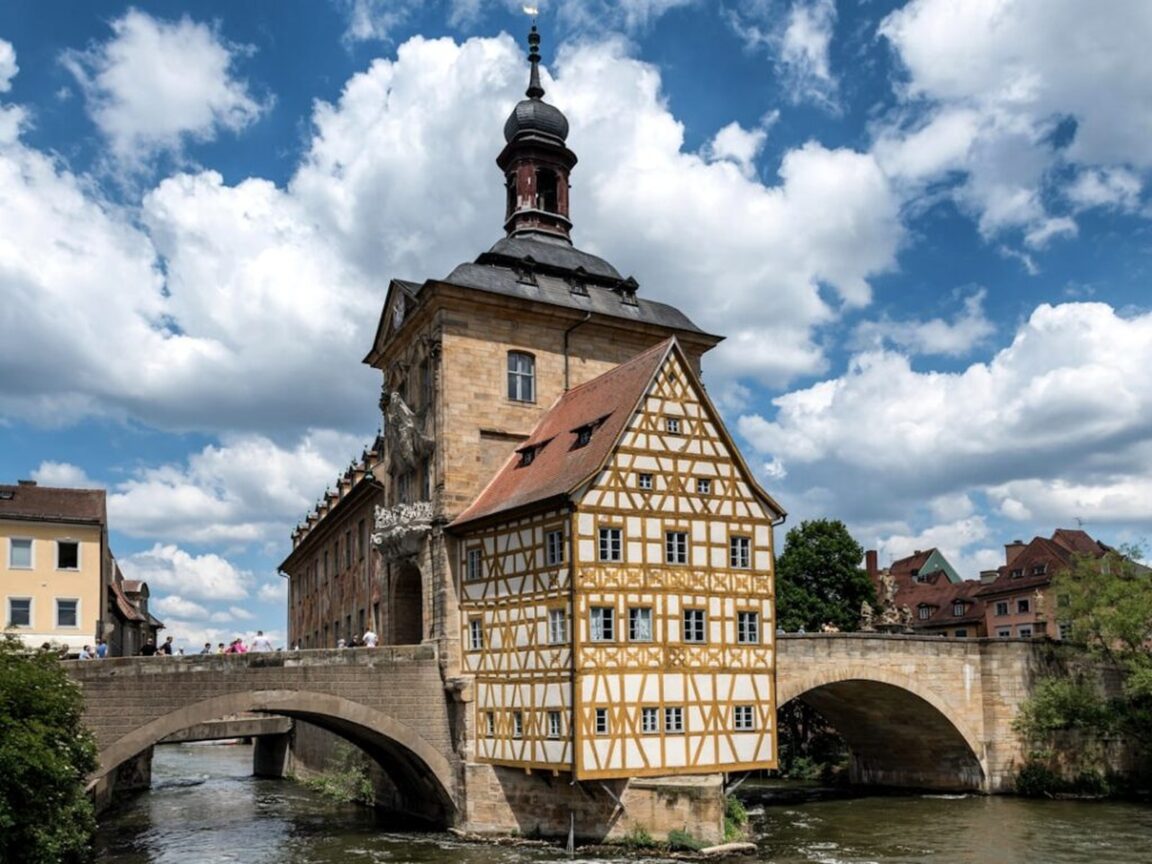
- The famous sight: The Altes Rathaus, the old town hall built on an artificial island in the Regnitz, the starting point this route deliberately goes beyond
- Cathedral: Bamberg Cathedral, the four towered Romanesque and early Gothic church consecrated in 1237, holding the Bamberg Horseman and the tomb of Pope Clement II, the only papal tomb north of the Alps
- Altenburg: The castle on the highest of Bamberg’s seven hills, first mentioned in 1109, residence of Bamberg’s bishops from 1251 to 1553, now open to visitors with a restaurant
- Gardeners: The Market Gardeners’ District, cultivated since the Middle Ages, records of vegetable growing from the 14th century; Bamberg’s gardening tradition was inscribed on Bavaria’s intangible heritage inventory in 2014 and Germany’s national inventory in 2016
- Beer: Rauchbier, smoked beer from malt dried over beechwood fires, poured at Schlenkerla, brewing since 1405, and at Spezial, among a cluster of historic Bamberg breweries
How do you read the Bergstadt lanes, hill by hill?
Bamberg grew over seven hills, each crowned by a church, which is why it is called the Franconian Rome, and the Bergstadt is that hill town proper: the ecclesiastical and princely Bamberg of cathedral, courts and monasteries, built in stone above the merchants’ island and the gardeners’ flatland. The lanes are the substance of it. They are narrow, cobbled and steep in places, connecting Domplatz, the cathedral square, with the Michaelsberg monastery hill, the Kaulberg lanes and the upper parishes, and they reward slow, upward wandering rather than a checklist march. Houses lean in, small squares open without warning, and every third corner frames the cathedral towers or the red rooftops falling to the Regnitz.
Work the hill in one direction to avoid re climbing it. Start at river level in the island district, cross to the Sandgebiet at the foot of the hill, then climb the Kaulberg lanes to Domplatz. From the square, the Michaelsberg lane continues the climb to the former Benedictine monastery and its views, and the lanes down the far side return you towards the gardeners’ quarter. Walkers who pace it that way, with the cathedral in the middle of the route rather than at its end, understand Bamberg as a vertical city, which is the entire point of the Bergstadt. The town survived the Second World War with one of Germany’s largest intact old town centres, more than a thousand listed buildings in the usual count, so the lanes are original fabric, not reconstruction.
What matters on Domplatz, beyond the cathedral photograph?
Three buildings, read as a set. The cathedral itself, consecrated in 1237 and the third church on this site since 1002, is late Romanesque shading into early Gothic, with four towers and, inside, two of Germany’s great medieval sculptures in one visit: the Bamberg Horseman, whose identity is still debated, and the carved tomb of Emperor Henry II and Kunigunde by Tilman Riemenschneider. The west choir holds the tomb of Pope Clement II, who died in 1047, the only papal tomb north of the Alps. Next door, the Alte Hofhaltung, the old court, gives you the half timbered courtyard of the bishops’ earlier residence, and across the square the Neue Residenz, the later palace, gives you the baroque answer, with state rooms and, behind it, the rose garden.
The rose garden is the Bergstadt’s essential pause, and the one most Rathaus bound visitors miss entirely. From its terrace the whole argument of this guide is visible at once: cathedral towers behind you, island district and Rathaus below, gardeners’ green flatland beyond the river, and the Altenburg on its hill in the distance, marking where the route goes next. It is also the practical rest stop of the climb, with the view doing the work that a cafe stop does in flatter towns. Travellers building a wider German and Czech old town route will find the same hill town logic, at smaller scale, in our guide to Cesky Krumlov, Czechia.
Why climb on to the Altenburg?
Because it completes the hill system and pays the best view in Bamberg. The Altenburg sits on the highest of the seven hills, was mentioned for the first time in 1109, and served between 1251 and 1553 as the residence of Bamberg’s bishops, before destruction in 1553, a long decay, a spell as a prison and an eventual rescue and repair in private hands in the early 1800s. Its round keep, nicknamed for its barrel shape, is the landmark visible from half the city. Today the castle is open for public visits and again houses a restaurant, so the climb can end with a meal at the top of Bamberg rather than a retreat back down it.
Set expectations honestly. The Altenburg is a rewarding ruin turned landmark, not a furnished palace on the scale of the Neue Residenz, and the walk up, whether by the lanes and paths from the Bergstadt or by bus and a shorter climb, is a genuine ascent that takes time out of a day trip. That is precisely why it filters for the travellers this guide is written for. Day visitors who stay for one night can put the Altenburg in the late afternoon, take the view in the best light, eat at the top and walk down through the lanes as the cathedral floodlights come on, which is as good an evening as Bamberg offers.
What are the brewery taprooms beyond the Rathaus?
Start with the smoke. Bamberg’s signature is Rauchbier, beer made from malt dried over beechwood fires, which gives it a distinct smoky flavour that locals cheerfully warn takes a few glasses to convert the sceptical. Schlenkerla, the historic brewpub on Dominikanerstrasse below the cathedral, has been serving since 1405 and pours its Aecht Schlenkerla Rauchbier in vaulted rooms that fill with locals as much as visitors; order the slow roasted pork shoulder, the Schaufele, alongside it. Spezial, across the river, is the other classic smoked beer address, mellower in style, and the pair together make the essential comparison tasting of the trip.
Beyond those two, Bamberg holds a cluster of historic breweries and taprooms within walking distance, more per head than any comparably sized German town, many of them in the Bergstadt lanes and the Sandgebiet at the hill’s foot. The Franconian brewery museum, housed in the old Michaelsberg monastery brewery, fills in the 900 year story for travellers who want it. The practical rule is the same as in the lanes: one hill, one direction, taprooms as the descent. Cathedral in the afternoon, Schlenkerla at the foot of the hill in the evening, and no attempt to do the Altenburg climb after the second smoked beer. For a contrasting Austrian take on the brewery and palace city, see our itinerary for 3 days in Vienna.
Why end in the gardeners’ district?
Because the Gartnerstadt is Bamberg’s third UNESCO component and its most original: a working market gardeners’ quarter of wide, open plots and gardeners’ houses inside a world heritage city, cultivated since the Middle Ages, with records of vegetables and herbs grown here from the 14th century on the fertile alluvial soil. The gardeners, remembered as onion treaders for their famous Bamberger onion, once exported onions, seeds and liquorice far beyond Franconia, and their tradition was inscribed on Bavaria’s intangible cultural heritage inventory in 2014 and on Germany’s national inventory in 2016. A museum of market gardeners and wine growers, a scenic trail through the quarter and direct sales from the gardens themselves make it visitable without intruding on a working landscape.
It also completes the city’s geography in a way no viewpoint can. From the gardeners’ flat, open plots you look back at the Bergstadt hills and the island between, and Bamberg reads as what it always was: a prince bishops’ hill town, a merchants’ island and a gardeners’ plain, feeding each other. Ending there, with a bag of whatever is in season, is the strongest possible answer to the Rathaus postcard: the famous sight is real, and it is the smallest part of the city.
Frequently Asked Questions
What is the Bergstadt in Bamberg?
It is the City on the Hills, one of the three parts of the UNESCO listed Town of Bamberg alongside the Island District and the Market Gardeners’ District. It holds the cathedral, the old and new bishops’ residences and the monastery hills, linked by the steep cobbled lanes this guide follows.
How do you get to the Altenburg castle?
On foot by the lanes and paths climbing from the Bergstadt, or by bus towards the hill followed by a shorter climb. The castle, first mentioned in 1109 and the bishops’ residence from 1251 to 1553, is open for public visits and houses a restaurant, and its keep gives the widest view over Bamberg.
What is Rauchbier and where should you drink it?
Rauchbier is smoked beer, made from malt dried over beechwood fires, a Bamberg speciality. Drink it at Schlenkerla, serving since 1405 below the cathedral, and at Spezial for the mellower comparison. Expect a pronounced smoky flavour that most drinkers warm to by the second or third glass.
What is special about Bamberg’s gardeners’ district?
It is a working market gardening quarter inside the World Heritage site, cultivated since the Middle Ages and recorded from the 14th century, famous for the Bamberger onion. Its gardening tradition is inscribed on Germany’s national intangible heritage inventory, and a museum and trail make it visitable.
How long do you need for the Bergstadt beyond the Rathaus?
A full day at minimum, and a night in town to do it justice: cathedral hill and Domplatz, the Michaelsberg lanes, the Altenburg climb, an evening taproom and the gardeners’ district each take real time. A half day covers Domplatz and the rose garden only.
When is the best time to visit Bamberg?
May to June and September to early October balance mild climbing weather, working gardens and thinner crowds. Late September adds the Sandkerwa folk festival in the Sandgebiet, lively but busy, while winter visits suit the taprooms and cathedral at the cost of the gardeners’ quarter in full growth.
Photo: The Altes Rathaus, Bamberg’s old town hall on its island in the Regnitz, the famous sight this route starts from and goes beyond. Photo by Wolfgang Weiser on Unsplash, Unsplash License. Facts checked 16 November 2026 against UNESCO, city heritage and brewery sources; confirm castle and museum opening arrangements locally before visiting.