 Jordan Ellis
Three days is the right length for Staunton, and the order matters more than the list. Give the Frontier Culture Museum a full, unhurried second day, because its farmsteads are spread across open ground and reward slow walking. Put a Blackfriars Playhouse performance on your first evening, when the downtown streets around it are at their liveliest, and keep the third day flexible for the Blue Ridge, because Staunton sits within easy reach of both the southern end of Skyline Drive and the northern end of the Blue Ridge Parkway. Book the theatre first, check the museum hours against the season, and the rest of the trip falls into place around those two anchors.
Quick Facts
- Base: Downtown Staunton, Virginia, in the Shenandoah Valley, at the junction of Interstates 81 and 64
- The museum: Frontier Culture Museum, 1290 Richmond Road, the biggest open air living history museum in the Shenandoah Valley, with 11 exhibits on about 200 acres
- Museum hours: 9am to 5pm from 15 March to 1 December, and 10am to 4pm in winter, open seven days a week and 360 days a year, closed on Thanksgiving Day, Christmas Eve, Christmas Day, New Years Eve and New Years Day, per the museum
- Museum admission: Most recently listed at 12 dollars for adults and 7 dollars for children aged 6 to 12, with under 5s free; confirm current prices on the museum site before you go
- The theatre: Blackfriars Playhouse, 10 South Market Street, the American Shakespeare Center home stage and the worlds only re-creation of Shakespeares indoor theatre, with about 300 seats
- Blue Ridge access: Rockfish Gap, above nearby Waynesboro, is the junction of Skyline Drive and the Blue Ridge Parkway, roughly 20 miles east of Staunton
- Arriving without a car: Amtrak Cardinal trains serve Staunton station on the Chicago to New York route, and Shenandoah Valley Airport is the local airfield
- Book first: Blackfriars tickets for weekend performances, then any guided museum tour, which needs a group of more than 15 and more than two weeks notice
Why does Staunton work as a three day base?
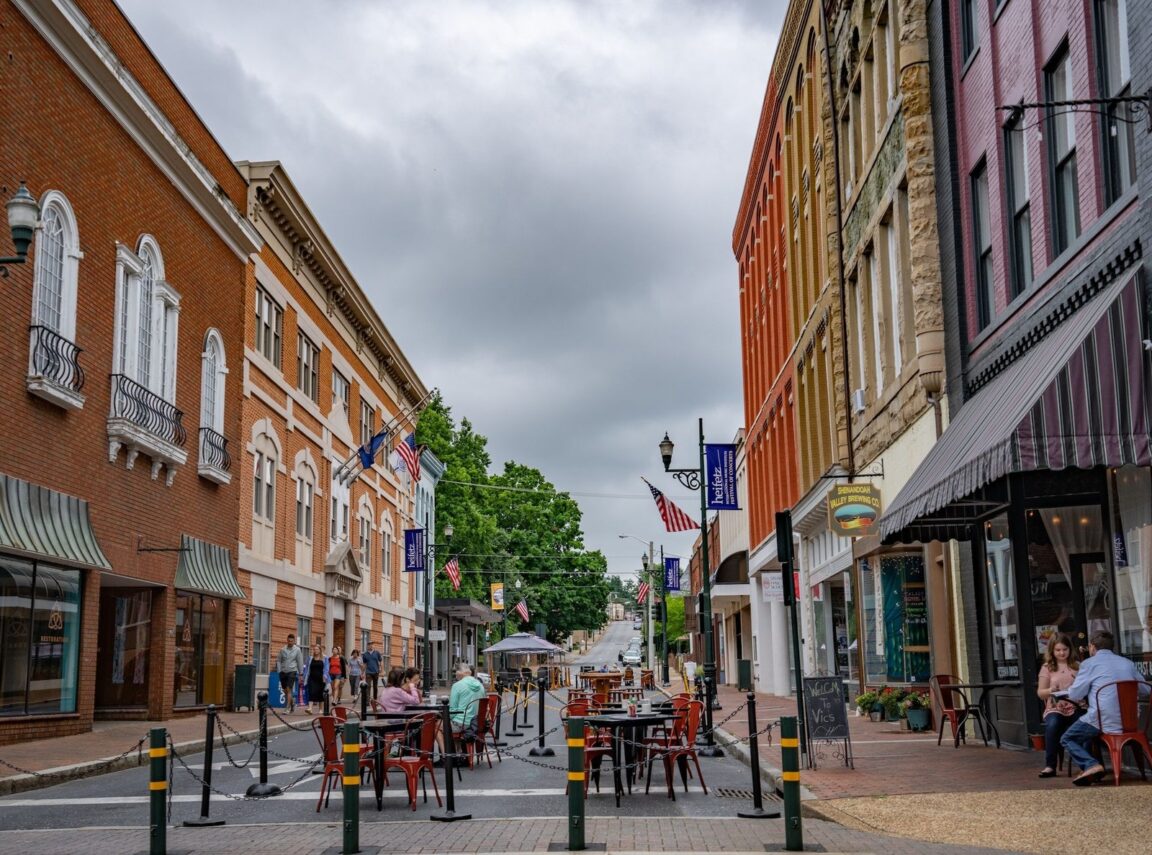
Staunton packs three different trips into one small, walkable city. The first is a preserved Victorian downtown along Beverley Street, with brick commercial blocks, cafes, galleries and the kind of streetscape that the photograph above shows at its best, tables out in the road and flags over the storefronts. The second is a serious history day at the Frontier Culture Museum, where whole farmsteads from England, Ireland, Germany and West Africa stand in fields outside town, matched with the American farms their people went on to build in the valley. The third is a mountain day, because few small towns sit this close to two of Americas great scenic drives at once.
The town is also a presidential birthplace. Woodrow Wilson was born in the Greek Revival manse on North Coalter Street, now the centrepiece of his presidential library and museum, and that visit slots neatly into a downtown day without needing its own expedition. Staunton was settled in the 1730s and named for Lady Rebecca Staunton, and its layered building stock, from early stone houses to the grand Augusta County Courthouse, makes even the walks between sights feel like part of the itinerary rather than dead time.
Day 1: Downtown Staunton and Shakespeare at the Blackfriars
Start on Beverley Street in the morning, when the coffee shops are open and the light is on the brickwork. The downtown historic districts reward a slow loop: the Wharf area by the old rail lines, the Beverley Street shops, and the side streets climbing toward Mary Baldwin University. Sunspots Studios, where glassblowers work in view of visitors, and the Camera Heritage Museum are the two small stops that punch above their size, and both fit a morning without rushing.
Give the Woodrow Wilson Presidential Library the early afternoon. The birthplace house is restored to its 1850s appearance, the museum covers Wilsons life and presidency including his wartime leadership, and the gardens behind the buildings are a quiet place to reset before the evening. It is a contained visit, an hour or two rather than a day, which is exactly what a first day needs.
The evening belongs to the Blackfriars Playhouse. The American Shakespeare Center performs in a re-creation of Shakespeares own indoor theatre, and the house style is the point: the lights stay up, the actors share the room with the audience, a limited number of stools sit on the stage itself, and there are no microphones or recorded sound. Productions run in repertory through the year, mixing Shakespeare with other classics, so on a three day trip you may have a choice of two or three titles. Book the performance before you book anything else on this itinerary, choose centre seats rather than stage stools for a first visit, and eat early on Beverley Street, because the streets empty quickly after curtain up and most kitchens wind down while the play is on.
Day 2: The Frontier Culture Museum, given its full weight
The Frontier Culture Museum is the reason this itinerary gives Staunton three days instead of two. The museum tells the story of the Shenandoah Valley through the people who came to it, and it does so with real buildings: farmhouses, barns, a forge and a schoolhouse dismantled in England, Ireland, Germany and West Africa and rebuilt here, set along a walking route of about two miles that continues into the American section, where valley farms of the 1700s and 1800s show what those arrivals and the enslaved Africans brought with them became. A reconstructed Native American village covers the people who were here first. Costumed interpreters work the farms in season, cooking, smithing, spinning and farming with period tools, and the livestock are historic breeds.
Practicalities decide how good the day feels. Arrive near opening time, because the site is outdoors, exposed and best walked in the cooler part of the day in summer. The museum is open 9am to 5pm from mid March to 1 December and 10am to 4pm through the winter, and interpreters are not on site in the deepest winter weeks, when guided tours run instead, so a winter visit is a buildings and landscape day rather than a living history one. Golf carts can be rented for a fee on a first come, first served basis until 4:30pm, which is the honest solution for anyone who cannot walk two miles of paths, and free power wheelchairs have been reported by visitors. There is ample free parking at 1290 Richmond Road, reached from Interstate 81 exit 222 via Route 250 West.
Sequence the exhibits in the order the museum lays them out, Old World first and America second, because the argument of the place is cumulative: the Irish farm explains the valley farm built by Irish hands two centuries later. Trying to cherry pick highlights breaks that thread and usually means more walking, not less. Allow four to five hours, eat before or after rather than counting on food inside, and keep the evening free. After a full museum day, a quiet dinner downtown, at long standing local institutions such as Mill Street Grill or a tasting menu at The Shack if you booked ahead, is a better finish than a second attraction.
Day 3: The Blue Ridge, or the Staunton you skipped
The third day is a fork, and the weather should choose. In clear conditions, drive east to Rockfish Gap, where Skyline Drive begins its run north through Shenandoah National Park and the Blue Ridge Parkway begins its run south. From Staunton you are not committing to either drive in full; a half day out and back on the northern Parkway, stopping at overlooks and one short trail, or the first miles of Skyline Drive, gives you the ridge top scenery that explains the whole valley geography you have been looking at from below. Shenandoah National Park charges an entrance fee for Skyline Drive and the Parkway itself is free, and both roads close in ice and snow, so check conditions on the morning itself. For more walking ideas on that road, see our guide to Skyline Drive day hikes, ranked.
If the ridge is in cloud, stay in town and take the slower Staunton: Gypsy Hill Park, the citys green living room with its duck pond and gardens; the Saturday farmers market in the Wharf in season; and the shops and galleries you walked past on day one. This is also the day to catch a second Blackfriars production in repertory if the first one landed well, because matinees often run on weekends.
What should you skip, and what needs booking?
Skip trying to combine the Frontier Culture Museum with a Skyline Drive day. Each deserves daylight and energy, and the museum closes at 5pm, which makes a same day pairing a rush at both ends. Skip, too, the temptation to day trip to Charlottesville or Lexington from Staunton on a three day visit; both are close and both deserve their own trips, and leaving town breaks the rhythm that makes Staunton work. What genuinely needs booking is short: Blackfriars tickets, especially for Friday and Saturday nights and for stage stools, which are few; a table at The Shack, whose small dining room and tasting menus are Stauntons hardest reservation; and, only for groups, the museums guided tours. Everything else on this itinerary is walk up.
Getting here is straightforward. Drivers use Interstate 81 or 64, and Staunton sits at their crossing. The Amtrak Cardinal calls at Staunton station three times a week in each direction between New York and Chicago, which makes a car free version of this itinerary realistic if your dates match the timetable. Shenandoah Valley Airport, near Weyers Cave, has limited commercial service, and Charlottesville and Washington Dulles are the larger airports drivers pair with a rental car. For a contrasting three day city pattern in a very different setting, compare our Coimbra itinerary.
Frequently Asked Questions
How many days do you need in Staunton, Virginia?
Three days is the comfortable answer: one for downtown and an evening at the Blackfriars, one full day for the Frontier Culture Museum, and one for Skyline Drive and the Blue Ridge Parkway or a slower town day. Two days works if you drop the mountain day.
What are the Frontier Culture Museum hours and prices?
The museum is open seven days a week, 360 days a year: 9am to 5pm from 15 March to 1 December and 10am to 4pm in winter, closed on Thanksgiving, Christmas Eve, Christmas Day, New Years Eve and New Years Day. Admission was most recently listed at 12 dollars for adults and 7 dollars for children 6 to 12, with under 5s free; check the museum site for current prices.
Do you need to book Blackfriars Playhouse tickets in advance?
Yes for weekends and for the limited stage stools. The playhouse seats about 300, productions run in repertory year round, and popular titles sell out. Weekday tickets are easier, but booking ahead still secures the better centre seats.
Can you visit Staunton without a car?
Yes, with planning. Amtrak Cardinal trains serve Staunton station between New York and Chicago three times a week, downtown and the Blackfriars are walkable, and the Frontier Culture Museum is a short taxi or rideshare ride from the centre. A car is only really needed for the Skyline Drive and Blue Ridge Parkway day.
When is the best time of year for this itinerary?
Late spring and autumn suit it best: the museum interpreters are on site, the valley is green or in fall colour, and the ridge drives are at their clearest. Winter visits work for the theatre and the town, but museum hours shorten to 10am to 4pm and interpreters are not on site in the deepest weeks.
Is the Frontier Culture Museum suitable for children and for visitors with limited mobility?
Children do well here because the exhibits are working farms with animals and demonstrations rather than cases of objects. The route is about two miles of paths; golf carts are rented first come, first served until 4:30pm, and the museum lists accessible paths, so plan the cart early in the day if you need one.
Facts checked 16 November 2026 against the Frontier Culture Museum plan your visit page, the American Shakespeare Center and Visit Staunton listings. Featured image: Beverley Street, downtown Staunton, Virginia, with streetside cafe seating. Photo by mana5280 on Unsplash, Unsplash License, via a captioned hosted copy on TheTravel.