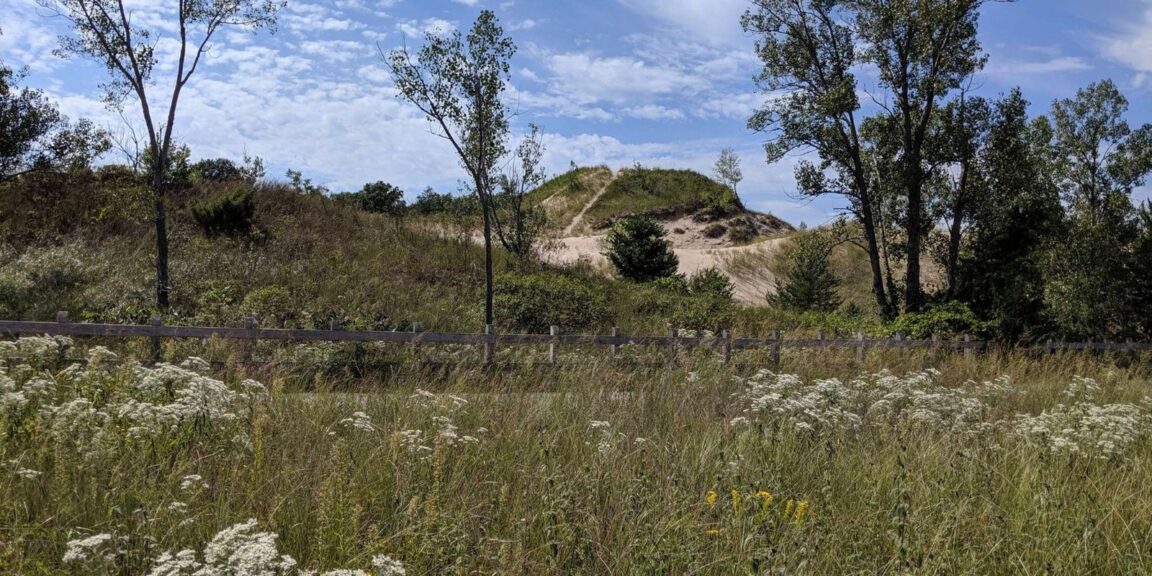
 River Callahan
A weekend at Indiana Dunes works best when you treat it as two parks, not one, and sequence them instead of trying to see everything at once. The national park and Indiana Dunes State Park sit inside each other along the Lake Michigan shore, they charge separate entrance fees, and neither pass covers the other. Put the 3 Dune Challenge, which is in the state park, on your freshest morning, give the Cowles Bog Trail in the national park its own half day, and use the South Shore Line from Chicago if you want to skip the drive and the parking queues altogether. Done in that order, a two day trip covers the famous climbs, the quietest trail in the park and the beaches without backtracking across the whole lakeshore twice.
Quick Facts
- Where: The southern shore of Lake Michigan in northwest Indiana, roughly an hour east of downtown Chicago by train or car
- National park entrance: 25 dollars per private vehicle for a pass valid 1 to 7 days, 20 dollars per motorcycle, 15 dollars per person on foot or bicycle aged 16 and over, checked on the National Park Service fees page on 16 November 2026
- National park annual pass: 45 dollars; America the Beautiful passes are also accepted for national park entry only
- State park warning: Indiana Dunes State Park, which holds the 3 Dune Challenge and its own beach, charges a separate per vehicle fee and accepts none of the national park passes, and the national park accepts no state pass
- Best rail access: South Shore Line trains from Millennium Station in Chicago to Dune Park, Beverly Shores and Portage Ogden Dunes stations; check the current timetable at mysouthshoreline.com before you travel
- Visitor centre: Indiana Dunes Visitor Center, 1215 North State Road 49, Porter, Indiana, where passes are sold and rangers post trail and beach conditions
- Headline hike: The 3 Dune Challenge in the state park, about 1.5 miles over Mount Tom, Mount Holden and Mount Jackson
- Quiet hike: Cowles Bog Trail in the national park, a loop of about 4.7 miles through bog, marsh, black oak savanna and dune to the lake
Why are there two parks, and why does it change your plan?
Indiana Dunes National Park is federal land managed by the National Park Service. Indiana Dunes State Park is older state land that sits completely surrounded by the national park near the town of Chesterton. On a map they look like one green block on the lake. At the gate they behave like two separate attractions, with two fees, two sets of rules and two beaches a short drive apart. The National Park Service states the position plainly on its fees page: each park has fees and passes that are separate and unique, and none of the passes work between the two parks.
That split decides your weekend structure. The 3 Dune Challenge, the state park beach and the state park campground are on the state side. West Beach, Mount Baldy, Cowles Bog, the Dune Succession Trail and most of the long trail network are on the national park side. If you buy only one pass and assume it covers everything, you will pay twice anyway, just at the more annoying moment, in a queue, with a line of cars behind you. Budget for both fees from the start and the weekend runs smoothly. For a sense of how differently other parks handle entry money, see our guide to what a trip to Theodore Roosevelt National Park actually costs.
How should you sequence the 3 Dune Challenge?
Do it first, on your first morning, before the sand heats up and before your legs have a Cowles Bog day in them. The challenge route climbs the three tallest dunes in the state park, Mount Jackson, Mount Holden and Mount Tom, over about 1.5 miles of loose sand. The distance sounds trivial. The surface is not. Every step uphill slides back, the cumulative climb is a genuine workout, and there is very little shade on the exposed faces. An early start gives you cooler sand, a emptier trail and the Chicago skyline views from Mount Tom at their clearest, because haze builds over the lake as the day warms.
Enter through the state park gate, pay the state fee there, and ask at the gatehouse or the nature centre where the challenge route currently starts, because trailheads and parking arrangements shift with erosion work and events. Wear shoes you can empty sand out of easily, carry water even though the route is short, and treat the descent sides with respect. Running down a dune face is the classic way visitors turn an ankle here. When you finish, the state park beach is right there for a swim or a long sit down, which is exactly why this half of the park belongs at the start of the day rather than after a long national park hike.
What if the state park beach lot is full?
On summer weekends the state park entrance can back up and its beach fills early. If you arrive to a long gate queue, do not burn your best morning hours in it. Flip the plan: go to the national park side first, walk the Dune Succession Trail at West Beach or the boardwalks of the Great Marsh, and come back to the state park later in the afternoon when day trippers start leaving. The challenge is just as good in lower late day light, as long as you leave enough time to finish well before dark.
Why does Cowles Bog deserve its own half day?
Cowles Bog is the trail that explains why this shoreline became a national park at all. The botanist Henry Cowles did foundational work on plant succession here, watching how vegetation colonises bare sand and turns dune into forest over time, and the trail walks you through that whole sequence in one loop. It starts in wetland, with boardwalk and marsh plants, passes through black oak savanna, climbs over dunes and ends at a quiet stretch of Lake Michigan beach before looping back. Few short trails anywhere in the Midwest pass through this many distinct habitats in under five miles.
Give it a morning or a full afternoon, not the leftover hour at the end of a beach day. The loop is about 4.7 miles, the dune sections are sandy and slow, and the beach at the far end deserves at least half an hour of sitting still. Carry more water than you think you need, because there is none on the route, and expect insects around the wetland sections in warm months. Footwear that handles both boardwalk and sand matters more here than outright hiking boots. If you enjoy this kind of layered landscape walking, our Cuyahoga Valley National Park in winter guide covers a very different park built around a river valley rather than a lakeshore.
How does the South Shore Line change the trip?
The South Shore Line is the reason Indiana Dunes is one of the easiest national parks in the country to visit without a car. Trains run from Millennium Station in downtown Chicago through northwest Indiana, with Dune Park station acting as the main gateway for the dunes area and Beverly Shores and Portage Ogden Dunes stations serving other parts of the shore. From Dune Park station it is a short hop to the visitor centre and the state park side of the dunes. Schedules change with construction work on the line, and the National Park Service itself directs riders to check mysouthshoreline.com for current times, so build your day around the timetable you check that week, not around times quoted in older guides.
The train does impose one discipline: your last train back sets a hard end to the day, so work backwards from it. Put the farthest trail first, keep the beach closest to your station for last, and never start Cowles Bog late in the afternoon on a train day. Drivers have the opposite problem. Parking at the popular national park lots, especially West Beach in summer, can fill by late morning, so the same rule applies in reverse: arrive before 10 a.m. or aim for the later afternoon. Either way, the visitor centre on State Road 49 is the right first stop for a pass, a map and the day’s conditions, including any beach closures or trail warnings.
What should fill the rest of the weekend?
With the challenge and Cowles Bog placed, the remaining time divides naturally. West Beach pairs a big swimming beach with the Dune Succession Trail, a short interpretive climb that explains the dune building process in stages and works well for anyone who found the challenge enough climbing for one weekend. Mount Baldy, at the eastern end near Michigan City, is the park’s famous moving dune; access arrangements there have been restricted in recent years for safety and restoration, so check its current status at the visitor centre rather than assuming you can climb it. The Great Marsh Trail offers flat boardwalk birding that suits a slower second afternoon, and the Bailly Homestead and Chellberg Farm area adds the human history of the lakeshore, from fur trade to Swedish farming, in a compact stop near the visitor centre.
Base yourself according to your transport. Drivers do well in Chesterton or Porter, closest to both park entrances and the visitor centre, or in Michigan City for a bigger choice of places to eat and a beach town feel at the east end. Train travellers should weight everything toward the Dune Park and Beverly Shores stations and confirm how they will cover the last stretch between station, trailhead and lodging before booking anything. In November the lake wind is the main character: pack a real windproof layer, a hat and gloves for exposed dune tops, and treat a calm sunny forecast as a bonus rather than a plan.
Frequently Asked Questions
Does one entrance pass cover both Indiana Dunes parks?
No. The National Park Service is explicit that national park and state park fees and passes are separate and do not work between the two parks. Budget for the national park pass, 25 dollars per vehicle for 1 to 7 days, plus the state park’s own per vehicle fee if you enter the state park for the 3 Dune Challenge or its beach.
Where exactly is the 3 Dune Challenge?
In Indiana Dunes State Park, the state run park surrounded by the national park near Chesterton. It climbs Mount Jackson, Mount Holden and Mount Tom over about 1.5 miles of sand. It is not a national park trail, which is why the national park pass does not cover your entry to attempt it.
Can you visit Indiana Dunes from Chicago without a car?
Yes. The South Shore Line runs from Millennium Station in Chicago to stations including Dune Park, Beverly Shores and Portage Ogden Dunes. Check the live timetable at mysouthshoreline.com, because construction work changes schedules, and plan your trail order backwards from your return train.
How long does the Cowles Bog Trail take?
The loop is about 4.7 miles through wetland, savanna, dune and beach. Allow half a day at a relaxed pace, longer if you stop at the Lake Michigan beach it reaches. There is no water on the route, so carry everything you need from the trailhead.
When is the best time of year for a weekend here?
Late spring and early autumn balance warm enough weather for the beach with quieter trails and fewer gate queues. Summer brings the full swimming season but the fullest car parks. November weekends are cold and windy on the exposed dunes, but the trails are at their emptiest and the lake views at their clearest.
Is the national park entrance pass good for a whole weekend?
Yes. The standard vehicle pass is valid for 1 to 7 days from purchase, so one 25 dollar pass covers a full weekend of national park entry. If you expect to return within the year, the 45 dollar park annual pass or an America the Beautiful pass may work out better, but neither helps with the separate state park fee.