 Aiko Tanaka
Three days in Coimbra works best as a slow climb: one day for the university hill and its baroque library, one day for the old cathedral, the monastery where Portugal’s first kings are buried and the lanes of the lower town, and one day for the river, the gardens and the Roman ruins at Conimbriga. Coimbra sits between Lisbon and Porto on the Mondego River, and because most visitors pass through in a few hours, anyone who stays two nights gets the city at its best, in the early morning and again after the day groups leave. This itinerary sequences the sights so the walking stays mostly downhill and the timed ticket for the Joanine Library is booked before anything else is planned around it.
Quick Facts
- Best base: The Baixa, the flat lower town near the river and the train station, for easy evenings, or the Alta near the university if steep lanes are not a problem.
- Do not miss: The Joanine Library and Paco das Escolas on the university hill, Se Velha, the Romanesque old cathedral, and the Monastery of Santa Cruz.
- Book first: The combined University of Coimbra visitor ticket. Entry to the Joanine Library runs in small timed groups and photography is not allowed inside, so reserve the slot before fixing the rest of Day 1.
- Getting in: Coimbra B station is the main line stop for Lisbon and Porto trains. A local shuttle or a short walk connects it with the old town.
- Good to know: The University of Coimbra, Alta and Sofia were inscribed by UNESCO as a World Heritage Site in 2013. The university was founded in 1290 and settled permanently in Coimbra in 1537.
- Prices checked: November 2026. Ticket prices and opening times change, so confirm both on the university visitor pages before travelling.
Day 1: The University Hill, the Joanine Library and Student Fado
Morning: Paco das Escolas and the Joanine Library
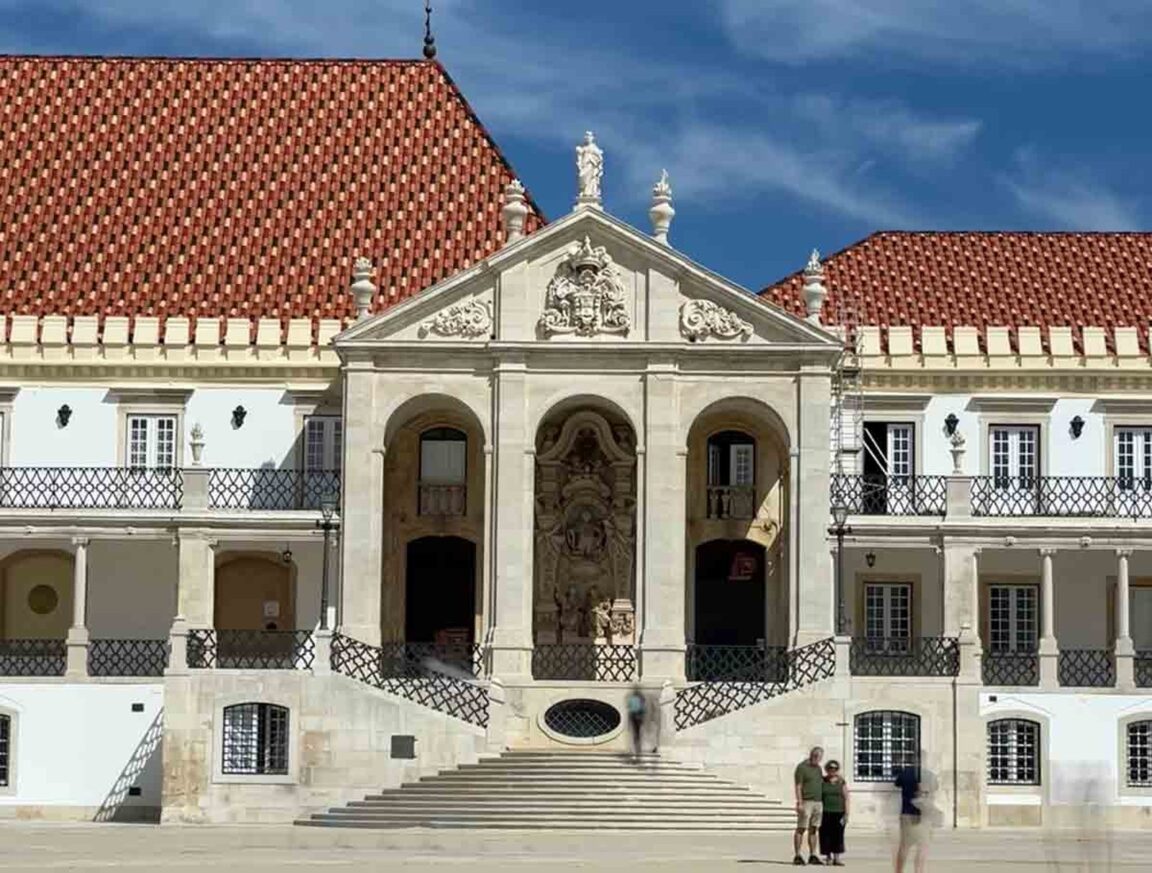
Start at the top of the city. Enter the university through the Porta Ferrea, the iron gate decorated with the patron kings Dinis and Joao III, and step into the Paco das Escolas, the courtyard of the former royal palace. The Via Latina colonnade, the Sala dos Capelos where graduation ceremonies are still held, the Royal Palace rooms and the Chapel of Sao Miguel all sit within a few minutes of each other, so the hill rewards a slow circuit rather than a checklist dash.
The centrepiece is the Joanine Library, the baroque library built under King Joao V in the early 18th century. Visitors enter in small timed groups, move through the lower level first and then reach the Noble Floor, three gilded rooms of carved wood, painted ceilings and floor to ceiling shelves. Visits are short, around ten minutes on the main floor, and photography is forbidden, which most people find makes them look harder rather than less. A small colony of bats lives in the library and helps protect the books from insects, a detail the guides mention with justified pride. Background on the wider World Heritage listing is on the UNESCO page for the University of Coimbra, Alta and Sofia, and the university’s own visitor pages carry the current ticket options and times.
Afternoon: The Tower, Se Nova and the Science Museum
Climb the university tower, known to students as A Cabra, the goat, for the widest view in the city, down over the Mondego and across to the Santa Clara hill. From the courtyard, walk two minutes to Se Nova, the New Cathedral, a former Jesuit church with a restrained facade and rich gilded chapels inside. The combined university ticket also covers the Science Museum in the old chemistry laboratory building nearby, an easy add on if the weather turns. If Coimbra is one stop on a longer Portugal trip, our 3 days in Lisbon itinerary pairs naturally with it on the same rail line.
Evening: Student Fado in the Alta
Coimbra fado is its own tradition, different from Lisbon’s. Here it grew up with the university, sung historically by male students in black academic dress, often as serenades. Small venues in the Alta host evening performances, and the repertoire leans on themes of study, departure and saudade, the Portuguese sense of longing. Book a seat rather than relying on walking in, especially on weekends, and read our guide to fado in Lisbon for the contrasting capital style before you compare the two.
Day 2: Se Velha, Santa Cruz and the Baixa
Morning: Se Velha, the Old Cathedral
Walk down into the Alta lanes to Se Velha, the Old Cathedral, one of the finest Romanesque buildings in Portugal and the only Portuguese cathedral from the Reconquista period to survive largely intact. Building began in the 12th century, and the fortress like west front, the lantern tower and the carved capitals still read as a church built for a frontier city. Do not skip the cloister, begun in 1218 and among the earliest Gothic works in the country, cut into the hillside with double pointed arches and a quiet that the main church rarely gets. Inside, look for the gilded Flemish altarpiece in the chancel, made by Olivier de Gand and Jean d’Ypres.
Midday: The Arco de Almedina and Lunch in the Baixa
Descend through the Arco de Almedina, the old Moorish gate and tower that once guarded the entrance to the walled town and later served as the town hall. Below it, the Baixa is the commercial heart of Coimbra, a grid of pedestrian streets around Rua Ferreira Borges and the Largo da Portagem by the river. This is the practical lunch zone, with bakeries selling the local queijadas and tentugal pastries and simple restaurants serving the region’s roast suckling pig, leitao, for those who want it.
Afternoon: The Monastery of Santa Cruz
Give the afternoon to the Monastery of Santa Cruz, founded in 1131 and rebuilt in the 16th century in a rich Manueline style. Saint Anthony of Padua studied theology here before leaving Portugal. The church holds the tombs of Afonso Henriques, the first king of Portugal, and his successor Sancho I, which is why the monastery church was declared a National Pantheon in 2003. The sacristy, the Cloister of Silence and the chapter house reward anyone who lingers, and the cafe in the cloister garden is one of the calmest coffee stops in the city. A fuller account of the monastery and the other historic sites in this itinerary is at The Collector’s guide to Coimbra’s key historical sites.
Day 3: The River, the Gardens and Conimbriga
Morning: Santa Clara and the Mondego
Cross the Santa Clara bridge to the far bank. The ruined Monastery of Santa Clara a Velha, founded in the 14th century for Queen Isabel, was repeatedly flooded by the Mondego and abandoned in the 17th century, when the community moved uphill to Santa Clara a Nova. The restored ruins, with their visitor centre and recovered artefacts, are one of the most atmospheric sights in the city, and the story of a convent slowly surrendering to a river explains Coimbra’s geography better than any viewpoint. Higher up, Santa Clara a Nova holds the tomb of Queen Santa Isabel, the city’s patron, whose feast each July still shapes the local calendar.
Midday: The Botanical Garden and Portugal dos Pequenitos
Back on the city side, the University Botanical Garden, founded in 1772 as part of the Pombaline reforms of the university, is a green reset between sights, with terraced beds climbing the slope below the aqueduct. Families often add Portugal dos Pequenitos, the miniature park near Santa Clara where Portugal’s monuments and traditional houses are rebuilt at child height. It sounds like a diversion, and it is, but as an orientation to Portuguese architecture before or after the real thing, it works surprisingly well.
Afternoon: Conimbriga, the Roman City
End with the excursion most day visitors never make. Conimbriga, about 16 kilometres south of Coimbra, is one of the largest and best preserved Roman sites in Portugal, with forum remains, baths, an aqueduct that ran more than three kilometres from its source, and a series of houses with polychrome mosaic floors. The House of the Fountains, a villa arranged around a garden of water jets, is the highlight. Buses run from Coimbra and the site museum displays finds from the excavations, so allow half a day rather than squeezing it into an hour. Travellers continuing south can pair this route with our Alentejo travel guide for the slow wine and cork country beyond Lisbon.
Where to Stay and How to Move Around
Stay in the Baixa for flat walking, the station and the widest choice of restaurants, or in the Alta for atmosphere and morning access to the university before groups arrive. The historic centre is compact and walkable, but the slope between the river and the university is real, so plan routes that climb once and descend gradually. Local buses cover the Santa Clara bank and the road to Conimbriga. Coimbra works well without a car, and most visitors who rent one use it only for the Conimbriga run and onward travel.
Frequently Asked Questions
How many days do you need in Coimbra?
Three days is comfortable. One day covers the university hill properly, one covers Se Velha, Santa Cruz and the Baixa, and the third allows Santa Clara and Conimbriga without rushing. Two days is workable if Conimbriga is dropped.
Do you need to book the Joanine Library in advance?
Yes. Entry is by timed ticket in small groups, sold as part of the combined university visitor ticket, and popular slots sell out. Book online before travelling and arrive at the library entrance at the printed time, because latecomers are not admitted to a later group automatically.
Can you take photos inside the Joanine Library?
No. Photography is not allowed inside the library, a rule that protects the books and the painted and gilded interiors. Photos are fine in the Paco das Escolas courtyard and from the tower.
Is Coimbra a day trip from Lisbon or Porto?
It can be, since fast trains link it to both cities, but a day trip usually means choosing between the university and everything else. Staying overnight is what turns Coimbra from a stop into a place, and the evenings, when student fado venues open and the Alta empties, are the best argument for it.
What is the difference between Coimbra fado and Lisbon fado?
Coimbra fado is the university tradition, historically sung by male students, often outdoors as serenades, with lyrics about student life, love and leaving the city. Lisbon fado is the tavern tradition of the Alfama and Mouraria districts, historically led by female singers. Both are worth hearing, and they do not sound alike.
When is the best time to visit Coimbra?
Spring and autumn give mild weather and thinner crowds. May brings the Queima das Fitas, the week long student festival that ends the academic year, which is wonderful if booked well ahead and chaotic if it catches you by surprise. Summer is hot on the hill, so start the university visit early.