 Thandiwe Nkosi
Ellerman House is the Atlantic Seaboard answer to the V&A Waterfront, and the choice between them is a choice of temperament: the Waterfront gives a traveller a working harbour, malls and boat trips at the door, while this 1906 Edwardian mansion on Kloof Road in Bantry Bay gives 13 rooms, terraced gardens above the ocean, one of the most significant private collections of South African art anywhere, a Wine Gallery holding some 7,500 bottles, and a house rule that keeps the main house for guests over 14. Nothing at Ellerman House is open to the public, not the restaurant, not the gallery, not the bar, so the calm is structural rather than lucky. Travellers who collect hotels as cultural institutions should book it; travellers who want Cape Town’s buzz at the door should not.
Quick Facts
- Where: Ellerman House, Kloof Road, Bantry Bay, on Cape Town’s Atlantic Seaboard, on the slopes of Lion’s Head above the ocean
- Building: A Cape Edwardian mansion built in 1906 for shipping magnate Sir John Ellerman; a hotel since 1992, owned by Paul Harris
- Rooms: 13 rooms and suites in the main house, each individually decorated, plus two exclusive use villas, Villa One and Villa Two, with private pools and chefs
- Art: More than 1,000 works of South African art spanning some 200 years, hung throughout the house, with a dedicated Contemporary Gallery in the grounds
- Wine: The Wine Gallery cellar holds around 7,500 bottles of South African wine, with a brandy lounge, a champagne cellar and guided tastings
- Children: Per the property’s own conditions, children over 14 are welcome in the main house and Villa Two; children of all ages are welcome in Villa One
- Access: Residents only throughout: the restaurant, bar, gallery and terraces take no outside bookings
- Grounds: About 1.5 acres of terraced indigenous gardens, a pool and ocean facing terraces, a spa and a fitness centre
- Facts checked: November 21, 2026, against the property’s official site, ellerman.co.za
Ellerman House or the V&A Waterfront: which side of Cape Town suits you?
The two addresses sit about ten minutes apart by car and belong to different cities in every way that affects a stay. The V&A Waterfront is Cape Town’s commercial front room: hotels there open onto a marina, a shopping district and a ferry dock, and the city feels available at all hours. Bantry Bay, around the shoulder of Lion’s Head on the Atlantic Seaboard, is a residential enclave of large houses and almost no street life at all, protected from the south east wind that can rake the rest of the coast, with the ocean directly below and the Sea Point promenade and Clifton’s beaches as the nearest public pleasures. Ellerman House leans entirely into that seclusion. There is no signposted scene, no passing trade and no reason for anyone who is not staying to be there.
That is the honest trade. A first time visitor who wants to walk to dinner, browse and boat will feel marooned on Kloof Road despite the house’s drivers and the short hop to the Waterfront and city centre. A returning visitor, or any traveller whose Cape Town plan is built on wineries, galleries, the mountain and long lunches, gets something the Waterfront cannot sell: a great house that behaves like a private home with a serious collection, where the public spaces are shared with at most a dozen other rooms. Our two days in Cape Town itinerary shows how the city’s headline sights divide across a short stay, and Ellerman House works best as the quiet base at the end of those days rather than as a substitute for them.
How serious is the art collection, really?
Serious enough to be the reason some guests book. The collection, assembled by owner Paul Harris, a co founder of the Rand Merchant Bank group, runs to more than 1,000 works and surveys South African art across roughly two centuries, from nineteenth century Cape landscape painters such as Thomas Bowler through to contemporary figures including William Kentridge. It is not hung as a museum. Paintings and sculpture fill the drawing room, library, dining room and bedrooms in domestic density, floor to ceiling in places, and a purpose built Contemporary Gallery in the grounds, added in 2009, carries the modern end of the story. Sculpture continues into the terraced gardens.
The way to use it is the guided tour the house offers its guests, led through the collection with the stories of individual works and artists, because the hang rewards context: what reads as decoration in a corridor resolves into a deliberate history of a country’s painting when someone explains the sequence. The house also ties the collection to an annual charity art auction that funds technology for local schools, a detail that tells a traveller something true about the place’s self image: it presents itself as a custodian, not merely an owner. No other hotel in Cape Town, and few anywhere, asks its art to carry this much of the stay, and travellers who care about South African culture will find an afternoon with the collection as substantial as a gallery visit in the city. The mountain backdrop gets its own due in our Table Mountain hiking routes guide, and Lion’s Head, which rises directly behind the house, is the local walk.
What happens in the Wine Gallery?
The Wine Gallery is the cellar built as a destination: a gallery space sunk into the hillside below the house, holding around 7,500 bottles of South African wine arranged on a spiralling display wall, with an interactive multimedia wine library cataloguing the collection, a brandy lounge devoted to Cape brandies and a separate champagne cellar. It was built to present the Cape’s wines the way the house presents its art, as a national collection to be walked through rather than a list to be ordered from, and the sommelier led tastings work through established estates and emerging producers with that framing.
In practice, the wine programme runs on three levels. A daily tasting introduces the collection to any guest who wants it. Private tours of the Wine Gallery go deeper, by arrangement, and suit travellers heading out to Stellenbosch and Franschhoek who want a map of what to look for. And the cellar supplies a dining room that is, like everything else here, residents only, serving South African inflected cooking on the terraces and in the dining room, with the collection as its list. The property’s own presentation of the gallery and its tastings is set out on the official Ellerman House site. For a wine focused traveller, the combination of this cellar with day trips into the Winelands is the strongest single argument for the Seaboard over the Waterfront.
Who is the no children under fourteen rule really for?
The property’s own conditions state it precisely: children over 14 years of age are welcome at Ellerman House and in Villa Two, and children of all ages are welcome at Villa One. The main house rule is not a quirk; it is the mechanism that produces the atmosphere the hotel sells. With 13 rooms, no young children, no outside diners and no events trade, the house runs at the volume of a large private home: breakfast on the terrace is quiet, the pool lawn is a place to read, the bar feels like a drawing room, and staff learn guests’ names and habits within a day. The title shorthand for the policy, no children under fourteen in the house, should be read with its villa exception attached, because the two villas exist precisely to give families the property without breaking the house’s calm.
The villas are the pressure valve and, for groups, arguably the better product. Villa One and Villa Two are contemporary multi level houses in the grounds, each with three bedrooms in standard configuration, private infinity pools, generous living and dining space and their own entrances; Villa One can expand to five bedrooms, and each villa comes with a private chef and a dedicated hospitality team. Villa guests use the hotel’s spa, Wine Gallery and art collection while sleeping in complete privacy, and Villa One’s all ages policy makes it the family route in. A multigenerational group in Villa One gets Ellerman House’s culture and service with none of the main house’s constraints, which is why the villas book out over the festive season long before the rooms do. Travellers extending a South African trip beyond the Cape will find the same private house logic, at safari scale, in our Drakensberg hiking guide to the country’s other great landscape.
Frequently Asked Questions
Where exactly is Ellerman House in Cape Town?
On Kloof Road in Bantry Bay, on the Atlantic Seaboard, set on the slopes of Lion’s Head above the ocean. The V&A Waterfront and the city centre are a short drive around the mountain, roughly ten minutes by car, and Sea Point and Clifton are the nearest coastal neighbourhoods. The position is residential and quiet, with no shops or restaurants at the door.
Can children stay at Ellerman House?
In the main house, only guests over 14, per the property’s own conditions of reservation, which apply the same rule to Villa Two. Children of all ages are welcome in Villa One, the larger of the two exclusive use villas, which has a private chef, its own pool and space for up to ten guests in its five bedroom configuration. Families should book the villa route rather than the house.
How many rooms does Ellerman House have?
Thirteen rooms and suites in the main Edwardian house, each individually decorated with pieces from the art collection, in categories running from Classic House Rooms to the two Ellerman House Suites with private terraces. Beyond the house stand two exclusive use villas, Villa One and Villa Two, each with three bedrooms as standard, a private pool and dedicated staff.
Can non residents visit Ellerman House for dinner or the art?
No. The restaurant, bar, Contemporary Gallery and Wine Gallery are open to residents only, and the house takes no outside bookings. The art collection of more than 1,000 South African works and the 7,500 bottle wine cellar are part of the stay itself, seen on guest tours and tastings arranged by the house.
What is the Wine Gallery at Ellerman House?
A purpose built cellar and gallery below the house holding around 7,500 bottles of South African wine on a spiralling display wall, with an interactive wine library, a brandy lounge and a champagne cellar. The house sommelier runs daily tastings for guests and private Wine Gallery tours by arrangement, covering both established Cape estates and emerging producers.
When is the best time to stay at Ellerman House?
Cape Town’s summer, November to March, gives the full Atlantic Seaboard life of terraces, pool days and sunset drinks, and Bantry Bay is notably sheltered from the summer south easter wind. The winter months, June to August, are cooler and wetter but suit the house’s indoor strengths, the art, the cellar, fires and long dinners, often at lower rates.
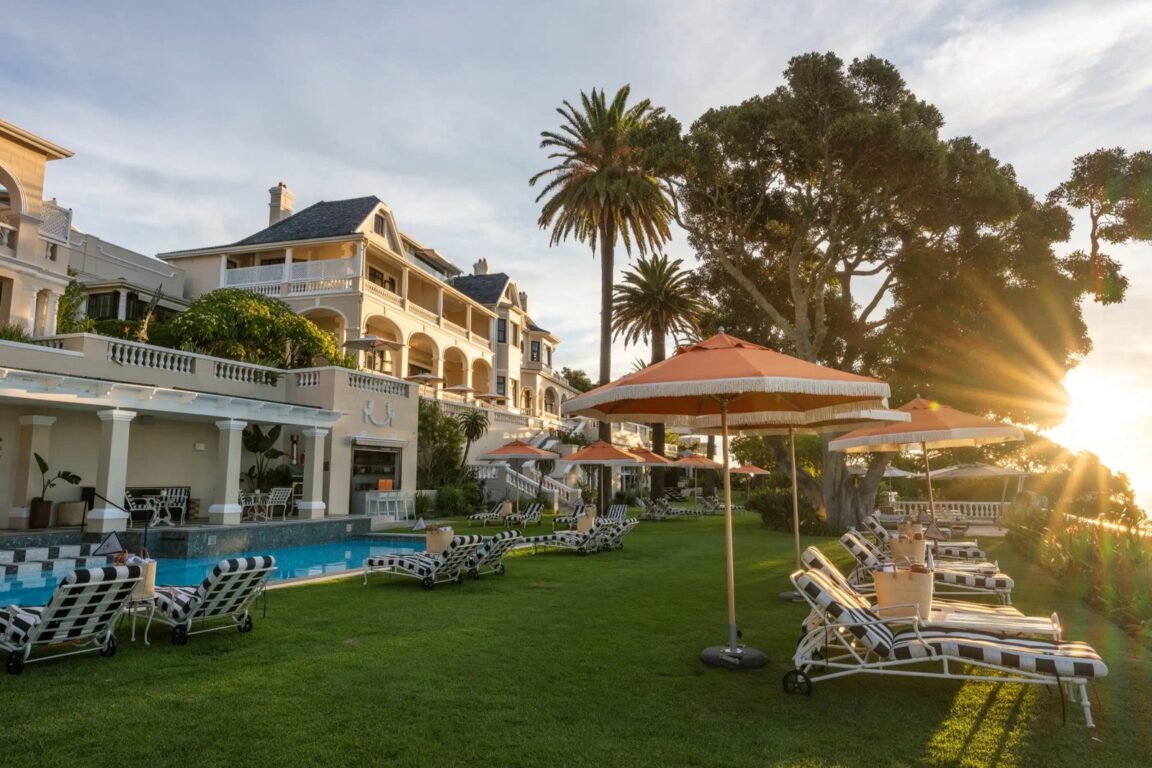
Featured image: Ellerman House at sunset, the Edwardian mansion and its arched terraces above the pool lawn, striped loungers and orange parasols in the terraced garden at Bantry Bay. Photo by Felix Studios, from Ellerman House, the property’s official site (ellerman.co.za), used with credit.