 Elena Vasquez
The mistakes that cost first time visitors in Dubrovnik are almost all timing mistakes. The city walls, the single best walk in the city, are at their worst in the cruise peak middle of the day; Banje Beach, the postcard swim just outside Ploce Gate, is at its worst at noon; and dinner on the Stradun carries a premium that the same kitchens one lane back do not charge. None of this requires local genius to fix. It requires walking the walls at opening or in the last two hours, swimming early or late, checking the port schedule the night before, and making one clear eyed decision about Lokrum Island instead of drifting onto a boat. This guide names the errors in the order they usually happen and gives the working alternative for each.
Quick Facts
- City walls ticket: 40 euros per adult for November 2026 visit dates and 15 euros for children aged 7 to 18 on the official webshop of the Society of Friends of Dubrovnik Antiquities; the price is set by visit date and drops to 20 euros per adult for December 2026 dates
- Wall hours: 09:00 to 15:00 from November 1 to March 31, stretching to an 08:00 start and early evening close in the main season; the posted closing time is also the last entry, and the walls close only on December 25
- Ticket rules: One circuit only, no re-entry; the ticket also covers Fort Lovrijenac and, except in its December to February closure, the Western Outer Wall
- The walk: About 2 kilometres of wall top circuit with many stairs and little shade; allow 1.5 to 2 hours without rushing
- Dubrovnik Pass: 40 euros for 1 day, 50 euros for 3 days and 60 euros for 7 days in the season running March 1 to November 30, 2026, including the walls, museums and city buses; no winter pass is sold
- Lokrum: 30 euros per adult including the return boat from the Old City Port and reserve entry; from November 9, 2026 boats run hourly from 10:00 to 15:00 with the last boat back at 16:00
- Cruise pattern: Ships berth at Gruz, about 3 kilometres from the Old Town, and passengers arrive by bus through the morning; the walls and the Stradun peak from mid morning to mid afternoon
- Prices checked: November 21, 2026, against the Society of Friends of Dubrovnik Antiquities webshop, the Dubrovnik Pass shop and the Lokrum Reserve
Why is walking the walls at midday the first mistake?
Because the walls concentrate every pressure in Dubrovnik into one narrow walkway at exactly the hours when pressure peaks. Cruise ships berth at Gruz port, a few kilometres northwest of the Old Town, and their passengers are bussed in through the morning, which makes the wall circuit and the Stradun busiest from mid morning to mid afternoon on ship days. The Port of Dubrovnik publishes its arrivals and departures schedule, and reading it the night before is the cheapest planning act of the whole trip: a day with several large ships in port is a day to be on the walls at opening, while a no ship day returns the Old Town to something like its own rhythm. In the main season the walls open at 08:00, which is the slot to take in summer, before the heat builds on stone that offers almost no shade. In winter the window compresses to 09:00 to 15:00, and opening time matters even more, because the whole visitable day is six hours long.
The second half of the timing fix is the end of the day. The posted closing time on the walls is also the last entry time, a rule the operator states plainly and visitors routinely misread as the time they must be off. Entering in the last two hours of opening, once the cruise groups have returned to Gruz and the light has dropped across the rooftops, gives a quieter circuit and better photographs than any midday start. What does not work is arriving near closing expecting a full loop at leisure: the circuit is about 2 kilometres with long stair climbs, and it deserves 1.5 to 2 hours. Visitors continuing along the Dalmatian coast can apply the same arrive early logic in our Hvar and the Pakleni Islands guide, where the fortress climb has the same midday problem.
What order should the wall circuit be walked in?
The order mistake is treating the walls as a casual stroll that can be paused and resumed. The ticket, sold at the entrances and on the official webshop at shop.citywallsdubrovnik.hr, is valid for one circuit only, and once you step off the walls the visit is finished, with no re-entry on the same ticket. The Dubrovnik Pass carries the same one visit rule. So the circuit has to be planned as a single deliberate loop: choose the entrance nearest the sights you want afterwards, walk the full ring in the direction of travel, and save Fort Lovrijenac, which the same ticket covers across the water at Pile, for immediately before or after, not for another day, since ticket validity should be confirmed at purchase and the fort is a separate climb of its own.
Within the loop, the landward side is the high work and the seaward side is the reward. The Minceta Tower, the great round fortress at the northwest corner, is the highest point of the circuit and the place where queues form at the stairways in peak hours, another reason the early or late circuit beats the midday one. Walkers who start at the Pile entrance get the landward towers and the full rooftop panorama first and finish along the sea walls above the old port; starting near Ploce reverses the effort. Either direction works. What fails is the half circuit followed by lunch and an attempted return, which the one visit rule turns into a second 40 euro ticket. Buy the Dubrovnik Pass instead of a standalone walls ticket if any museum is on the same trip: at 40 euros for one day it costs exactly the walls ticket price on November dates and adds the Rector’s Palace, the Maritime Museum, other sights and 24 hours of city buses, as set out on dubrovnikpass.com.
Why is Banje Beach at noon the swim to avoid?
Banje is the closest beach to the Old Town, a few minutes east of Ploce Gate, and its famous view back to the walls and Lokrum is precisely why it fills. At noon in season it combines the day’s strongest sun, the day’s largest crowd and paid lounger territory at its most contested, on a small shingle beach with limited natural shade. The fix costs nothing: swim early, before the wall walk on a late entry plan, or swim late, after an opening time wall walk, when the light on the city is at its best and day visitors have thinned. Travellers who want a longer, quieter swim should treat Banje as the scenic short dip it is good at and put their real beach hours elsewhere, rather than paying noon prices in effort and elbows for the postcard angle.
The same noon logic governs the Stradun itself. The marble main street is a sight to walk at almost any hour, but sitting down to a full priced lunch or dinner in its centre is paying for the address. The established local pattern is to eat one lane back: the parallel and side streets off the Stradun carry restaurants serving the same Dalmatian repertoire, grilled fish, black risotto, peka dishes ordered ahead, at noticeably gentler prices, and stepping even a street or two further toward the residential lanes above the old town improves value again. Read the posted menu before sitting down anywhere in the old town, confirm whether bread, cover and side dishes are charged, and remember that a restaurant full at 19:00 with tour groups is pricing for location, while the kitchen one lane back is pricing for repeat trade. The cross border day trip in our Mostar guide makes a useful contrast: the same traveller euros go conspicuously further ninety minutes inland.
Should Lokrum Island be a yes or a no?
Lokrum is the decision visitors most often make by drift, following the crowd to the Old City Port and buying a ticket because the boat is there. Make it deliberately instead, using the reserve’s own numbers from lokrum.hr. The combined ticket costs 30 euros per adult and covers both the return boat and entry to the reserve, and the same entry charge applies even if you arrive by your own boat or kayak, because the fee is for the protected reserve itself. Children aged 7 to 17 pay 5 euros and students 10 euros. The island is a car free nature reserve of pine paths, a Benedictine monastery complex, a small salt lake known as the Dead Sea, and rocky swimming coves, and it needs three to five hours to be worth its ticket.
The seasonal timetable is the deciding fact in the quiet months. From November 9, 2026, the official boats leave the Old City Port hourly from 10:00 to 15:00 and the last boat back leaves Lokrum at 16:00, with tickets sold at the Luza office by the port; nobody may stay on the island outside boat hours, and the boats do not run in unsuitable weather. So the honest rule is this: with a full day, calm weather and a wish for swimming and shade away from the old town crowds, Lokrum is a clear yes and the best half day in Dubrovnik. On a short cruise call, a windy day or a one day visit built around the walls and the museums, it is a no, because its fixed last boat and its three hour minimum will eat the day the walls needed. A bought ticket can be used within three days of its printed date, which softens the weather risk for anyone staying longer.
What other small mistakes add up in the Old Town?
Three recur constantly. The first is money and card assumptions: Croatia uses the euro, prices in the old town are posted, and the expensive error is not currency but unexamined extras, from unrequested appetisers to taxi rides taken without agreeing the fare or using the bus the Dubrovnik Pass already covers. The second is the cable car queue at midday, which repeats the walls mistake on Mount Srd: go at opening or toward sunset, or walk the waymarked path if knees and daylight allow, rather than spending the best hour of the day in a line. The third is scheduling the Franciscan Monastery, the Rector’s Palace and other pass sights without checking winter closing patterns: from November the Rector’s Palace closes on Mondays and the Franciscan Monastery closes on Sundays and shuts early, so a pass day planned on the wrong weekday loses value that a five minute check would have saved.
Underneath all of these sits the same principle that governs the walls: Dubrovnik’s Old Town is small, finite and shared with a working port schedule, so the visitor who reads the port arrivals, the seasonal hours and the ticket rules before arriving experiences a different and calmer city than the visitor who improvises at noon. None of the fixes in this guide cost money. Most of them save it.
Frequently Asked Questions
How much does it cost to walk the Dubrovnik city walls?
On the official webshop of the Society of Friends of Dubrovnik Antiquities, an adult ticket costs 40 euros for November 2026 visit dates, with children aged 7 to 18 at 15 euros and younger children free. The price is set by the visit date chosen and falls to 20 euros per adult for December 2026 dates. The ticket covers one circuit of the walls with no re-entry, plus Fort Lovrijenac.
What are the city walls opening hours in winter?
From November 1 to March 31 the walls are open from 09:00 to 15:00. The posted closing time is also the last entry time. The walls are open every day of the year except December 25. In the main season they open at 08:00 and close in the early evening, with the longest hours in June and early August.
When is the best time of day to walk the walls?
At opening, or in the last two hours before closing. Cruise passengers bussed in from Gruz port make the circuit busiest from mid morning to mid afternoon, and summer midday adds heat on shadeless stone. Check the Port of Dubrovnik arrivals schedule the night before: on heavy ship days, the opening slot matters most.
Is the Dubrovnik Pass worth buying for the walls?
For most visitors in season, yes. The 1 day pass costs 40 euros, the same as the walls ticket on November dates, and adds the Rector’s Palace, the Maritime Museum, other included sights and 24 hours of city buses. The 3 day pass costs 50 euros and the 7 day pass 60 euros. The pass is sold for the season from March 1 to November 30, 2026, and no winter pass is sold.
How much does the Lokrum Island boat cost, and when does the last boat return?
The combined ticket costs 30 euros per adult, including the return boat from the Old City Port and entry to the Lokrum Reserve; children aged 7 to 17 pay 5 euros. From November 9, 2026, boats leave the city hourly from 10:00 to 15:00 and the last boat back from Lokrum is at 16:00. Boats do not run in bad weather and staying on the island overnight is not permitted.
How long does the full wall circuit take?
Allow 1.5 to 2 hours for the roughly 2 kilometre circuit at a comfortable pace with stops. The route involves many stairs and long exposed stretches with little shade, so carry water in season. Because the ticket allows one visit only, complete the full loop in a single walk rather than leaving and returning.
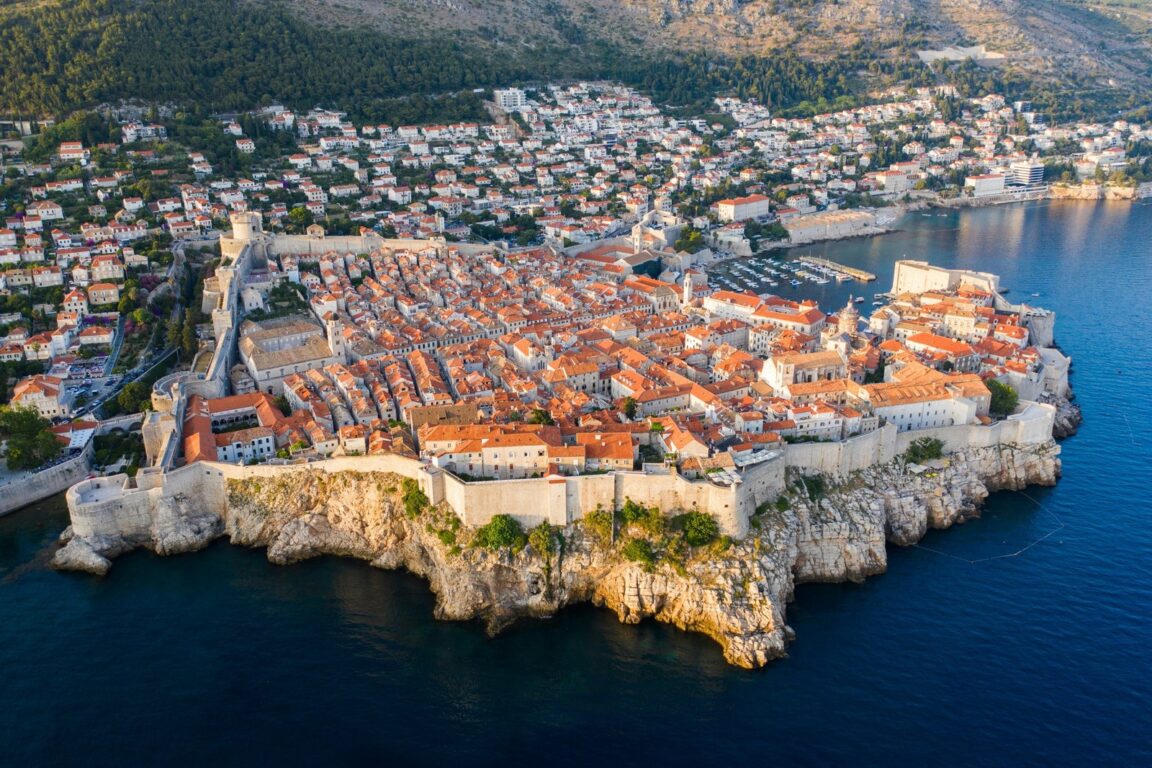
Featured image: Dubrovnik’s walled Old Town from the air, the full circuit of the city walls enclosing the terracotta rooftops above the Adriatic, with the old port and Lokrum beyond. Photo by Geio Tischler via Unsplash (unsplash.com), Unsplash License, used with credit.