 Aiko Tanaka
Stay in Springdale if Zion Canyon is the trip, and stay on the east side if quiet is the trip. That is the whole decision, and everything else is detail. Springdale, at the park’s South Entrance, puts a traveller on foot at the pedestrian entrance, on the free Springdale Line shuttle through town, and minutes from the Zion Canyon Visitor Center, where the separate Zion Canyon Line shuttle runs up the scenic drive to the Narrows and Angels Landing trailheads. The east side, along State Route 9 beyond the Zion Mount Carmel Tunnel, offers ranches and small inns near Checkerboard Mesa, slickrock walking from the door and evenings with a fraction of the canyon crowds, at the cost of driving the tunnel highway every time the main canyon is the goal. Neither base is wrong, but they produce different holidays: Springdale is a shuttle based hiking trip with restaurants on the doorstep, and the east side is a driving trip with the canyon as a planned excursion.
Quick Facts
- Park: Zion National Park, southwestern Utah; the South Entrance adjoins the town of Springdale, the East Entrance sits on State Route 9 toward Mount Carmel Junction and Kanab
- Entrance fee: $35 per private vehicle, $30 per motorcycle, $20 per person on foot or by bike, each valid for 7 days; Zion annual pass $70; non US residents aged 16 and over pay an additional $100 per person unless entering on an annual or America the Beautiful pass, per the National Park Service
- Shuttle: Free, with no ticket, permit or reservation; the Zion Canyon Line serves 9 stops from the visitor center to the Temple of Sinawava and takes about 45 minutes end to end; the Springdale Line serves 9 stops in town
- Late November 2026 shuttle hours: October 25 to November 28, the canyon line runs 7:00 am to 5:00 pm with the last ride out of the canyon at 6:15 pm, and the Springdale Line runs 8:00 am to 6:00 pm; November 29 to December 25 there is no shuttle service
- Only in park lodging: Zion Lodge, with 76 hotel rooms, 6 suites and 40 historic cabins, and the only place inside the park to buy food
- Tunnel limits: Vehicles over 35 feet 9 inches long, 7 feet 10 inches wide, 11 feet 4 inches tall or 50,000 pounds are not permitted on the Zion Mount Carmel Highway between Canyon Junction and the East Entrance
- East side walk: Canyon Overlook Trail, a moderate 1 mile round trip just east of the tunnel, with extremely limited parking
- Prices and hours checked: November 21, 2026, against the National Park Service site, nps.gov/zion
Springdale or the east side: which base fits which trip?
Match the base to the trail list. A traveller whose days are the Narrows, Angels Landing and Scout Lookout, the Emerald Pools and the Watchman belongs in Springdale or at Zion Lodge, because every one of those hikes starts from the Zion Canyon Scenic Drive, which is closed to private vehicles during the shuttle season and served only by the free canyon shuttle. A traveller whose list reads Canyon Overlook, Checkerboard Mesa, east side slickrock and a day trip onward to Bryce Canyon belongs on the east side, where those places are minutes away and the main canyon is the excursion. Families with young children usually do better in Springdale, where a tired child is a short shuttle ride and a walk from bed, and where dinner does not require a drive in the dark. Photographers, stargazers and anyone who has already done the canyon classics are the natural east side audience. Our Kolob Canyons district guide covers the park’s separate northwestern section, which neither base serves well and which deserves its own half day from Interstate 15.
Cost points the same way as convenience. Springdale is the park’s full service gateway, with the widest choice of lodges, inns and restaurants competing along one boulevard, while the east side supply is smaller and more spread out, a mix of ranch stays, inns and vacation rentals around Orderville, Mount Carmel Junction and on toward Kanab. The park fee is identical from either gate: the National Park Service fees page lists $35 per private vehicle for 7 days, and the pass works at both entrances, so the base decision is about time and temperament, not about the cost of entry.
How does staying in Springdale work day to day with the shuttle?
It removes the car from the holiday, which is the luxury on offer. The Springdale Line, marked with orange signs, stops at 9 locations in town, including the pedestrian and bike entrance at Zion Canyon Village, and runs about every 10 to 15 minutes in season, per the National Park Service shuttle page. From a shuttle side lodge, the morning is a walk or a short town shuttle ride to the pedestrian entrance, a walk across to the Zion Canyon Visitor Center, and a seat on the canyon line, which serves 9 stops and takes about 45 minutes to reach the Temple of Sinawava at the end of the road. Shuttles inside the park arrive about every 5 to 10 minutes, need no ticket or reservation, and cannot be driven around: during the shuttle season, private vehicles are barred from the scenic drive even before the first bus and after the last one.
Two honest frictions belong in the picture. The first is parking: the park service warns that its parking lots often fill early in the day, and paid parking in Springdale is the fallback, which is another argument for sleeping in town and leaving the car at the lodge. The second is the clock. In the current late season schedule, October 25 to November 28, the last canyon shuttle leaves the visitor center at 5:00 pm and the last ride out of the canyon leaves the Temple of Sinawava at 6:15 pm, and the park service advises visitors not to wait for that last bus, because a full or missed shuttle can mean a long walk back. Springdale also carries a paperwork detail worth knowing: the fees page notes that a pass bought while driving in must be shown again if a visitor later reenters on foot at the pedestrian entrance, so the pass stays in a daypack, not in the glovebox. From November 29 to December 25, 2026, the shuttles stop entirely, and the park notes that winter is the season when visitors can drive the scenic drive themselves, which briefly makes Springdale a driving base after all. Travellers sorting permits and reservations across several parks can cross check the system with our national park reservations guide.
What does the east side give up, and what does it give back?
It gives up the shuttle, and it gives back space. East of the tunnel, State Route 9 crosses a high slickrock plateau of cross bedded sandstone, and the country is open, pale and quiet in a way the main canyon never is in season. Checkerboard Mesa, the white sandstone cone etched with a grid of cracks beside the highway near the East Entrance, is the emblem of this side, and the pullouts along the road serve walkers who want to wander slickrock and watch for bighorn sheep rather than queue for a bus. The one named trail, the Canyon Overlook Trail, is a moderate 1 mile round trip that starts just east of the tunnel, climbs sandstone steps above a slot canyon and ends at a fenced cliff edge looking down into the main canyon, with the Towers of the Virgin in view. The park service warns that parking there is extremely limited and visitors may need more than one attempt, which is the east side in miniature: uncrowded in general, pinched at the famous spots.
The lodging pattern matches the landscape. Instead of a boulevard of lodges, the east side offers ranch properties and small inns scattered along the highway toward Orderville and Mount Carmel Junction, with Kanab further east as the larger service town. Evenings are the reward: dinner where you sleep, dark skies, and trailheads and pullouts that can be visited at dawn before any day visitor has crossed the park. The give back is real, but so is the give up. There is no shuttle on the east side, no walk in entrance to the canyon trail system, and no spontaneous evening stroll to a choice of restaurants. Every main canyon day starts with the tunnel drive, and that drive has to be timed honestly, which is the subject of the next section.
How should the tunnel drive between the two bases be timed?
Slowly, and with a buffer that Springdale guests never need. The Zion Mount Carmel Highway from Canyon Junction to the East Entrance is a historic road, completed in 1930 and listed on the National Register of Historic Places, built around tight curves, switchbacks and a tunnel of just over a mile through the sandstone. The National Park Service large vehicles page sets the current limits for the whole section between Canyon Junction and the East Entrance, not just the tunnel itself: a single vehicle may be no longer than 35 feet 9 inches, no wider than 7 feet 10 inches, no taller than 11 feet 4 inches and no heavier than 50,000 pounds, with combined vehicle and trailer limits on top. Vehicles over any limit are not permitted on that section at all and are turned around at the entrance stations, so anyone towing or driving a large RV should measure before choosing an east side base, not after.
For an ordinary car, the honest planning figure is this: allow around 45 minutes to an hour between a Springdale lodge and an east side trailhead or ranch in good conditions, and more when tunnel traffic is being held or the Canyon Overlook parking is full and a second attempt is needed. The distance is not great, but the road is a scenic drive, not a connector, and it collects slow vehicles, photo stops and sheep. East side guests driving in for a canyon day should aim to be through the tunnel early, park in Springdale or at the visitor center before the lots fill, and treat the shuttle timetable, not the drive, as the fixed point of the day. The same road is also the east side’s onward advantage: from the East Entrance, the highway continues toward Mount Carmel Junction and Kanab, which makes the east side the natural base for a combined Zion and Bryce trip. Our Kanab gateway guide covers that base town in detail, and our Bryce Canyon first timer guide plans the park that sits at the end of the same road east.
Where does Zion Lodge fit between the two?
In the middle, literally and in character. The National Park Service lodging page confirms that Zion Lodge is the only lodging inside the park: 76 hotel rooms, 6 suites and 40 historic cabins in the heart of Zion Canyon, with the only food available for purchase inside the park, plus a gift shop and post office. Guests board the canyon shuttle at the lodge itself, walk to nearby trailheads, and sleep inside the canyon walls, which neither Springdale nor the east side can offer. The trade offs are availability and choice: one property, booked far ahead in season, with a single dining room rather than a town of restaurants. For a traveller whose whole trip is the canyon and who books early, it can beat both bases. For everyone else it is the benchmark that explains the other two: Springdale trades a short shuttle ride for choice and availability, and the east side trades the canyon altogether for quiet.
Frequently Asked Questions
How much does it cost to enter Zion National Park?
A private vehicle pass costs $35, a motorcycle pass $30 and a per person pass for visitors on foot or by bike $20, each valid for 7 days. The Zion annual pass costs $70. Non US residents aged 16 and over pay an additional $100 per person unless admitted with an annual or America the Beautiful pass. Fees were checked on the National Park Service site on November 21, 2026.
Is the Zion shuttle free, and does it need a reservation?
Yes, it is free, and no ticket, permit or reservation is needed. The Zion Canyon Line serves 9 stops between the visitor center and the Temple of Sinawava about every 5 to 10 minutes in season, and the Springdale Line serves 9 stops in town. During the shuttle season, private vehicles cannot use the Zion Canyon Scenic Drive.
Can visitors stay inside Zion National Park?
Yes, at Zion Lodge, the only lodging inside the park, with 76 hotel rooms, 6 suites and 40 historic cabins. It is also the only place inside the park to buy food. All other lodging is outside the boundaries, in Springdale at the South Entrance, on the east side along State Route 9, or in larger towns such as Kanab.
What is there to do on Zion’s east side?
The east side is slickrock country along State Route 9: Checkerboard Mesa near the East Entrance, roadside pullouts for short walks on the sandstone, and the Canyon Overlook Trail, a moderate 1 mile round trip just east of the tunnel to a fenced viewpoint over the main canyon. There is no shuttle service on the east side, so a car is essential.
Can a large RV drive through the Zion Mount Carmel Tunnel?
No, if it exceeds the park limits. Vehicles longer than 35 feet 9 inches, wider than 7 feet 10 inches, taller than 11 feet 4 inches or heavier than 50,000 pounds, including mirrors and attachments, are not permitted on the highway between Canyon Junction and the East Entrance. Oversize vehicles are turned around at the entrance stations and must use an alternative route.
When do the Zion shuttles stop running in 2026?
On the current National Park Service schedule, the canyon and Springdale lines run reduced hours from October 25 to November 28, 2026, with no service from November 29 to December 25, and a short holiday season from December 26 to January 2. Always confirm the dates on the park shuttle page before fixing a base, because the schedule changes by season.
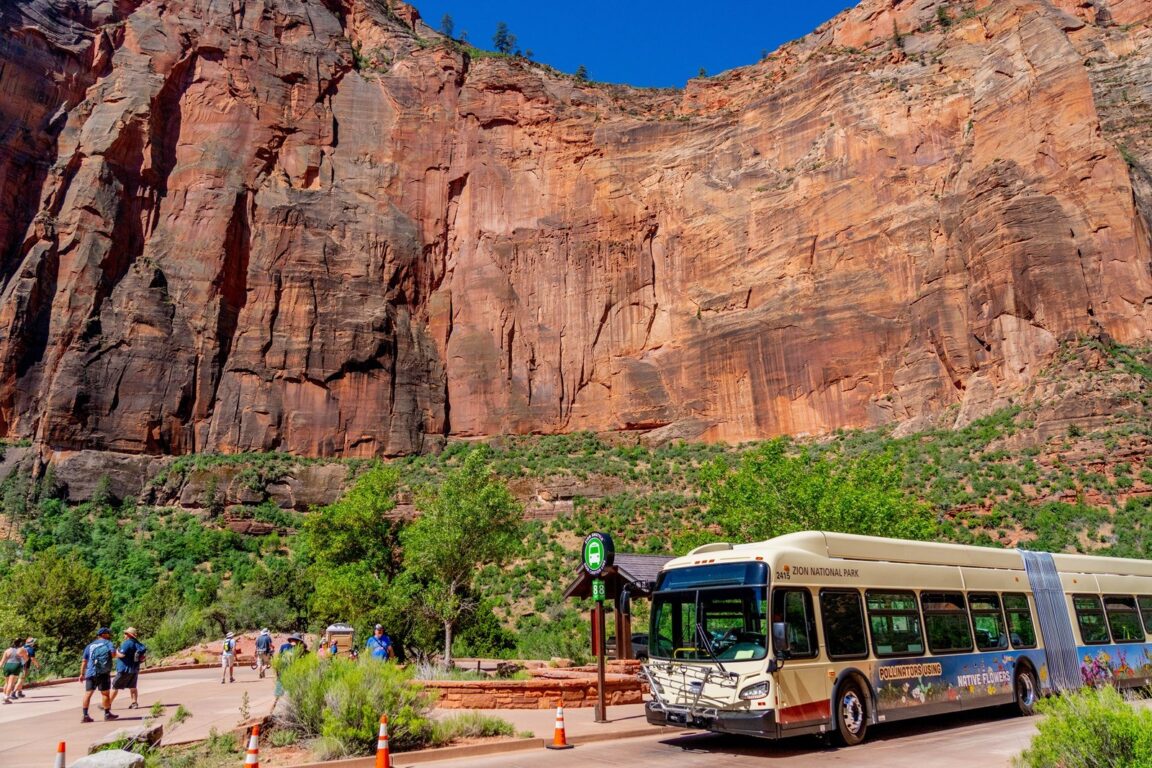
Featured image: A Zion Canyon Line shuttle at the Big Bend stop beneath the red sandstone walls of Zion Canyon, Zion National Park. Photo from the National Park Service official site (nps.gov), NPS Photo, US Government work, used with credit.