 Elena Vasquez
Flamenco in Seville separates into three different nights, and choosing the right one is the respectful first step: a tablao, where a professional company performs a set show in an intimate room built for it; a peña, a members’ flamenco club where aficionados gather for their own sake and visitors are guests at the edge of someone else’s community; and Triana, the quarter across the Guadalquivir where ceramics kilns, sailors’ streets and Gitano families shaped the art long before there were tickets for it. Do the tablao first, with the Museo del Baile Flamenco as the preparation if the trip allows it. Treat a peña as an invitation to listen quietly, not as a cheaper tablao. And give Triana a daytime of its own, starting at the ceramics centre, so the evening performance sits inside the history that produced it. That order, tablao, then context, then Triana, is what doing flamenco respectfully actually means in practice.
Quick Facts
- The art: Flamenco fuses cante (song), baile (dance) and toque (guitar), per UNESCO, which inscribed it on the Representative List of the Intangible Cultural Heritage of Humanity in 2010
- Heartland: Andalusia, in UNESCO’s wording, with the Gitano community playing an essential role in flamenco’s development and its transmission running through families and flamenco clubs
- First tablao names: Tablao Flamenco Los Gallos, Plaza de Santa Cruz 11, dating itself to 1966, and Tablao El Arenal, Calle Rodo 7, founded in 1976 by the bailaor Curro Vélez
- The museum: Museo del Baile Flamenco, Calle Manuel Rojas Marcos 3, inaugurated on April 7, 2006 on the initiative of the Sevillian dancer Cristina Hoyos, in an eighteenth century building with an Ecijan style courtyard where shows are held
- Triana anchor: Centro Cerámica Triana, Calle Callao 16, in the former Santa Ana pottery works; the city’s cultural institute lists it open Tuesday to Sunday, 10am to 8pm, with general admission at 2.10 euros, checked on November 21, 2026
- Peña rule: A peña is a members’ club first; visitors attend advertised nights as guests, arrive early, take the seat they are given and listen
- Facts checked: November 21, 2026, against UNESCO, Visita Sevilla, the venues’ own sites and the Seville cultural institute
What is the difference between a tablao, a peña and a museum show?
A tablao is a professional stage in a small room: a fixed company of singers, guitarists and dancers, a set start time, a ticket bought in advance and an audience that has come specifically to watch. It is the direct descendant of the cafés cantantes, the singing cafés of the nineteenth and early twentieth centuries, tightened into an hour or so of concentrated performance. A peña is something else entirely. UNESCO’s flamenco entry names the mechanism directly: transmission occurs through dynasties, families, social groups and flamenco clubs, all of which play a key role in preservation. The peña is that club, an association of aficionados who programme nights for themselves, honour particular singers and keep particular styles alive. Visitors can attend many peña nights, but the night does not belong to them. The third format, the museum show, sits between the two: at the Museo del Baile Flamenco the galleries explain the art and the courtyard stage then performs it, in the same building, which makes it the best single introduction for a visitor who knows nothing yet. Our Seville tablao guide covers the main rooms show by show; this guide is about choosing the right kind of night, and behaving well inside it.
Which tablaos are the serious first choices, and why?
Start with the two rooms whose histories are part of the argument. Tablao Flamenco Los Gallos, on Plaza de Santa Cruz in the old Jewish quarter, dates its opening to 1966 and describes itself as the oldest tablao in Seville, with a resident company of recognised artists performing cante, baile and toque every night; its own programme material stresses that the show runs with a full cuadro of eight artists. Longevity alone would not be a recommendation, but a room that has held a serious company together for decades in a small square in Santa Cruz is a different proposition from a dinner show assembled for a season. The second anchor is Tablao El Arenal, on Calle Rodo in the Arenal quarter near the bullring. The house dates its founding to 1976 and to the bailaor Curro Vélez, and presents itself as an intimate space where Andalusian food, cante, baile and guitar share the night. El Arenal is the tablao with dinner attached, so the respectful way to use it is to treat the performance, not the menu, as the booking reason, and to be seated and settled before the first cante begins.
The choice between the anchors is mostly about setting: Los Gallos for the classic small tablao in Santa Cruz, El Arenal for the Arenal room with a meal around it, and the museum, below, for a show that comes with its own explanation. What the serious rooms share, and what separates them from a hotel floor show, is a live cuadro in which the singer leads. In flamenco the cante is the source, the dance answers it and the guitar holds the two together, so a room where the singing can be heard in silence is doing the essential thing right, whatever its size.
What happens at the Museo del Baile Flamenco, and should it come first?
Yes, for most first time visitors, because it turns an evening’s entertainment into an education without dulling it. Visita Sevilla, the city’s official tourism site, describes it as the first and only museum in the world known to date dedicated to flamenco dance, created on the initiative of the Sevillian dancer Cristina Hoyos and inaugurated on April 7, 2006, after the remodelling of an eighteenth century building. The museum runs over four floors, keeps a vaulted basement from the original building and, on the first floor, holds a typical Andalusian courtyard in the Ecijan style, one of the few remaining in Seville, in which flamenco shows are offered. The museum’s own site lists museum hours and a pattern of daily shows in its courtyard tablao, with performances in the late afternoon and evening; check the day’s times and book the show ticket with the museum visit rather than treating them as separate errands, on the Museo del Baile Flamenco’s official site.
The order inside the visit matters. Go through the galleries first, slowly enough to learn the vocabulary the evening will use: the palos, the flamenco styles, the role of palmas, the handclapping, and the way a dancer’s footwork, the zapateado, is a percussion instrument in its own right. Then sit in the courtyard and watch the same ideas happen three metres away. A visitor who has done that hour hears a tablao differently for the rest of the trip, and is far less likely to talk through the cante or applaud in the wrong place, because the museum has quietly taught the audience its job as well as the performers theirs.
How can a visitor attend a peña without treating it like a theatre?
By remembering whose night it is. A peña, such as the long established Peña Cultural Flamenca Torres Macarena in the Macarena district to the north of the old centre, is a membership association. Its programme is set for aficionados, announced close to the date, and weighted toward cante, often a single singer and guitarist in a small room with a bar and a terrace, rather than toward dance spectacle. Visitors are commonly welcome at advertised recitals, and that welcome is the thing to honour. The practical rules are simple. Check the current programme before going, since peñas do not run a tourist season and a dark week is normal. Arrive early, because seating is limited and members and regulars come first. Buy whatever ticket or entry the house asks for at the door without comparing it aloud to tablao prices. Take the seat available, not the seat wanted. And once the cante starts, be an audience in the peña sense: quiet, attentive, responsive at the natural breaks, with phones put away entirely.
Handled that way, a peña night gives something no tablao can: flamenco as a living local practice rather than a performance product, in a room that knows when a verse has landed. Handled as a bargain hunt or a backdrop for conversation, it gives nothing and takes goodwill with it. One peña night per trip is plenty, chosen after a tablao, when the forms are familiar enough to follow a singer led evening.
Why does Triana matter, and how should its ceramics quarter be read?
Triana matters because flamenco was not invented for a stage. The quarter sits on the west bank of the Guadalquivir, reached across the Puente de Isabel II, the bridge everyone calls the Triana Bridge, landing at the Plaza del Altozano. It was historically a working quarter of sailors, fishermen and potters, set outside the old city walls, and home to Gitano families whose music, fused with the wider Andalusian tradition, is at the centre of what flamenco became. UNESCO’s account gives the Gitano community an essential role in flamenco’s development, and Triana is a quarter where that history has streets attached to it. The ceramics are not a separate attraction: the kilns are why the quarter existed in this form. River clay and space for firing were on this bank, workshops lined streets such as Alfarería and San Jorge, and Triana’s azulejos, its glazed tiles, went back across the river onto the city’s churches, palaces and plazas.
Read that history in the right building. The Centro Cerámica Triana, at Calle Callao 16 on the corner of Antillano Campos, occupies the former Santa Ana pottery works, one of the last Triana factories active into the twentieth century, and keeps the factory’s kilns in place with the production process explained around them. The Seville cultural institute’s page for the centre, checked on November 21, 2026, lists it open Tuesday to Sunday from 10am to 8pm, with last admission at 7pm, general admission at 2.10 euros and free entry for, among others, under 16s and holders of a general Real Alcázar ticket. From the centre, walk the Altozano and the market hall, built over the remains of the Castillo de San Jorge, then along Calle Betis on the riverfront. Visitors basing themselves across the river can pair the walk with our Corral del Rey Seville stay guide for the old centre side of the same trip.
What should a visitor look for on a Triana ceramics walk?
Three things. First, the factory evidence at the ceramics centre: kilns, moulds and tools in the rooms where the work happened, not finished pieces alone in glass cases. Second, the street level craft around it, workshops and tile shops on and near Calle Alfarería, where buying a single small tile directly from a maker is the most useful souvenir in the quarter. Third, the installed result: the tilework on Triana’s churches, bars and house fronts, read as the quarter advertising its trade on its own walls. Done in that order, process, workshop, facade, the walk explains both halves of Triana, because the quarter that fired the kilns produced the singers and dancers the city now sells tickets to hear.
What should a respectful audience member actually do on the night?
Arrive before the start and be seated when the house settles; a tablao room is small enough that a late entry crosses the performance. Put the phone away for the whole show, not just on silent, and follow the house rule on photography, which in serious rooms is restrictive for a reason: a flash breaks a dancer’s concentration and a screen lights a dark room made for listening. Do not talk during the cante; conversation belongs to the interval and the bar afterwards, and in a peña it belongs outside the recital altogether. Offer the traditional encouragement, the jaleo, only where the room itself does it, and follow the regulars’ lead. Dress as for a small theatre, because the artists have. Finally, pay the proper price at a proper house and skip the free flamenco offered as a lure in a bar doorway: an art UNESCO lists as heritage of humanity is worth a ticket, and buying one is the most concrete form respect takes.
Frequently Asked Questions
What is the best flamenco night for a first time visitor to Seville?
A serious tablao, ideally prepared by the Museo del Baile Flamenco on the same day. The museum, at Calle Manuel Rojas Marcos 3, was inaugurated on April 7, 2006 on Cristina Hoyos’s initiative, per Visita Sevilla, and its Ecijan style courtyard hosts shows. Tablao Los Gallos in Santa Cruz and Tablao El Arenal in the Arenal quarter are the classic first rooms, both dating themselves to the twentieth century, 1966 and 1976 respectively.
Can visitors really attend a peña flamenca?
Often, yes, at advertised recitals, but as guests of a members’ club. Peñas programme for aficionados, announce nights close to the date and put members and regulars first, so check the current programme, arrive early, take the seat available and listen quietly. A peña night is usually singer led and later and less theatrical than a tablao, which is its appeal and its condition.
Why is Triana linked to flamenco?
Triana, across the Guadalquivir from the old centre, was a working quarter of sailors, potters and Gitano families. UNESCO credits the Gitano community with an essential role in flamenco’s development, and Triana is one of the Seville quarters where that community’s music took shape. The quarter’s ceramics trade, centred on the Santa Ana works now housing the Centro Cerámica Triana, shaped the same streets.
How much does the Centro Cerámica Triana cost, and when is it open?
General admission is 2.10 euros, with a reduced rate of 1.60 euros and free entry for categories including under 16s and holders of a general Real Alcázar ticket, per the Seville cultural institute page checked on November 21, 2026. It opens Tuesday to Sunday from 10am to 8pm, with last admission at 7pm, and closes on Mondays. The address is Calle Callao 16, in Triana.
Is it rude to take photos during a flamenco show?
It can be. Serious tablaos restrict photography, and a flash or a lit screen disturbs both artists and audience in a small dark room. Follow the house rule announced at the venue, keep phones away during the performance, and take pictures of the room or the quarter before or after instead. When in doubt, ask at the door and accept the answer.
What are cante, baile and toque?
The three parts of flamenco, in UNESCO’s definitions: cante is the vocal expression, sung preferably seated with no backing singers; baile is the dance of passion and courtship, ranging from sadness to joy; and toque is the art of guitar playing, which has long outgrown its original role as accompaniment. A good tablao night is built as a conversation among the three, led by the cante.
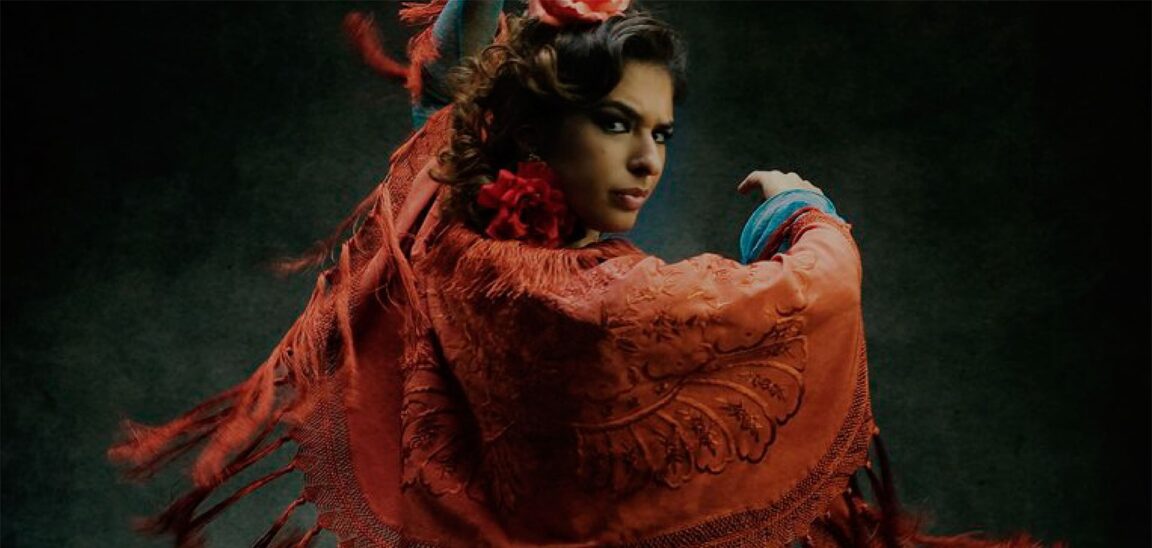
Featured image: A flamenco dancer in an embroidered red mantón, the fringed shawl, caught mid turn with a red flower in her hair, from Casa de la Memoria in Seville. Photo from Casa de la Memoria’s official website (casadelamemoria.es), used with credit. Native 1900px wide, resized to exactly 1600px.