 Camille Baptiste
Stromboli erupts after dark on most nights, and as of November 21, 2026, you can watch it legally in two ways: on foot to a guarded height limit that stops well below the craters, or from a boat holding off the Sciara del Fuoco, the open slope where the volcano throws its fire to the sea. The summit has been closed since 2019, there is no crater climb to buy at any price, and the rules that govern the night are set by ordinance, not by tour operators. Italy’s Civil Protection alert level stands at yellow, and INGV reported ordinary Strombolian activity through November 9 to 15, with lava overflows feeding the upper Sciara del Fuoco in early and mid November. Plan around those facts and Stromboli after dark is one of the great sights in the Mediterranean. Plan around an old summit photo and the evening ends at a barrier, or with a fine.
Quick Facts
- Status, November 21, 2026: Stromboli in continuing eruption; INGV reported Strombolian activity from the northern crater area vents during November 9 to 15, 2026, with lava overflows onto the upper Sciara del Fuoco
- Alert level: Yellow (attention) on the Dipartimento della Protezione Civile four level scale, green, yellow, orange, red; yellow means monitored parameters sit above the ordinary baseline, not that a major eruption is expected
- Summit: Closed since 2019. The crater terrace at about 750 metres and the highest point, Vancori at 924 metres, are off limits to everyone except scientists and civil protection staff
- On foot, Stromboli village side: Up to 290 metres alone; 290 to 400 metres only with an authorised volcanological guide, under Comune di Lipari ordinance number 16 of May 5, 2025
- On foot, Ginostra side: Up to 130 metres alone; guided groups may reach 400 metres on the Punta Corvi path
- Penalty: Walking above the limits, or above 290 metres without a guide, carries a fine of 500 euros
- Guided hike: About five hours and 8 kilometres to the 400 metre viewpoint over the Sciara del Fuoco; Magmatrek, the island guide cooperative, listed 30 euros per adult and 25 euros per child under 12 in 2026; season March 15 to October 31
- Group rules: Maximum 25 hikers per guide, excursions inside a set daily window running to midnight, helmet and respirator mask provided and required above 290 metres, signed risk waiver before departure
- By boat: Evening boats pause off the Sciara del Fuoco after dark, typically for 20 to 30 minutes; navigation closest to the slope is banned by the harbour authority
What is Stromboli doing right now, and what does yellow actually mean?
Stromboli is the northernmost of the seven Aeolian Islands and one of the few volcanoes on Earth in persistent activity. INGV, the national volcano institute that monitors it from its Etna Observatory in Catania, describes small explosions separated by minutes to hours, throwing incandescent fragments tens to hundreds of metres above the vents on the crater terrace at about 700 to 750 metres. That rhythm, regular enough that sailors called the island the lighthouse of the Mediterranean, is what gives the eruption style its name: Strombolian. Reporting INGV observations for November 9 to 15, 2026, the Smithsonian and USGS weekly report records Strombolian activity continuing from vents in the northern crater area at the head of the Sciara del Fuoco, and INGV bulletins record lava overflows from that area on November 2 to 3 and again around November 14, each flow staying in the upper Sciara. An overflow is good news for boat viewing and changes nothing about the walking limits.
The alert level needs translating, because two colour systems run at once. The one that governs access is the Civil Protection level, set by the Dipartimento della Protezione Civile from INGV monitoring assessments. At yellow, the level in force on November 21, 2026, the volcano is in a state of enhanced disequilibrium: parameters such as explosion frequency, gas flux and tremor sit above ordinary values, surveillance is strengthened, and local authorities can tighten access at short notice. Yellow is Stromboli’s working state for long stretches, not an emergency. Separately, INGV issues an aviation colour code for air traffic, which stood at orange in its November 3, 2026 notice after the early November overflows. That code speaks to pilots about ash, not to hikers about trails. The traveller’s rule is simple: check the Civil Protection level and the guide companies’ operating notice on the day itself, because the level, and with it the permitted heights, can move in either direction within a season.
How high can you actually walk, and when is a guide the law?
The framework is the mayoral ordinance of the Comune di Lipari, the municipality that administers Stromboli, number 16 of May 5, 2025. From Stromboli village, a walker may climb independently to 290 metres, where a viewpoint gives a side on view into the Sciara del Fuoco. Between 290 and 400 metres, an authorised guide is compulsory. Above 400 metres there is no public access at all, and there has been no legal route to the crater terrace or the summit since the stronger eruptions of 2019 closed the top of the mountain. From Ginostra, the small village on the western side reached only by boat or on foot, the independent limit is 130 metres, with guided groups able to reach 400 metres on the Punta Corvi path. Guides must be registered alpine or volcanological guides, groups are capped at 25 people per guide, excursions run inside a defined daily window that ends at midnight, and above 290 metres every hiker wears a helmet and a respirator mask supplied by the guide company and signs a declaration accepting the risks of the terrain. The 500 euro fine for breaking the height rules is enforced by checks on the path, and no operator can sell an exception.
The standard guided evening runs like this in season. Magmatrek, the cooperative of volcanological guides based by Piazza San Vincenzo in Stromboli village, sets out roughly three hours before sunset, climbs to the 400 metre terrace above the Sciara, and waits there as darkness turns each explosion into a fountain of orange against black rock. The round trip is about five hours and 8 kilometres with roughly 500 metres of climbing, and the descent is by headlamp on a track of sand and ash. Trekking boots and a torch are compulsory; a phone light does not pass. The listed price in 2026 was 30 euros per adult and 25 euros for children under 12, helmet included. One date matters more than any other in this article: the main guided season runs from March 15 to October 31. A traveller arriving on November 21, 2026 is outside it. The honest late November plan is the boat, the lower independent viewpoint within the rules, and a return in season for the guided terrace. Our companion piece, Stromboli volcano hiking, the 400 metre limit and pacing, works through the climb itself in detail.
How do the boat nights off the Sciara del Fuoco work?
The Sciara del Fuoco is a vast horseshoe shaped scar on the northwestern flank, running from the crater terrace to below sea level. Everything the craters throw out on that side travels down the Sciara in full view of the water. That is why the boat is not a consolation prize. From a deck off the Sciara after dark, the whole system is visible at once: the flash at the terrace, the brief fountain, then incandescent blocks bouncing down the slope. In an overflow week such as mid November 2026, a lava flow in the upper Sciara adds a steady glowing thread.
Practically, evening boats work three patterns. Boats based at Scari, the Stromboli landing, make the short run around the island’s northern point in the evening and hold off the Sciara for roughly 20 to 30 minutes after dark before returning. Day boats from Lipari and from Tropea on the Calabrian mainland build Stromboli into a longer island hopping day, with time ashore in the village in the late afternoon and the Sciara pause on the return leg. In season, a Lipari departure can also be combined with the guided hike, a long day of about 11 hours. Two limits govern every version. Navigation in the water closest to the Sciara is banned by the harbour authority, the Capitaneria di Porto, so the boat holds at its permitted distance and no captain may close in for a better photograph. And the sea decides: in rough weather the Sciara leg is shortened or dropped, and no ticket guarantees an eruption on schedule. Stromboli explodes often, but often is not always. Island hoppers should also note that the hydrofoil network, run by Liberty Lines from Milazzo and between the islands, winds down well before the eruptions are at their best in the darker months, which is why a boat night or a guided hike almost always means sleeping on Stromboli or returning on a tour boat to Lipari or Tropea. For the wider network the night sits inside, see our guide to the Aeolian Islands and their one ferry network.
Which eruptions close access entirely?
Three escalations override every plan in this article. The first is the paroxysm, a sudden explosion far larger than the ordinary rhythm, throwing bombs and blocks to the summit area and beyond. The paroxysms of July and August 2019 are the reason the summit is closed today, and Civil Protection is candid that paroxysms can be forecast only minutes ahead. Stromboli carries two automatic early warning systems for exactly this reason, one for paroxysmal explosions and one for tsunami, each sounding sirens with voice messages in Italian and English across Stromboli village and Ginostra. A siren is not a spectacle cue; it means move away from the shore and the slopes and follow local authority instructions immediately. The second escalation is a sustained lava overflow combined with instability on the Sciara. Overflows confined to the upper slope, like those of November 2026, leave access unchanged, but an overflow that follows a crater collapse or sends a pyroclastic flow down the slope and across the sea surface, as happened in May 2021, has previously raised the alert level to orange and closed trails and the surrounding sea area while the slope is assessed. The third is the administrative one, and it is the most common: when the alert level rises to orange, guided excursions are suspended or their ceiling lowered, and boat operators lose their Sciara holding area. The July 2024 escalation, when alert levels rose sharply during lava flows and stronger explosions, is the recent template. The practical translation is a single habit: the booking is a hope, the morning check is the plan. Read the Civil Protection status, read the INGV bulletin summary, and ask the operator which ceiling and which sea area are in force that day.
How should an island hopper sequence a Stromboli night?
Build the night as the fixed point and let the ferries arrange themselves around it, because the hydrofoil timetable will not bend. In season, the strongest pattern is two nights on Stromboli itself: a guided sunset hike on the first evening, when the 400 metre terrace gives the close view, and a boat night on the second, when the whole cone is visible from the water. One night only means choosing. Between March 15 and October 31, a fit walker who wants the eruptions close and loud takes the guided hike; anyone travelling with children, with limited mobility, or outside the hiking season takes the boat, which also suits Lipari based travellers using a combined day boat. In the darker months, when the guided season has ended and hydrofoils finish early, sleeping in Stromboli village or in Ginostra is a requirement for seeing the volcano after dark at all. Pack for the plan: boots and a headlamp for the hike, a warm layer for the boat deck, and a next morning with no tight connection, because a cancelled sailing after a windy night is an ordinary Aeolian event. What no itinerary should contain is a self guided push above 290 metres in the dark. The limits exist because the slope above them is where the volcano drops what it throws.
Frequently Asked Questions
Can you climb to the summit of Stromboli at night?
No. The summit area, including the crater terrace at about 750 metres and Vancori at 924 metres, has been closed since 2019. The highest public point is 400 metres, reached only with an authorised guide. Listings that offer a summit climb are out of date.
Do you need a guide to watch Stromboli erupt after dark?
Only for the higher viewpoint. A guide is compulsory between 290 and 400 metres, for the 400 metre terrace at dusk in season, March 15 to October 31. No guide is needed for the walk to 290 metres, or for any boat trip off the Sciara del Fuoco.
What does the yellow alert level mean for a visitor?
Yellow, the level in force on November 21, 2026, is the second of four Civil Protection levels. It means monitored parameters are above the ordinary baseline and surveillance is strengthened. Visiting under the ordinance rules continues, but limits can tighten at short notice, so recheck the level and the operator’s notice on the day.
Can you see lava from the boat trips off the Sciara del Fuoco?
Explosions and glowing fallout down the Sciara are the normal sight on a clear night, and during lava overflows, including those INGV reported in early and mid November 2026, a flow in the upper Sciara can also be visible. Nothing is guaranteed: boats hold at the distance the harbour authority permits, weather can cancel the Sciara leg, and the volcano’s rhythm varies.
What happens if Stromboli has a major explosion?
Large paroxysmal explosions close access. They ended summit access in 2019, they can be forecast only minutes ahead, and the island runs automatic siren systems for paroxysms and for tsunami. If sirens sound, leave the shoreline and slopes and follow local authority instructions. A rise in the alert level to orange also suspends or restricts guided hikes and boat holding areas.
Can you day trip to Stromboli, watch the eruptions and leave the same night?
Not on the scheduled hydrofoils, whose last departures leave before the eruptions show at their best, especially outside summer. The workable same day patterns are the organised day boats from Lipari or Tropea that include the Sciara del Fuoco pause after dark on the return leg. Otherwise, plan to sleep on Stromboli. Liberty Lines publishes the hydrofoil timetable; check it for the exact travel date.
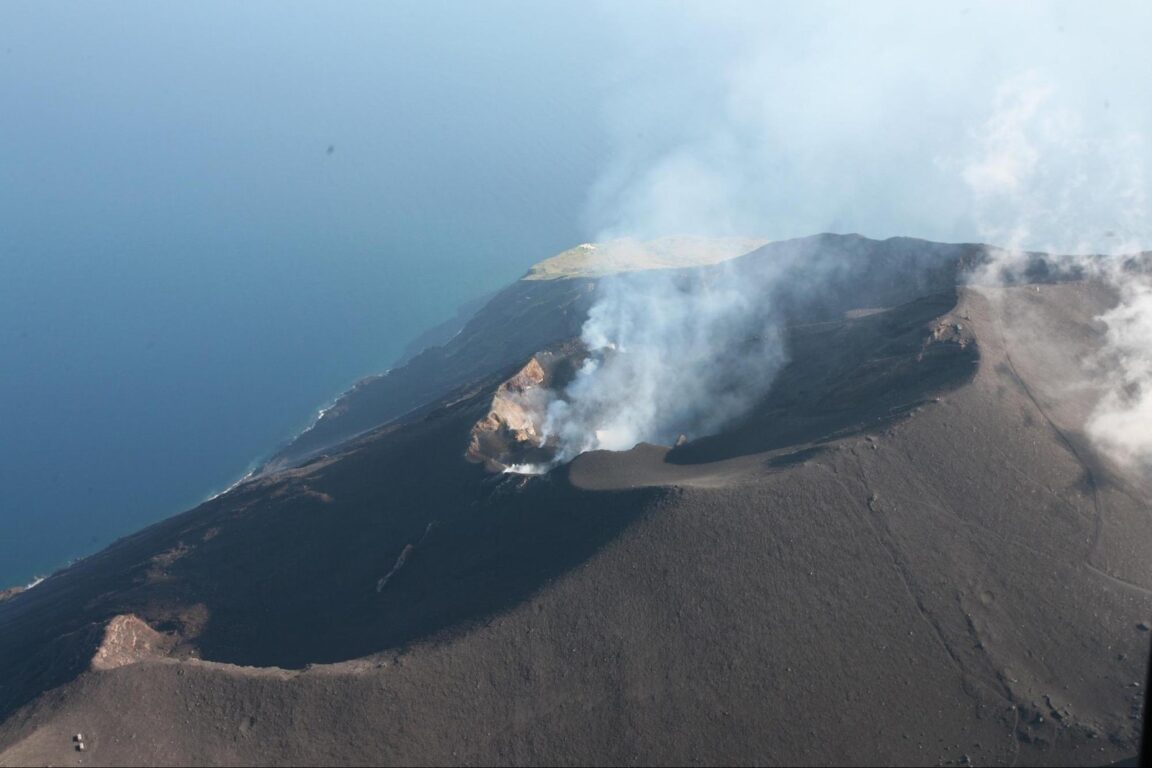
Featured image: Aerial view of Stromboli’s craters, with the Sciara del Fuoco in the background at left, Stromboli, 2009. Photo by G. De Astis, published by INGV (ingv.it), the volcano’s monitoring institute, used with credit.