 Jordan Ellis
Plan Stromboli around the correction first: there is no summit hike. The crater terrace and the 924 metre top of the volcano have been closed since 2019, and under the Lipari municipal ordinance of 5 May 2025 the highest anyone may walk is 290 metres alone and 400 metres with an authorised volcanological guide. That guided sunset hike, about 8 kilometres with roughly 500 metres of climbing over five hours, is still one of the great walks in Italy: a steep evening ascent to a viewpoint over the Sciara del Fuoco, an hour watching eruptions arc into the dark, and a headlamp descent to the village. Everything below covers the guide rules exactly as they stand, the fitness the climb really needs, and how to pace the effort and the recovery around it.
Quick Facts for Stromboli Volcano Hiking
- The headline rule: Summit closed since 2019. Independent walking is allowed to 290 metres on the village side; with an authorised guide the limit is 400 metres. Going higher, or above 290 metres without a guide, carries a 500 euro fine.
- The standard hike: Guided sunset excursion of about five hours, roughly 8 kilometres and about 500 metres of cumulative ascent, run from both Stromboli village and Ginostra in season.
- Season and price: The main operator season runs 15 March to 31 October. Magmatrek, the island’s volcanological guide cooperative, listed 30 euros per adult and 25 euros per child under 12 for its guided excursion in 2026.
- Group rules: Maximum 25 hikers per guide, guided excursions within a set daily window, helmets and respirator masks provided and required above 290 metres, and a signed risk waiver before departure.
- The volcano: Stromboli rises 924 metres above the Tyrrhenian Sea, has been in near continuous eruption for around 2,000 years, and typically produces small explosions every 20 to 30 minutes from its summit craters.
- The base: Sleep on the island. The guided hike ends after dark, hours after the last useful boats, so an overnight stay in Stromboli village or Ginostra is built into the plan.
Is the Stromboli summit open to hikers?
No, and any listing that still sells a crater climb is out of date. The summit area, including the crater terrace at about 750 metres and the highest point, Vancori at 924 metres, has been off limits since the stronger eruptions of 2019, and the closure is set by ordinance, not by operator choice. Access is governed by the Comune di Lipari, the municipality that administers the island, and the current framework is the mayoral ordinance of 5 May 2025: up to 290 metres independently on the Stromboli village side, up to 400 metres only with an authorised guide, with lower limits on the Ginostra side for independent walkers. Italian Civil Protection sets the volcanic alert level, which was yellow through autumn 2026 reports, and limits can tighten at short notice when activity rises, as they did in July 2024 when alert levels were raised sharply. Check the alert level and the operator’s current ceiling before booking, and treat any promised height as conditional on the day.
What are the licensed guide rules in detail?
Above 290 metres, a licensed guide is the law, not an upgrade. Guides on Stromboli are volcanological or alpine guides registered with the Regional College of Alpine and Volcanological Guides of Sicily; Magmatrek, founded in 2002 by guides who live on Stromboli and in Ginostra, states that all of its guides belong to that college. Groups are capped at 25 people per guide, guided excursions run inside a defined window that the 2025 ordinance set from late morning to midnight, and above 290 metres every hiker wears a helmet and a respirator mask, both provided by the guide company. Hikers sign a waiver acknowledging the volcanic risk before setting out, guides maintain contact with the monitoring point in the village during the excursion, and the penalty structure is real: a 500 euro fine for visitors who climb beyond the limits, and professional consequences for guides who allow it.
Kit rules are enforced at the trailhead. Sturdy hiking boots are mandatory and hikers are turned away in trainers, sandals or beachwear; a headlamp is required for the descent, long trousers are expected on the upper mountain, and operators can refuse anyone whose clothing or health makes the climb unsafe. Children join under operator conditions, commonly from around ten years old on the standard excursion, and the hike is not suitable for people with asthma, heart conditions or serious vertigo. None of this is bureaucracy for its own sake: the path crosses loose volcanic ground above a slope, the Sciara del Fuoco, down which the volcano routinely sends glowing material to the sea.
How does the guided sunset hike actually run?
The excursion is timed backwards from darkness. Groups meet in the village in the afternoon, with departures shifting between about 3pm and 6pm across the season to match sunset, walk out past the old cemetery and climb steadily through scrub and then bare volcanic slopes. The ascent to the 400 metre viewpoint takes around two and a half to three hours with regular breaks, and the reward is position rather than altitude: the viewpoint looks across the Sciara del Fuoco to the crater terrace above, close enough that each explosion is a fountain of orange fragments against the darkening sky, with the sound arriving a breath after the light. Groups typically spend the better part of an hour at the top as full dark falls, then descend by headlamp for one and a half to two hours, reaching the village around five hours after departure. The full route is about 8 kilometres with roughly 500 metres of climbing, figures published by the island’s guide companies for the current trail.
What you see is not guaranteed in detail, because Stromboli performs on its own schedule, but its rhythm is unusually reliable for a volcano. The Global Volcanism Program records typical Strombolian activity as small explosions every 20 to 30 minutes, throwing incandescent material a hundred metres or more above the craters, and this pattern has continued, with interruptions for larger events, for centuries. From the sea the same show explains the island’s old nickname, the Lighthouse of the Mediterranean.
How fit do you need to be, and how is the effort paced?
Honest benchmark: if you can climb 500 metres of steep, loose path over two and a half hours, at a slow group pace with breaks, and then walk down in the dark, you are fit enough. The difficulty is the surface and the gradient rather than the distance: volcanic sand and ash give underfoot on the upper slopes, the path is unrelenting rather than technical, and summer departures still start in real heat even in late afternoon. The pacing built into the excursion helps: guides stop regularly, the group moves at the speed of its slowest member, and the long pause at the viewpoint is a genuine recovery hour before the descent. Help it along by arriving on the island the day before rather than hiking off a ferry, keeping the hike day itself empty, eating a proper lunch, and starting hydrated, with at least a litre and a half of water per person in the bag as operators advise.
Anyone building up to this level of volcano walking in Sicily can usefully compare it with our Madonie Mountains trails adventure, where the same steady climb, break and descend pacing applies on limestone rather than ash, and with the higher, colder guided walking in our Pollino National Park trails adventure.
What kit is required, and what should you carry?
- Boots: Sturdy hiking boots with ankle support and a grippy sole. Mandatory, checked at departure, and the single item that decides whether you climb at all. Hire shops in the village exist for travellers who arrive without them.
- Headlamp: Required for the night descent. The guide company may have spares, but bringing your own removes the risk.
- Helmet and mask: Provided by the guide and compulsory above 290 metres. No need to buy or carry your own.
- Clothing: Long trousers for the upper mountain, a breathable layer for the climb, and a warm layer and windproof for the viewpoint, where an hour standing still after sunset feels cold in any month.
- Water and food: At least 1.5 litres of water per person, plus snacks or a sandwich for the top. There is nowhere to buy anything on the mountain.
- Small essentials: Sunscreen and a hat for the first hour, a change of top if you sweat heavily on the climb, and a bag for the fine black ash that will get into everything.
What does Ginostra add, and what are the alternatives?
Stromboli has two villages. The main village, San Vincenzo, on the north east coast has the hotels, the guide offices and the black sand beaches. Ginostra, on the south west coast, is reachable only by boat or on foot, has no cars and a handful of houses, and offers the quieter version of the island: guided excursions also run from Ginostra, climbing its side of the mountain, and its terraces face the sunset and the Sciara del Fuoco across the water. A stay split between the two villages, or a boat trip round to Ginostra for lunch and a swim, is the best use of a second day. If the mountain closes entirely, which happens when the alert level rises, the fallback is the sea: night boat trips hold position off the Sciara del Fuoco after dark and watch the same eruptions from the water, an experience many visitors rate as highly as the hike, and the independent walk to the 290 metre viewpoint remains a worthwhile shorter outing in daylight when it is open.
How do you get to Stromboli, and how should the days be paced?
The island is reached only by sea. Hydrofoils and ferries run from Milazzo on the Sicilian mainland with Liberty Lines and Siremar, there are connections from Lipari and the other Aeolian Islands, and a ferry links Naples to Stromboli. Build the trip as a minimum of two nights if you can: day one for the crossing, the village and an early night; day two kept deliberately empty until the afternoon hike, with a late breakfast, a swim and a long lunch as the whole programme; day three for a slow morning, Ginostra by boat or the 290 metre viewpoint, and the ferry out. Recovery is part of the product here. Legs that have climbed and descended 500 metres of ash will feel it the next morning, calves especially, so stairs, another summit attempt or a same day Etna transfer are all poor planning. Swim, eat, sit in the piazza, and let the island’s pace do the work.
Frequently Asked Questions
Can you climb to the summit of Stromboli?
No. The summit and crater terrace have been closed since 2019. Under the Lipari ordinance of 5 May 2025, independent walkers may reach 290 metres and guided groups 400 metres, and climbing higher carries a 500 euro fine. Any operator advertising a crater climb is selling an outdated product.
How much does the guided Stromboli hike cost?
Magmatrek listed its guided excursion at 30 euros per adult and 25 euros per child under 12 for 2026, including the guide, helmet and mask. Other authorised operators charge similar rates. The excursion runs in season from 15 March to 31 October and lasts about five hours.
How hard is the Stromboli hike?
Moderate to demanding. Expect about 8 kilometres, roughly 500 metres of climbing on steep, loose volcanic ground, two and a half to three hours up and a headlamp descent. Regular hikers manage it comfortably at the guided group pace; sturdy boots are compulsory.
Do you need to book the Stromboli hike in advance?
Yes, in season. Groups are capped at 25 per guide, summer departures fill, and operators need to confirm that conditions and the current alert level allow the excursion. Book ahead, then reconfirm on the island the day before.
What happens if the volcano closes the trail?
Access limits tighten when Civil Protection raises the alert level, and excursions can be suspended at short notice. The alternatives are the independent walk to the lower viewpoint when open, and night boat trips that watch the eruptions from off the Sciara del Fuoco. Build a spare day into the trip so a closure is a change of plan, not a ruined one.
Can you visit Stromboli as a day trip and still hike?
Not realistically. The guided hike is a sunset excursion that returns to the village around five hours after departure, long after the last boats that would make a day trip work. Stay at least one night on the island, and two if your schedule allows.
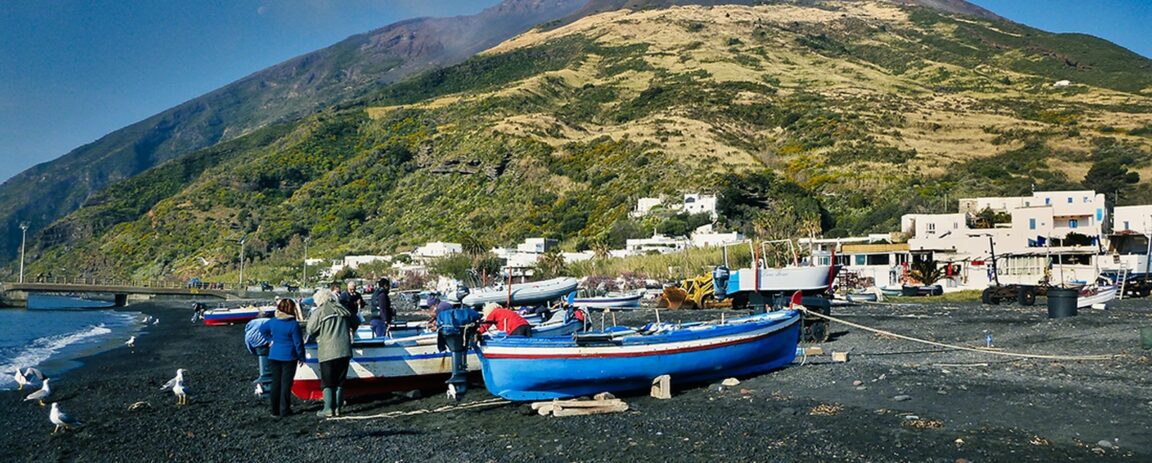
Featured image: Fishing boats on the black sand beach at Stromboli village, with the volcano cone rising behind, by Lyle Wilkinson via Unsplash, Unsplash License. Access rules, season and prices checked 17 November 2026 against the Lipari ordinance of 5 May 2025 as reported with INGV and Protezione Civile data, and against Magmatrek, the island’s guide cooperative.