 Elena Vasquez
Pack for the Alentejo in July around one fact: this is the hottest corner of Portugal, where Evora averages daytime highs of 33 to 34 degrees Celsius, nights stay near 17 degrees, rain is close to zero, and heatwave afternoons push past 40 degrees. The bag that works is a heat management system, not a wardrobe. Breathable natural fibres in pale colours form the base, one serious sun kit and one proper walking shoe handle the white villages, a compact swim kit covers pool afternoons and the Alqueva lake, and everything is chosen to be rinsed, dried overnight and worn again, because July sightseeing here runs on an early start, a long shaded middle and a second outing after 6pm.
Quick Facts for Packing for the Alentejo in July
- The climate in one line: Evora in July averages highs around 33 to 34 degrees Celsius and lows around 17 degrees, with roughly 370 hours of sunshine in the month and almost no rain; Monsaraz and the eastern plains run a degree or two hotter still.
- The heatwave reality: On the warmest July days temperatures usually reach around 40 degrees and have gone higher, so the bag must work at 40 degrees, not just at the average.
- The daily rhythm: Sightsee from 8am to 1pm, retreat to shade, a pool or a dark room through the fiercest hours, then go out again from about 6pm, when villages come back to life and dinner rarely starts before 8.30pm.
- The bag: One medium case or a 40 to 50 litre bag is plenty, because July clothes are thin; spend the saved weight on shoes, sun protection and a refillable water bottle instead of extra outfits.
- Shoes: Two pairs do the trip: cushioned walking shoes with grip for polished cobbles, worn in transit, and sandals that double for pool decks and evening terraces.
- The items people forget: A wide brim hat that shades the neck, a lightweight scarf or overshirt for churches and air conditioned buses, and electrolytes for days when water alone does not catch up.
What does July in the Alentejo actually feel like?
The Alentejo covers about a third of mainland Portugal and holds only a small share of its people, and in July its interior plains bake under a dry, continental style heat that the Atlantic never reaches. Evora, the regional capital and a UNESCO World Heritage city since 1986, is regularly among the hottest cities in the country, sharing that title with Beja to the south. Long term records put Evora’s July average high at about 33 to 34 degrees Celsius, with average nights near 17 degrees and monthly rainfall of only a few millimetres. The gap between day and night matters for packing: a July evening after a 38 degree day can feel almost cool at midnight, and a thin extra layer earns its place for late dinners and rooftop viewpoints.
Sunshine is the other constant. July is the sunniest month of the Evora year, at around 370 hours, which means roughly twelve hours of strong sun a day and a UV load that burns unprotected skin quickly, especially on the pale stone of hilltop villages such as Monsaraz, Marvao and Evoramonte, where shade is scarce and light bounces off whitewash in every direction. The practical translation is that sun protection in July Alentejo is equipment, not cosmetics: it belongs in the bag with the same priority as shoes.
How should a July day be paced in the heat?
Pacing is the real packing skill, because the clothes only work if the day is built around them. The pattern that suits the region is the one local life already follows. Start early and do the exposed sights first: the Roman Temple and cathedral roof in Evora, the castle walls at Monsaraz, the megaliths at Almendres, all before noon. Book indoor sights, museums, wine cellars and long lunches for the early afternoon, when streets empty and even short walks feel punishing. Treat 2pm to 5pm as protected time for a pool, a lake beach on the Alqueva, a nap in a shuttered room or a slow hour in a cafe, and never schedule a transfer, a viewpoint climb or a vineyard walk in that window if it can be helped.
The second shift is the reward. From about 6pm the light turns gold, temperatures slide back through the low 30s, swallows come out over the rooftops and villages refill. Evening is for the second walk of the day, the sunset from Monsaraz over the Alqueva, which the official Turismo do Alentejo site singles out among the region’s great sunset spots, and for dinner at Spanish hours. Packing follows the rhythm: a day bag that carries water, hat and sunscreen for the morning, swim kit ready at the hotel for the afternoon, and one smarter outfit kept fresh for the evening, because that is when the Alentejo is at its best and when photographs happen.
What fabrics and clothes earn their place in the bag?
July rewards natural, loose and pale. Linen is the region’s honest fabric: linen shirts, trousers and dresses breathe in dry heat, look right in white villages and dry overnight after a rinse. Cotton is second best and heavier when damp; light cotton and linen blends are a good compromise for anyone who finds pure linen too creased. Technical travel fabrics also work well here because the heat is dry rather than humid, so moisture wicking tops dry fast and pack tiny, though they can look out of place at a good restaurant table in Evora. The rule that keeps the bag small is a strict colour palette of white, stone, sand and one accent colour, so every top matches every bottom and nothing travels that only works in one outfit.
Numbers that work for a week: four to five tops, two bottoms in long trousers or a long skirt for sun and church cover, one pair of shorts for pool and lake settings rather than village sightseeing, one dress or smart shirt for evenings, and underwear and socks planned around a rinse every second night. Shoulders and knees covered is still the respectful default inside churches such as Evora Cathedral and the Chapel of Bones, and a lightweight scarf or overshirt solves it without adding a full outfit. Sleepwear should be the thinnest thing in the bag, and anyone sensitive to air conditioning should add one long sleeved layer for buses, trains and cellar tours, where temperatures can sit fifteen degrees below the street outside.
Which shoes handle white village cobbles and pool decks?
Alentejo villages are beautiful underfoot and treacherous in the wrong shoes. Streets in Monsaraz, Marvao, Castelo de Vide and old Evora are laid with polished stone and schist that turns slick, gradients are steep, and July sightseeing easily stacks up 15,000 steps before lunch. The main shoe should be a broken in walking shoe or sturdy sandal with a cushioned sole, a grippy tread and support for a full morning, worn on the journey to save bag space. Thin fashion sandals, smooth leather soles and heels are the three classic mistakes; each one ends with slower walking, sore feet or a twisted ankle on a castle stair.
The second pair is the double duty pair: a sandal with a back strap and a sole that grips wet stone, so it works on a pool deck, at a river beach on the Alqueva and at an evening terrace without a third pair travelling at all. Anyone planning rural walks between villages or out to the Almendres Cromlech should keep the walking shoes as the default and treat sandals as the change pair, not the other way round. For more on building a walking first bag for southern Europe, see our guide to packing for the Azores in September, where the same two shoe logic handles island cobbles and crater paths.
What does the full packing list look like?
- Tops: Four to five, in linen, cotton linen blend or technical fabric, pale colours, at least one with sleeves for sun and churches.
- Bottoms: Two long and light, trousers or a long skirt, plus one pair of shorts reserved for pools, lakes and the coast.
- Evening outfit: One dress or one smart shirt and trousers combination, kept unworn during sightseeing hours so it stays fresh.
- Layers: One lightweight overshirt or scarf for churches and air conditioning, and one thin long sleeved layer for late evenings.
- Shoes: Broken in cushioned walking shoes with grip, plus strap sandals that grip wet stone and dress up for dinner.
- Sun kit: Wide brim hat shading the neck, sunglasses, high protection sunscreen for face and body, and lip balm with sun protection.
- Swim kit: One swimsuit, a fast drying travel towel, and a dry bag or pouch that keeps a phone and book safe on a pool deck or lake beach.
- Water kit: A refillable bottle of at least 750 millilitres, electrolyte sachets, and a small bottle that lives in the day bag for village walks.
- Health kit: Aftersun or aloe gel, blister plasters, any personal medication carried in hand luggage, and a basic painkiller and rehydration salts.
- Tech and documents: Phone, charger and European plug adapter, a power bank for long driving days, and bookings saved offline for rural areas with thin signal.
How does the bag handle pools, lakes and the coast?
The afternoon retreat is part of the itinerary, so the swim kit deserves planning rather than leftovers. Many Alentejo stays, from Evora hotels to rural herdades among the cork oaks, have pools, and the region adds two bigger waters: the Alqueva, one of Europe’s largest artificial lakes, with river beaches near Monsaraz and Moura, and the Alentejo coast around Vila Nova de Milfontes for anyone ending the trip by the Atlantic. One swimsuit is enough if it dries fast and is rinsed each night; a second is a luxury that earns its space only on a pool heavy itinerary. A sarong or light cover up doubles as a church shoulder cover, a picnic cloth and a beach layer, which is exactly the kind of triple duty item a July bag should be built from.
Two cautions belong in this section. First, midday sun on water doubles exposure, so the pool hours still need the hat, the sunscreen and a shade plan; the retreat is from peak heat, not a licence to bake beside the water. Second, stone and tile around pools and lake jetties get extremely hot underfoot and slippery when wet, which is another reason the second shoe needs a real sole rather than a foam flip flop build.
What health and heat kit is non negotiable?
Heat illness in the Alentejo rarely arrives dramatically; it accumulates through a morning of sightseeing on too little water, a skipped lunch and a second walk taken too early. The defence is boring and effective: drink before thirst, add electrolytes on the hottest days, eat a real lunch in the shade even when appetite dips, and treat a headache or sudden tiredness as a stop signal rather than a challenge. The bag supports this with the bottle, the sachets, a salty snack reserve and the discipline to carry them. Sunscreen needs reapplying after swimming and every couple of hours on exposed sights such as castle walls, and the hat is not optional kit for anyone with fair skin or thinning hair at this latitude in July.
Medication and documents travel in hand luggage on the way in, and anyone driving the region should keep water in the car as a rule, because Alentejo distances are long, villages are far apart and a breakdown at 3pm in July is a heat event, not an inconvenience. Travellers pacing a more active southern Europe trip alongside this one may also find our Madonie Mountains trails adventure useful for how heat, water and start times are handled on exposed limestone paths.
How do you pack it all into one bag?
July is the easiest month of the year to pack light, and the Alentejo rewards it, because cobbled lanes, castle town stairs and small hotel lifts all punish a heavy case. Roll the thin clothes, cube the sun and swim kits separately so the afternoon change takes thirty seconds, and keep the day bag packed the night before with bottle, hat, sunscreen and scarf, so the early start that the whole system depends on is never delayed by repacking. Wear the walking shoes and the heaviest layer in transit. Leave space rather than filling it: Alentejo purchases are cork goods, pottery from Sao Pedro do Corval and wine, and at least one bottle of good Alentejo red deserves a protected corner of the bag on the way home.
Frequently Asked Questions
How hot does the Alentejo get in July?
Evora averages daytime highs of about 33 to 34 degrees Celsius in July, with nights near 17 degrees and almost no rain. Heatwave days usually reach around 40 degrees and can go higher, and eastern towns such as Monsaraz often run slightly hotter than Evora, so pack and plan for 40 degrees rather than for the average.
What is the best time of day to sightsee in the Alentejo in summer?
Early morning and evening. Do exposed sights such as castle walls, viewpoints and megaliths before noon, protect the hours from about 2pm to 5pm for shade, a pool or rest, and take the second walk of the day after 6pm, when villages refill and temperatures fall.
Can one bag really cover a week in the Alentejo in July?
Yes. July clothes are thin, the palette can be kept to pale neutrals that all combine, and a rinse and dry routine every second night halves the clothing count. A medium case or a 40 to 50 litre bag holds the full list here, including shoes and swim kit, with room left for purchases.
What shoes are best for Monsaraz and the white villages?
Broken in walking shoes with cushioning and a grippy sole. Village streets are polished stone and schist, steep in places and slick when dusty or wet, so smooth soles, thin sandals and heels are poor choices. Add strap sandals with a real sole as the pool and evening pair.
Is the Alqueva lake good for swimming stops?
Yes. The Alqueva, one of Europe’s largest artificial lakes, has river beaches near Monsaraz and Moura that work well as the afternoon heat retreat, and the Monsaraz walls above the lake are a noted sunset spot. Pack the swim kit, a fast drying towel and full sun protection, because shade is limited on the shore.
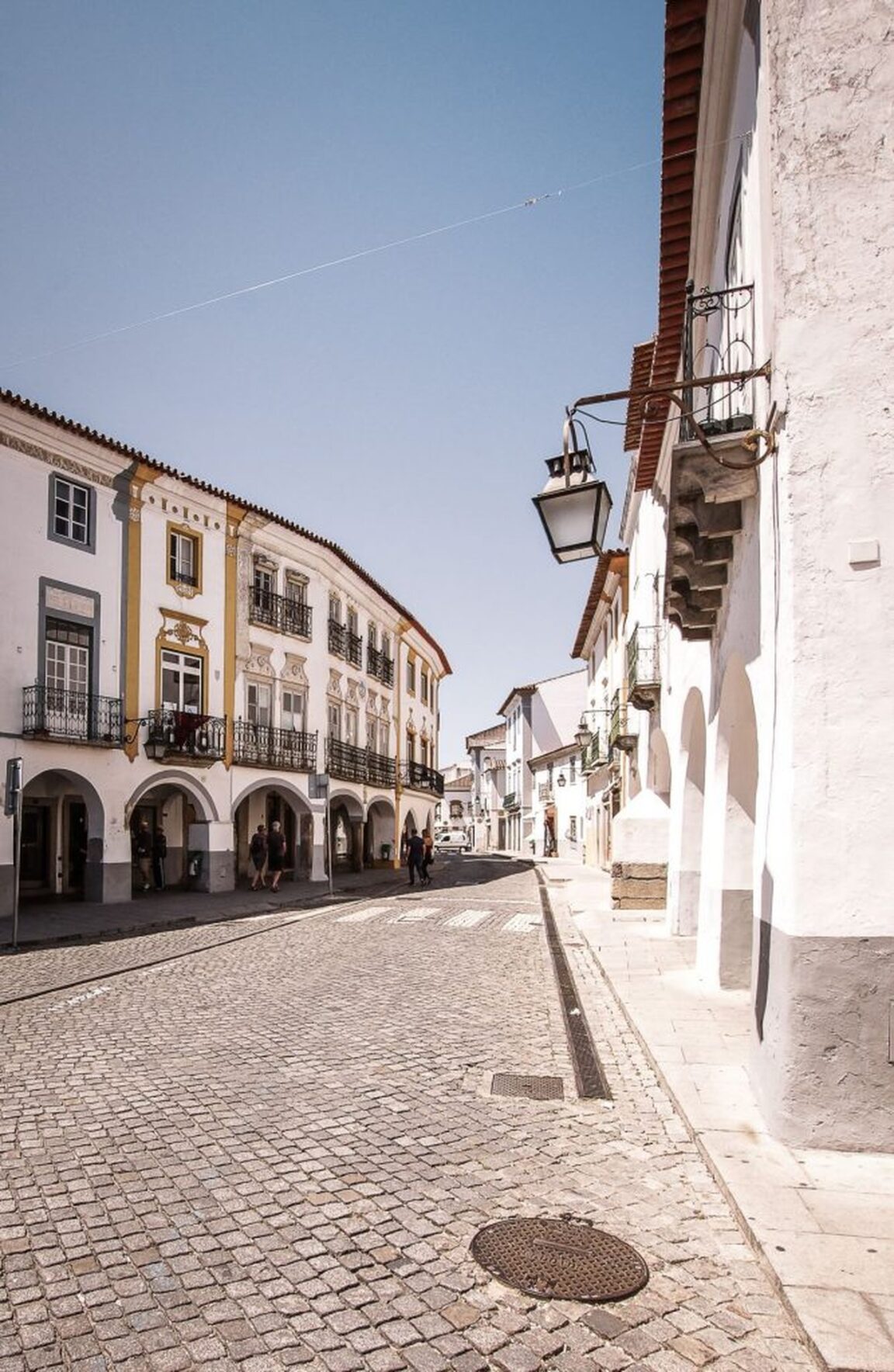
Featured image: A cobbled, whitewashed street in Evora, Alentejo, by Frank Nurnberger via Unsplash, Unsplash License. Climate figures checked 17 November 2026 against long term Evora records; regional highlights checked against Turismo do Alentejo, the region’s official tourism site.