 Sofia Rossi
Do the Reggia di Caserta in one fixed order and Europe’s largest royal palace stops being overwhelming: Royal Apartments first, while you are fresh and before the school groups peak; then out into the Royal Park and straight up the three kilometre water axis, the Via d’Acqua, to the Grand Cascade; then the English Garden at the top, before its early last entry cuts you off; then walk or ride back down past the fountains at a stroll. The numbers that govern the day, all confirmed on the palace’s official site for November, are these: the full ticket, apartments plus park plus English Garden, costs 18 euros, plus 1 euro if bought online through TicketOne, the only authorised online seller; the apartments open 08:30 to 19:15 with last entry at 18:15; and the whole complex is closed every Tuesday, as well as on 1 January and 25 December. The trap is the park, not the palace: in November the park closes at 15:30 and the English Garden at 15:00, hours before the apartments, so garden first timers who save the outdoors for the afternoon lose it entirely.
Quick Facts
- Site: Reggia di Caserta, Piazza Carlo di Borbone, Caserta, Campania; the Bourbon palace of Charles VII, designed by Luigi Vanvitelli and begun in 1752, with Caserta station facing the palace across the square
- Full ticket: 18 euros for Royal Apartments plus Royal Park plus English Garden, plus 1 euro online fee; TicketOne is the only authorised online seller, and the Piazza Carlo di Borbone ticket office sells on site
- Other tickets: Park plus English Garden 9 euros; apartments only 12 euros, sold when the park or garden is closed; apartments after 17:00, 5 euros, park excluded; a park only ticket excluding the English Garden is sold only at the ticket office
- Closed: Every Tuesday, 1 January and 25 December; the English Garden is also closed on the first Sunday of each month and on all free admission days
- November hours, apartments: 08:30 to 19:15, last entrance 18:15; the Court Theatre opens Saturday and Sunday only, 10:00 to 13:00
- November hours, outdoors: Royal Park 08:30 to 15:30, last entrance 14:30; English Garden 08:30 to 15:00, last entrance 14:00; park hours shrink and stretch with the season, the apartments do not
- Scale: About 1,200 rooms in the palace and some 120 hectares of park; the Via d’Acqua water axis runs about 3 kilometres from the palace to the Grand Cascade
- Time needed: A full day done properly; two hours for the apartments, three or more for the park and English Garden, and no honest way to compress both into an afternoon in winter
What order do the Royal Apartments run in, and why does it matter?
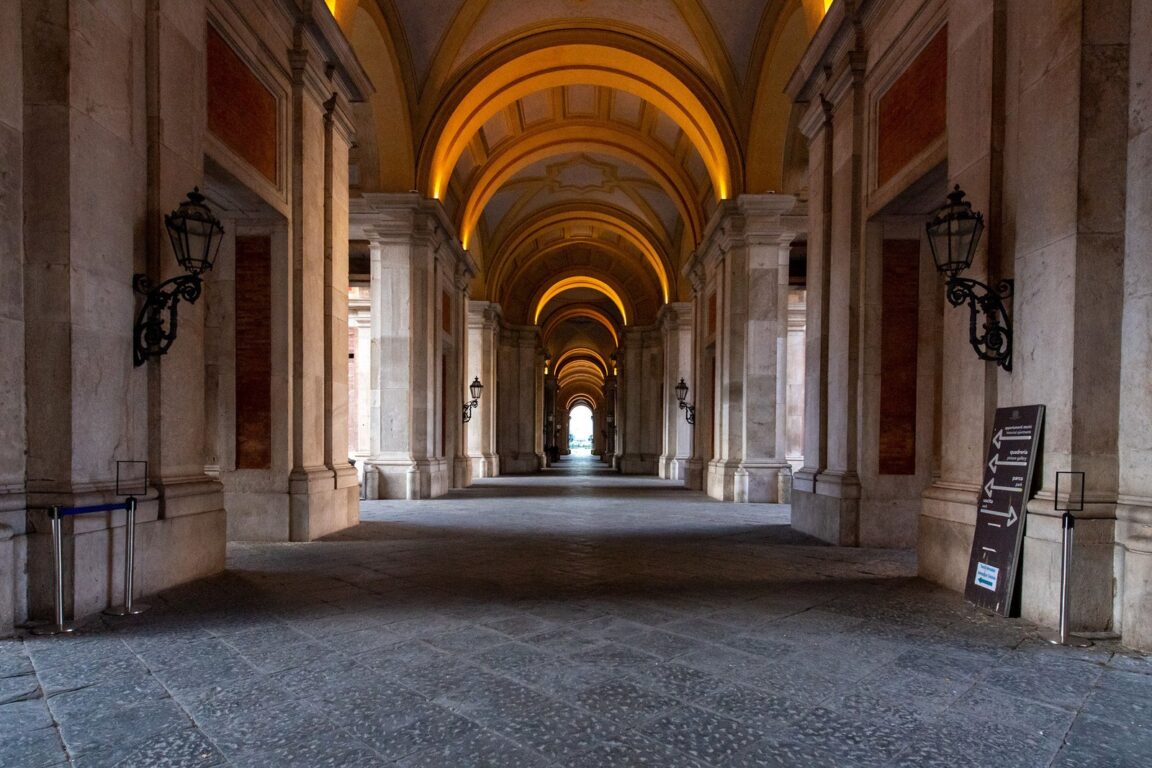
The visit begins with theatre before a single painting appears. From the central entrance you step into the great octagonal vestibule and the cannocchiale, the telescope: Vanvitelli aligned the palace, the park axis and the waterfall into one straight sightline, so the cascade sparkles at the end of a three kilometre vista before you have climbed a stair. Then the Scalone d’Onore, the grand staircase of honour, splits and sweeps upward in marble, designed to slow a courtier, and a visitor, into the right frame of mind. At the top sits the Palatine Chapel, modelled consciously on Versailles, which still keeps its own hours and Sunday Mass.
Beyond the chapel the apartments run in two distinct halves, and reading them in order is reading the Bourbon century. The antechambers and guard rooms lead to the Throne Room, the palace’s ceremonial summit, finished late and vast. Then come the older apartments, the 18th century rooms, rococo in spirit, frescoed, mirrored and intimate by palace standards, including the queen’s rooms and the celebrated seasonal rooms. The route continues into the 19th century apartments, heavier, neoclassical and imperial in taste, and through the palace library, whose shelves and globes are the visit’s quiet highlight. The practical point: do not dawdle in the first rooms. Visitors who spend an hour in the antechambers rush the library and the older apartments, which are the rooms they came for. Keep a steady pace until the Throne Room, then slow down.
How do tickets and timing actually work on the day?
Buy the full 18 euro ticket unless the park is closed by weather; it is the only version that includes the English Garden, and the garden is half the reason to come. Online sales run exclusively through TicketOne with a 1 euro fee, and timed entry applies, so book a morning slot: the official November timetable gives the park barely seven hours, and every hour of late start is subtracted from the garden end of the day, never from the apartments. Reduced price tickets exist for eligible young EU visitors with ID and under 18s enter free under the standard Italian state museum rules; check the official tickets page when booking, because reduction bands are the detail most often changed.
Two dates deserve a warning in bold. First, Tuesdays: the palace is simply closed, every week, and day trippers from Naples still regularly arrive at a locked gate. Second, the free first Sunday of the month: entry costs nothing, crowds surge, and the English Garden, the Court Theatre and several palace rooms are closed on free admission days, so the free visit is a materially smaller visit. The connoisseur’s alternative is the 5 euro evening ticket for the apartments after 17:00, park excluded, which buys the state rooms in near quiet at the end of the day. Readers planning the other great Italian palace garden day should compare our Hadrian’s Villa done properly guide, where the same free Sunday trap applies.
How should you work the park, the waterfall axis and the shuttle?
Out of the palace’s rear facade the park unfolds in two different languages. Below is the formal half: the Bosco Vecchio and then the Via d’Acqua, the long central axis of canals, basins and fountain groups, the Fountain of Diana and Actaeon, the Fountain of Venus and Adonis, the dolphins and Aeolus, climbing in gentle stages toward the Grand Cascade, where Vanvitelli’s aqueduct pours the whole system down the hillside. It is about three kilometres from palace to cascade, uphill all the way, and it is the single greatest walk in any Italian royal park. Above and to the side, hidden at the top, is the other language entirely: the English Garden.
Logistics decide whether you enjoy it. A shuttle bus service operates inside the park along the axis; confirm the day’s running and ticket arrangements at the park entrance, ride it up to the cascade in the morning when legs and hours are precious, and walk back down through the fountains, reading each group properly on the descent. On foot both ways, budget at least ninety minutes of pure walking before any looking. In November, with the park closing at 15:30 and last entry at 14:30, the only sane shape is apartments at opening, park by late morning, cascade and garden by early afternoon. Summer visitors get park hours into the evening and can reverse the order, chasing the light up the axis instead.
What makes the English Garden worth its early deadline?
The English Garden, created from the 1780s for Queen Maria Carolina, is one of the earliest English style landscape gardens in Italy, and the deliberate opposite of everything below it: no axes, no symmetry, just winding paths, a lake, grottoes, a bathing house with a statue of Venus, fake ruins and rare trees collected from across the world. After two hours of Bourbon geometry it feels like walking into a different century’s idea of nature, which is exactly what it is. It sits at the far top of the park beside the cascade, keeps the shortest hours on the site, 08:30 to 15:00 in November with last entry at 14:00, and closes entirely on free admission days. Go there straight from the cascade, not after a leisurely fountain descent, and give it a full hour. Pair the day with the other great Campanian antiquity excursion in our Segesta done properly guide if the trip continues to Sicily, where the same early start logic applies.
Frequently Asked Questions
How much is the full Reggia di Caserta ticket?
18 euros for the Royal Apartments, Royal Park and English Garden combined, plus a 1 euro fee when bought online through TicketOne, the only authorised online seller. Park plus English Garden without the apartments costs 9 euros, and an evening apartments only ticket after 17:00 costs 5 euros.
When is the Reggia di Caserta closed?
Every Tuesday, and on 1 January and 25 December. The English Garden is additionally closed on the first Sunday of each month and on free admission days, and the Court Theatre opens only on Saturday and Sunday mornings.
What time does the park close in November?
The Royal Park opens 08:30 to 15:30 in November, with last entrance at 14:30, and the English Garden 08:30 to 15:00, last entrance 14:00. The Royal Apartments stay open far later, to 19:15. Park hours change by month, so check the official opening times page for your date.
How long does a proper visit take?
A full day. Allow about two hours for the Royal Apartments, at least ninety minutes of walking on the three kilometre park axis, and an hour for the English Garden. In winter, when the park closes mid afternoon, arrive at opening time or the gardens will not fit.
How do you get to the Reggia from Naples?
By regional train to Caserta station, which stands directly across Piazza Carlo di Borbone from the palace entrance. The journey takes under an hour from Napoli Centrale, making the Reggia the easiest great palace day trip in Campania.
Last updated 17 November 2026. Hours and prices checked against the Reggia di Caserta official site, reggiadicaserta.cultura.gov.it, on the day of writing; park hours vary by month and the park can close in severe weather.