 Jonas Lindqvist
Hadrian’s Villa is not a villa in any modern sense. It is a 120 hectare imperial city of palaces, baths, theatres, libraries and pools that Emperor Hadrian built between 118 and 134 AD in the countryside below Tivoli, and the way to do it properly is to treat it as a city walk, not a monument stop: enter at the 8.30am opening, walk the long green canal of the Canopus first while it is empty, loop back through the Maritime Theatre island, and save your remaining energy for the great baths and the Piazza d’Oro. The standard ticket is 15 euros on the official Villae institute pricing, the site is a UNESCO World Heritage Site, and the single most useful purchase is the 30 euro VILLAE Pass, which adds Villa d’Este and the Sanctuary of Hercules Victor within 72 hours and turns Tivoli into a coherent two day plan.
Quick Facts
- Site: Villa Adriana (Hadrian’s Villa), Largo Marguerite Yourcenar 1, Villa Adriana, Tivoli, about 30 km east of Rome; UNESCO World Heritage Site since 1999
- Built: Between 118 and 134 AD by the Emperor Hadrian; the excavated complex covers about 120 hectares, the largest imperial villa of the Roman world
- Standard ticket: 15 euros; reduced 2 euros for eligible visitors aged 18 to 25; under 18s free, on the official Villae pricing
- VILLAE Pass: 30 euros, covering Hadrian’s Villa, Villa d’Este and the Sanctuary of Hercules Victor within 72 hours of first use
- November hours: Entry 8.30am to 3.30pm, exit by 5pm, in the November to December band of the official calendar; April to September entry runs to 6pm with exit by 7.30pm
- Closed: 1 January and 25 December only
- Free entry: The first Sunday of each month, plus 25 April, 2 June and 4 November
- Time needed: Three hours minimum; four to five for the full circuit without rushing
- Pairing: Villa d’Este, the Renaissance fountain villa in Tivoli town, is run by the same Villae institute and is the natural second half of the day or the following morning
What exactly was Hadrian building out here?
Hadrian ruled the Roman Empire from 117 to 138 AD and spent much of the reign travelling it. The villa below Tivoli, begun a year into the reign and occupied from the 120s, was his answer to Rome: a seat of government designed by an emperor with strong architectural opinions, laid out as a series of pavilions and precincts that quoted the famous places of the empire he had seen. Ancient sources and the buildings themselves tie names to those travels, most famously the Canopus, named for the canal town near Alexandria in Egypt. This was never a holiday cottage. At its height the complex housed the imperial court, officials, guards and an army of staff, with service tunnels below the gardens so that the machinery of the place stayed invisible to the people using it.
Scale is the thing to grasp before you arrive. The site is roughly a kilometre and a half end to end, paths are gravel and grass, shade is patchy, and there is no shortcut that does not cost you a headline building. Visitors who budget an hour see the Canopus and leave thinking the villa is pretty. Visitors who budget a morning understand that it was a working capital. Plan footwear, water and time accordingly, and use the official model and map near the entrance to fix the geography in your head before you set off.
Why does the Canopus deserve to be first?
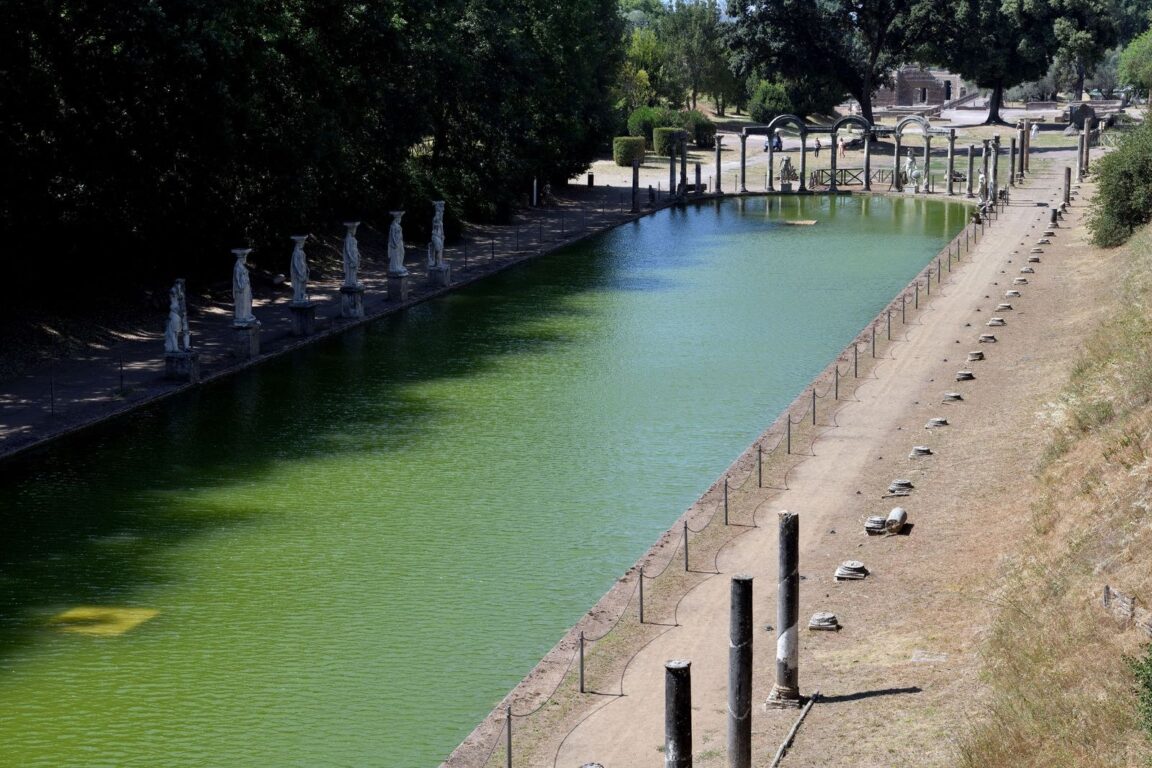
The Canopus is the image of Hadrian’s Villa that survives every summary: a long, serene canal of green water, lined on one side by columns and statues, including caryatids copied from the Erechtheion in Athens, and closed at the far end by the half-domed Serapeum, a vaulted dining grotto where the emperor could eat beside the water on summer evenings. It is beautiful at any hour, but at opening time, before the school groups and day tours arrive from Rome, it is still. The reflections hold, the statues cast long shadows, and you can walk its length at the pace the space was designed for.
Read it as engineering as well as scenery. The canal is about 119 metres long, fed and kept by a serious water system in a complex that also ran fountains, baths and latrines across the whole estate. The statues around it were not decoration in the modern sense; they were a curated statement about an empire that could gather Egypt, Greece and Rome into one garden. Take the far end slowly, look back down the water, and then climb for the view over the canal before moving on. Our guide to staying in the capital, the Hotel de Russie in Rome, covers the city end of a trip that pairs naturally with a Tivoli day.
What is the Maritime Theatre, and why is it an island?
A short walk from the Canopus, the Maritime Theatre is the villa’s most intimate and most revealing building: a circular portico ringing a moat of water, with an island in the middle carrying a miniature villa of its own, complete with small baths, a dining room and latrines, reached by wooden bridges that could be drawn away. The standard reading is that this was Hadrian’s private retreat within the retreat, a place where the most powerful man in the world could make himself unreachable. Whether or not he used it exactly that way, the design intent is unmistakable, and it is the single best stop for understanding the man rather than the empire.
From there, work through the imperial palace quarter and the great bathing complexes, the Grand Baths and Small Baths, whose vaulted halls show the villa’s other register, industrial-scale comfort. Then finish at the Piazza d’Oro, the gilded square at the eastern end, a pavilion complex of extraordinary architectural ambition that probably served for audiences and banquets. If your legs force a choice, the order that loses least is Canopus, Maritime Theatre, Piazza d’Oro, baths with whatever energy remains.
How does the Villa d’Este pairing actually work?
Tivoli holds two UNESCO sites run by one institute, the Villae, and they are deliberate opposites. Hadrian’s Villa is ancient, sprawling, horizontal and in ruins, down on the plain. Villa d’Este is Renaissance, compact, vertical and alive with water, up in the town: a cardinal’s palace garden of fountains built from 1550 for Ippolito II d’Este, fed by diverting the Aniene river, with the Hundred Fountains walk and the great water organ fountain. Doing both in one day is possible with an early start at Hadrian’s Villa and a late afternoon at Villa d’Este, but the better rhythm, if you have it, is the 72 hour VILLAE Pass used across two days: villa ruins in one morning, fountains the next, and the Sanctuary of Hercules Victor, the vast Roman sanctuary terraced into the hillside, fitted in between. The pass at 30 euros against 15 euros for Hadrian’s Villa alone makes the arithmetic easy for anyone seeing at least two of the three sites.
The same discipline of arriving at opening and walking a site in a deliberate order pays off across Italy’s ancient places; it is the approach set out in our Matera cave city guide for a very different kind of old stone.
When should you go, and how do you get there from Rome?
The site opens daily at 8.30am and the last entry moves with the seasons: 3.30pm in the November to December band, with exit by 5pm, stretching to a 6pm last entry and 7.30pm exit from April to September. In mid November, the current season at the time of writing, that means a morning visit is not a preference but a necessity; arrive at opening and you still have a full, unhurried circuit. Summer rewards the same early start with empty paths before the heat builds on a site with limited shade. The villa closes only on 1 January and 25 December, and entry is free on the first Sunday of each month, when arriving at opening matters most of all.
From Rome, the standard route is the Cotral bus from Ponte Mammolo metro station, which drops you in the Villa Adriana district a short walk from the entrance; allow about an hour door to door and check the return times before you go in, as services thin out in the evening. Trains run to Tivoli station in the town, which suits Villa d’Este better than the villa on the plain; from the station, local buses connect down to Hadrian’s Villa. Drivers will find the site signed from the A24 and the Via Tiburtina, with parking near the entrance. Book tickets online through the official Villae channels to pick an entry slot on busy weekends.
Frequently Asked Questions
How much does Hadrian’s Villa cost in 2026?
The official standard ticket is 15 euros, with a 2 euro reduced rate for eligible visitors aged 18 to 25 and free entry for under 18s. The VILLAE Pass, covering Hadrian’s Villa, Villa d’Este and the Sanctuary of Hercules Victor within 72 hours, is 30 euros.
How long do you need at Hadrian’s Villa?
Three hours is the honest minimum for the Canopus, Maritime Theatre, baths and Piazza d’Oro. Four to five hours lets you walk the full 120 hectare site without hurrying.
What are the opening hours in November?
Entry runs 8.30am to 3.30pm with exit by 5pm in the November to December band of the official calendar. The site closes only on 1 January and 25 December.
Is Hadrian’s Villa the same as Villa d’Este?
No. Hadrian’s Villa is the ancient Roman imperial complex on the plain below Tivoli; Villa d’Este is the Renaissance fountain palace in Tivoli town. Both are UNESCO sites run by the Villae institute, and the VILLAE Pass covers both.
Can you do Hadrian’s Villa as a day trip from Rome?
Yes. Cotral buses from Ponte Mammolo reach the site in about an hour. Enter at the 8.30am opening, walk the villa in the morning, and you can be at Villa d’Este in the town by afternoon.
Photo: The Canopus canal at Hadrian’s Villa, Tivoli, by Quirino Berti, via the Villae institute official website (villae.cultura.gov.it).