 Camille Baptiste
Pantelleria rewards walkers who pace it like the volcanic island it is: one serious trail day built around the Specchio di Venere lake, one high day on Montagna Grande, and recovery built into the plan rather than bolted on after sore legs force it. The national park’s own Lago di Venere itinerary runs 10 kilometres in about three and a half hours with 550 metres of climbing, and that single route sets the template for the whole trip. Walk the lake loop early, swim and use the thermal shore as the recovery session, sleep in a stone dammuso, and keep the vineyard terraces and the island’s second summit for separate, shorter days. Done that way, Pantelleria is a demanding but manageable walking holiday. Done as back to back summit days in summer heat, it becomes a grind on black lava with very little shade.
Quick Facts
- Where: Pantelleria, a volcanic Italian island in the Strait of Sicily, about 106 kilometres southwest of Sicily and roughly 68 kilometres east of the Tunisian coast.
- Anchor trail: The Lago di Venere itinerary in Pantelleria National Park, 10 kilometres, about 3 hours 30 minutes, 550 metres up and down, graded E for hiking.
- The lake: Specchio di Venere covers about 2 square kilometres, sits just above sea level, reaches about 12.5 metres deep, and is fed by rain and by thermal springs on its southeast shore.
- Highest ground: Montagna Grande at 836 metres, the island summit, with Monte Gibele the second major peak on the park trail network.
- Park status: Pantelleria National Park, created in 2016, is Sicily’s only national park, and its marked routes carry CAI style numbering such as trails 971, 972 and 973.
- Stay style: The dammuso, a thick walled lava stone house with a domed roof, built to hold cool air in summer and shed wind and rain in winter.
- Signature walk and taste pairing: Terraced Zibibbo vineyards trained as low alberello bushes, a practice inscribed by UNESCO in 2014, producing Moscato and Passito di Pantelleria wines.
- Getting there: Year round flights from Palermo, Trapani and Catania, a car ferry from Trapani taking roughly six to seven and a half hours, and a seasonal summer hydrofoil at about two and a half hours. Always recheck the operator before booking.
- Best walking windows: Spring and autumn, when temperatures suit full trail days. Summer walking means dawn starts and a hard stop by late morning.
Why does the Specchio di Venere loop work as the anchor day?
Because it gives a complete Pantelleria day at a controlled effort level. The park itinerary starts at the lake, follows trail 972, a mountain path and unpaved road of 6 kilometres taking about two hours, and trail 973, an unpaved road of 3.5 kilometres taking about an hour and a half. Between them the route climbs the Sillume path toward the coast at Zinedi, crosses the Cannachi valley, passes wartime ruins, climbs Monte Gelfiser along the edge of an old lava flow, then descends through the Siba plain and the vineyard district of Tikirriki, where dry stone walls hold the terraces in place. It finishes past Cuddia Valletta and Bugeber, across the Kaggiar lava flow to Cala Cinque Denti, and back along a stretch of original caldera rim to the lake.
That is a lot of island in one walk: crater lake, lava flow, farmed valley, vineyard terraces and coast. The fitness ask is honest rather than extreme. Ten kilometres with 550 metres of climbing on rough volcanic ground will take most regular walkers the full three and a half hours the park allows, and slower parties should budget four. Start by 8 in the morning in spring or autumn, earlier in summer, carry all the water you need for the full loop, and treat the lake at the end as the reward rather than a quick photo stop.
Walkers comparing Sicilian volcanic terrain should also read our guide to adventure in the Madonie Mountains trails, which uses the same one big day, one recovery day rhythm on the Sicilian mainland.
What actually happens at the lake, and how should you use it for recovery?
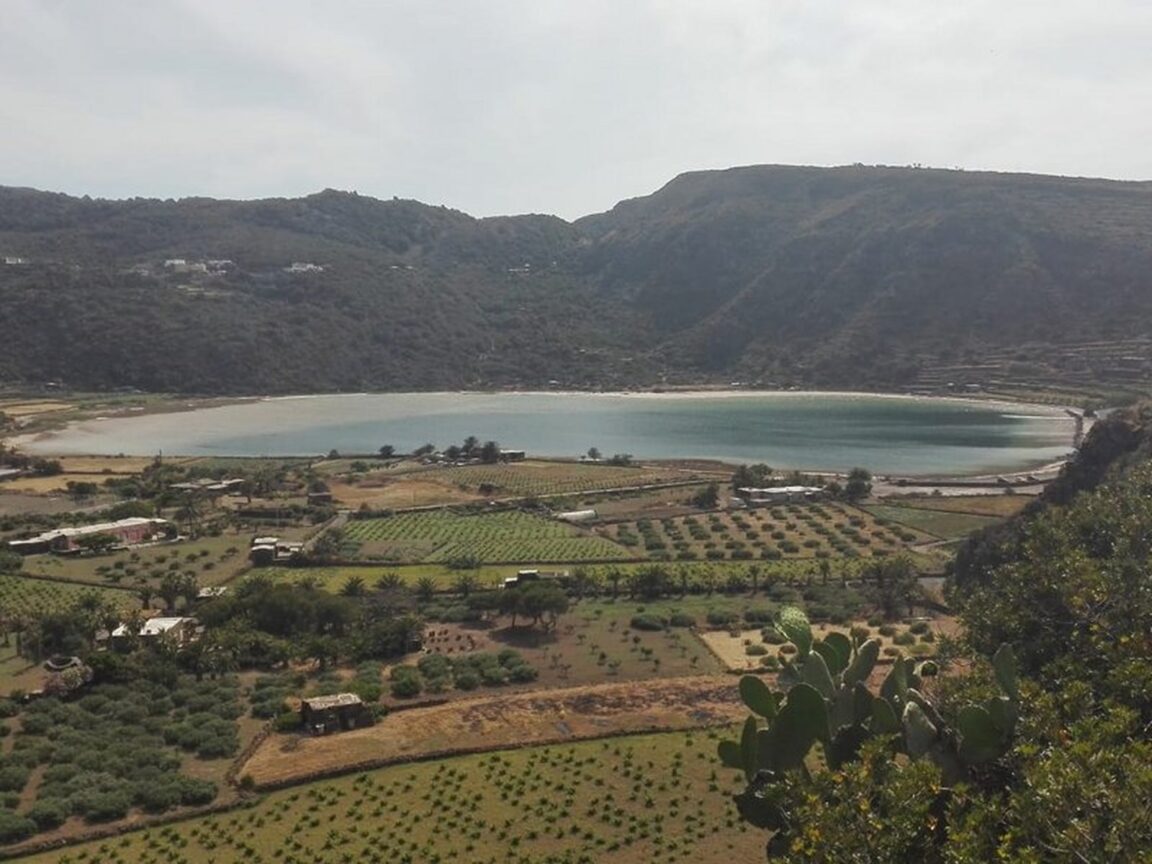
Specchio di Venere, the Mirror of Venus, fills a natural depression in the north of the island. The park describes it as a unique ecosystem, a resting place for migratory birds and a protected biotope, so the shoreline deserves care: stay on established access points, do not disturb the vegetated margins, and take everything away with you. Thermal springs rise on the southeast side, and the warm, mineral rich shallows and the soft shore mud are the reason generations of visitors have treated the lake as an open air spa.
As a recovery tool it is genuinely well designed by nature. Finish the loop, eat first, then wade in gradually and test the water with a hand before settling anywhere, because spring fed pockets run much hotter than the lake average. Alternate ten to fifteen minutes in the warm shallows with shade and water to drink, keep the whole session under an hour, and rinse off afterwards. What you should not do is treat the lake as a substitute for sleep or food. The pacing system that works on Pantelleria is simple: big trail day, lake and early night, short day, big trail day. The lake fills the recovery slot beautifully, but it is the easy day around it that does the real repair.
How fit do you need to be, honestly?
For the lake loop, you need steady hill fitness: the ability to walk for three to four hours on uneven ground, climb the equivalent of a 50 storey building spread across the route, and stay comfortable on loose volcanic stone. Trail shoes with a stiff sole matter more here than outright speed, because lava rock punishes thin soles and tired ankles. For Montagna Grande, step the requirement up. The park’s Montagna Grande itinerary runs 8 kilometres in about three and a half hours through the pine forest on trails 971, 971A and 971C, and combined routes linking Montagna Grande at 836 metres with Monte Gibele climb considerably more. If you plan to link the two summits in one outing, train for a full mountain day of six hours or more and start before dawn in warm months.
A practical test before you book: walk 12 kilometres with 500 metres of climbing on back to back days at home. If day two feels fine, Pantelleria’s rhythm will suit you. If day two is a write off, keep the same trip but demote one summit to a viewpoint drive and a short forest loop. The island does not care which version you choose, and the views from the Montagna Grande forest clearings and the Kuddia Mida viewpoint over the lake are available on the shorter routes too.
Where do the vineyard walks fit into the week?
Between the big days, and they are not filler. Pantelleria farms in terraces held by dry stone walls, another practice recognised by UNESCO, and its signature vine, the Zibibbo, is trained as a low bush, the alberello, in hollows that shelter it from the wind. The alberello of Pantelleria was inscribed on the UNESCO Representative List of the Intangible Cultural Heritage of Humanity in 2014, the first agricultural practice to receive that honour. The Tikirriki district on the lake itinerary shows the system at work, and the Valle del Monastero, a broad lava crater planted with vines, makes an excellent half day walk paired with the Grotta di Benikula, a natural sauna cave where volcanic steam fills a stone chamber.
Book cellar visits ahead rather than assuming doors are open, especially outside summer. Tastings of Passito, the sweet wine made from sun dried Zibibbo grapes, belong at the end of a walking day, not the middle, and a designated driver or a base within walking distance of the cellar solves the obvious problem. Capers are the other crop you will meet on the trails, grown on terraced plots across the island, and a farm stop for capers, dried tomatoes and passito is the easiest souvenir run you will ever do, provided it is booked and not improvised at a farmhouse gate.
For a second volcanic walking benchmark, see how the pacing compares in our Mount Etna hiking adventure guide, where altitude rather than heat sets the limit.
Why sleep in a dammuso, and how do you choose one for a walking trip?
The dammuso is Pantelleria’s traditional house: walls of lava stone up to two metres thick in the oldest examples, a white domed roof that collects rainwater and deflects the wind, and small windows that keep the interior cool and dim through the hottest afternoon. For walkers the design is functional, not just photogenic. Thick stone holds the night cool into the day, the dome sheds the scirocco, and most dammusi sit in garden plots with a shaded terrace, which is exactly where a recovery afternoon wants to happen.
Choose for location before charm. A dammuso near Scauri suits the south coast and the Valle del Monastero walks. A base near the town of Pantelleria shortens the drive to the lake and the airport. Ask three direct questions before paying: is there a washing machine or laundry service, because trail kit on a multi day walking trip needs it; is the terrace shaded in the afternoon, not just at breakfast; and how long is the drive to the Lago di Venere trailhead, in minutes, on the island’s actual roads. Book early for spring and autumn, the walking seasons, because the best placed dammusi are individual properties and do not multiply in number the way hotel rooms do.
How do you get there, and how do you get around once you arrive?
Pantelleria is reached only from Sicily. Flights operated under the island’s public service routes connect it year round with Palermo, Trapani and Catania, taking about 40 minutes from western Sicily, with additional seasonal summer flights from mainland Italian cities. By sea, the car ferry from Trapani takes roughly six to seven and a half hours and runs through the year, while the summer hydrofoil cuts the crossing to about two and a half hours for foot passengers. Schedules on this route change often and weather can cancel both planes and boats, so verify the sailing or flight with the operator close to departure and never build a same day international connection on top of an island arrival.
On the island, hire a car. Trailheads at the lake, Siba and Punta Spadillo are spread around a 15 kilometre long island with limited bus coverage, and a walking itinerary built on dawn starts cannot wait for a timetable. A small car is enough: the roads are paved but narrow, parking at trailheads is informal, and the distances are short. What matters is fuel and water discipline. Fill up in town, carry more water than the route seems to need, and download offline maps before you leave the dammuso, because signal drops in the island’s interior valleys.
What does a well paced four day walking plan look like?
Day one, arrive, settle into the dammuso, and walk only the short lake shore path in the late afternoon to learn the ground. Day two, the full Lago di Venere itinerary, 10 kilometres, followed by the thermal shore recovery session and an early night. Day three, the short day: Valle del Monastero vineyard walk, the Benikula natural sauna, a booked cellar tasting late in the day, and no alarm set. Day four, Montagna Grande through the pine forest on the park itinerary, with the Kuddia Mida fumarole viewpoint if legs allow, then a final swim at a north coast cala such as Cala Gadir, where warm springs also meet the sea. That sequence alternates load and recovery, puts the two biggest efforts 48 hours apart, and leaves a weather spare day if you have five, which on a wind exposed island is not a luxury.
Frequently Asked Questions
Do I need a permit or a guide to walk the Specchio di Venere loop?
No permit or entrance fee applies to the park’s marked itineraries for individual walkers, and the Lago di Venere route is waymarked as trails 972 and 973. A local guide adds real value on the longer summit links and for the geology and farm culture along the way, but the lake loop is designed to be walked independently. Check the park site before you go for any temporary closures.
Can you swim in Specchio di Venere?
Yes, visitors bathe in the lake, and the warm thermal shallows on the southeast shore are the popular entry points. Test the water temperature with a hand first, because spring fed pockets are much hotter than the rest of the lake, keep sessions short, and respect the protected shoreline vegetation. It is a natural lake in a national park, not a managed spa, so there are no lifeguards or facilities of that kind.
When is the best time of year for walking on Pantelleria?
Spring and autumn are the reliable windows, roughly April to May and September to October, when full trail days are comfortable. Summer walking is possible with dawn starts, a hard stop by late morning and a sea or lake swim as the midday plan. Winter brings the fewest visitors and the highest chance of wind disrupting ferries and flights.
How many days do I need for a Pantelleria walking trip?
Four walking days cover the lake loop, Montagna Grande and the vineyard country with proper recovery between them. Three days forces a choice between the second summit day and the vineyard day. A week allows the coastal routes, a boat day and a weather buffer, which this island regularly requires.
What should I pack differently for Pantelleria than for mainland Sicily?
Stiff soled trail shoes for lava rock, more water capacity than usual, a sun hat with a chin strap for the island wind, swim kit that lives in the day pack for lake and cala stops, and a warm layer for the Montagna Grande forest, which sits in cloud often enough to feel like a different climate from the coast. Formality is not required anywhere on the island; dammuso evenings are terrace casual.
Is Pantelleria suitable for walkers who want views without big climbs?
Yes, if the plan is built around the lake shore, the vineyard districts and the coastal paths rather than the summits. The island’s drama is in its lava coast, terraces and crater lake, all reachable on short routes. The summits add scale, but nobody should feel the trip failed without them.
Sources checked 17 November 2026: Pantelleria National Park official itineraries for the Lago di Venere and Montagna Grande trails, UNESCO listing for the alberello vine of Pantelleria, and current operator information for flights and Trapani sailings. Reverify schedules with the operator before booking.