 Wei Chen
The Japan eVISA is narrower than its name suggests, and understanding that narrowness is the whole job. As of the Ministry of Foreign Affairs of Japan (MOFA) page dated 15 May 2026, the system issues one product only: a single-entry, short-term stay visa for tourism, for a stay of up to 90 days, and only to people who live in a listed country or region. Where you live decides how you apply. Residents of nine countries and regions apply directly on the JAPAN eVISA website. Residents of the other listed places must apply through an accredited agency, and two of those routes, the Philippines and Viet Nam, are limited to travellers on packaged tours organised by designated travel agencies. If your trip to Tokyo is for business, study, work, transit or visiting relatives, the eVISA is not your route at all: MOFA directs those applicants to the Japanese embassy, consulate general or consular office with jurisdiction over their place of residence. This guide works through the lists, the limits and the order to file in, in plain language.
Quick Facts
- What it is: The JAPAN eVISA system, run by the Ministry of Foreign Affairs of Japan, for online application and electronic issue of a tourist visa.
- Visa type: Single-entry, short-term stay, tourism only, for a period of up to 90 days.
- Apply directly online if you live in: Australia, Brazil, Cambodia, Canada, Saudi Arabia, South Africa, Taiwan, the United Kingdom or the United States of America.
- Apply through an accredited agency if you live in: China, the Philippines, Viet Nam, Hong Kong, India, Indonesia, Macau, Mongolia, the Republic of Korea, Singapore or the United Arab Emirates.
- Shorter stays on agency routes: 15 days for Philippine and Vietnamese nationals on packaged tours; 15 or 30 days for nationals of China residing in China.
- Passport rule: Only holders of an ordinary passport can apply through the JAPAN eVISA website.
- How you must travel: By air, or by sea only on an international scheduled passenger ferry between Japan and Busan or Shanghai.
- At the airport: You must display the Visa issuance notice live, in an internet environment. A PDF, a screenshot or a printed copy will not be accepted.
- Source checked 17 November 2026: MOFA, The JAPAN eVISA system page, dated 15 May 2026, at mofa.go.jp.
Who can apply directly on the JAPAN eVISA website?
The first list is the simple one. MOFA states that all foreign nationals and people residing in Australia, Brazil, Cambodia, Canada, Saudi Arabia, South Africa, Taiwan, the United Kingdom and the United States of America can apply for an eVISA through the JAPAN eVISA website, except those who are already exempt from a short-term visa. Read that exemption clause carefully, because it catches many Tokyo-bound travellers out. A large share of the people living in those nine places hold passports that enter Japan without any visa for a short tourist stay. If that is you, you do not need an eVISA, and filing for one wastes time and invites confusion at check-in. The eVISA exists for residents of those countries whose nationality is not visa exempt: a long-term resident of Canada, Australia or the United Kingdom, for example, whose passport comes from a country with no exemption agreement. Residence, not the airport you depart from, is what places you on the list, so a holiday address or a transit stop does not qualify you.
For a first trip to Tokyo, pair this with our First Time in Tokyo: A 5-Day Itinerary, Where to Stay and Mistakes to Avoid, which covers where to base yourself once the paperwork is settled.
Who has to apply through an accredited agency instead?
The second list works differently, and the board intent for this article asked for the tour-group rules in particular, so here they are exactly as MOFA sets them out. Applications from the following places are made through an accredited agency, and applicants are told to check the website of the Japanese overseas establishment with jurisdiction over their place of residence for the local detail. China: nationals of China who reside in China. The Philippines: nationals of the Philippines who reside in the Philippines and participate in a packaged tour organised by designated travel agencies. Viet Nam: nationals of Viet Nam who reside in Viet Nam and participate in a packaged tour organised by designated travel agencies. Then a wider group: all foreign nationals and people residing in Hong Kong, India, Indonesia, Macau, Mongolia, the Republic of Korea, Singapore and the United Arab Emirates, except those exempt from a short-term visa, with one geographic carve-out: the Republic of Korea listing excludes the jurisdiction of the Consulate General of Japan in Jeju.
The packaged tour condition is the part travellers most often misread. For Philippine and Vietnamese nationals, the eVISA route is tied to the tour: the stay issued is 15 days, the application runs through the agency channel, and an independent traveller who does not fit the packaged tour condition should not assume the online route is open to them. Their fallback is the ordinary application at the Japanese mission with jurisdiction over where they live. For nationals of China residing in China, the electronic visa issued carries a period of stay of 15 days or 30 days, not the headline 90. The 90-day figure is the maximum for the visa type, not a promise attached to every nationality.
What does the eVISA actually allow, and what does it not allow?
It allows one entry, for tourism, for a short-term stay of up to 90 days where the full period is granted. Single-entry means exactly that: once you have entered Japan on it, it is used, and a side trip out of the country ends the visa rather than pausing it. Anyone building a two-country itinerary, Tokyo with a few days in Seoul or Taipei in the middle, needs to plan the Japan leg as one continuous block or take advice from the mission before booking, because re-entry is not what this product does.
It does not cover any other purpose. MOFA is explicit that people who wish to visit Japan for other purposes, or for a long-term stay, submit their application to the Japanese embassy, consulate general or consular office with jurisdiction over their place of residence, and in some countries those applications must themselves be made through accredited travel agencies. In Taiwan, the equivalent offices are the Taipei and Kaohsiung offices of the Japan-Taiwan Exchange Association. In those cases the visa is issued as a sticker in the passport, in the traditional way. Business meetings, conferences, study, paid or unpaid work, transit and visiting friends or relatives all sit on that side of the line, however short the trip.
Two further limits from the MOFA page deserve prominence. First, the travel method: the Japan eVISA is available for those travelling to Japan by air or by sea, where sea means an international scheduled passenger ferry between Japan and Busan or Shanghai. Arriving by any other sea route is outside the system. Second, the passport: only an ordinary passport holder is eligible to apply through the JAPAN eVISA website, so official and diplomatic passport holders use the conventional channels.
What is the order to file in, step by step?
Step one: confirm you need a visa at all. Check whether your nationality is exempt for a short-term stay; if it is, stop here. Step two: confirm your residence puts you on one of the two MOFA lists, and identify which route, direct online or accredited agency, applies to you. Step three: if you are on an agency route, find the accredited agency and the local requirements through the Japanese embassy or consulate website for your place of residence, because MOFA directs applicants there for details and the designated agency arrangements for packaged tours are local. Step four: prepare a complete and accurate application. MOFA warns that entering incorrect information, or uploading incomplete or wrong documents, can lead to a delay in examination or cancellation of the application, and that if an application is incomplete it will be cancelled without processing, after which the applicant is supposed to reapply. Treat the form as a one-shot document check, not a draft you can patch later. Step five: stay reachable and flexible, because during the application process you may be requested to appear in person at the Japanese overseas establishment with jurisdiction over your residence for an interview. An online application is therefore not a guarantee of an entirely remote process. Step six: once the visa is issued, protect the way you will show it. Travellers with an eVISA are required to display the Visa issuance notice at the airport in an internet environment, and MOFA states plainly that PDF data, a screenshot and a printed copy will not be accepted. That means a working phone, a data connection on arrival at the departure airport, and enough battery to open the notice live. Build that into your departure routine the way you would a passport check.
On timing, MOFA’s eVISA page does not promise a fixed turnaround, and this guide will not invent one. The safe sequence is to file as early as your route allows, keep flights and hotels refundable until the visa is issued, and leave slack for the two delays MOFA itself names: a possible interview request, and cancellation and reapplication if anything in the file is incomplete or wrong. Travellers comparing online systems in the region may also find our Vietnam’s 90-Day E-Visa: Who Qualifies, How to Apply, and the Entry Points That Count useful, because the two systems differ sharply in who may apply directly.
What are the traps that catch applicants out?
The first trap is fraud. MOFA’s page carries a direct warning to beware of fraud websites that look like the JAPAN eVISA website. The genuine application site is the one linked from MOFA’s own page, and any lookalike collecting fees or documents should be treated as hostile. Start from mofa.go.jp and follow its link, rather than from a search advert or a social media post. The second trap is the residence and nationality mix-up: eligibility turns on where you live and which passport you hold, and the packaged tour conditions for the Philippines and Viet Nam turn on both together. The third trap is assuming the headline terms apply to everyone: the 90-day stay, the direct online route and the full eVISA process each have exceptions set out above. The fourth trap is the screenshot habit. Most travellers screenshot every confirmation they receive; for this visa, a screenshot is expressly not accepted at the airport, so the live notice, opened online, is the document that matters. The fifth trap is purpose drift: a trip that begins as tourism and gains a business meeting, a conference day or a visit that is really about family needs the other application route, decided before you file, not explained at the border.
Frequently Asked Questions
Is the Japan eVISA a multiple-entry visa?
No. MOFA describes the applicable type as a single-entry short-term stay visa for tourism. Once you enter Japan on it, it has been used, and leaving the country ends it.
How long can I stay in Japan on an eVISA?
Up to 90 days for the standard grant. Two exceptions are stated by MOFA: nationals of China residing in China receive electronic visas with a period of stay of 15 or 30 days, and nationals of Viet Nam and the Philippines on the packaged tour routes receive 15 days.
I live in the United States but my passport is not American. Can I apply online?
Generally yes, that is the group the direct route is built for: all foreign nationals residing in the United States can apply through the JAPAN eVISA website, except those already exempt from a short-term visa. You need an ordinary passport, and you may still be asked to attend an interview in person.
Can I use the eVISA to visit friends, attend a conference or transit through Japan?
No. The eVISA is for tourism only. MOFA directs applications for other purposes, and all long-term stays, to the Japanese embassy, consulate general or consular office with jurisdiction over your residence, where the visa is issued as a passport sticker.
Can I show a screenshot or a printout of my Visa issuance notice at the airport?
No. MOFA states that travellers with an eVISA must display the Visa issuance notice at the airport in an internet environment, and that PDF data, screenshots and printed copies will not be accepted. Keep a working phone and a data connection ready.
What happens if my application has a mistake in it?
MOFA warns that incorrect information or incomplete or wrong documents can delay examination or lead to cancellation, and that an incomplete application will be cancelled without processing. After a cancellation, you are supposed to reapply, so check every field before submitting.
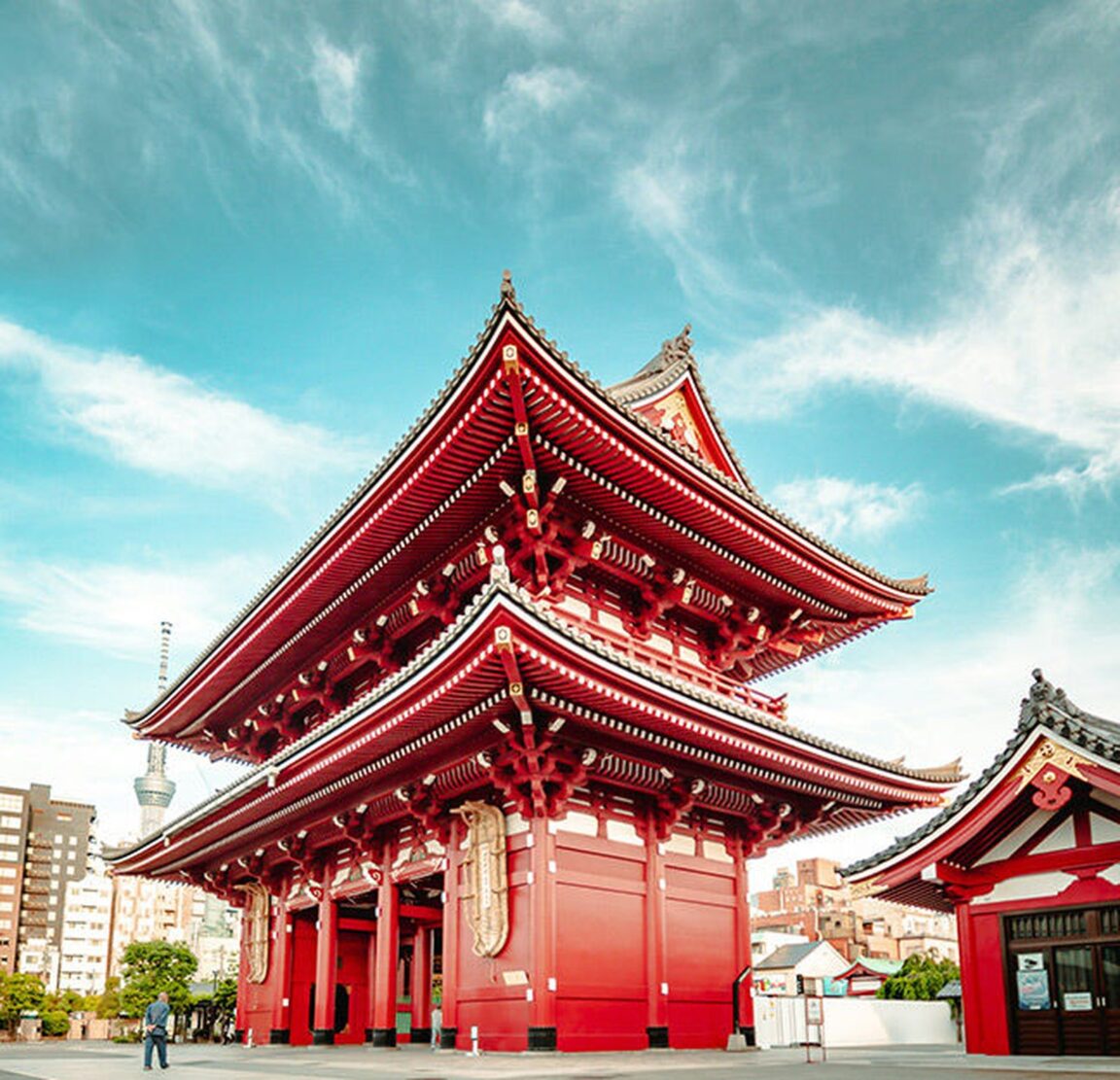
Sources checked 17 November 2026: Ministry of Foreign Affairs of Japan, The JAPAN eVISA system, page dated 15 May 2026, mofa.go.jp. Photo: Senso-ji, Asakusa, Tokyo, by Sunil Poudel on Unsplash, Unsplash License.