 Maya Chen
Beyond the Parte Vieja, the pintxos order changes: start in Gros, the residential quarter across the Urumea River behind Zurriola beach, where the counters serve the people who live there, then cross back to the Centro for the older, quieter bars around Reyes Católicos and San Marcial, and only finish in the Old Town if there is room left. In Gros the order is built on two anchors, Bar Bergara for award winning hot and cold pintxos and Bodega Donostiarra for the classics at published menu prices. In the Centro the order is built on one story, the Gilda, the skewer that started the whole culture. The drink follows the bar: txakoli, the crisp local white, in the seafood and counter bars, and Rioja red where the pintxo is meat, mushrooms or a tortilla eaten sitting down. That split, Gros first and Centro second, is the returning eater’s version of the city.
Quick Facts
- First district: Gros, across the Urumea River from the Parte Vieja, the residential quarter behind La Zurriola beach and the Kursaal, per Tourism Euskadi
- Gros anchor 1: Bar Bergara, General Artetxe 8, in the pintxo trade since 1950 according to the bar, known above all for the Txalupa, a gratin of mushrooms and prawns
- Gros anchor 2: Bodega Donostiarra, Peña y Goñi 13, known for the Completo of tuna, anchovy and pickled pepper, and for tortillas made on the spot
- Published prices: On Bodega Donostiarra’s own menu, checked on November 21, 2026, a Gilda is 2.75 euros, an Indurain 3.90 euros and a potato omelette pintxo 3.75 euros, with terrace service adding 9 percent
- Centro anchor: Casa Vallés, Reyes Católicos 10, where a regular named Joaquín Aramburu, known as Txepetxa, first skewered an anchovy, a pickled chilli and an olive together and named it the Gilda
- Drink rule: Txakoli with counter pintxos, anchovies and seafood; a glass of Rioja red with beef, mushrooms, cheese and the richer hot pintxos
- Tortilla rule: Tortilla is a timed dish, not an all day one; order it where it is made on the spot and be there when it comes out
- Prices checked: November 21, 2026, against the bars’ own sites and Tourism Euskadi
Why should a returning eater start in Gros instead of the Parte Vieja?
Because Gros is where the pintxo stops being a visitor ritual and goes back to being a neighbourhood habit. San Sebastián Turismo describes the Parte Vieja, at the foot of Mount Urgull between the river and the port, as the quarter with the greatest concentration of pintxo bars in the city, and that concentration is exactly the problem on a second visit: the famous counters are full, the ordering is rushed and the same five names absorb every evening. Gros sits on the other side of the Urumea, a short walk over the bridge from the Kursaal end of the Boulevard. Tourism Euskadi’s Gros pintxo page frames the quarter around the Kursaal and La Zurriola beach and then points straight at its bars, which tells the story in the right order: this is a surf and residential district first, and its counters are set up for regulars coming off the beach or out of their own streets.
The practical difference is space and pacing. Counters in Gros are wider, the streets around Peña y Goñi and General Artetxe are calmer, and a bar can be judged on one or two pintxos without a queue forming behind the stool. Readers who want the first visit version first can start with our San Sebastián pintxos guide, which covers the Old Town canon; this order assumes that canon is already done. Start in Gros while the light is still on Zurriola, eat the main body of the night there, and treat everything after the river crossing as a supplement.
What is the order at Bar Bergara and Bodega Donostiarra?
At Bar Bergara, General Artetxe 8, order the Txalupa first. The bar’s own site calls Bergara a reference point for miniature cooking in the city and lists its best known pintxos as the Txalupa, the Udaberri and the Itxaso, all of them prize winners. Tourism Euskadi describes the Txalupa the same way, as a wide ranging counter’s standout, a gratin of mushrooms and prawns. The order that works is one signature hot pintxo and one counter pintxo: the Txalupa, then the Itxaso, monkfish with a seafood cream in the Michelin Guide’s description of the bar, or the bar’s anchovy tortilla if it is on the counter. Bergara also publishes a set way through its greatest hits: Bar Bergara’s official site lists a tasting menu of six named pintxos with a dessert and two drinks at 40 euros per person including VAT, checked on November 21, 2026. That suits a group; at the counter, two pintxos and a glass is the better rhythm.
At Bodega Donostiarra, on Peña y Goñi, the order turns classic. Tourism Euskadi singles out its Completo, the bonito or tuna pintxo with anchovies and a gilda style pickled pepper. The bodega’s own menu fills in the rest with unusual clarity, because it publishes its prices: a Gilda at 2.75 euros, the Indurain, its stacked tuna, anchovy and pepper skewer, at 3.90 euros, anchovies at 4.90 euros and a potato omelette pintxo at 3.75 euros, all checked on Bodega Donostiarra’s official menu on November 21, 2026. The bodega also states the principle that governs the Gros order: it starts the day with popular tortillas made on the spot and keeps non stop cooking running all day. So the order is a Gilda to open, a Completo or an Indurain as the main counter pintxo, and tortilla if a fresh one is coming out. Two bars, four or five pintxos, and the centre of the evening is done.
Where does the Centro fit, and what should be ordered there?
The Centro, the Romantic Area south of the Boulevard, fits as the second half: older bars, wider streets and a slower glass. San Sebastián Turismo notes that the Boulevard connects the Parte Vieja with this neighbourhood, and that social life runs from the Basilica of Santa María in the Old Town to the Cathedral of the Buen Pastor in the Centre, barely a kilometre apart. The Centro’s pintxo claim is historical. On Reyes Católicos, the bar street behind the Buen Pastor, stands Casa Vallés at number 10. The city’s pintxo association tells the origin story plainly: in the 1940s a regular there, Joaquín Aramburu, nicknamed Txepetxa, skewered an anchovy, a chilli pepper and an olive together, then named the result after the film Gilda, released in Spain at Christmas 1947, because both were, in his phrase, green, salty and a little spicy. Whether or not it was literally the first pintxo, the Gilda became the template: one skewer, three strong flavours, eaten in a single bite.
So in the Centro, order the Gilda where it began, and order it first, before richer things flatten the palate. After that, work the San Marcial bars on the official pintxo route published by Tourism Euskadi, which passes Alustiza, known for its gavillas, and La Espiga, described as a pioneer bar. These are the traditional end of the culture, and the right order is small: a Gilda, one traditional counter pintxo and a single glass, then move on. The Centro also holds market halls including San Martín on Urbieta, which makes it the natural district for a morning round too, buying Idiazabal cheese and a bottle of txakoli to take home.
How do the tortilla queues actually work?
They work on timing, not on patience. A good potato tortilla here is made in small batches and cut while it is still juicy in the middle, so the queue is really a schedule: people at a counter at a particular minute are waiting for a particular tortilla to come out, not for tortilla in general. Bodega Donostiarra states the model openly, opening its menu page with popular tortillas made on the spot. Bergara builds an anchovy tortilla into its tasting menu, treating tortilla as a headline dish, not a filler. The rules follow. Ask what time the next tortilla comes out rather than whether there is tortilla; if the answer is twenty minutes, order a Gilda and a drink and wait. Never take the last slice of one that has sat through a whole service and expect the dish the queue was for. Eat tortilla early, at lunch or at the start of an evening round, when batches turn over fastest.
Txakoli or Rioja: which drink belongs in which bar?
Txakoli in the counter bars, Rioja where the food gets darker. Txakoli is the Basque Country’s own white, light, crisp and poured in a small glass that is meant to be finished while the pintxo is still warm; it is built for anchovies, gildas, tuna, seafood skewers and fried fish, which is to say for most of the Gros counter order at Bergara and Bodega Donostiarra. Its acidity cuts salt and oil without filling the drinker up, which matters in a format where the evening is five small glasses, not one bottle. Rioja, from the neighbouring wine region to the south, belongs with the other half of the repertoire: beef cheeks and grilled meats, wild mushrooms, Idiazabal cheese, black pudding and the richer hot pintxos, and with a tortilla eaten sitting down rather than at a crowded counter. It also belongs in the Centro’s older bars, where the glass is more likely to be the point of the stop and not just the accompaniment.
The simple test is the pintxo in the other hand. If it came off a skewer, out of the sea or off the cold counter, pour txakoli. If it came off the grill, out of a casserole or under a gratin, a Rioja red will hold up better. Keep the glasses small and moving: the txikiteo crawl from bar to bar assumes one drink per bar, and ordering a bottle in the second bar ends the crawl. Travellers stringing this coast into a longer Iberian trip can pair the same small plates logic with our three days in Lisbon itinerary, where the tasca plays the role the pintxo bar plays here.
How should the whole evening be sequenced?
Start at Zurriola in the late afternoon, walk into Gros as the counters fill, and do Bergara first while its hot pintxos are turning over, then Bodega Donostiarra for the classics and, if the timing lines up, a fresh tortilla. Cross the Urumea on foot, through the Boulevard and into the Centro, for the Gilda at Casa Vallés on Reyes Católicos and one traditional stop on San Marcial. Finish, only if there is appetite left, with a single Old Town counter, chosen for one dish rather than a full second crawl. San Sebastián Turismo’s district guide is the right final check before setting out, since bar closing days vary and most famous names shut at least one day a week. The sequence matters more than any single bar on it: Gros gives the evening its substance, the Centro gives it its history, and the Parte Vieja, for once, is allowed to be the encore instead of the whole show.
Frequently Asked Questions
Is Gros really better than the Parte Vieja for pintxos?
Not better in absolute terms, but better for a returning eater. The Parte Vieja has the greatest concentration of bars and the most famous names. Gros, across the Urumea behind Zurriola beach, has wider counters, a residential crowd and two anchors, Bar Bergara and Bodega Donostiarra, that cover the award winning and the classic ends of the repertoire without the Old Town crush.
What should be ordered first at Bar Bergara?
The Txalupa, the bar’s signature gratin of mushrooms and prawns, followed by one more of its prize winning pintxos such as the Itxaso or the Udaberri. The bar’s own site lists those three as its best known pintxos. Groups can instead take its published tasting menu of six pintxos with a dessert and two drinks, listed at 40 euros per person on the bar’s site, checked on November 21, 2026.
How much do pintxos cost in Gros?
At Bodega Donostiarra, whose menu is published on its own site and was checked on November 21, 2026, a Gilda is 2.75 euros, an Indurain 3.90 euros, anchovies 4.90 euros and a potato omelette pintxo 3.75 euros, with a 9 percent supplement for terrace service. Prices at other bars vary by pintxo, and hot pintxos cooked to order cost more than counter classics as a rule.
Where was the Gilda invented?
At Casa Vallés, Reyes Católicos 10 in the Centro, according to the story told by the city’s pintxo association. A regular, Joaquín Aramburu, known as Txepetxa, skewered an anchovy, a pickled chilli and an olive together in the 1940s and named it after the film Gilda, describing both as green, salty and a little spicy. The bar is still the symbolic first stop for the pintxo in the Centro.
Should txakoli or Rioja be ordered with pintxos?
Both, in different bars. Txakoli, the crisp Basque white, suits the cold counter, anchovies, tuna and seafood, which is most of the Gros order. A Rioja red suits grilled meat, mushrooms, cheese and the richer hot pintxos, and the slower Centro bars. Keep each glass small: the crawl assumes one drink per bar.
When is tortilla worth queuing for?
When a fresh one is about to come out. Tortilla in the best Gros and Centro bars is made on the spot in small batches, so ask for the time of the next one, order a Gilda and a drink, and wait for that batch. A slice that has sat through a whole service is a different and lesser dish.
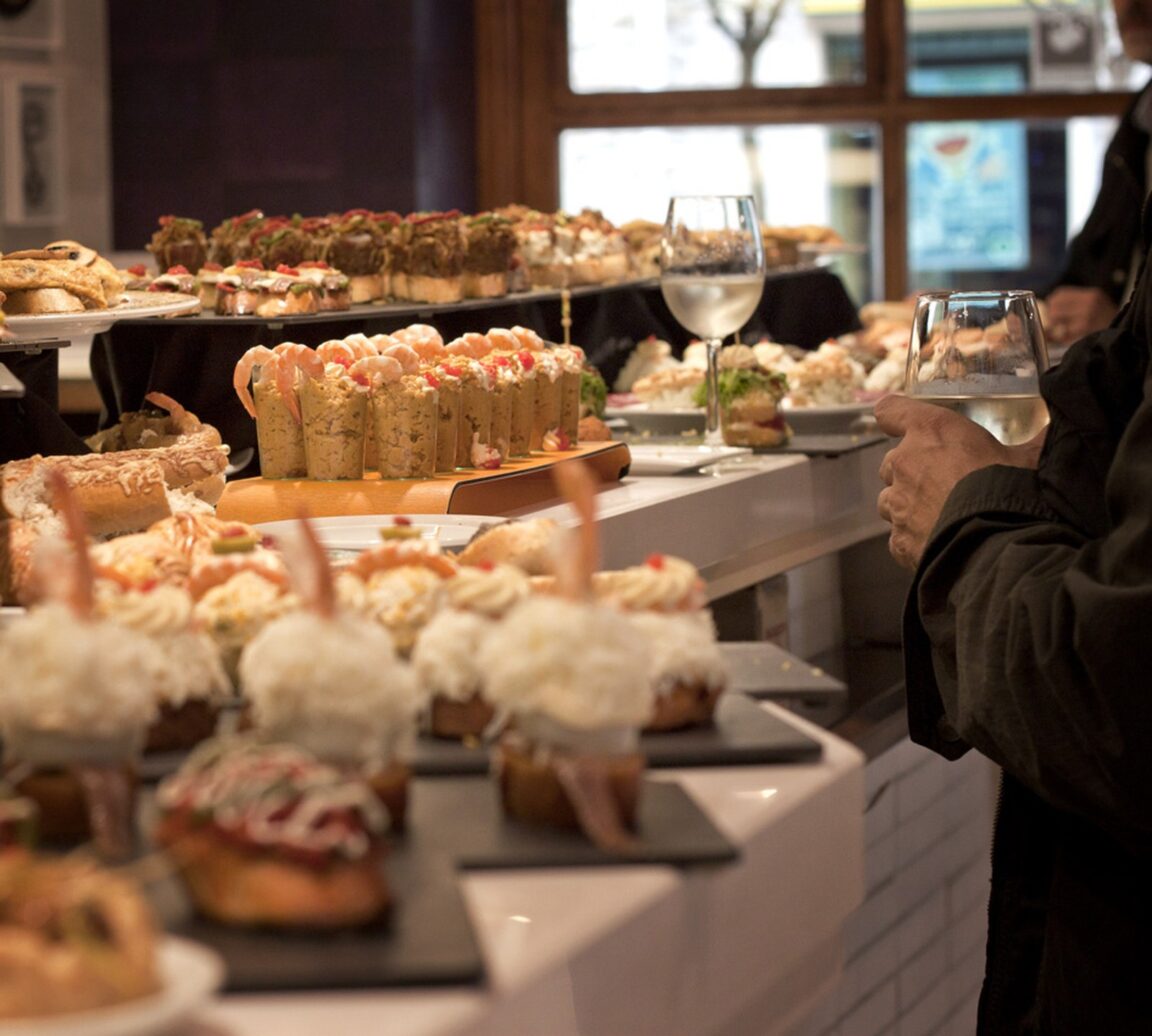
Featured image: Pintxos lined along the counter at Bar Bergara in Gros, San Sebastián, with prawn pintxos in the foreground and a glass of white wine held at the bar. Photo from Bar Bergara’s official website (pinchosbergara.es), used with credit. Native 945px wide, upscaled to exactly 1600px.