 Lucas Meyer
Spain has no single train luggage rule, because Spain no longer has a single high speed operator. On a Renfe AVE service, a traveller can carry up to three pieces of hand luggage with a combined weight of 25 kilograms and a combined size of 290 centimetres, and no single piece may exceed 85 x 55 x 35 centimetres. On Ouigo, the low cost rival that shares many of the same stations and corridors, every ticket includes only two smaller bags, one hand bag of 36 x 27 x 15 centimetres and one cabin bag of 55 x 35 x 25 centimetres, and anything bigger travels as a paid additional or XL piece. Renfe’s own low cost brand, Avlo, is stricter than the AVE allowance its passengers often assume applies. Layered over all three is the station reality that separates Spanish high speed rail from most of Europe: bags pass through airport style security screening before the boarding area, so the luggage decision and the arrival time decision are the same decision. Read the operator on the ticket first, pack to that operator’s numbers, and arrive with the screening queue already counted.
Quick Facts
- Renfe AVE allowance: Up to 3 pieces of hand luggage, combined weight no more than 25 kg, combined size no more than 290 cm, largest single piece 85 x 55 x 35 cm, per Renfe’s luggage policy page
- Ouigo included bags: 1 hand bag up to 36 x 27 x 15 cm and 1 cabin bag up to 55 x 35 x 25 cm on every ticket, per Ouigo’s Spain pages
- Ouigo additional or XL bag: Maximum 200 cm in total size and 25 kg; from 5 euros per piece on Ouigo Esencial, 1 piece included with Ouigo Plus, 2 pieces included with Ouigo Full
- Avlo warning: Renfe’s low cost Avlo includes 1 hand bag of 36 x 27 x 25 cm and 1 suitcase of 55 x 35 x 25 cm; a larger additional piece costs 10 euros at purchase or 15 euros afterwards
- Security: Bags are X-ray screened before the boarding area at Spanish high speed stations, so arrival time must include the screening queue
- Labelling: On AVE International services between Spain and France, luggage tagging is mandatory under the same Renfe allowance
- Checked: November 21, 2026, against the official luggage pages of Renfe and Ouigo
What exactly does Renfe allow on an AVE train?
The headline Renfe rule is generous by European rail standards, and it is a combined rule rather than a per bag rule. The Renfe luggage policy page states that a passenger can carry up to three pieces of hand luggage onto the train, provided the sum of the three does not exceed 25 kg or 290 cm, and that the maximum dimensions allowed for a piece are 85 x 55 x 35 cm, measured as height, width and depth. In practice that covers the classic three piece travel set: one large suitcase built under the 85 cm ceiling, one cabin sized case or holdall, and one small day bag or laptop bag, as long as the three together stay under the weight and size totals. Renfe lists suitcases, handbags, rucksacks and laptop bags as ordinary hand luggage, and baby seats and pushchairs travel as hand luggage only when folded away.
Two consequences follow from the combined structure. First, weight is pooled: a 17 kg main case leaves only 8 kg for the other two pieces combined, so a heavy second bag can break the rule even when every bag is small. Second, there is no separate checked hold product in this allowance to fall back on. Everything carried is hand luggage that the passenger lifts, stores and keeps responsibility for, in the racks at the ends of carriages and the overhead shelves above seats. A bag that cannot be lifted into those spaces, or that blocks an aisle, is a problem the combined numbers do not solve. Travellers used to airline logic should also note what is absent: Renfe does not price the AVE allowance by fare bundle in the way Ouigo does, so the same three piece, 25 kg framework is the starting point across the AVE network, with the stricter Avlo exception covered below.
How do Ouigo’s paid tiers change the same journey?
Ouigo runs the same corridors with an airline style model: a small free allowance, then paid size. On Ouigo’s official Spain route pages, every ticket, including the entry Ouigo Esencial fare, includes one hand bag or backpack of a maximum 36 x 27 x 15 cm and one cabin bag of a maximum 55 x 35 x 25 cm. The English language Spain page adds that those dimensions include handles, pockets and wheels, which is the measurement that matters at the station: a case that only fits with its handle pushed in and its front pocket empty is a case measured over the limit. Anything beyond those two bags, or a single bag larger than the cabin size, needs the additional or XL luggage option, capped at 200 cm in total size and 25 kg in weight.
The price of that option depends on the fare tier chosen. On Esencial it starts from 5 euros per piece. Ouigo Plus, the mid tier, includes one additional or XL piece in the fare. Ouigo Full, the top tier, includes two additional or XL pieces. The option can be added when booking or afterwards through the My Bookings area, up to 30 minutes before the train departs, so the decision does not have to be final at purchase, but it does have a hard deadline half an hour out. The practical reading is simple: a traveller with a full size suitcase should price the Ouigo ticket with the bag included before comparing it with an AVE fare, because the AVE headline price already contains a much larger allowance. The same smallest common limit logic governs mixed operator trips across Europe, as our guide to Europe’s budget airline cabin bag rules shows for flights: buy and pack for the strictest carrier on the itinerary, not the most generous.
Why is Avlo the trap inside Renfe’s own network?
Because the brand on the platform is Renfe, many passengers assume the AVE allowance follows them onto Avlo, Renfe’s low cost high speed brand. Renfe itself flags the difference on its luggage page, warning that the luggage policy is stricter on Avlo trains. The included Avlo allowance is one piece of hand luggage, such as a bag or rucksack, at a maximum of 36 x 27 x 25 cm with no weight limit, plus one suitcase at a maximum of 55 x 35 x 25 cm, also with no weight limit. A traveller needing one additional, larger piece, up to 85 x 60 x 35 cm or no more than 180 cm in total, can add it for 10 euros when purchasing the ticket, or for 15 euros after purchase through any Renfe sales channel, up to 30 minutes before the train departs.
The Avlo numbers reward a different packing style from the AVE numbers. With no weight limit on the two included pieces, dense packing is fine; with a hard 55 x 35 x 25 cm ceiling on the suitcase, volume is not. A standard airline cabin case fits the Avlo suitcase box exactly, which makes Avlo workable for short trips with one wheeled case and one small bag. It stops working when a trip needs a large case, sports kit or a third bag, and at that point the 10 euro at booking price is the cheapest version of the fix. Adding the same piece later costs 5 euros more, and leaving it to the station invites an argument the timetable will not wait for. Anyone building a Spain itinerary that mixes AVE, Avlo and Ouigo legs should list the allowance for each leg before packing, because the strictest leg, usually Avlo or Ouigo Esencial, sets the real limit for the whole trip. Our explainer on Spain’s short term rental registration rules is the companion read for the accommodation side of the same trip planning.
How does station security screening change arrival timing?
Spanish high speed travel begins before the platform. At the major high speed stations, passengers pass through a departures area where bags go through an X-ray scanner and tickets are checked, a system closer to a small airport than to the open platform boarding common in France or Germany. The screening itself is usually quick, and there is no separate liquids ritual of the airport kind, but the queue is a real variable: at the largest stations, at peak hours and on holiday weekends, the line for the scanner, not the walk to the platform, is what consumes the buffer. Rail Europe’s Renfe help pages advise arriving about 30 minutes early to allow for the mandatory X-ray screening and ticket and ID checks, and state that boarding closes 2 minutes before departure and does not reopen. A closed boarding gate in Spain is final in the way an airline gate is final.
Luggage size interacts with screening in two ways. An oversize bag is most likely to be challenged at the scanner or the boarding control, which is the worst place to renegotiate it, with the queue behind and the departure clock running. A traveller carrying the maximum Renfe set of three pieces also moves slower through the whole sequence: scanner belt, ticket check, platform, carriage rack. The working rule that follows from the operators’ own deadlines is to treat 30 minutes as the floor for a high speed departure with luggage, and more at the biggest stations or with an additional bag still to be regularised. Both Renfe’s Avlo extra and Ouigo’s additional bag share that same 30 minute cutoff for changes, which means a passenger who arrives inside the final half hour has also lost the chance to fix a luggage problem at the published price. Arrive outside that window and every option is still open; arrive inside it and the only remaining option is the train itself.
What about bikes, instruments and other special luggage?
Renfe folds most special items into the hand luggage framework rather than selling separate products. Musical instruments travel in their case as hand luggage up to a maximum of 30 x 120 x 38 cm, a long, thin box shaped for a guitar or similar instrument. Bicycles and scooters that are folded and carried in a cover count as hand luggage when their dimensions add up to no more than 180 cm across the three measurements, and on that basis they are accepted free of charge on regular Renfe services; the policy for unfolded bicycles depends on the train type, so a full size bike is a check before booking, not an assumption. One special piece per person is the general pattern, carried alongside a smaller piece of hand luggage. Ouigo handles the same category differently: bicycles travel under its additional baggage option, disassembled and in a suitable case, which means the bike consumes the paid XL allowance rather than riding inside a free one. The contrast sums up the whole article in miniature. Renfe prices space into the ticket and polices totals; Ouigo prices space as an add-on and polices pieces. Pack, and budget, for the system named on the ticket.
Frequently Asked Questions
How much luggage can I take on a Renfe AVE train?
Up to three pieces of hand luggage, with a combined weight of no more than 25 kg and a combined size of no more than 290 cm. No single piece may exceed 85 x 55 x 35 cm. The allowance is pooled across the three pieces, so one heavy bag reduces what the other two may weigh.
What luggage is included with an Ouigo ticket in Spain?
Two bags: one hand bag up to 36 x 27 x 15 cm and one cabin bag up to 55 x 35 x 25 cm, with dimensions including handles, pockets and wheels. A larger or additional bag, up to 200 cm in total and 25 kg, costs from 5 euros per piece on Ouigo Esencial, is included once with Ouigo Plus and twice with Ouigo Full.
Is Avlo luggage the same as AVE luggage?
No. Avlo, Renfe’s low cost brand, includes only one hand bag of 36 x 27 x 25 cm and one suitcase of 55 x 35 x 25 cm, both without a weight limit. A larger additional piece, up to 85 x 60 x 35 cm, costs 10 euros at booking or 15 euros afterwards, up to 30 minutes before departure.
How early should I arrive for a Spanish high speed train?
Plan on at least 30 minutes with luggage. Bags pass through X-ray screening and ticket checks before the boarding area at high speed stations, queues build at peak times, and boarding closes shortly before departure. The 30 minute mark is also the deadline for adding extra luggage on both Avlo and Ouigo, so arriving later removes the cheap fix for an oversize bag.
Can I take a bicycle on a Spanish high speed train?
On Renfe, a bicycle folded and carried in a cover counts as hand luggage if its three dimensions add up to no more than 180 cm, and travels free on regular services. On Ouigo, a bicycle must be disassembled, packed in a suitable case and carried under the paid additional baggage option. Unfolded bicycle rules vary by train type on Renfe, so check the specific service before booking.
Do the same rules apply on AVE International trains to France?
The hand luggage terms are the same, three pieces within the 25 kg and 290 cm combined limits and the 85 x 55 x 35 cm piece maximum, with one addition: luggage tagging is mandatory on AVE International services between Spain and France. Allow the same screening buffer at the station.
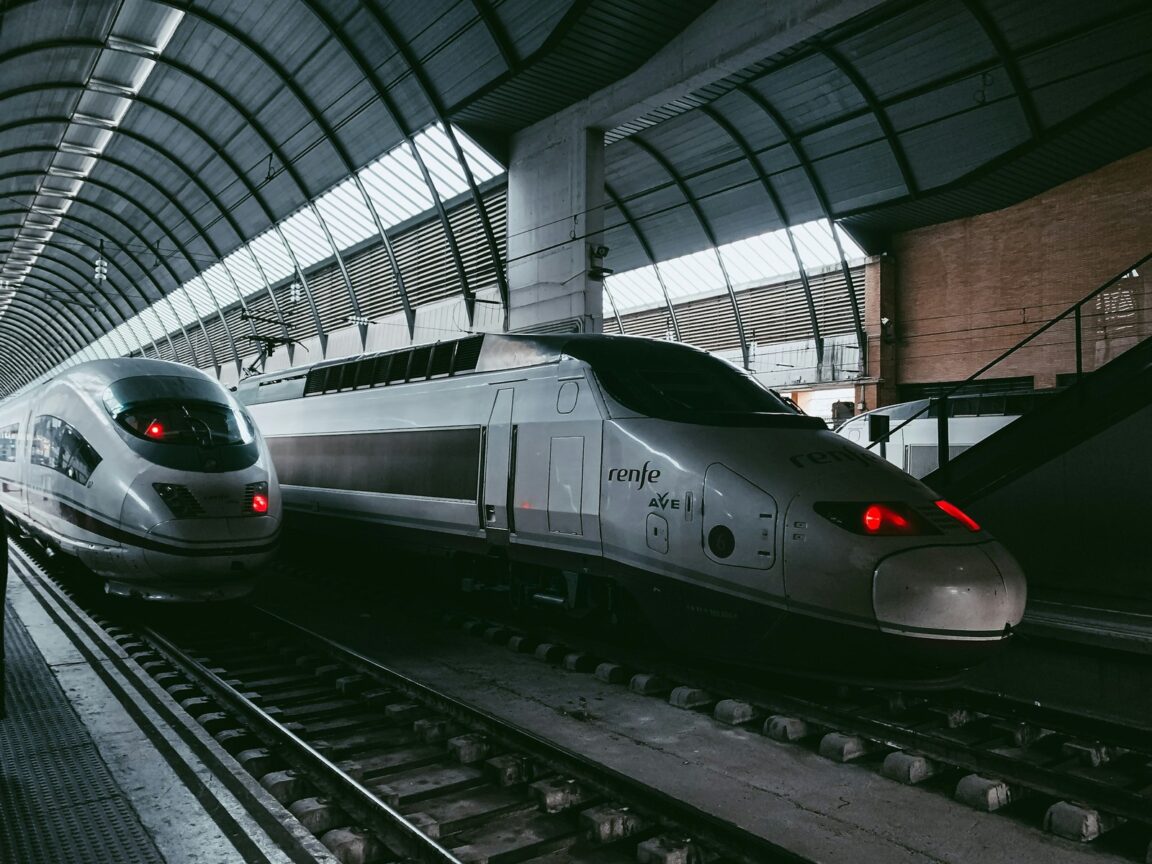
Featured image: Two Renfe AVE high speed trains at a covered station platform in Spain, the nearer train carrying Renfe AVE lettering on its nose. Photo by Marcelo on Unsplash, used under the Unsplash licence.