 Lucas Meyer
Pack for a November rail trip in Japan around one rolling case you rarely carry: forward the big case hotel to hotel with takkyubin, Japan’s luggage delivery services, ride the shinkansen and local lines with a daypack and a small overnight bag, and dress in layers built for November’s swing, mild afternoons around 17 degrees in Tokyo and Kyoto and near freezing mornings further north. The system rests on three numbers verified on November 21, 2026: a forwarded suitcase is priced by the sum of its three sides, with the standard large case band at 160 centimetres and 25 kilograms; a bag over 160 centimetres in total needs a reserved oversized baggage seat on the Tokaido, Sanyo, Kyushu and Nishi Kyushu shinkansen; and station coin lockers bridge the hours, not the days. Everything else in this guide is arrangement: what goes in which bag, in which order, and why.
Quick Facts
- System: One rolling case forwarded by takkyubin, one daypack and one overnight bag carried on trains
- Forwarding benchmark: Yamato TA-Q-BIN Size 160 (up to 160 cm total, 25 kg) at 2,510 JPY within the Kanto region and 2,630 JPY from Tokyo to Kyoto or Osaka, tax included, per Yamato’s published rate table
- Forwarding limits: Maximum Size 200 and 30 kg; 100 JPY off per parcel when dropped off in person; airport deliveries should be sent two days before the flight, three in some areas
- Shinkansen rule: Bags of 160 to 250 cm total require a seat with an oversized baggage area on the Tokaido, Sanyo, Kyushu and Nishi Kyushu lines, reserved at no extra charge; boarding without one costs a 1,000 JPY fee, and bags over 250 cm are not carried
- November normals: Tokyo averages a 16.7 degree high and an 8.8 degree low, Kyoto 17.3 and 8.4, Sapporo 8.7 and 1.6, per Japan Meteorological Agency 1991 to 2020 climate normals
- Lockers: Station coin lockers typically run from about 300 JPY a day for the smallest to about 1,000 JPY for the largest, with the largest sizes the first to fill
- Prices checked: November 21, 2026, against Yamato Transport, JR West and the Japan Meteorological Agency
How does takkyubin luggage forwarding actually work, step by step?
Takkyubin, written TA-Q-BIN by the largest operator, Yamato Transport, is a door to door parcel service that Japanese travellers use for suitcases as routinely as for boxes. Hand the case over at a hotel front desk, a Yamato counter or a convenience store, fill in the waybill with the next hotel’s name, address and your check in date, pay, and keep the tracking slip. Delivery is normally the next day on Honshu’s main corridors and can be dated further ahead, which is what makes the system sing on a rail itinerary: the case sent from Tokyo on Monday morning is waiting in the Kyoto hotel room on Tuesday, and can be sent onward to Osaka or the departure airport while its owner rides with a daypack. The price is set by size band, the sum of length, width and height, with weight caps per band, and by the regions travelled between: the published table puts a Size 160 case at 2,510 JPY within Kanto and 2,630 JPY from Kanto to Kansai, tax included, with 100 JPY off for dropping the parcel off in person rather than having it collected. Two cautions complete the picture: keep passports, medication, valuables and one full change of clothes out of the forwarded case, because a missed connection between case and owner is an inconvenience only if the essentials travelled separately; and send airport bound cases early, two days before the flight as Yamato directs, three from some regions.
What size case should the whole system be built around?
One rolling case whose three sides add up to no more than 160 centimetres, which is also the shinkansen’s dividing line, and this is not a coincidence worth ignoring. At 160 or under, the case forwards at the standard large rate, fits the largest common coin lockers when it must, and, on the days it does ride a train, needs no special seat anywhere in Japan. The moment a case crosses 160, every system charges it attention: on the Tokaido, Sanyo, Kyushu and Nishi Kyushu shinkansen it must travel at a seat with an oversized baggage area, the last row seats with space behind them, reserved in advance at no extra charge beyond the normal reserved seat fare, as JR West’s oversized luggage page sets out; board without that reservation and the conductor charges 1,000 JPY and decides where the bag goes; and above 250 centimetres total the bag is not carried at all. The Japan National Tourism Organization’s shinkansen page makes the same point for visitors in one line: oversized baggage means overall dimensions of more than 160 centimetres, and the seat with space should be reserved ahead. One case at or under the line, packed to about 20 kilograms so it stays comfortably inside the Size 160 weight cap of 25 kilograms, is therefore the entire luggage strategy; everything else is a bag that fits under a train seat.
How do station coin lockers fit a rail itinerary without taking it over?
As a bridge, in three specific gaps. Gap one is arrival morning: a case too early for check in goes into a large locker at the arrival station while its owner starts sightseeing, though on a forwarded itinerary this gap mostly disappears. Gap two is the temple day detour: the overnight bag rides in a medium locker at a hub station while the daypack does the walking, which is the locker system’s best use in Kyoto and Nara, where dragging any bag through temple precincts is miserable. Gap three is the last day shuffle between hotel check out and an evening train. Prices scale by size, typically from about 300 JPY a day for the smallest lockers to about 1,000 JPY for the largest, and two operational rules matter more than the price: the largest lockers are few and fill first at major stations on autumn weekends, so a plan that requires one at Kyoto Station at noon on a Saturday is a plan with a hole in it; and most locker banks now take IC cards such as Suica rather than coins, despite the name. Travellers stringing the classic Tokyo, Kyoto and Osaka line together can plan station choices with our Kanazawa travel guide open alongside, since the Hokuriku side trip is where locker and forwarding decisions most often collide.
What layers does November in Japan actually demand?
Layers for a 10 to 15 degree daily swing, not a winter kit, unless Hokkaido is on the route. The Japan Meteorological Agency’s 1991 to 2020 normals put November in Tokyo at a 16.7 degree average high and an 8.8 degree average low, Kyoto at 17.3 and 8.4, and Sapporo at 8.7 and 1.6, which translates into a packing list with a clear shape: a packable insulated jacket as the outer layer, a warm mid layer that works alone on mild afternoons, long sleeved bases that can be washed in hotel sinks and dry overnight, and one genuinely warm set, hat, gloves and thermal top, reserved for early starts, mountain temples and any northern leg. Temple days drive the details: shoes that slip off quickly for interiors, socks without holes for tatami, and a daypack that swallows the jacket by midday when the sun is out and the frost has burned off. Rain in November is moderate rather than relentless, so a compact umbrella beats a full waterproof shell for city based itineraries. The same layer logic, shifted one season colder, is what our spring Japan packing guide applies to cherry blossom trips, and the two systems share the same case and forwarding backbone.
How should the three bags be divided on a two week route?
By time, not by category. The rolling case holds everything not needed in the next 36 hours: the bulk of the clothes, the warm set outside its season of use, purchases, and the laundry bag that grows as the trip does. The overnight bag, a soft duffel or large tote that fits a shinkansen overhead rack, holds tonight and tomorrow: sleepwear, one full change, wash kit, chargers and medication, and it is the bag that makes forwarding painless, because the case can be sent a full day ahead without touching the traveller’s routine. The daypack holds the day itself: documents, water, the layer of the hour, camera and umbrella. Worked through a sample route, the rhythm looks like this: arrive Tokyo with all three, forward the case to Kyoto on the morning of the Tokyo departure minus one, ride with two bags, reunite in Kyoto, day trip to Nara on lockers and the daypack, forward the case to Osaka, and send it finally to the airport two days before the flight home. At no point does the traveller carry the case up a station staircase in the autumn crowds, which, more than any saving, is what the system is for.
Frequently Asked Questions
How much does it cost to forward a suitcase from Tokyo to Kyoto?
On Yamato Transport’s published TA-Q-BIN rates, a Size 160 case, up to 160 centimetres in total dimensions and 25 kilograms, costs 2,630 JPY from the Kanto region to Kansai, tax included, with 100 JPY off if the case is dropped off in person at a sales office, agency or convenience store. Delivery is normally the next day.
What happens if a shinkansen bag is over 160 centimetres?
On the Tokaido, Sanyo, Kyushu and Nishi Kyushu shinkansen, a bag between 160 and 250 centimetres in total must travel at a seat with an oversized baggage area or compartment, reserved in advance at no extra charge. Boarding without the reservation brings a 1,000 JPY fee. Bags over 250 centimetres are not carried. Other shinkansen lines do not require the reservation.
Are coin lockers big enough for a full size suitcase?
The largest station lockers take a full size case, but they are the scarcest size in every bank and the first to fill at major stations in peak autumn. Typical pricing runs from about 300 JPY a day for small lockers to about 1,000 JPY for the largest. Forwarding the case and locking only the overnight bag is the more reliable pattern.
How cold does Japan get in November?
By the Japan Meteorological Agency’s 1991 to 2020 normals, Tokyo averages a 16.7 degree high and an 8.8 degree low in November, Kyoto 17.3 and 8.4, while Sapporo is already near winter at 8.7 and 1.6. Pack layers for mild afternoons and cold mornings in Honshu, and a real warm layer for any Hokkaido leg.
Can luggage be forwarded directly to the airport?
Yes, through the airport TA-Q-BIN services. Yamato directs travellers to send the case two days before the flight, three days from some areas, and an airport counter fee applies on airport deliveries. The case waits at the departure airport, which turns the final travel day into a daypack only day.
Is one rolling case really enough for two weeks in Japan?
With the three bag division in this guide, yes. The case carries the wardrobe’s bulk and is forwarded rather than carried, hotel laundry and sink washing handle the rotation, and the overnight bag covers every gap. The binding constraint is the 160 centimetre, 25 kilogram Size 160 band, which a disciplined two week wardrobe fits comfortably.
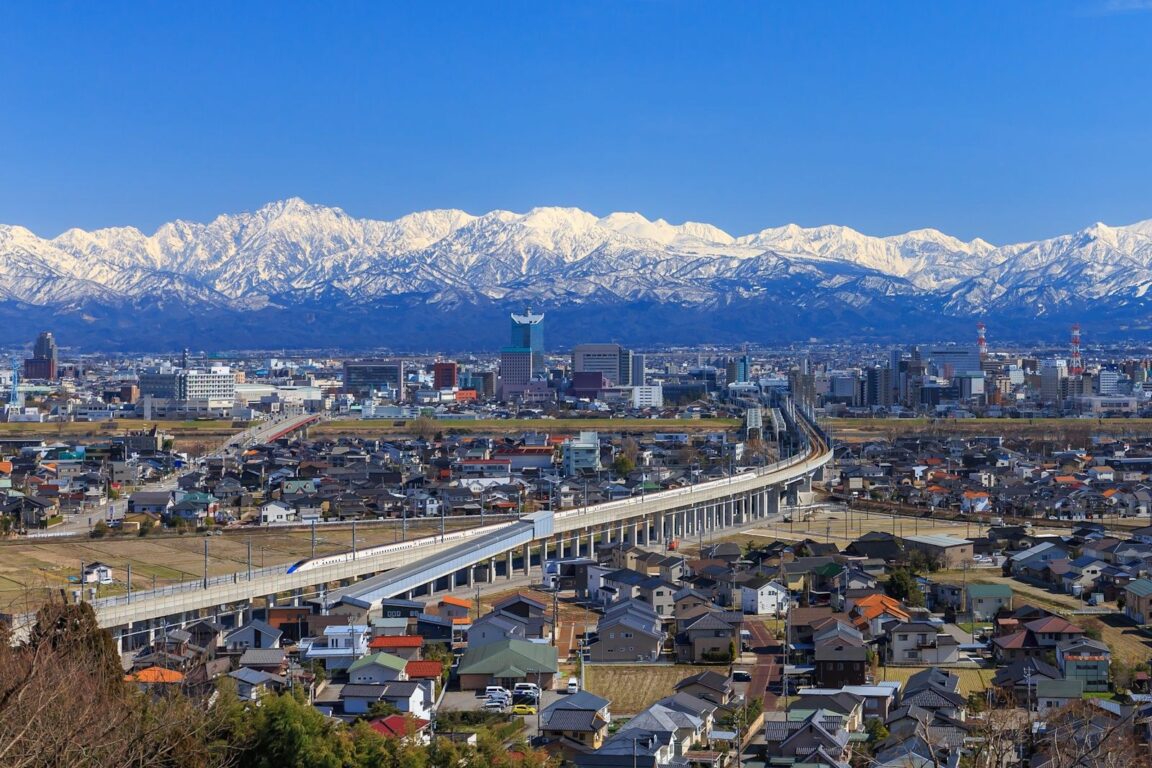
Featured image: A Hokuriku Shinkansen train crossing Toyama on its elevated line, the snow capped Tateyama range behind the city. Photo by East Japan Railway Company, via the Japan National Tourism Organization official site (japan.travel), used with credit.