 Sofia Rossi
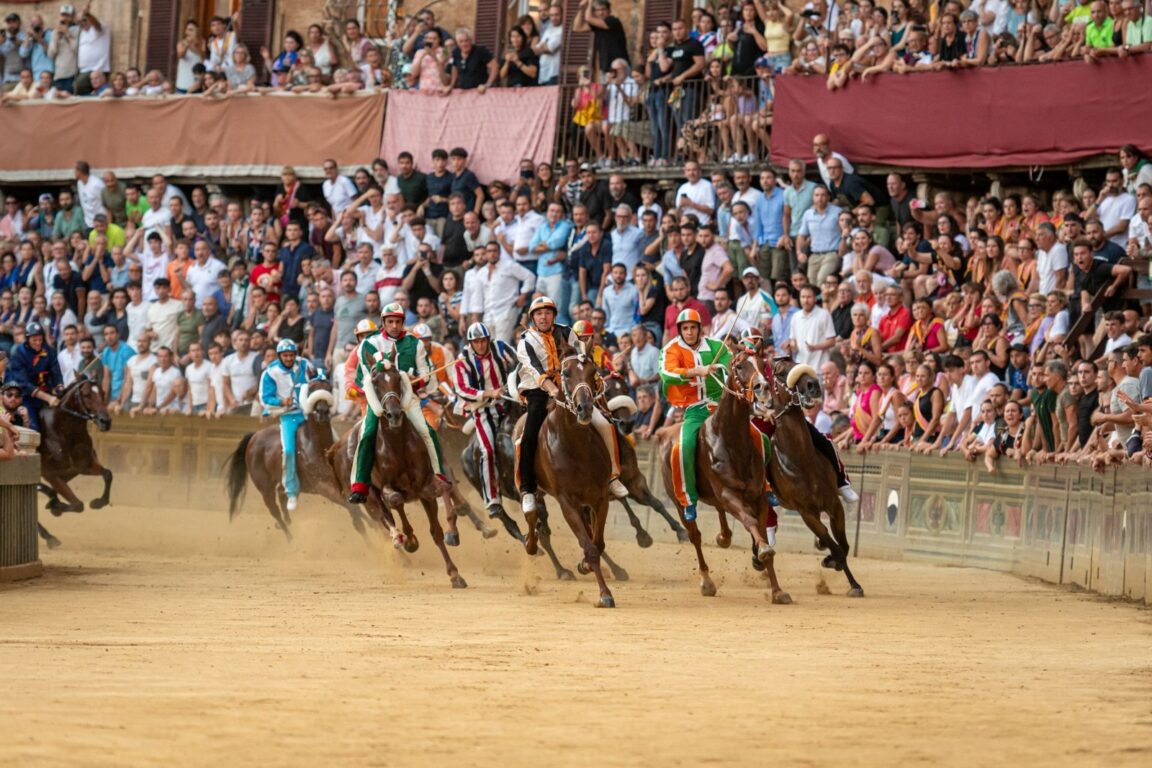
The Palio di Siena is not a show staged for visitors, and understanding that single fact is the whole visitor skill: Siena races twice a year, on July 2 for the Madonna di Provenzano and on August 16 for the Madonna dell’Assunta, when ten of the city’s seventeen contrade, its historic districts, send a horse and a bareback jockey three times around the earth covered Piazza del Campo for a painted silk banner, the drappellone. A visitor’s realistic choices are to stand free in the centre of the Campo for hours, to pay a palco or balcony owner for a seat above the track, or to skip the race itself and give the four days of trials, blessings and dinners the attention they deserve. The contrade system, the prova trial races and the viewing economics, in that order, are what this guide explains.
Quick Facts
- Event: Palio di Siena, bareback horse race in Piazza del Campo, Siena, Tuscany
- Dates: July 2 (Palio di Provenzano) and August 16 (Palio dell’Assunta) every year, with four day programmes running June 29 to July 2 and August 13 to 16; the next races are in 2027
- Field: 10 of Siena’s 17 contrade in each race: the seven that sat out the corresponding race the year before, plus three drawn by lot
- The horse: Assigned to each contrada by public lottery, the tratta, three days before the race, and cannot be changed; a horse can even win riderless, scosso
- Rules: Governed by Palio Regulations in force since 1720, per Siena’s official visitor site
- Watching free: Standing in the centre of the Campo costs nothing; grandstand, window and balcony places are sold privately and budget at several hundred euros
- Weather rule: Rain can postpone a race, as it did in July 2026, when the race ran a day late
- Facts checked: November 21, 2026, against Visit Siena, the city’s official visitor site, and ilpalio.org’s published programme
What is a contrada, and why does it run a visitor’s whole Palio?
Siena is divided into seventeen contrade, each a small republic in miniature with its own emblem, colours, church, museum, fountain and patron saint: Aquila the eagle, Bruco the caterpillar, Chiocciola the snail, Civetta the little owl, Drago the dragon, Giraffa, Istrice the porcupine, Leocorno the unicorn, Lupa the she wolf, Nicchio the shell, Oca the goose, Onda the wave, Pantera, Selva, Tartuca the tortoise, Torre the tower and Valdimontone, as Visit Siena, the city’s official visitor site, lists them. A Sienese belongs to a contrada from birth, is baptised into it, marries within its calendar of feasts and measures the year by its results. Alliances and enmities between contrade run for decades, sometimes centuries, and they, not the horses, are the race’s real competitors. For a visitor the practical consequence is simple: during Palio days the contrada quarters are not themed decoration but private civic space at its most intense, and the respectful posture is that of a guest at someone else’s family event, welcome to watch, expected not to intrude at moments of tension, and never to wear or wave another contrada’s colours in its streets.
How do the four days, the tratta and the prova trials actually run?
Each Palio is a four day programme, and the race is only its last ninety seconds. On the first morning, June 29 or August 13, the horses presented for selection run trial heats, the tratta, in the Campo; the ten captains then choose the ten horses they judge suitable for the track, and a public draw in front of the Palazzo Pubblico assigns one horse to each racing contrada by lot. No contrada may choose, refuse or trade its horse, and from that moment the animal is guarded around the clock by its barbaresco, the groom who stays with it until the race. Six trial races, the prove, follow across the remaining days, morning and evening, as set out in the published Palio programme on ilpalio.org: the evening trial on the eve of the race is the Prova Generale, followed by the dress rehearsal dinners held in the streets of the racing contrade, and race day itself opens with the Messa del Fantino, the jockeys’ Mass, a final morning trial, and the blessing of horse and jockey in each contrada church, where the priest ends with the words every visitor remembers: go, and return victorious. The historical procession, the Corteo Storico, in 15th century costume, then circles the Campo before the race runs in the early evening.
The trials matter to a visitor for a hard headed reason: they are the same horses, the same track and much of the same crowd energy, watched from the centre of the Campo without the race day crush or the race day prices. A traveller with three days in Siena and no balcony ticket will usually remember the Prova Generale and a contrada dinner longer than a distant, sun baked view of the race itself. Travellers pairing Siena with the province’s quieter corners can use our Torrita di Siena countryside guide for the days either side, when the city returns to normal speed.
Where can a visitor actually watch the race from, and what does it cost?
There are three tiers, and honesty about each saves trips. The centre of the Campo is free and unticketed, and it is also a commitment: entry closes well before the race, the standing crowd is dense, the July sun is direct, and leaving midway is effectively impossible, so it suits the young, the patient and the genuinely committed. Around the track stand the palchi, the tiered grandstands, and above them the windows and balconies of the palazzi that ring the square. There is no central box office and no official price list for these seats, because the places belong to the buildings’ owners and reach visitors through owners, agencies and package sellers at prices set seat by seat; the planning figure to hold is several hundred euros for a decent balcony or window place, rising for the start line and the San Martino bend, with the best addresses routinely committed months ahead and effectively gone by spring for the July race. What the money buys is not luxury but information: height, shade, a view of the mossa, the rope start where races are won and lost in negotiation, and the ability to sit down. Visitors who baulk at the price are not missing a secret cheaper tier; the free centre and the paid seats are the whole market, and the trials exist precisely to give everyone else a full Palio.
How should a visitor behave inside a contrada during Palio days?
As a guest, in the specific ways the Sienese themselves publish for outsiders. Do not disturb contrada members escorting the horse to and from the trials, do not photograph inside contrada churches during the blessing, do not treat a defeated contrada’s streets as a place for celebration, and do not pick up, wave or wear the scarf of a contrada you do not belong to as a souvenir gesture. Do attend the public parts fully: the draw, the trials, the procession, the flag throwing displays, and the dinners where a contrada explicitly sells places to guests. The distinction running through all of it is participation by invitation versus observation by right, and visitors who keep it rarely have a bad Palio. A useful base strategy is to sleep inside the walls for the four days rather than day tripping, since the programme starts early, ends late and fills the middle with events no timetable fully captures; our Lucca travel guide covers the walled Tuscan city that pairs most naturally with Siena on the same trip, at the opposite emotional volume.
Frequently Asked Questions
When is the next Palio di Siena?
The Palio runs on fixed dates, July 2 and August 16 each year, with the four day programmes beginning June 29 and August 13. The 2026 races have been run, the August race going to Nicchio, so the next editions are July 2 and August 16, 2027. Rain is the one force that can shift a race by a day, as happened in July 2026.
How many contrade race in each Palio?
Ten of the seventeen. The seven contrade that did not run in the corresponding race the previous year qualify automatically, and three more are drawn by lot. The horses are then assigned to those ten contrade by a second lottery, the tratta, three days before the race.
Can visitors watch the Palio for free?
Yes. Standing in the centre of Piazza del Campo is free and unticketed for the trials and the race. The trade off is time and comfort: arrive hours early, expect dense crowds and full sun, and plan on staying in place until the race ends. Paid grandstand, window and balcony seats are sold privately and budget at several hundred euros.
What is the Prova Generale?
The final evening trial race, run on the eve of the Palio with the race’s own horses and jockeys on the Campo track. It is followed by dress rehearsal dinners in the racing contrade. For visitors without race seats, it is widely the best single session to attend.
Can a horse win the Palio without its jockey?
Yes. The protagonist of the race is the horse, which is assigned by lot and cannot be substituted. A horse that finishes first riderless, known as scosso, still wins the Palio for its contrada, a rule that underlines how completely the event belongs to the districts and their animals rather than to individual riders.
When do balcony seats for the Palio sell out?
There is no single sale date, because seats are sold privately by owners and agencies rather than through a box office. In practice the best located balconies and windows are committed months in advance, and visitors set on a prime seat for the July race should be arranging it by the preceding winter or early spring.
Featured image: Bareback jockeys in contrada colours racing on the earth track in Piazza del Campo during the Palio di Siena, crowds packed into the stands and balconies behind. Photo from Visit Siena, the city’s official visitor site (visitsiena.it), used with credit.