 River Callahan
Split a first Kenai Fjords trip by access, not by enthusiasm: one day on land at Exit Glacier, the only part of the park reached by road, walking the Glacier View Loop and the Glacier Overlook Trail with the Harding Icefield Trail as the strenuous option, and one full day on the water out of Seward on the longest boat, the Northwestern Fjord cruise of about 8.5 hours, because the park’s tidewater glaciers and marine wildlife live in the fjords and nowhere else. Base in Seward for both days, keep a third morning unplanned as the weather buffer, and accept the park’s central bargain: entry is free, there is no entrance fee at all, and the money goes on the boat, the bed and the rain gear instead.
Quick Facts
- Park: Kenai Fjords National Park, Alaska, about 670,000 acres where the Harding Icefield meets the Gulf of Alaska, outside Seward on the Kenai Peninsula
- Entrance fee: None. Kenai Fjords charges no entrance fee and no camping fee and does not sell park passes, per the National Park Service, checked November 21, 2026
- Base: Seward, at the head of Resurrection Bay, about 127 miles and roughly 2.5 to 3 hours south of Anchorage on the Seward Highway
- Land day: Exit Glacier, the park’s only road accessible area, at the end of Herman Leirer Road, also called Exit Glacier Road, about 15 minutes from Seward
- Trails: Glacier View Loop, about 1 mile and accessible; Glacier Overlook Trail beyond it; Harding Icefield Trail, about 8.2 miles round trip, strenuous, allow 6 to 8 hours
- Boat day: Fjords cruises from Seward’s Small Boat Harbor run from about 4 hours to the full day Northwestern Fjord cruise of about 8.5 hours
- Camping: Exit Glacier Campground, 12 walk in tent only sites, free and first come
- Winter rule: Exit Glacier Road is unmaintained and closed to cars roughly from late October to early May
- Prices checked: November 21, 2026, against National Park Service sources; boat fares are set by the operators and vary by date
How should the Exit Glacier day be built?
Start at the Exit Glacier Nature Center, the trailhead for the only maintained trails in the park, as the National Park Service Kenai Fjords hiking page makes plain: the connected Exit Glacier Trails and the Harding Icefield Trail both begin just beyond the parking lot at the end of Exit Glacier Road. Walk the Glacier View Loop first, about a mile of accessible trail to the panorama over the outwash plain, then continue on the Glacier Overlook Trail, which climbs the exposed rock beside the glacier for the closer view of the ice itself. That pairing takes a half day at a humane pace and gives every first timer the park’s essential land experience: a valley glacier in retreat, with the year markers along the road and trail showing where the ice stood in living memory.
The Harding Icefield Trail is a different commitment and should be chosen, not added. At about 8.2 miles round trip with a climb of well over 3,000 feet, and 6 to 8 hours on the park’s own estimate, it climbs through forest and alpine meadow to an overlook above the Harding Icefield, the roughly 700 square mile icefield that feeds the park’s dozens of glaciers, Exit among them. Fit hikers on a clear day should take it as the whole land day, starting early, carrying rain gear and water, and treating the Glacier View Loop as the warm up rather than the warm down. Everyone else loses nothing by skipping it: the overlook trail already delivers the glacier, and the boat day delivers the scale. Travellers budgeting the land day line by line can use our Exit Glacier costs and budget guide, which prices the cabins, the campground and the ranger walk pattern around this same free core.
Why does the boat day need to be the longest boat?
Because Kenai Fjords is a marine park with a road attached, not the reverse. Most of the park is fjord, island and tidewater glacier, reachable only by water, and the wildlife that defines it, humpback and killer whales, Steller sea lions, sea otters, puffins and other nesting seabirds, is distributed along the coast in proportion to time spent on it. The Seward operators run a ladder of cruises from the Small Boat Harbor, from short Resurrection Bay trips of about 4 hours through mid length glacier cruises to the full day Northwestern Fjord cruise of about 8.5 hours, which pushes farthest into the park’s most remote fjord, spends the longest at calving tidewater ice and uses smaller boats that can work closer to shore. On a first trip with one boat day, the longest boat is the correct extravagance: it is the difference between sampling the park and seeing it.
Book the boat for the first full day of the trip, not the last, and book it before the lodging if the dates are peak summer. That order is the weather strategy in disguise, explained below, and it also protects the trip’s centrepiece: if the sailing is cancelled or curtailed by Gulf weather, a first day booking leaves the whole remainder of the stay to rebook into, while a last day booking leaves nothing. Dress for the boat as the park’s climate demands, waterproof outer layers, warm mid layers, hat and gloves even in July, because a fjords deck in wind and spray is a cold place at any air temperature, and take motion sickness seriously on the open water legs beyond Resurrection Bay.
What is the weather cancelled backup plan?
Seward itself, used properly, plus the land day swapped forward. Kenai Fjords weather cancels in two ways: boats that do not sail or sail shortened, and trail days washed into low cloud. The buffer system is simple. Hold one unplanned morning in a three day stay, and when a sailing is cancelled, move the Exit Glacier day into the gap, rebook the boat into the buffer, and spend the wettest hours on Seward’s indoor and shoreline assets: the Alaska SeaLife Center on the waterfront, the town’s museum and library, the harbour boardwalk and the Two Lakes and waterfront trails between showers. None of that is a consolation prize version of the park; it is how Seward residents themselves sequence a fjords week, and it is why the base decision matters. A traveller based in Anchorage, 127 miles away, has no such flexibility: every cancellation is a lost day and a long wet drive. Our Talkeetna weekend guide covers the same Alaskan weather logic applied to Denali flightseeing, and the principle transfers exactly: book the weather dependent centrepiece first, hold a buffer, and let the town days absorb the storm.
Where should a first timer sleep and eat in Seward?
In town, within walking distance of the Small Boat Harbor if possible, because boat check ins are early and Seward’s evenings are short walks between harbour, restaurants and bed. The town divides into the harbour and downtown grid at the north end of Resurrection Bay and the Lowell Point road to the south, quieter and more scattered. First timers should stay in the grid: the early start is painless, dinner needs no driving, and the Exit Glacier road begins just north of town, about 15 minutes to the nature centre parking. Campers have the park’s own option, the Exit Glacier Campground’s 12 walk in tent sites, free and first come, plus the city’s waterfront campgrounds in town. Eat where the harbour eats, seafood first, and keep one evening for the simple Seward ritual of walking the waterfront path at the head of the bay after dinner, watching the light stay up far later than it should.
Frequently Asked Questions
Does Kenai Fjords charge an entrance fee?
No. The National Park Service states that no entrance fees and no camping fees are charged at Kenai Fjords, and the park does not sell or require any park pass. The Exit Glacier trails, the nature centre and the campground are all free. What costs money is everything commercial around that free core: the fjords boat tours, lodging and food in Seward, and fuel or shuttles.
How many days does Kenai Fjords need?
Two full days is the honest minimum for a first visit: one land day at Exit Glacier and one full day boat into the fjords, plus a buffer morning if the schedule allows a third day. A single day forces a choice between the glacier on foot and the fjords by boat, and the park is precisely the combination of the two.
What is the difference between the boat tours?
Length and reach. Short cruises of about 4 hours stay largely in Resurrection Bay. Mid length cruises of about 6 hours reach a tidewater glacier in Aialik Bay with strong wildlife time. The full day Northwestern Fjord cruise, about 8.5 hours, travels farthest into the park’s remote northwestern fjord on a smaller boat, with the most glacier and wildlife time. First timers with one boat day should take the longest.
Can I visit Exit Glacier in winter?
Not as a drive up visit. Exit Glacier Road is unmaintained in winter and closed to automobile traffic from the first gate, typically from late October to early May, and the area beyond becomes ski, snowshoe and snowmachine country. The summer season, when the road is open, the nature centre staffed and the boats running, is the first timer’s season.
Is the Harding Icefield Trail suitable for children?
For most families, no, not in full. It is a strenuous climb of about 8.2 miles round trip taking 6 to 8 hours, with snow possible on the upper trail into summer. Families should take the Glacier View Loop and the Glacier Overlook Trail instead, which deliver the glacier itself at a fraction of the effort, and save the icefield climb for a return trip with older children.
What wildlife will I see on the boat?
Nothing is guaranteed, and any operator promising otherwise should be distrusted. The realistic summer expectation on a full day cruise is strong: sea otters and harbour seals near the harbour, Steller sea lions hauled out on the rocks, puffins and other seabirds at the nesting islands, and a genuine chance of humpback whales and orcas in the fjords. The full day boat maximises time in the habitat, which is the only honest way to improve the odds.
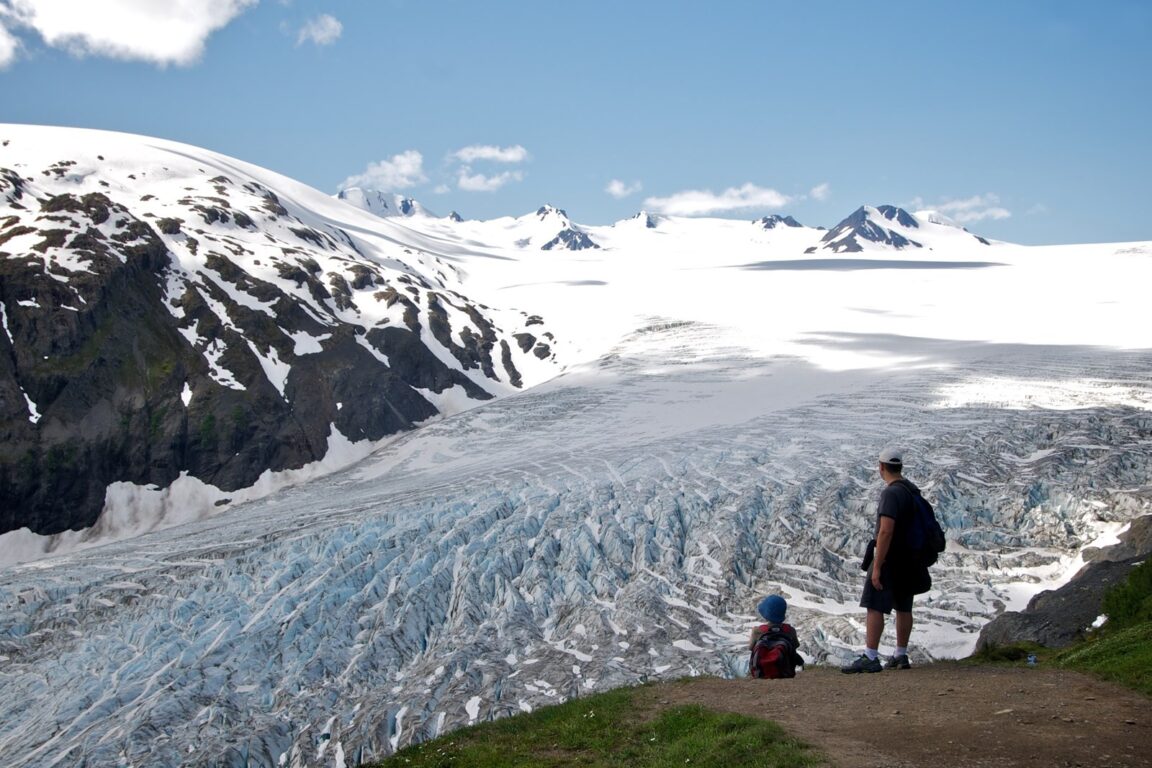
Featured image: Two hikers on the trail above Exit Glacier looking out over its crevassed surface toward the Harding Icefield, Kenai Fjords National Park. Photo by P. Calamari, National Park Service (nps.gov), US Government work, used with credit.