 River Callahan
The honest headline number for Exit Glacier is zero. Kenai Fjords National Park charges no entrance fee, no camping fee and sells no park pass, so the glacier itself, the ranger led walks and the trails all cost nothing. What a trip actually costs is everything around that free core: getting to Seward, a bed for the night, food, and any commercial fjord boat tour you add on the side. The only National Park Service prices in the Exit Glacier area are the public use cabins, at 75 dollars a night for the coastal cabins in summer and 50 dollars a night for the Willow Cabin at Exit Glacier in winter. Plan the visit in three layers, in this order: fix your dates inside the short summer season, when the road is open and the ranger walks run; choose between the free campground, a cabin and a Seward bed; then walk the trail system in stages, the valley floor first and the Harding Icefield climb only if the weather and your legs agree. One timing warning belongs at the top: the road to Exit Glacier is closed to cars from around late October to early May, so a November arrival is a winter expedition, not a summer day trip, and this budget is built for the summer season it describes.
Quick Facts
- Entrance: No entrance fee at Kenai Fjords National Park, no entrance pass required, and the park does not sell passes, per the NPS Fees and Passes page checked today
- Camping: No camping fee; the Exit Glacier campground has 12 tent only sites, walk in and first come in character, beside the Exit Glacier road
- Cabins: Coastal public use cabins 75 dollars per night in summer; Willow Cabin at Exit Glacier 50 dollars per night, winter only; reservations are required for all public use cabins
- Ranger walks, summer 2026 pattern: Exit Glacier ranger led walks twice daily at 10:00 AM and 2:00 PM, 23 May to 7 September 2026, about 1 hour 30 minutes to the Glacier Overlook, no reservations, meet outside the Exit Glacier Nature Center
- More free programs: Pavilion talks once daily at 1:30 PM, 6 June to 15 August 2026; Junior Ranger walks Tuesdays, Thursdays and Saturdays at 11:00 AM in the same window, sign up same day at the Nature Center
- Trails: Glacier View Loop about 1 mile round trip, with the first stretch wheelchair accessible; the Glacier Overlook trail continues beyond it; the Harding Icefield Trail is about 8 miles round trip, climbing roughly 3,000 feet in 4.1 miles, allow 6 to 8 hours
- Access: Exit Glacier is the only part of Kenai Fjords National Park reachable by road, at the end of Herman Leirer Road, also called Exit Glacier Road, out of Seward
- Winter: The road is unmaintained and closed to automobile traffic from the first gate, typically late October to early May; the Exit Glacier area is a further 7 miles beyond the gate, plus 1 mile to the overlook
- Season logic: The 2026 ranger program dates above are the most recent published pattern; the park had not published a 2027 schedule when this was checked on 17 November 2026, so treat times as the template, not a promise
What does an Exit Glacier day actually cost, line by line?
Start with the park column, because it is refreshingly short. Entrance: nothing. Parking at the Nature Center: nothing. The ranger led walk: nothing, and no reservation to compete for. The campground, if you stay: nothing. The NPS is unusually blunt about it, stating that no entrance fees and no camping fees are charged at Kenai Fjords, and that the park does not sell or require any park passes. An America the Beautiful pass buys you nothing here, because there is no fee for it to cover.
The real budget lines sit outside the park boundary. Fuel or a shuttle for the run out of Seward and back. A bed, priced below. Food, because there is no cafe at the Nature Center and Seward is your supply town. And the optional extras that tempt every Seward visitor: a commercial boat tour into the fjords, a guided kayak day or a flightseeing trip, all sold by private operators at prices they set and change. None of those operator prices is quoted here, because none could be verified against a primary park source today; check the operator own listings when you book, and keep them in a separate column from the park costs, which are fixed and free.
Where do you sleep, and what does each bed cost?
The cheapest bed is inside the park: the 12 site, tent only Exit Glacier campground, free of charge. Twelve sites is a small number for the only roadside campground in the park, so in July and August the plan has to include an early arrival and a fallback. The fallback inside the park system is a public use cabin, and cabins are the one place the NPS does charge: 75 dollars a night for the coastal cabins in summer, which are reached by boat rather than by road, and 50 dollars a night for the Willow Cabin at Exit Glacier, which is a winter only rental, set up for ski and snowshoe access when the road is closed to cars. Reservations are required for every public use cabin.
Most visitors sleep in Seward instead, where the lodging stock runs from hostel bunks to harbour view hotels at commercial rates that move with the season. That choice trades money for flexibility: a Seward bed keeps restaurants, the small boat harbour and the fjord tour docks on your doorstep, and turns Exit Glacier into a short drive out and back. The cost honest way to compare is nights in Seward plus fuel against a free campground night plus the discipline of carrying all your food in. Either way, book summer beds early, because the same short season that limits the ranger program limits the town room supply.
For a second Alaska park where the bed and boat maths work completely differently, see our deep dive on day boat booking in Glacier Bay Bartlett Cove.
How do the ranger walk schedules shape the day?
The summer 2026 schedule, the most recent the park has published, ran ranger led walks twice a day, at 10:00 AM and 2:00 PM, from 23 May to 7 September. The walk lasts about 1 hour 30 minutes, follows the trail to the Glacier Overlook, and starts just outside the Exit Glacier Nature Center, with no reservation needed. The first part, along the trail to the Glacier View lookout, is wheelchair accessible, which makes the 10:00 AM walk the natural anchor for a mixed ability group: everyone does the accessible opening together, and those who want more continue to the overlook.
Around that anchor, the supporting programs fill the gaps. Pavilion talks ran once daily at 1:30 PM from 6 June to 15 August, about 20 minutes at the pavilion roughly 40 yards from the Nature Center, an easy bridge between the two walks. Junior Ranger walks ran on Tuesdays, Thursdays and Saturdays at 11:00 AM in the same window, with same day sign up at the Nature Center and a cap on group numbers, so families should sign up on arrival rather than at 10:55. Build the day backwards from the walk you care about most: Harding Icefield hikers should skip the morning walk and start climbing early, while valley floor visitors can take the 2:00 PM walk after a slow morning and still be back in Seward for dinner.
How should you stage the Harding Icefield Trail?
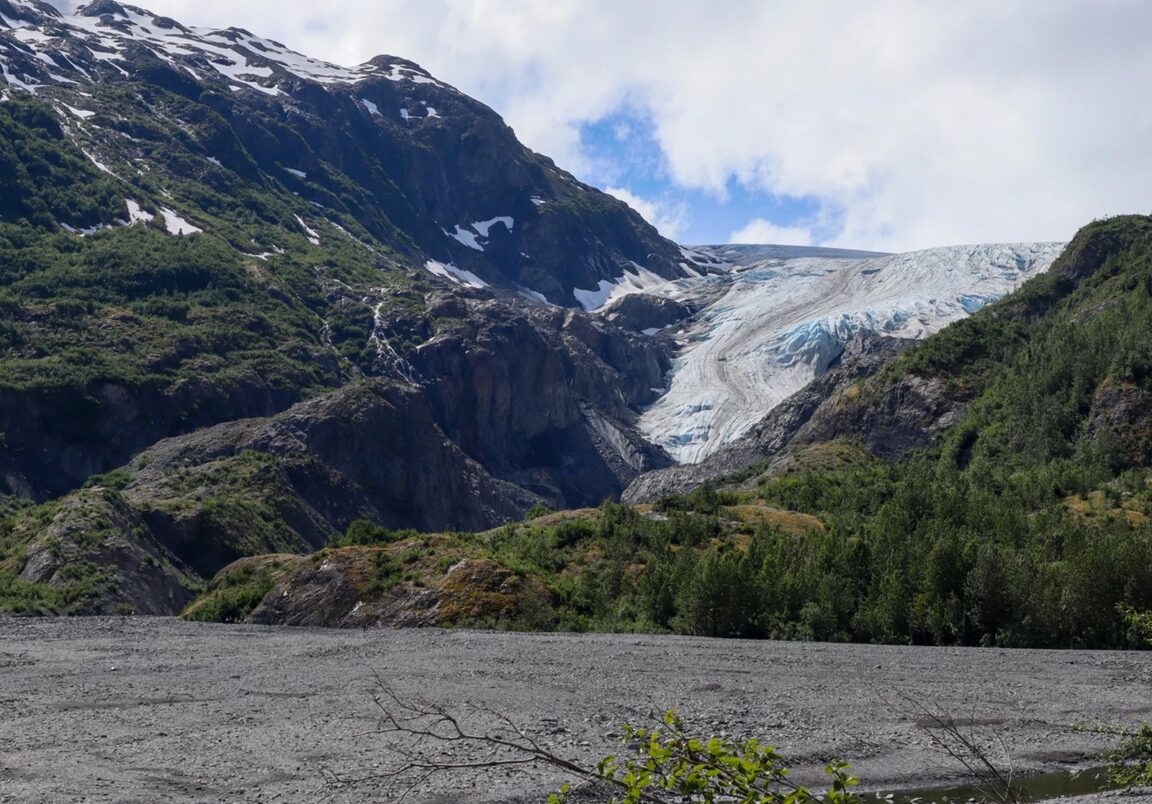
In stages, with decision points, because the trail is really four hikes stacked on one path. It leaves the valley floor near the Nature Center and climbs beside Exit Glacier at roughly 1,000 feet of gain per mile. The NPS trail map marks the staircase: Marmot Meadows at about 1.5 miles, the first big rest and the point where the glacier view opens out; Top of Cliffs at about 2.3 miles and roughly 2,454 feet, a satisfying turnaround in its own right at about 4.6 miles round trip; then the high, exposed section past the emergency shelter to the end of trail at about 3.9 miles, looking over the Harding Icefield itself, the largest icefield entirely within the United States and the source of the park glaciers, Exit included.
The full round trip is about 8 miles and the park advises allowing 6 to 8 hours. Snowfields can linger on the upper trail well into summer, weather at the top is a different climate from the car park, and there is no water supply on the route. The staging rule that keeps the day honest: decide at Marmot Meadows, not at the trailhead, whether the full climb is on, using weather, snow and how your party actually feels after the first climb. Turning at Top of Cliffs is not a failed day; it is the stage most strong walkers should plan as their default, with the icefield overlook as the bonus if everything lines up.
How do you combine Exit Glacier with the rest of a Seward stay?
Give Exit Glacier the land day and the fjords the water day, and do not try to compress both into one. The glacier area rewards an unhurried morning: Nature Center exhibits first, the ranger walk, then the valley trails or the Harding climb. The fjords, the tidewater glaciers, the whales and seabird colonies, are a separate full day by boat from the Seward small boat harbour, booked with a commercial operator. Splitting the days also hedges the weather, since a grey, wet day that ruins an icefield climb is often still a workable boat day, and a calm clear morning is worth spending high on the trail.
Winter reverses the whole plan. From around late October to early May the road is closed to cars at the first gate, the Nature Center programs stop, and reaching the Exit Glacier area means 7 miles of skiing, snowshoeing, fat biking or, when conditions allow, snowmobiling, with a warming hut and the Willow Cabin as the only facilities. It is a fine expedition and a poor sightseeing shortcut. If your Alaska dates fall in winter, plan Exit Glacier as that expedition or move it to a summer return, and spend the Seward days on the town and the bay instead. Our guide to Denali Teklanika River corridor covers another Alaska park area where the season, not the sight, decides the itinerary.
Frequently Asked Questions
Is there really no entrance fee for Exit Glacier?
Really none. The NPS Fees and Passes page for Kenai Fjords states that no entrance fees are charged, no entrance pass is required, and the park does not sell passes. Camping is also free. The only NPS charges connected with the area are public use cabin rentals.
How much are the public use cabins?
Coastal public use cabins cost 75 dollars per night in summer, and the Willow Cabin at Exit Glacier costs 50 dollars per night in winter. Reservations are required for all of them, booked through the park system, and the coastal cabins are reached by water, not by road.
When do the ranger led walks run?
In summer 2026 they ran daily at 10:00 AM and 2:00 PM from 23 May to 7 September, lasting about 1 hour 30 minutes, meeting outside the Exit Glacier Nature Center with no reservation. The park had not published 2027 dates when this was checked in November 2026, so confirm the new schedule on the NPS site before a 2027 trip.
How hard is the Harding Icefield Trail, really?
It is a strenuous climb of about 8 miles round trip, gaining roughly 3,000 feet in 4.1 miles, and the park advises 6 to 8 hours. Use the marked stages, Marmot Meadows at 1.5 miles and Top of Cliffs at 2.3 miles, as planned turnaround options rather than treating the end of trail as compulsory.
Can I visit Exit Glacier in winter?
Yes, but not by car. The road closes to automobile traffic from around late October to early May, and the area is 7 miles beyond the first gate, reached by ski, snowshoe, fat bike or snowmobile when allowed. Facilities are minimal: a warming hut, pit toilets and the rentable Willow Cabin, and no potable water.
What is the one cost people forget to budget?
The commercial layer. The park is free, but fjord boat tours, kayak guides, water taxis and Seward summer lodging are not, and they are priced by operators in a short, high demand season. Price those from the operators own listings when you book, and keep them separate from the park costs, which are zero.