 Kwame Mensah
One case can do a November trip from Hanoi to Ho Chi Minh City, but only if it is packed as three separate trips sharing one bag. The north is cool and mostly dry, the centre is in its wettest stretch of the year, and the south is hot with the rainy season tailing off. Pack a light insulated layer and a proper rain shell for the north and centre, breathable heat clothing for the south, and keep the whole bag under the strictest limit on your ticket, which is usually a VietJet cabin bag rather than the checked allowance on Vietnam Airlines.
The system below splits the case into climate zones, ring fences a small overnight bag for a Ha Long Bay cruise, and sizes everything against the baggage rules that were checked on the airlines’ own sites on 18 November 2026.
Quick Facts
- Trip shape: Hanoi and Ha Long Bay in the north, Hue or Da Nang in the centre, Ho Chi Minh City in the south, linked by domestic flights.
- Hanoi in November: Average high about 26 degrees C and low about 19 degrees C, with about 48 mm of rain across the month in the 1991 to 2020 climate normals.
- Central coast in November: Hue averages roughly 620 mm of rain in November and Da Nang roughly 430 mm in the same normals, so a waterproof shell and dry bags are not optional.
- Ho Chi Minh City in November: Average high about 32 degrees C and low about 25 degrees C, with about 128 mm of rain as the wet season fades.
- Vietnam Airlines domestic economy: One checked piece up to 23 kg is the standard published economy allowance, with a maximum total dimension of 158 cm per checked piece.
- VietJet standard fares: Cabin baggage is capped at 7 kg in total, the cheapest Eco fare includes no checked baggage, and checked bags are sold by weight and cost less bought in advance.
- Ha Long Bay overnight: Take a small soft overnight bag onto the cruise boat and leave the main case in storage in Hanoi or at the cruise office.
What does November actually do in each region?
Vietnam is long enough that November means three different packing problems. In Hanoi, the month sits in the cool, dry part of the year. The World Meteorological Organization climate normals for 1991 to 2020, published from the Lang station data, put the November average high at 26.3 degrees C and the low at 19.2 degrees C, with about 48 mm of rain. That is T shirt weather at midday that turns into a light jacket evening, and a cool, damp start on an open boat or a motorbike taxi. Pack for the evening, not the noon photo.
The centre reverses the picture. Hue and Da Nang receive their heaviest rain in the autumn, and November is one of the wettest months of their year. Long run climate tables for Vietnam put Hue at roughly 620 mm of rain across November and Da Nang at roughly 430 mm, on around 20 to 22 rain days. Streets in Hoi An and Hue can flood after sustained rain, and a day that starts grey can deliver a genuine downpour by lunch. Anything that cannot survive being soaked either stays in a dry bag or stays out of the case.
Ho Chi Minh City stays tropical. The WMO normals for the city give a November average high of about 32.4 degrees C and a low of about 24.9 degrees C, with about 128 mm of rain spread over roughly 9 rain days as the wet season winds down. Rain here usually arrives as a heavy afternoon burst rather than an all day soak, so the southern kit is about heat, humidity and one fast drying layer, not insulation. The same pair of trousers that felt right in Hanoi will feel like a mistake by the second afternoon in District 1.
How do you build one case for three climates?
Start with the layer that solves two regions at once. A lightweight insulated jacket or a warm mid layer fleece covers Hanoi evenings, air conditioned trains and buses, and the cool wind on a Ha Long Bay top deck. Under it, build the wardrobe from quick drying shirts and trousers that work in the south and layer cleanly in the north. Cotton is the weak link on this route: it is heavy when wet, slow to dry in central Vietnam humidity, and bulky in the case. Synthetic or merino travel fabrics earn their space because they can be washed in a sink in Hue and worn again in Ho Chi Minh City.
Zone the packing cubes by climate rather than by outfit. One cube holds the north kit: the mid layer, a long sleeved shirt, closed shoes and socks. One holds the centre kit: the rain shell, a spare set kept permanently in a dry bag, and footwear that can get wet and recover. The largest cube is the south kit: shorts or light trousers, breathable shirts and sandals. Zoning matters because the trip usually moves in one direction, so each cube is opened, used and then left shut as the climate changes behind you.
Footwear decides more of this bag than clothing does. Take one pair of comfortable closed walking shoes that can handle Hanoi pavements and a wet Hue citadel, and one pair of sandals or light trainers for the south and for giving the main shoes a drying day. A third pair is dead weight on a route with this many flights, hotels and boat transfers. If a Ha Long Bay kayak outing or a central coast beach stop is planned, the sandals double as the water shoe.
What belongs in the Ha Long Bay overnight bag?
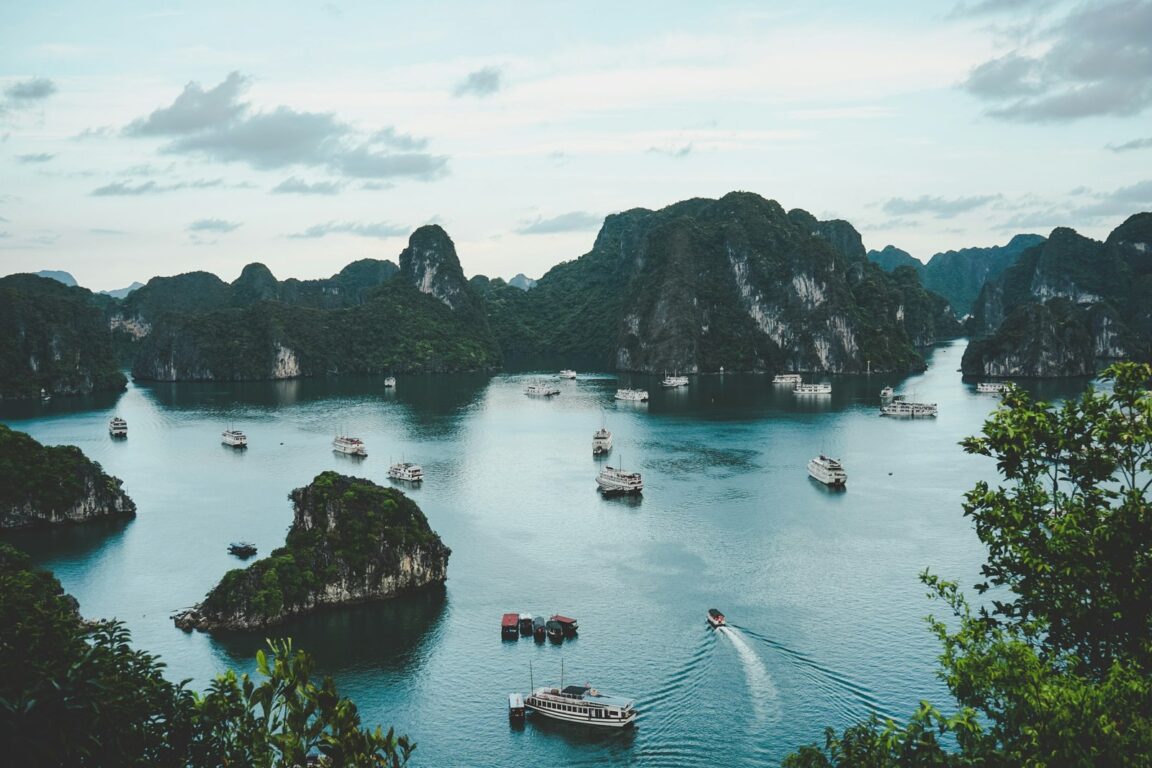
Most Ha Long Bay cruises collect the main luggage before boarding or store it while guests take a small bag to the cabin, and cabins are compact even on generous boats. Pack a soft overnight bag of around 20 litres as a separate item inside the main case, then fill it the night before the cruise. It needs one change of clothes, swimwear, sun protection, any medication, a phone charger, and the warm layer for the top deck in the morning, when the bay is at its coolest and stillest in November.
Keeping the overnight bag separate solves two problems at once. It avoids opening a full case on a boat, and it means the main bag can stay locked in Hanoi if the cruise is taken as an out and back trip from the capital. Travellers continuing south from Ha Long rather than returning to Hanoi should check the transfer plan with the cruise operator before relying on storage, because the bag has to rejoin the trip somewhere. For food and sightseeing context in the capital before or after the cruise, see our guide to what to eat in Hanoi, from pho to bun cha and egg coffee.
Which baggage limit actually decides the bag?
The honest answer is the smallest limit on any single flight in the itinerary, not the most generous one. On Vietnam Airlines, the published free checked baggage standard for domestic economy is one piece up to 23 kg, and the airline states that the three dimensions of a checked piece must not exceed 158 cm in total. Its cabin baggage standard is built around a main bag of at most 56 by 36 by 23 cm. The airline also advises passengers to check the exact allowance on their own ticket in Manage Booking or its baggage calculator, because fare type can change the allowance. A case packed to exactly 23 kg for a Vietnam Airlines leg is a comfortable case, as long as every other leg accepts it too.
VietJet is where November itineraries get caught. The airline’s own baggage service page caps total cabin baggage at 7 kg, made up of one main item of at most 56 by 36 by 23 cm plus one small personal item. Checked baggage is not included in the cheapest Eco fare at all and is bought as a weight package, with 20 kg the standard Deluxe inclusion and higher packages above that. No single checked piece may exceed 32 kg, and the airline states that checked baggage bought at the airport costs more than baggage arranged in advance. A traveller who packs a 15 kg case for Vietnam Airlines and then books a cheap VietJet leg to Ho Chi Minh City has not packed one bag for the trip. They have packed a bag plus an airport fee.
The practical response is to pick the bag size from the VietJet rule and the weight from the Vietnam Airlines rule. A cabin sized soft case or a medium case checked on every leg, kept near 15 to 18 kg, passes both systems without repacking at a check in desk. Buy any VietJet checked weight at booking, not at the airport, and weigh the finished case at home. Entry paperwork is the other fixed point of the route, and our explainer on Vietnam’s 90 day e visa, who qualifies and how to apply covers it before packing starts.
What goes in the case, zone by zone?
The north cube carries the only genuinely warm items: the mid layer, one long sleeved top, a light scarf or buff for boat wind and temple visits, and socks. The centre cube carries the waterproof shell with a hood, a compact umbrella as backup rather than as the main defence, two dry bags in different sizes, and a spare outfit that lives in a dry bag until it is needed. The south cube carries the lightest clothing on the trip, plus a hat and high factor sun protection that also serve the Ha Long Bay deck hours.
Shared items sit outside the cubes. A small wash kit with leak proof bottles matters more than usual because a leaking bottle in a case that gets rained on during a transfer is a double failure. A universal adapter is not needed for most travellers, since Vietnam uses Type A, C and F sockets and most phone chargers are dual voltage, but a short multi port USB charger reduces the nightly socket hunt in small hotels. A photocopy of the passport photo page and a phone photo of it belong in the overnight bag, separate from the passport itself.
For the central stop itself, expectations should be set by the rain rather than the brochure. Our guide to Hue, the imperial citadel city explains how to pace the citadel and tombs, and in November the winning move is a flexible order: citadel first on the driest morning, indoor and cafe time held in reserve for the wettest afternoon, and shoes that forgive flooded lanes.
Frequently asked questions
Can I do Hanoi to Ho Chi Minh City in November with cabin baggage only?
Yes, if every flight is on Vietnam Airlines or the case genuinely stays under the VietJet 7 kg total cabin limit. That means a small soft bag, the mid layer worn on travel days, and laundry every three or four days. Most travellers find a checked medium case less stressful.
Do I need a proper winter coat for Hanoi in November?
No. With average lows near 19 degrees C, a light insulated jacket or warm fleece over a long sleeved layer is enough for evenings and for Ha Long Bay. A heavy coat earns its bulk only on trips continuing into the northern mountains.
What is the single most useful item for central Vietnam in November?
A hooded waterproof shell, backed by dry bags inside the case. With Hue and Da Nang receiving several hundred millimetres of rain in the month, keeping one complete dry outfit in reserve changes a soaked day from a trip problem into a laundry problem.
Should I buy VietJet checked baggage in advance?
Yes. VietJet states that checked baggage fees are higher when bought at the airport, and its Eco fare includes no checked baggage. Add the weight package during booking and keep the total case weight inside the package bought.
What should stay in the Ha Long Bay overnight bag?
One change of clothes, swimwear, medication, chargers, sun protection and the warm layer for the early morning deck. Everything else stays in the main case in storage, which keeps a compact cruise cabin workable.
Prices and baggage rules checked on 18 November 2026 against Vietnam Airlines and VietJet official pages. Climate figures are 1991 to 2020 normals from the World Meteorological Organization and published Vietnam climate tables, as cited in the text, and describe a typical November rather than a forecast.