 Wei Chen
One bag works for a European winter city break when you stop trying to pack the coat and start wearing it. The system is simple: your heaviest coat, your heaviest boots and your warmest jumper travel on your body, through the airport and onto the plane, and the bag itself, sized to the strictest cabin rules in Europe, carries four days of thin, layered, repeatable clothes that work in heated museums, on snowy cobbles and at one good dinner. Winter in a city like Vienna runs around 0 degrees C, cold enough to punish the wrong shoes and mild enough that a ski wardrobe is dead weight. Pack for the pavement and the cafe, not for the Alps.
Quick Facts
- The strictest bag: Ryanair’s free small bag is 40 x 20 x 25 cm. Its Priority cabin bag is 55 x 40 x 20 cm up to 10 kg. Size your one bag to the ticket you actually bought, checked 20 November 2026.
- The coat rule: The coat is worn, never packed. It is your blanket, your pillow and your weather system, and it never enters the bag’s volume maths.
- The climate: Vienna’s winters run around 0 degrees C, per the Vienna Tourist Board’s climate pages, which use GeoSphere Austria data for 1991 to 2020. Snowfall is possible, usually as a dusting.
- The boots: One pair, worn, waterproof, with tread for wet cobbles and slush. A second pair is the first thing cut.
- The layers: Base, mid and shell logic in miniature: thermal base layers, two mid layers, and the worn coat as the outer.
- The repeat rule: Four days, three bottoms maximum, everything in one colour family so every top matches every bottom.
What bag size should you build the system around?
Build it around the smallest allowance on your itinerary, because European winter breaks usually chain a low cost flight, a train and a walk from the station. Ryanair publishes the tightest common numbers: a free small bag of 40 x 20 x 25 cm that must fit under the seat, and, with Priority, a cabin bag of 55 x 40 x 20 cm up to 10 kg. A soft backpack at the Priority size is the sweet spot for four winter days; the free small bag alone is possible for two or three days if your coat is doing heavy work, and the test is honest, because a soft bag that only closes when worn items are removed has failed before you leave home. Trains across Europe add no cabin bag drama, but old town hotels add stairs, and a soft bag you can carry on your back up four flights and across a slushy square beats a wheelie case in every winter city in Europe. The same one bag discipline runs through our Caribbean island hopping one bag system, with the coat logic inverted: there the worn item is the lightest layer, here it is the heaviest.
How does the worn coat strategy actually work?
You board wearing the full weather system: boots, your warmest trousers, a thermal base layer, your heaviest jumper and the coat. That single decision moves roughly a third of a winter wardrobe’s bulk out of the bag. The coat needs to earn the role. It should be long enough to cover to mid thigh, warm enough for standing still on a tram platform at 0 degrees, and presentable enough for a museum cloakroom and a good restaurant, because it is also your evening layer. Vienna’s Tourist Board makes the climate case for you: its climate pages describe cool to cold winters around 0 degrees C, with snow possible but storms rare, a city dusted rather than buried. That is coat weather, not expedition weather. Indoors, the strategy pays again: European museums, cafes and trains are heated hard, so the coat comes off at the door and the layers beneath have to work as an outfit on their own. Dress under the coat as if the coat did not exist.
What goes in the bag itself?
Four days of thin things. Two spare base layer tops in merino or synthetic, which regulate temperature between a frozen square and a heated gallery and can be rinsed and dried overnight on a hotel radiator. One spare mid layer, lighter than the one you wore to fly. One spare pair of trousers, dark, straight and smart enough for dinner, worn on the day you want them most. Sleep clothes that double as a lounge layer. Underwear and socks for four days, with socks weighted to warmth: in winter, socks are insulation, and two of the pairs should be your warmest. A compact scarf, hat and gloves set lives in the coat pockets, not the bag, so the full system assembles the moment you step outside. Toiletries stay at the 100 ml cabin standard, decanted, because a one bag trip that checks a bag for shampoo has misunderstood the assignment. Our Azores in autumn system uses the same radiator laundry logic in milder weather.
Which boots survive cobbles, slush and museum floors?
The worn pair, chosen for three surfaces at once. Cobbles in old towns, from Vienna’s Innere Stadt to any granite sett street in the north, are polished, uneven and, wet or icy, genuinely treacherous in smooth soles. Choose waterproof boots with a lugged or deeply patterned sole, a shaft high enough to keep slush out at kerbs, and a shape that passes at dinner. Break them in before the trip; a winter break is walked, often 15,000 steps a day between markets, museums and metro stations. Inside the bag, footwear is where one bag trips go to die, so the second pair is cut unless it is a pair of light flats or trainers for a specific evening, rolled into the bag’s corners. Snow changes little: in the Tourist Board’s Vienna, snow tends to arrive as a thin layer on trees and rooftops, beautiful rather than blocking, and cleared pavements plus trams keep the city moving. Grips or microspikes are for mountain towns, not for capital city breaks.
How do you handle the one good dinner?
With the outfit you have already worn twice, sharpened. The spare dark trousers, the cleanest base layer under a shirt or fine knit from the worn set, and the coat over the top get you into any restaurant a city break realistically books. Winter is the one season where repeating clothes carries no social cost, because everyone is in the same coat in every photograph anyway. Spend the saved space on the things winter actually consumes: a second pair of warm socks, lip balm, a compact umbrella for the wet snow days, and room for what the Christmas markets, which open from mid November in Vienna, will try to sell you on the walk back to the hotel.
Frequently Asked Questions
What size bag do I need for a European winter city break?
A soft backpack or case at 55 x 40 x 20 cm, Ryanair’s Priority cabin bag size, up to 10 kg, covers four winter days with the coat worn. For two or three days, disciplined packers can work within the free 40 x 20 x 25 cm small bag, again with coat, boots and heaviest jumper worn to travel.
How cold is a European city break in winter, really?
Colder than the number suggests, because you are standing still in it. Vienna’s Tourist Board puts winter around 0 degrees C on 1991 to 2020 climate data, with light snow possible. Wind on open squares and waiting on platforms is what bites, which is why the system spends its warmth budget on the worn coat, hat, scarf and gloves rather than on thicker packed clothes.
Can I do a winter city break with only one pair of boots?
Yes, and you should. Wear waterproof boots with real tread for cobbles and slush, broken in before you go. A second pair is the single biggest space cost in a winter bag and the first thing the one bag system cuts. Pack light flats only if a specific evening demands them.
How many outfits fit in one cabin bag in winter?
Four days, on a repeat system: two spare base layers, one spare mid layer, one spare pair of dark trousers, sleep clothes, and four days of underwear and socks, with the heaviest outfit worn to travel. Everything in one colour family, everything layered, one wash or rinse mid trip if the break runs longer.
What should stay in my coat pockets?
Hat, gloves, scarf, lip balm, phone, cards and your passport or ID when moving between cities. Pockets are free volume that no airline measures, and the hat and gloves are the items you need in the first cold minute outside the station, not at the bottom of a packed bag.
Is a wheelie case or a backpack better for winter cities?
A soft backpack, for most old towns. Wheels clog with slush, rattle on cobbles and fail on hotel stairs, while a backpack keeps your hands free for tram poles, market stalls and the coat you are forever taking off in heated museums. Choose wheels only if your route is station taxi hotel with lifts throughout.
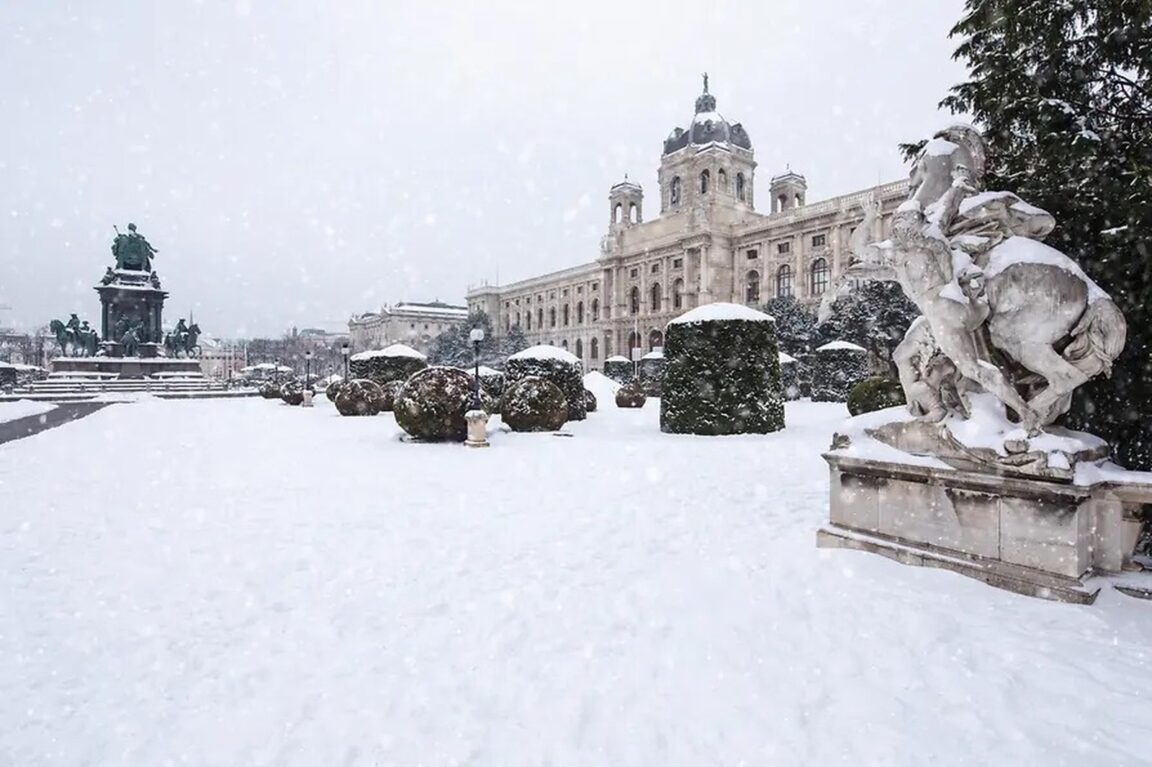
Featured image: The Kunsthistorisches Museum and Maria Theresien Platz under falling snow, Vienna in winter. Photo: WienTourismus, Christian Stemper, via wien.info, used with credit.