 Camille Baptiste
Pack for the Azores in autumn by building one bag around three certainties: rain will find you, wind will find you at every crater rim, and the bag still has to pass the inter-island flight limits. SATA Air Açores, the only airline flying between the islands, allows one cabin bag of up to 8 kg measuring 55 x 40 x 20 cm and one checked bag of up to 23 kg on inter-island tickets, checked against the airline’s published fares page on 20 November 2026. Autumn temperatures make the layering easy to plan and hard to skip: long-term climate records for Ponta Delgada on São Miguel put October highs near 22°C with lows near 16°C, and November highs near 19 to 20°C with lows near 14°C, with rain on roughly half the days of the month. The system below fits those numbers, the crater wind and the swim stops into a single checked bag plus a cabin bag that works as your daypack on every island.
Quick Facts
- Inter-island cabin limit: 1 bag up to 8 kg, 55 x 40 x 20 cm, on SATA Air Açores
- Inter-island checked limit: up to 23 kg per passenger on inter-island fares
- October on São Miguel: highs around 22°C, lows around 16°C, sea around 21°C
- November on São Miguel: highs around 19 to 20°C, lows around 14°C, sea around 19°C
- The one rule: waterproof shell and a warm mid layer live in the cabin bag, never the hold
- Swim kit: swimsuit, microfibre towel and dark colours for iron-rich thermal water
- Checked: prices and allowances verified 20 November 2026
What are the SATA inter-island baggage limits, exactly?
The limits are set by SATA Air Açores and published on the Azores Airlines fares page. In economy on inter-island routes, every fare level listed, from the Azores Fare through Smart and Value, carries the same baggage shape: one piece of carry-on baggage up to 8 kg with maximum dimensions of 55 x 40 x 20 cm, and checked baggage up to 23 kg. A small personal item is also permitted, provided the combined weight of cabin bag and personal item stays within the fare’s cabin allowance.
Two practical consequences follow. First, the 8 kg cabin ceiling is the real packing constraint, not the 23 kg hold allowance: a hard-shell cabin case can eat 3 kg of it before a single shirt goes in, so a soft cabin bag or a backpack-format case is the smarter Azores choice. Second, because island hopping usually means several short sectors, every gram of glass, liquid and hardback book multiplies its inconvenience at every small airport. Pack the checked bag to do the heavy work, keep the cabin bag genuinely light, and weigh both at home. The same discipline that makes a Caribbean island-hopping one-bag system work applies here, with colder water and more wind.
Why does everyone say four seasons in one day?
Because the archipelago sits in the middle of the Atlantic, where weather systems cross quickly and altitude does the rest. The nine islands span some 600 kilometres of ocean, and on a single island the coast can sit in mild sunshine while a crater lake a few hundred metres up is in cloud and driving wind. Long-term records show average winds of 15 to 25 km/h year round, gusting far higher on exposed coasts and rims. Autumn adds Atlantic rain: October and November are among the wetter months, with rain recorded on around 14 to 16 days in a typical month on São Miguel.
The packing translation is simple. Dress for the mildest version of the day at sea level, then carry the kit for the worst version at altitude. That means a breathable base, an insulating mid layer and a genuinely waterproof shell, worn or carried in combination, rather than one heavy coat that is wrong in both directions. It is the same layering logic used for packing for Iceland in winter, scaled down from sub-zero to mild and wet.
What goes in the checked bag?
How many outfits does an autumn week need?
Plan on a five-day rotation, washed once, rather than seven full outfits. Three pairs of trousers or leggings in quick-drying fabrics, five tops that layer under the same mid layer, and underwear and socks for six days cover a week comfortably. Merino or synthetic socks matter more than their count: crater rim trails and hydrangea-lined lanes stay damp, and cotton socks stay damp with them. Add one smarter outfit only if a specific dinner demands it. Azorean restaurants, including the well-known dining rooms of Ponta Delgada and the Furnas hotels, run informal by capital-city standards.
What footwear survives crater rims and cobbles?
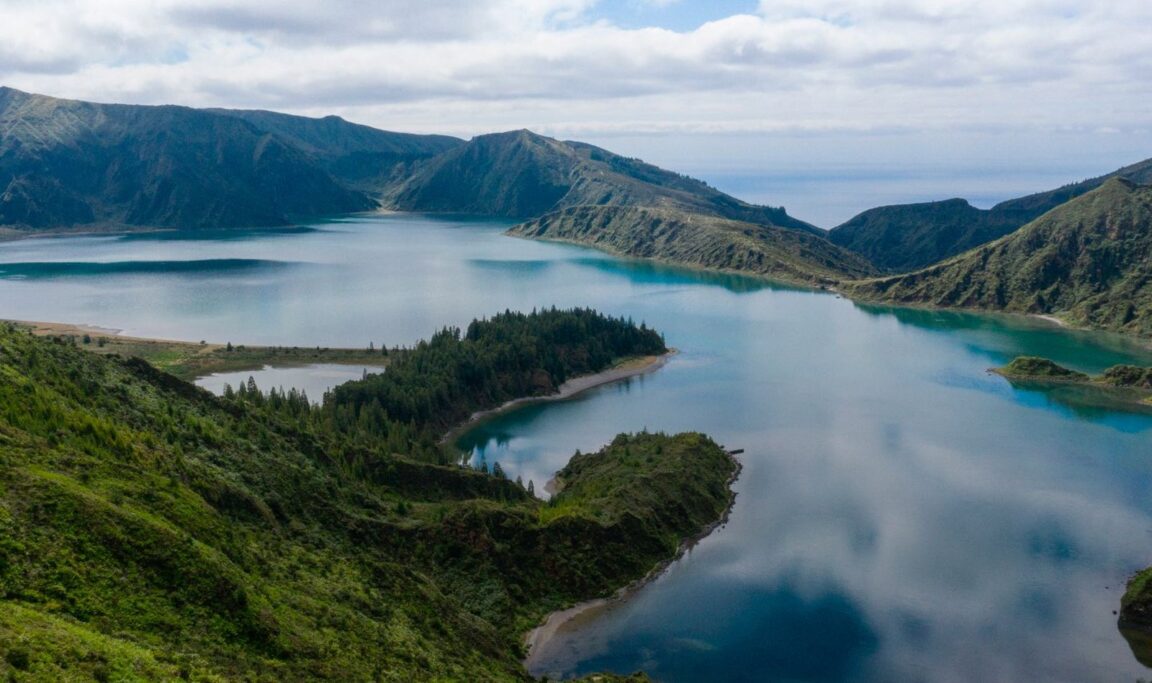
Two pairs, no more. Wear the heavier pair on the plane: waterproof walking shoes or light boots with real tread, broken in before the trip, for rim trails around Sete Cidades and Lagoa do Fogo, tea plantation paths and wet farm tracks. Pack one lighter pair of trainers or sturdy sandals for town days, short coastal walks and driving. Ponta Delgada’s basalt cobbles are slippery when wet, which in autumn is often, so soles matter more than style. Leave heels and smooth leather soles at home entirely.
What belongs in the cabin bag?
Everything the trip cannot lose a day to. The waterproof shell and mid layer, because the first viewpoint stop often comes before the first hotel check-in on a hopping itinerary. A full change of clothes, because a 23 kg checked bag that misconnects on a short sector leaves you with what you are carrying. Swim kit, for the same reason: the thermal pools of Furnas and the ocean pool at Ponta da Ferraria, on São Miguel’s west coast, where volcanic heat warms the sea water in a natural rock pool, are exactly the stops that fill a delayed afternoon. Add medication, chargers, a power bank, documents and one warm hat. Crater rims at 500 to 800 metres in a 30 km/h wind make a hat the highest-value 60 grams in the bag.
What is the swim kit for autumn?
Swimming does not end in autumn in the Azores; it changes address. Sea temperatures hold around 21°C in October and 19°C in November on São Miguel, and the geothermal options run all year. Pack one swimsuit, two if you dislike putting on a damp one, in a dark colour: the iron-rich water at the Terra Nostra garden pool in Furnas is famous for tinting pale fabrics orange-brown. Add a microfibre towel that earns its place at natural pools with no rental desk, swim shoes or old trainers for lava rock entries at ocean pools, and a dry bag for the wet kit afterwards. Goggles are optional; a warm layer to pull on the moment you climb out is not.
What do most people pack wrong?
Three mistakes repeat. The first is a heavy winter coat: autumn lows near 14°C never justify it, and it consumes the cabin allowance whole. The second is a big rigid suitcase for the checked bag: Azorean guesthouses and quinta stays often involve stairs, gravel drives and small lifts, and a soft or hybrid case is kinder on all three, as well as on the small aircraft holds. The third is forgetting that wind, not cold, is the comfort killer. A windproof shell over a fleece beats a thick jacket with no shell in almost every autumn hour on the islands.
Frequently Asked Questions
Can I manage the Azores in autumn with carry-on only?
Yes, if your cabin bag is soft, your layers are disciplined and you accept laundry. The binding limit is the 8 kg cabin weight on inter-island flights, so wear your boots and heaviest layer to board, keep liquids minimal and plan one wash per week. Travellers combining hiking, swimming and smarter dinners will usually be happier using the 23 kg checked allowance.
Do I need a wetsuit for autumn swimming?
For ocean pools and short sea swims, no: the sea sits near 19 to 21°C through autumn and the geothermal pools are warm. Snorkelling and diving operators supply wetsuits with their trips. A swimsuit, swim shoes for lava rock and a warm layer for afterwards cover independent swimming.
Will a standard European cabin case fit the SATA limit?
Dimensionally, many do: the limit is 55 x 40 x 20 cm, which is at the smaller end of cabin sizes, and the depth of 20 cm catches out wider cases. Weight is the bigger risk, since the 8 kg ceiling includes the case itself. Measure and weigh the packed bag at home rather than at the check-in desk.
What should I wear on the inter-island flights?
Your walking boots, your mid layer and, if weight is tight, your shell. Small aircraft cabins run cool, the next island’s weather is a coin toss, and wearing the bulky items keeps both bags legal. It also means a delayed checked bag costs you nothing on day one.
Is a hire car boot part of the packing plan?
On most islands, yes in practice: the classic Azores day is a driving loop between viewpoints, lakes and pools, and the car becomes a rolling wardrobe. Keep valuables and the day’s swim and rain kit in the cabin bag you carry, and never leave documents or electronics visible in a parked car at a trailhead.