 Maya Chen
If the three sides of your suitcase add up to more than 160 cm, you cannot simply board a Tokaido, Sanyo, Kyushu or Nishi Kyushu Shinkansen and put it behind any seat: you must book a seat with an oversized baggage area, in the last row of the car, at the same price as an ordinary reserved seat. Board without that reservation and the crew will charge you 1,000 yen including tax and store the bag where they direct. Bags of 160 cm or less need no reservation at all, and bags over 250 cm in total cannot be brought on board in any circumstances. This guide works through the measurement, the booking sequence and the exceptions, in the order you will actually meet them, checked against JR Central’s own luggage pages on the day of writing.
Quick Facts
- The measurement: Add length, width and height. 160 cm (63 inches) or less is ordinary baggage; over 160 cm and up to 250 cm (98 inches) is oversized baggage; over 250 cm cannot be brought on board.
- Lines covered: Tokaido, Sanyo, Kyushu and Nishi Kyushu Shinkansen only. The reservation rule does not apply on other Shinkansen lines or on conventional trains.
- The seat: A seat with an oversized baggage area, in the last row of certain cars. The space behind it is shared by the passengers who reserved those last row seats.
- The price: No extra charge. The seat costs the same as an ordinary or Green Car reserved seat.
- The penalty: 1,000 yen including tax if you bring oversized baggage without the reservation, and the crew decides where the bag is stored.
- Unreserved cars: Oversized baggage may not be brought into an unreserved car, or into a reserved car with no oversized baggage area.
- Booking channels: SmartEX, JR West and JR Kyushu online reservation services, station ticket offices and reserved seat ticket machines, selecting “seat with an oversized baggage area”.
- Facts checked: 19 November 2026, against JR Central’s official luggage information, linked below.
How do you measure a bag the JR way?
Measure the three outside dimensions of the closed bag, including wheels and handles, and add them together: length plus width plus height. JR Central’s official luggage information sets the bands plainly. A total of 160 cm or less is ordinary baggage, which goes on the overhead rack, at your feet, or in the deck baggage storage area, with no reservation of any kind. A total between 161 and 250 cm is oversized baggage, and that single centimetre over the line is what triggers the whole system described in this article. A total over 250 cm is not a fee problem or a booking problem: the bag cannot be brought on board at all, and the realistic options are a smaller case, a delivery service, or splitting the load into two bags. Do the measurement at home with a tape, not at the station with a train approaching, because the fix for an oversized bag is a specific seat, and those seats are limited per train. A typical large checked suitcase of about 80 by 55 by 30 cm totals 165 cm, which is oversized; a standard cabin case totals well under 160 cm and is not.
Which trains does the 160 cm rule actually cover?
Only four lines: the Tokaido Shinkansen from Tokyo to Shin Osaka, the Sanyo Shinkansen continuing to Hakata, and the Kyushu and Nishi Kyushu Shinkansen beyond it. That is the corridor most first time visitors ride, Tokyo to Kyoto, Osaka, Hiroshima, Fukuoka and Kagoshima, which is why the rule catches so many people. On the Tohoku, Hokkaido, Joetsu, Hokuriku, Yamagata and Akita Shinkansen, and on all conventional line trains, there is no oversized baggage reservation system: you use the luggage areas on board in the ordinary way. JR Central’s page states this directly in its questions section: reservations are only required on the Tokaido, Sanyo, Kyushu and Nishi Kyushu trains. Travellers building a longer rail itinerary around a pass should read our Japan Rail Pass guide alongside this one, because the pass changes which legs are worth reserving, but it does not change the baggage rule itself: pass holders reserve the same oversized baggage seats, at the ticket office or through the pass reservation service, at no extra charge.
What exactly is a seat with an oversized baggage area?
It is a normal reserved seat in the last row of certain cars, sold together with the right to use the floor space directly behind that row. That space is not private: JR Central notes it is shared by the five passengers who reserved the five back row seats with an oversized baggage area in that car, so stack considerately and expect other large cases beside yours. The supply is limited and varies by service. On the Tokaido Shinkansen, JR Central lists 57 seats with a baggage area on a Nozomi, 42 on a Hikari and 17 on a Kodama, split between ordinary and Green Cars, plus a small number of seats with a separate oversized baggage compartment on some cars. Two consequences follow. First, on busy Nozomi departures these seats can sell out before the train itself does, so book the baggage seat when you book the journey, not as an afterthought. Second, if no oversized baggage seat remains on your preferred train, the honest options are an earlier or later train, a smaller bag, or forwarding the big case by delivery service and travelling light. What you cannot do is take the oversized bag into an unreserved car and hope: JR’s rules bar oversized baggage from unreserved cars entirely.
How do you book the oversized baggage seat, step by step?
First, measure the bag and confirm it falls in the 161 to 250 cm band. Second, when you buy the ticket, choose the specific product named “seat with an oversized baggage area” rather than an ordinary reserved seat: online through SmartEX for the Tokaido and Sanyo lines, JR West’s online train reservation, or JR Kyushu’s reservation service; at a station, tell the ticket office staff you want a seat with an oversized baggage area, or select it on a reserved seat ticket machine. Third, check the confirmation shows the baggage area seat, because an ordinary reserved seat on the same train does not entitle you to the space behind the last row, and other passengers may not use that space. Fourth, on the day, go to your reserved car, stow the bag in the area behind your last row seat, and keep smaller items on the rack or at your feet. Japan Rail Pass holders follow the same steps at a ticket office or via the pass reservation system. If your trip also involves winter luggage, our Japan winter packing guide shows how to keep a snow trip inside one case that stays under the 160 cm line in the first place.
What happens if you board without the reservation?
The rule is enforced on board, not at the gate, which tempts people to risk it. JR Central’s wording is exact: passengers travelling with oversized baggage without a reservation will be charged a baggage fee of 1,000 yen including tax, and the bag is placed where the crew instructs, which may be nowhere near your seat and may involve moving it during the journey. The 1,000 yen is not really the cost of the mistake. The real costs are travelling separated from luggage you may need, blocking a space another passenger has properly reserved, and, in the worst case, discovering that your bag is simply too large for anywhere the crew can put it. The reservation itself is free, so there is no saving to set against those risks: the same seat, at the same fare, was available with the baggage space included. Treat the fee as what it is, a penalty for skipping a free step.
What about strollers, skis and instruments?
JR Central carves these out of the rule. The oversized baggage requirements do not apply to strollers, sports equipment such as bicycles and skis, or musical instruments: they may be carried without a reservation and placed in the baggage racks, deck areas or compartments. The catch is space, not permission. The area behind the last row belongs to the passengers who reserved it, so a stroller or ski bag cannot simply be parked there. JR recommends that anyone with bulky equipment who wants to use the oversized baggage area or a compartment reserves the matching seat anyway, which converts an uncertain squeeze into a guaranteed space. Note also the trial change on some trains: certain deck oversized baggage compartments are being made available as general baggage storage areas that can be used without a reservation, on a trial basis. That trial does not remove the seat reservation rule for oversized suitcases, and JR’s page is the place to confirm the current position before you travel.
What are the other limits worth knowing?
The reservation rule sits on top of the older carry on limits, which have not changed. JR Central confirms you may still carry two pieces of baggage of 30 kg or less, with total dimensions of 250 cm or less and a maximum length of 200 cm. Bags of 160 cm or less that are simply large or heavy for the overhead rack can go in the deck baggage storage area with no reservation. If a bag defeats every on board option, the alternative JR itself points to is a same day delivery service between hotels and stations, which is a well established part of travelling in Japan: send the big case ahead in the morning and ride the Shinkansen with a day bag. For arrival formalities that pair with a first rail journey, our guide to Visit Japan Web covers the single QR code that replaced the paper forms.
Frequently Asked Questions
How is the 160 cm measured on the Shinkansen?
Add the bag’s length, width and height together, including wheels and handles. A total of 160 cm or less is ordinary baggage with no reservation needed. Over 160 cm and up to 250 cm is oversized baggage. Over 250 cm cannot be brought on board.
Does the oversized baggage seat cost extra?
No. JR Central states the ticket is the same price as a reserved seat in an ordinary car or a Green Car. You are reserving space, not buying an upgrade.
What is the fine for bringing an oversized bag without booking?
1,000 yen including tax, charged on board, and the crew will direct where the bag is stored. Oversized baggage is also barred from unreserved cars altogether.
Which Shinkansen lines require the oversized baggage reservation?
The Tokaido, Sanyo, Kyushu and Nishi Kyushu Shinkansen. The system does not apply on the Tohoku, Hokkaido, Joetsu, Hokuriku, Yamagata or Akita lines, or on conventional trains.
Can I use the space behind the last row if I have an ordinary reserved seat?
No. That space is for passengers holding a seat with an oversized baggage area in that car, and it is shared among the holders of those last row seats.
Do strollers, skis and instruments need an oversized baggage reservation?
No, the rule does not apply to strollers, sports equipment or musical instruments. But if you want to use the oversized baggage area or a compartment for them, JR recommends reserving the matching seat, because that space is otherwise reserved for others.
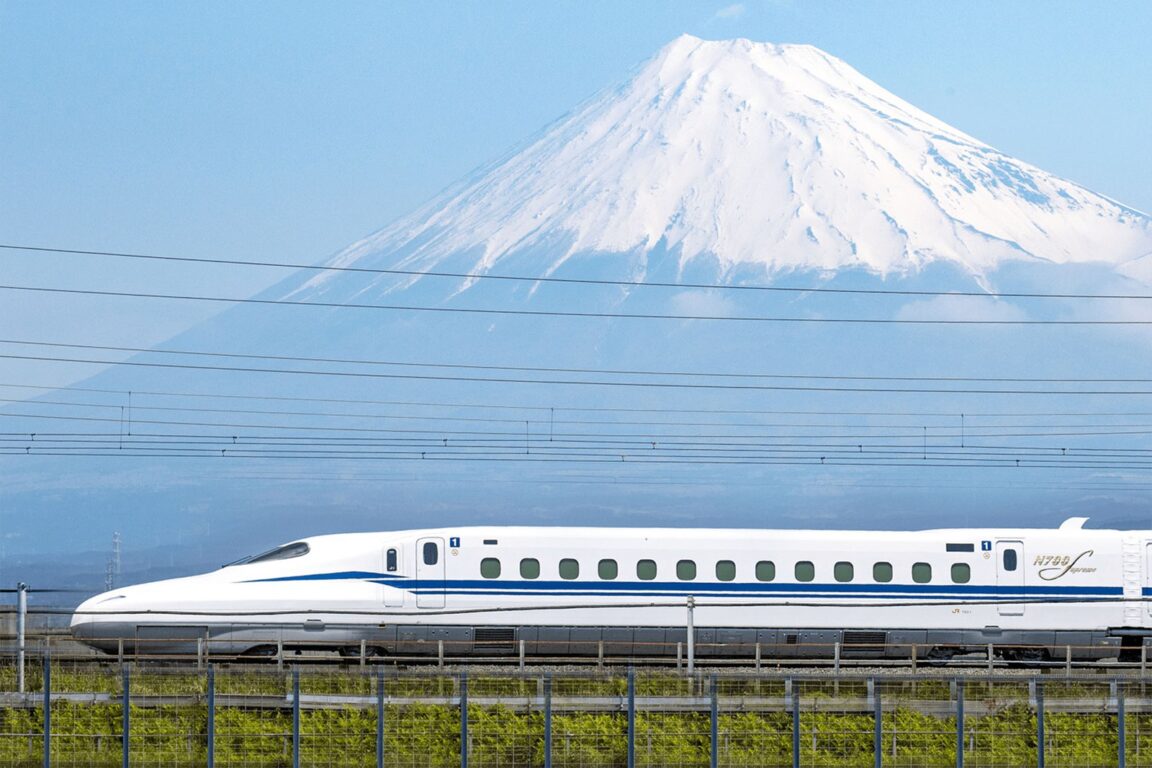
All rules, sizes, seat counts and the 1,000 yen fee were checked on 19 November 2026 against JR Central’s official luggage information at global.jr-central.co.jp, linked above. Rules can change and a trial of unreserved deck compartments is under way on some trains, so recheck the JR page before a journey that depends on it. Photo: an N700S Supreme Shinkansen passing Mount Fuji, from the JR Group’s official Japan Rail Pass website, japanrailpass.net (see image credit in the package metadata).