 Kwame Mensah
A long haul economy comfort kit earns its place only if every item fits inside the personal item, works in a standard economy seat, and does not depend on the airline providing anything beyond the seat itself. Built that way, the kit is short: a neck pillow that compresses, a thin seat cushion only if you accept its weight and bulk, a footrest only where the airline allows it, noise cancelling headphones, an eye mask, a one litre hydration plan built around buying water after security, and a small pouch of cables, medication and toiletries that never leaves your side of the seat. Everything else is space taken from your knees.
Quick Facts
- Bag rule: The whole kit lives in the personal item, the smaller bag that must fit under the seat in front on most airlines
- Personal item sizes: Limits vary by airline and fare, so check your own airline and ticket before packing; there is no single worldwide size
- Seat cushion: Worth it for travellers with back pain on flights over about 8 hours; dead weight for most others
- Footrests: Hanging and inflatable footrests are restricted or banned by some airlines and can be refused by crew; a footrest is never guaranteed kit
- Hydration: Liquids over the security limit cannot pass the checkpoint in most countries, so the bottle travels empty and is filled after security
- Compression socks: Airlines and health authorities commonly advise movement, aisle walks and loose clothing on long flights; travellers with medical risk should follow their own clinician, not a packing list
- Facts checked: November 20, 2026; airline specific rules are stated generically because they differ by carrier and change, and must be checked on your airline’s own site
What actually earns its space in the personal item?
Start with the items that change the flight rather than decorate it. Noise cancelling headphones are the single highest value object in the kit: cabin noise is constant for 8 to 15 hours, and reducing it lowers the effort of everything else, from sleep to films to simply sitting still. An eye mask that does not press on the eyelids pairs with them, because long haul cabins dim on the airline’s schedule, not yours. A neck pillow earns space only in its compressible form, either inflatable or memory foam in a compression bag, clipped outside the personal item or squeezed into a corner; a full size pillow carried loose is the classic beginner error, because it counts against your hands and your space from check in to arrival.
The second tier is the body kit: lip balm and a small moisturiser for cabin air, toothbrush and toothpaste for the pre landing reset, tissues, hand wipes, and any medication you need, which travels in the personal item and never in checked luggage. Add a pen for arrival forms, a phone charging cable that matches the seat power your aircraft actually offers, and a small power bank, carried in the cabin as aviation safety rules require for spare lithium batteries. Our Japan spring packing guide uses the same personal item discipline for a different trip: what you cannot afford to lose or be separated from stays under the seat.
Is a seat cushion worth its weight?
Sometimes, and the honest answer depends on your back, not on the product page. A thin inflatable or fold flat cushion adds almost no weight and can change a hard slimline seat on a 10 hour sector, which is the strongest case for carrying one. A thick memory foam cushion is a different trade: it can weigh as much as the rest of the kit combined, it raises you in a seat where headroom and tray alignment are already tight, and it must be carried through every connection. Travellers with a history of lower back pain on long flights usually find even the bulky version worth it. Everyone else is normally better served by the free alternative already on board: the airline blanket or a rolled jumper placed behind the lower back, adjusted each time you shift position.
There is also a fit question nobody mentions. A cushion changes how the seat belt sits and how far your knees project, and on the tightest economy pitches that can cost more comfort than it adds. Test the cushion at home in a dining chair for an evening before committing it to a 14 hour flight, and if it only feels good for the first hour, leave it behind.
Are footrests and leg hammocks actually allowed?
Not reliably, and this is the kit item to treat as a bonus rather than a plan. Hanging footrests and leg hammocks attach to the tray table structure of the seat in front, and inflatable foot pillows change the space at your feet; some airlines prohibit devices that attach to seat furniture or obstruct the footwell, others leave it to crew discretion on the day, and crew can ask you to remove anything that interferes with the seat, the passenger in front, or evacuation. Because the rules differ by airline and are enforced by the crew in front of you, no guide can promise that a footrest bought today will be usable on your flight. Check your airline’s own conditions of carriage and cabin baggage pages before travel, and pack any footrest so the flight still works if it stays in the bag.
What always works is using the space as designed: shoes off only if your feet are clean and in socks, feet flat or resting on your personal item bag, and regular movement. Standing, walking the aisle when the seat belt sign allows, and simple ankle and calf movements at your seat are the measures airlines themselves recommend on long sectors, and they cost no space at all. For the packing system behind that approach, see our Iceland winter packing guide, which builds a whole cold weather trip around one bag that stays with the traveller.
How should hydration and food be sequenced?
The sequence matters more than the bottle. Security rules in most countries limit liquids in hand luggage, so the bottle crosses the checkpoint empty, gets filled at a fountain or cafe after security, and boards full: that single litre is your baseline for the first half of the flight, independent of the drinks service. Drink steadily rather than in large amounts at meals, top the bottle up whenever crew offer water, and go easy on alcohol and caffeine, which work against both sleep and hydration on a long sector. An electrolyte sachet or two weighs nothing and is worth including on the longest routes.
Food follows the same logic of independence. Cabin meals arrive on the airline’s timing, which may be 3 a.m. by your body clock, so carry one substantial snack and one small sweet item of your own, chosen to survive a warm bag and to respect seat neighbours: nothing with a strong smell, nothing that crumbles across the row. Eat lightly, match your meals to destination time where you can, and treat the last cabin meal as breakfast or dinner according to where you are landing, not where you took off. That shift, started on board, is the cheapest jet lag measure in the kit.
How do you sleep in a standard economy seat?
By stacking small advantages rather than hunting for one miracle product. Window seats give a wall to lean on and control of the shade; the pillow goes between head and wall or around the neck, the eye mask and headphones go on together, and the seat belt stays fastened visibly over the blanket so crew do not wake you for checks. Set your watch or phone to destination time at take off, sleep in the destination’s night window even if it arrives early in the flight, and accept broken sleep as the plan rather than the failure. Melatonin and sleeping medication are personal medical decisions: if you use anything, it should be something you have used before, discussed with your own clinician where appropriate, and never first trialled at 38,000 feet.
Clothing is the final layer of the kit. Wear soft, loose layers you can sleep in, with one warm layer for the coldest part of the night cabin, and keep a complete light change of clothes in the personal item: it is insurance against spills and delayed checked bags, and arriving in a fresh shirt changes how the first day feels. Compression socks belong in this conversation with a health caveat: many travellers wear them for comfort on long flights, and travellers at elevated risk of deep vein thrombosis should follow medical advice specific to them, not general packing advice.
Frequently Asked Questions
What size is a personal item on long haul flights?
There is no single size. Each airline sets its own personal item dimensions and weight, and they can vary by fare type, so the only reliable figure is the one on your airline’s baggage page for your ticket, checked before you pack. Build the kit to the smallest limit on your itinerary if you are connecting between carriers.
Can I take an inflatable footrest in economy?
It depends on the airline, and sometimes on the crew. Some carriers ban devices that attach to the seat in front or fill the footwell, and any device can be refused if it obstructs movement or evacuation. Check your airline’s published rules, and never build your comfort plan around a footrest being allowed.
How much water should I carry onto a long haul flight?
Board with a full one litre bottle, filled after security, and refill it from the drinks service during the flight. Security liquid limits mean the bottle must cross the checkpoint empty or within your liquids allowance, which is why the fill point is always airside.
Is a seat cushion worth bringing?
For travellers with back pain on flights over about 8 hours, usually yes, in a thin inflatable or fold flat form. For most others, a blanket or rolled jumper behind the lower back does most of the same work for no weight, and a thick foam cushion often costs more knee room than it returns in comfort.
Where do power banks and medication go?
In the cabin, in your personal item. Spare lithium batteries and power banks are required to travel in hand luggage under aviation safety rules, and medication should never be in checked baggage that could be delayed. Keep both in the same top pouch so they are reachable without unpacking at the seat.
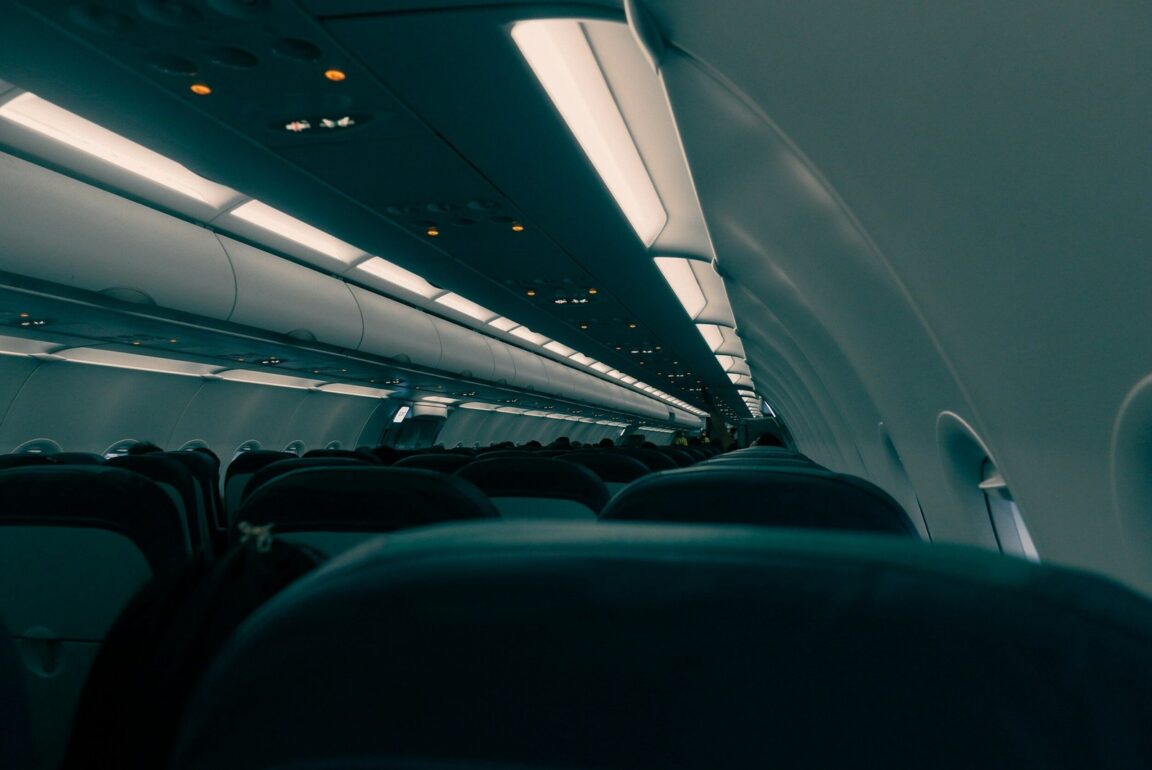
Featured image: A long haul economy cabin with cabin lights on, rows of economy seats stretching down the aircraft. Photo by Rey Joson on Unsplash, Unsplash License, used with credit.