 Kwame Mensah
Walk the Kumano Kodo on the Nakahechi route in one direction and in shrine order: start at Takijiri-oji, walk two days through Takahara and Chikatsuyu to Kumano Hongu Taisha, rest in the Hongu onsen villages, then cross two more mountain passes to Koguchi and Kumano Nachi Taisha above Nachi Falls. The full Takijiri to Nachi walk is about 70 kilometres in four walking days, your main bag moves between inns on the daily luggage shuttle booked through Kumano Travel, and the planning rule that governs everything is the booking deadline: lodging and luggage requests through the official system close well in advance, with Kumano Travel asking for requests at least 20 days ahead and the trail villages filling months ahead in spring and autumn.
Quick Facts
- Route: Nakahechi, the imperial route of the Kumano Kodo, Kii Peninsula, Wakayama, Japan
- Full walk: Takijiri-oji to Kumano Nachi Taisha, about 70 kilometres, four walking days plus a Hongu rest day in most sensible plans
- Key stages: Takijiri-oji to Chikatsuyu about 16 kilometres; Chikatsuyu to Hongu about 24.5 kilometres in full, shortened by bus to the 7.5 kilometre Hosshinmon-oji walk; Hongu to Koguchi about 13 to 14 kilometres; Koguchi to Nachi about 14.5 kilometres
- Shrine order: Kumano Hongu Taisha first, then Kumano Nachi Taisha; Kumano Hayatama Taisha in Shingu completes the three grand shrines, the Kumano Sanzan, and is usually visited by bus or train
- Nachi Falls: 133 metres, the tallest single drop waterfall in Japan, per the Japan National Tourism Organization
- Booking: Lodging and the daily luggage shuttle are booked through Kumano Travel, the reservation service of the Tanabe City Kumano Tourism Bureau; requests at least 20 days in advance, and peak season villages fill far earlier
- Access: Limited express train to Kii-Tanabe, then a local bus of about 40 minutes to Takijiri-oji
- Heritage status: The Kumano Kodo routes are part of the UNESCO World Heritage listing for the Sacred Sites and Pilgrimage Routes in the Kii Mountain Range, inscribed in 2004
- Facts checked: November 20, 2026, against the Tanabe City Kumano Tourism Bureau, Kumano Travel and the Japan National Tourism Organization
Why does the Nakahechi start at Takijiri-oji?
Because Takijiri-oji is the traditional gateway where the mountain route proper begins, and starting there gives the walk its correct shape: a steep introduction, a long middle day, and a shrine arrival that feels earned. The practical start is the night before, in Tanabe, the coastal city whose station area holds the Tanabe Tourist Information Center, where walkers collect maps, the pilgrim credential and current bus information. From Kii-Tanabe Station the local bus ride to Takijiri-oji takes about 40 minutes, and the trailhead sits beside the Tonda River with the Kumano Kodo Kan centre opposite the shrine for a last check of route conditions.
The first walking day splits naturally in two. Takijiri-oji to Takahara is short and steep, about 4 kilometres with roughly 430 metres of climbing, ending in a ridgeline village known for mist and wide views. Takahara to Chikatsuyu adds about 8 to 10 kilometres of forest walking, so the combined Takijiri-oji to Chikatsuyu day is about 16 kilometres and around 6 hours, per the stage figures published through the Tanabe City Kumano Tourism Bureau. Sleeping in Takahara breaks that day in half and is the gentlest start; pushing through to Chikatsuyu is the standard start for walkers with four days and no more. Either way, Chikatsuyu, a village along the Hiki River with a handful of guesthouses, is the first night that matters, because the longest day of the walk leaves from it.
How does the long day to Hongu actually work?
Honestly, by choosing how much of it to walk. The full Chikatsuyu to Kumano Hongu Taisha stage is about 24.5 kilometres and around 9 hours, with well over 1,000 metres of climbing and more descent, across the route’s toughest middle section. Many walkers walk the first part to Tsugizakura-oji, with its giant cedars and spring, then take a bus forward to Hosshinmon-oji and walk the final 7.5 kilometres, about 2 to 3 hours, into Hongu. Hosshinmon-oji is the traditional outer gate to the sacred precinct, and the walk from it passes Fushiogami-oji, where pilgrims historically first saw the shrine below and stopped to pray, before descending to Hongu itself. Shortening the day this way is not cheating the route: the bus supported version is built into how the Nakahechi is walked today, and it preserves energy for the two pass days that follow.
Hongu rewards a full stop. Kumano Hongu Taisha is the first of the grand shrines in walking order, its dark timber halls set below a forested hill, and a short walk away stands Oyunohara, the shrine’s original site on a river sandbank, marked by a torii gate 33.9 metres tall. The three onsen villages beside Hongu, Yunomine, Kawayu and Watarase, are the natural rest base: Yunomine’s tiny Tsuboyu bath, a wooden hut over the creek holding one or two bathers at a time, is part of the World Heritage site itself. A rest day here, or at minimum an unhurried afternoon, is what turns the walk from a schedule into a pilgrimage, and it is the right place to reorganise bags before the harder second half. Walkers combining the route with city time in Japan can frame the trip with our first time Tokyo itinerary.
What happens between Hongu and Nachi?
The route crosses the mountains in two stages with a single small village between them, and this is the section to plan most carefully. Hongu to Koguchi, about 13 to 14 kilometres over the Kogumotori-goe pass, takes roughly 5 to 6 hours and is usually started by bus from Hongu to the Ukegawa trailhead. Koguchi is a tiny settlement with very limited lodging, which is why it fills early and why some itineraries use a shuttle back to Hongu area inns instead. Koguchi to Kumano Nachi Taisha, about 14.5 kilometres over the Ogumotori-goe pass, is the hardest day of the second half, 7 to 8 hours with a long climb and a final descent on the Daimon-zaka, a slope of old stone steps through towering cedars, into Nachisan.
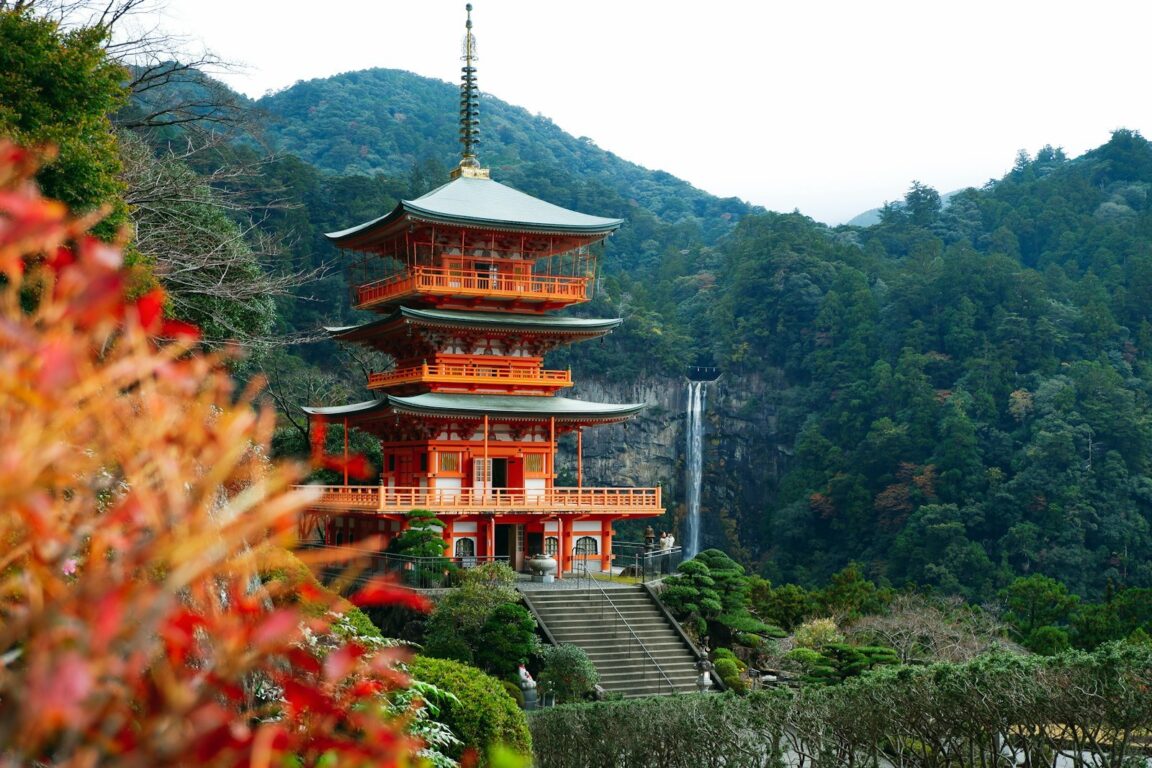
The arrival justifies the ordering. Kumano Nachi Taisha stands beside Seiganto-ji temple, and from the temple grounds the three storey pagoda lines up against Nachi Falls, which the Japan National Tourism Organization describes as the tallest waterfall in Japan at 133 metres. Shrine, temple, pagoda and waterfall in one frame is the image most walkers carry home, and reaching it on foot, in sequence after Hongu, is the point of walking the route whole rather than busing between sights. Kumano Hayatama Taisha, the third grand shrine, sits in Shingu on the coast and is most simply added by bus or train from the Hongu or Katsuura side, completing the Kumano Sanzan without another mountain crossing. Kii-Katsuura, the fishing port below Nachi with onsen hotels and the rail line back toward Osaka, is the natural final night.
How does luggage forwarding work between the inns?
Through the same booking that reserves your rooms, and only through it. The daily luggage shuttle moves one main bag per guest between accommodations along the route, so you walk with a daypack carrying water, layers, rain gear and lunch, and your bag is waiting at the next inn. The shuttle is booked through Kumano Travel, the Tanabe City Kumano Tourism Bureau’s reservation service, and it works only with lodging booked through that system, which is the strongest practical reason to book the whole walk there rather than piecing rooms together elsewhere. Requests must be made well ahead: Kumano Travel’s packages and lodging bookings operate on an advance request basis, with 20 days before travel the stated minimum in its booking guidance, and no realistic prospect of arranging the shuttle on arrival in Tanabe.
Two luggage decisions sit outside the shuttle. Anything you do not need on the mountain, a city suitcase, for example, should be forwarded separately from Kyoto or Osaka to your final hotel by a courier service, or left in storage, rather than shuttled inn to inn. And the daypack itself needs to be a real walking pack of 20 to 30 litres, because the long Hongu day and the Ogumotori-goe crossing are full mountain days in changeable weather, in a region the tourism bureau itself flags as very wet. Broken in footwear with grip, a proper waterproof jacket, quick drying layers and walking poles are the core kit; our Japan spring packing guide covers the layering logic for the same climate in cherry blossom season.
When should the walk be booked and walked?
Book months ahead for the classic seasons and walk in them if you can. Spring, March to May, and autumn, October to November, are the comfortable and popular windows, and the small villages on the route, Takahara, Chikatsuyu, Nonaka and above all Koguchi, have so few rooms that they fill first and early. The Nakahechi is open year round, but summer is hot, humid and very wet, with typhoon season risk in late summer and early autumn, and winter brings short days and occasional ice on the passes. Fitness should be judged against the two long days rather than the daily averages: a walker comfortable with 15 to 20 kilometre hill days on consecutive days, with several hundred metres of climbing, will find the Nakahechi demanding but fair, especially with the bus shortened Hongu day in the plan. Build the pacing around arriving at each inn in daylight, carry cash for buses and small purchases in villages with few services, and order the packed lunch, the bento your inn prepares, the night before each walking day, because there are stretches of this route with no shop at all.
Frequently Asked Questions
How long is the Kumano Kodo Nakahechi route?
About 70 kilometres from Takijiri-oji to Kumano Nachi Taisha, walked in four days in most plans: Takijiri-oji to Chikatsuyu, Chikatsuyu to Hongu, Hongu to Koguchi, and Koguchi to Nachi. The Takijiri-oji to Hongu section alone is about 38 kilometres and can be walked in two to three days as a shorter trip.
Do I have to walk the full 24.5 kilometres into Hongu?
No. The standard supported option is to walk to Tsugizakura-oji, take a bus to Hosshinmon-oji, and walk the final 7.5 kilometres into Kumano Hongu Taisha. That version takes about 2 to 3 hours for the walking section and keeps the shrine arrival on foot, which is the part that matters.
How does the luggage shuttle work?
Booked through Kumano Travel alongside your lodging, the daily shuttle moves one main bag per guest between inns, and you walk with a daypack. It is only available with accommodation booked through Kumano Travel, must be requested in advance, at least 20 days ahead per the booking guidance, and cannot be arranged at short notice in Tanabe.
What is the Dual Pilgrim programme?
The Kumano Kodo and the Camino de Santiago in Spain are twinned pilgrimage routes, and walkers who complete qualifying walks on both can register as Dual Pilgrims. On the Kumano side the classic qualifying walk is Takijiri-oji to Kumano Hongu Taisha. The credential is free and available from the Tanabe Tourist Information Center and points along the route, where stamp boxes sit at the oji shrines.
When is the best time to walk the Kumano Kodo?
Spring and autumn are the most comfortable and the busiest, which is why lodging in the small trail villages should be booked months ahead for those seasons. The route is open year round, but summer is hot and very wet, and winter days are short with occasional ice at altitude.
How do I get to the Takijiri-oji trailhead?
Take a limited express train to Kii-Tanabe, then a local bus of about 40 minutes to Takijiri-oji. Most walkers sleep in Tanabe the night before starting, collect maps and the pilgrim credential at the tourist information center beside the station, and take a morning bus to the trailhead.
Featured image: The three storey pagoda of Seiganto-ji with Nachi Falls behind, at Kumano Nachi Taisha, the end of the Nakahechi walk. Photo by Susann Schuster on Unsplash, Unsplash License, used with credit.