 Maya Chen
Walk the Nakasendo from Magome to Tsumago, in that direction, and the famous stage of Japan’s old mountain highway becomes a mostly gentle descent of about 9 km that most walkers finish in two and a half to three hours. Walk it the other way and the same road is a sustained climb to Magome Pass at 790 metres. Add the same day baggage forwarding service between the two post towns, which removes the rucksack from the equation entirely, and this is the most accessible historic trail walk in Japan: two preserved Edo period towns, a stone paved pass, a free rest house with an open hearth, and, with two extra days, the longer, quieter post town of Narai at the end of the Kiso Valley.
Quick Facts
- The stage: Magome to Tsumago, about 9 km, two and a half to three hours on foot over Magome Pass, 790 metres.
- The direction: Magome to Tsumago involves less uphill walking than the reverse, according to the Kiso Ontake Tourism Office. Magome is the higher town; the pass is crossed early and the road then descends to Tsumago.
- The bag service: Same day forwarding between the Magome and Tsumago tourist information centres in season, drop off in the morning and collect in the afternoon. Current season listings price it at 1,000 yen per bag; older official pages still show 500 yen, so confirm the price at the counter.
- The access: Bus from JR Nakatsugawa Station to Magome, about 25 minutes. Bus from Tsumago to JR Nagiso Station, under 10 minutes, at the far end.
- The season: The forwarding service runs in the main season, roughly late March to the end of November. The walk itself is possible year round, with snow and ice the winter caveat.
- The extension: Narai, the longest and best preserved of the Kiso post towns, rewards two added days, reached by train along the valley rather than on foot from Tsumago.
- Facts checked: 20 November 2026, against the Kiso Ontake Tourism Office official site and current season service listings linked in this guide.
Which direction should you walk, and why does it matter?
Magome to Tsumago. The Kiso Ontake Tourism Office, the official tourism body for the valley, states the reason in one sentence: the hike from Magome to Tsumago involves less uphill walking than the opposite direction. The geography explains it. Magome is a hillside town, built up a stone paved slope, and the trail leaves from its top end already high. The climb that remains, up to Magome Pass, is the shorter, earlier part of the day. From the pass the road gives height back steadily, through forest, past the Odaki and Medaki waterfalls and the hamlet of Otsumago, down into Tsumago at the valley floor.
Walking south to north also puts the logistics in the right order. The bus from Nakatsugawa drops walkers in Magome in time to forward bags and start walking by mid morning, the trail’s rest house and waterfalls land in the middle of the day rather than at its tired end, and Tsumago, the more strictly preserved of the two towns, is the reward at walking pace in the afternoon, when day trip crowds have thinned. Reverse walkers are not wrong, and anyone based in Tsumago for two nights may prefer it, but they should know they are choosing the climbing version of the day.
How does the baggage forwarding work between the post towns?
It is the service that makes the walk a stroll rather than a trek. The tourist information centres in Magome and Tsumago run a same day forwarding service in season: drop the bag at either centre in the morning, walk the pass with a daypack, and collect the bag at the other town’s centre in the afternoon. Current season listings give the drop off window as 8:30 to 11:30 in the morning and collection from 13:00 to 17:00, at 1,000 yen per item, operating from late March to the end of November. The Kiso tourism office’s English page still shows an older 500 yen figure, a reminder to confirm the current price at the counter rather than from any guide, including this one.
Two practical points follow. First, the 11:30 drop off is the real start time of the walk, not an administrative detail: miss it and the options narrow to an on demand transfer at several times the price or carrying the bag over the pass. Second, the service moves bags between the towns, not to railway stations or onward cities, so the wider trip still needs a plan for the main suitcase. The standard pattern is to forward the big bag from a city hotel to the hotel after the Kiso Valley using Japan’s nationwide delivery services, and to walk the valley itself with one small bag that the local service shuttles between post towns. Walkers building a longer Japanese trail trip can compare the system with the forwarding arrangements on the Kumano Kodo walking guide, where luggage moves on a booking model rather than a same day counter model.
What will you actually see between Magome and Tsumago?
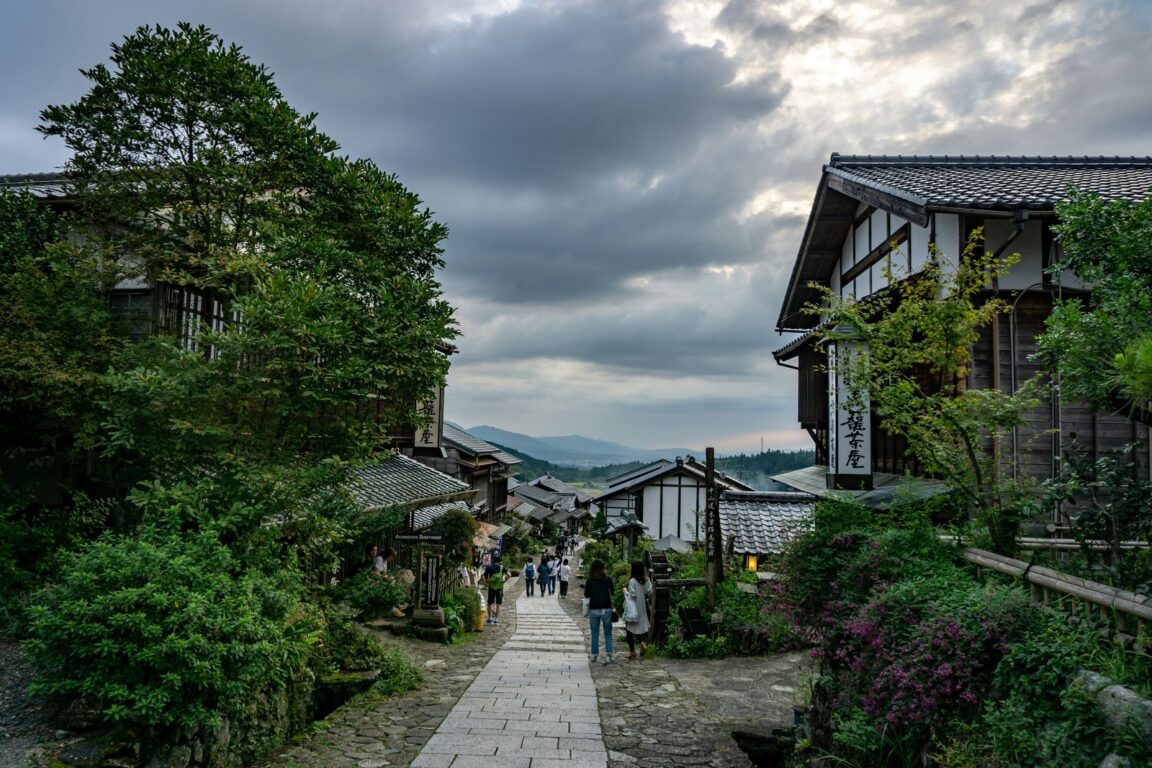
Magome first: a single sloping street of dark wooden buildings, waterwheels turning in the channels beside the road, and the memorial museum to the writer Shimazaki Toson, who was born in the town’s former honjin, the official inn for travelling lords. The town was rebuilt after a fire in the nineteenth century, which is why it reads as handsome and uniform rather than ancient and frayed.
The trail itself is the exhibit. Stone paving survives on the pass section, the ichirizuka mounds that once marked distance for porters still stand beside the road, and bear bells are posted at intervals for walkers to ring as they pass, a practical response to the valley’s real bear population rather than a photo prop. Halfway stands Tateba, a rest house in a former checkpoint building where the keeper serves free tea beside an open hearth. It asks nothing and is remembered by almost everyone who walks the route. Below it, the road passes the paired Odaki and Medaki waterfalls, male and female in the local naming, and levels into Otsumago, a hamlet of farmhouses that is Tsumago in miniature and without the visitors.
Tsumago protected itself early and strictly. Its residents adopted a charter in the late 1960s built on not selling, not renting out and not demolishing the houses of the old road, cars are kept off the main street during the day, and the result is the most complete post town streetscape in Japan: the restored honjin and the waki-honjin, the secondary inn, now a museum, are the two buildings to enter, ideally late in the day when the light drops and the tour groups have gone.
How do you extend the walk to Narai and the post towns beyond?
By train, honestly, and there is no shame in it. The Nakasendo stages north of Tsumago include long stretches on modern road, and the valley railway exists precisely along the line of the old highway. The extension that earns its days is Narai, about an hour up the Kiso Valley by local train via Kiso-Fukushima. Narai was the busiest of the Kiso post towns, known as Narai of a thousand houses, and its preserved street runs longer than Magome and Tsumago combined, with a different, working town feel and far fewer day visitors.
Give Narai a full day and a night in a minshuku, a family run inn, rather than a platform stop. Walk the street in the early morning before the first trains arrive, visit the former Nakamura family residence and the town’s lacquerware and wooden comb workshops, and walk out to the Torii Pass trailhead if a second hill day appeals; the pass between Narai and Yabuhara is the other genuinely rewarding walking stage in the valley, shorter than Magome to Tsumago and wilder in feel. Two nights split between Tsumago and Narai, with the famous stage walked on the day between, is the pacing this valley rewards. Travellers planning the wider trip around it will find the layer and rain system in our Japan spring packing guide transfers directly to the Kiso mountains, which run colder than the cities at either end.
How fit do you need to be, and when should you book?
The Magome to Tsumago stage is a walk, not a climb: about 9 km on a good surface with one pass, suitable for anyone comfortable walking for three hours with stops, in shoes with grip rather than boots. The demands are logistical instead. Minshuku in Tsumago are small, few and booked out on spring and autumn weekends weeks ahead, and many serve dinner and breakfast at set times that assume guests arrive on foot by late afternoon. Book the Tsumago night before booking anything else in the valley, walk with the bus timetable back from Tsumago to Nagiso Station in hand rather than in hope, and carry cash, because the forwarding counter, the local buses and the smaller inns still run on it.
Season decides the walk’s character. Late March to May brings the forwarding service back and the valley’s green at its freshest; June and early July are the rainy weeks; October and November are the premium season, when the maples along the pass turn and every minshuku in Tsumago fills. Winter walkers get the towns to themselves and a silent, snow covered pass, but no forwarding service and a trail that needs checking at the tourist office before setting out.
Frequently asked questions
How long does the Magome to Tsumago walk take?
Two and a half to three hours of walking for most people, over about 9 km. Allow four hours door to door to do the rest house, the waterfalls and both towns justice without watching the clock.
Which town should I sleep in, Magome or Tsumago?
Tsumago, for most walkers. It is the stricter preservation zone, it is quieter after the day visitors leave, and sleeping there turns the direction of the walk into a simple morning bus ride to Magome to start. Magome suits travellers arriving late in the day who want to start walking from the door.
Can I walk the Nakasendo in winter?
Yes, with caveats. The trail stays open but the baggage forwarding service does not run in the closed season, snow and ice can cover the pass section, and daylight is short. Ask at either tourist information centre about trail conditions on the day, and start early.
Do I need to book the baggage forwarding in advance?
No. The seasonal service works on a counter basis: arrive at either tourist information centre between 8:30 and 11:30, hand over the bag, pay per item and collect at the other end from 13:00. The only booking that matters is the minshuku at the far end.
Is one day enough for the Kiso Valley?
One day is enough for the walk, and travellers do it as a day trip from Nagoya. It is not enough for the valley. A night in Tsumago and a day in Narai change the trip from a famous hike into the slower thing the Nakasendo actually was, a road travelled at walking pace between towns built for the night.