 Jonas Lindqvist
Naadam runs on a fixed rule: the National Naadam in Ulaanbaatar is held every year from July 11 to July 13, and its three sports are split across two venues, which is the fact that decides your whole trip. Wrestling and the opening ceremony happen inside the National Sports Stadium, archery and anklebone shooting take place on the grounds beside it, and horse racing happens far outside the city at Khui Doloon Hudag, an open steppe course roughly 40 kilometres west. Plan for both venues from the start, secure an opening ceremony ticket through a hotel or tour operator well ahead, and you will see the full festival. Arrive assuming everything happens in one stadium, and you will miss the horses entirely.
Quick Facts
- When: July 11 to 13 every year, Mongolia’s national holiday, with some archery and racing events beginning in the days just before July 11.
- Where: National Sports Stadium, Ulaanbaatar, for wrestling, the opening ceremony, archery and anklebone shooting. Khui Doloon Hudag, on the steppe outside the city, for horse racing.
- The three games: Mongolian wrestling, called bokh, horse racing and archery, traditionally called the Three Games of Men. Women compete in archery, and girls ride in the horse races. Wrestling remains men only.
- Tickets: The opening ceremony in the stadium is the ticketed prize. Archery and horse racing are generally free to watch.
- Scale: The national wrestling tournament fields 512 wrestlers, or 1024 in special anniversary years, in a single elimination contest of nine or ten rounds.
- Food: Khuushuur, deep fried meat pancakes, and airag, fermented mare’s milk, are the festival staples around the stadium.
- Recognition: Naadam was inscribed by UNESCO on its Representative List of the Intangible Cultural Heritage of Humanity in 2010.
- Festival pairing: For another summer festival built around a stadium and a city, see our guide to Edinburgh in August.
When is Naadam, and what does the July date rule mean for booking?
The dates do not float. Mongolia’s national holiday falls on July 11 to 13, the opening ceremony is held in the National Sports Stadium on July 11, and the festival officially marks the anniversaries of Mongolian statehood and of the 1921 revolution. Smaller Naadams are held across the provinces on dates around the national festival, in July and into August, which matters for the countryside option below.
Book in this order. First, flights and an Ulaanbaatar hotel, because the city fills completely for the holiday and rooms for the festival window should be secured months ahead, ideally by early spring. Second, the opening ceremony ticket route, through your hotel or a Mongolian tour operator, at the same time as the room, not after arrival. Third, a driver or tour for the horse racing day at Khui Doloon Hudag. Independent travellers who reverse that order, and start by looking for a public ticket website, discover the central reality of Naadam ticketing, which the next section explains.
How do the three games split across the two venues?
Wrestling is the stadium sport. Hundreds of wrestlers in the traditional open chest vest, the zodog, and briefs, the shuudag, meet in single elimination rounds across the festival, with no weight classes and no time limit. A wrestler loses when any part of his body other than the soles of his feet touches the ground. Winners perform the eagle dance around the flags, and titles accumulate with rounds won: five wins earns the title nachin, falcon, seven or eight earns zaan, elephant, and the tournament winner is arslan, lion, with repeat champions elevated to avarga, titan. The early rounds, with dozens of bouts running at once, are the best spectacle for a first timer. The final rounds are the best drama.
Archery is the stadium grounds sport, held beside the stadium and free to watch at close range. Archers in full traditional dress shoot at a wall of small leather targets, men at 75 metres and women at 60 metres, while judges sing out the uukhai call as arrows land. Anklebone shooting, shagai, the fourth traditional contest, is played in tents nearby, teams flicking sheep anklebones along a board at a target, and it rewards ten minutes of anyone’s time.
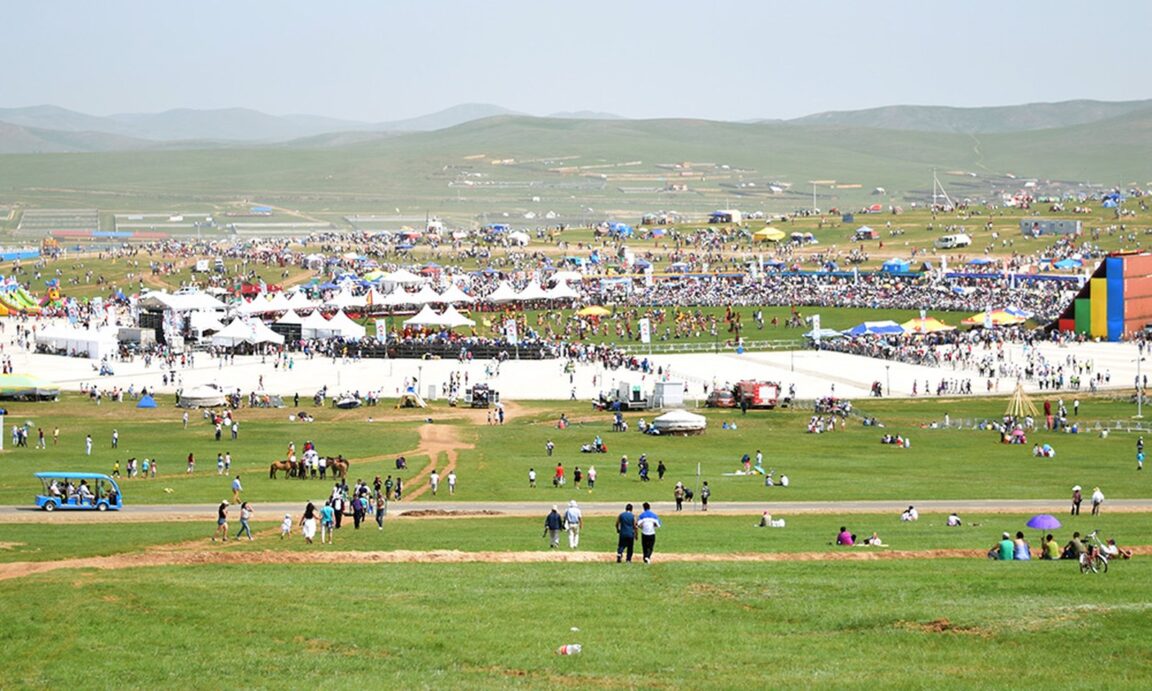
Horse racing is the steppe sport, and it is not a sprint. Races at Khui Doloon Hudag are cross country endurance events run over long distances that vary by the age of the horse, from around 10 kilometres for the youngest class to around 25 kilometres for mature stallions. The jockeys are children, typically between about five and thirteen years old, and the honour falls first on the horse and its trainer rather than the rider. The finish, with the leading horses arriving out of a dust cloud to a singing crowd, is the single most emotional scene of the festival, and it happens an hour’s drive, or considerably more in festival traffic, from your stadium seat.
What is the stadium ticket reality?
State it plainly: there is no simple, reliable online box office where an overseas visitor buys an opening ceremony seat months ahead in the way a European festival sells one. Stadium capacity is small by national festival standards, demand from Mongolians themselves is intense, and domestic ticket release tends to happen close to the festival. In practice, most foreign visitors see the opening ceremony because a tour operator or hotel obtained the seat as part of a package, at prices that vary by tribune and by year, from modest sums for ordinary seats to substantially more for shaded tourist tribune seating, and those seats sell out.
The practical conclusions follow. If the opening ceremony matters to you, commit early and pay an operator for a package that names the ceremony ticket explicitly, in writing. If you travel independently and miss the ceremony, Naadam is not ruined: wrestling continues in the stadium across the festival, archery and anklebone shooting beside it are open, the horse racing is free on open steppe, and the city around the stadium, with families in their finest deel robes, khuushuur stalls and airag sellers, is a festival in itself. What you should not do is arrive on July 10 expecting to solve ticketing at the gate.
Should you choose a countryside Naadam instead?
Consider it seriously, especially on a first Mongolia trip that continues into the steppe. Provincial and district Naadams run on their own dates around the national holiday, are held on open ground outside towns across the country, and offer everything the capital offers except scale and ceremony: the same three sports, at close quarters, with local families picnicking, children racing, and visitors welcomed rather than processed. Many travellers rate a small Naadam, watched from the grass a few metres from the wrestling, above a distant stadium seat.
The trade offs are honest ones. Dates for local Naadams are often confirmed only weeks ahead, the racing and wrestling fields are smaller, and there is no presidential opening ceremony. The strongest itinerary for a traveller with a week is both: July 11 in Ulaanbaatar for the opening and the stadium, a racing morning at Khui Doloon Hudag, then out to the steppe for a countryside Naadam on the way to a ger camp. Tour operators build exactly this pattern, and it is the pattern to copy if you are building your own.
Where should you base, and what does a Naadam trip cost?
Base in central Ulaanbaatar, within walking distance of Sukhbaatar Square if possible. The stadium sits south of the centre, reachable on foot or by a short drive in normal conditions, and a central base keeps restaurants, museums and the pre festival atmosphere in reach when you are not at events. For the racing day, leave early, expect the road west to slow to a crawl as the city decamps to Khui Doloon Hudag, and treat the journey as part of the event rather than a transfer to endure. A hired driver for the day, arranged through your hotel, is the standard solution and removes the parking and navigation problem entirely.
Costs divide cleanly. Watching archery and horse racing costs nothing beyond transport. The opening ceremony seat, bought through an operator, is the main ticket expense, and a guided Naadam day tour that bundles the ceremony, stadium events and the racing is a common and rational purchase even for committed independent travellers. Beyond that, Naadam itself is inexpensive: khuushuur and drinks around the grounds are street food priced, and your real budget goes to the Ulaanbaatar hotel at festival rates and to whatever steppe travel you attach after July 13, which is when Mongolia trips properly begin. Festival crowds leaving the capital after the holiday make onward transport busy for a day or two, another reason to book the whole chain early. For a festival where the food and the gathering matter as much as the programme, compare the spirit of our guide to Day of the Dead in Oaxaca.
Frequently asked questions
Is Naadam the same every year?
The structure is fixed: July 11 to 13, opening ceremony and wrestling at the National Sports Stadium, archery beside it, horse racing at Khui Doloon Hudag. Anniversary years expand the wrestling field and the ceremony. Provincial Naadams vary their dates.
Can women compete at Naadam?
Women compete in archery and girls ride as jockeys in the horse races. Wrestling is restricted to men, and its costume and rituals, including the eagle dance, are performed by the wrestlers and their zasuul, the holder and singer who attends each wrestler.
What should you wear and carry at the stadium and the steppe?
July in Ulaanbaatar is warm by day with cool edges, and the steppe course is open, dusty and without shade. Carry sun protection, water and a layer for wind, and expect dust at Khui Doloon Hudag. Mongolians dress up for Naadam, many in a formal deel, and visitors who dress smartly for the stadium fit the occasion.
What is khuushuur, and should you try airag?
Khuushuur is a deep fried flat pancake of dough and seasoned meat, sold hot all around the festival grounds, and it is the essential Naadam snack. Airag is fermented mare’s milk, mildly alcoholic, sour and central to Mongolian hospitality. Accept a small bowl when it is offered, taste it, and hand it back with thanks if it is not for you.
How many days do you need for Naadam?
Three festival days in and around Ulaanbaatar, plus a travel day either side, is the minimum that does it justice. Add at least three further days if you want a countryside Naadam or a ger camp stay, which most visitors rightly do.