 Kwame Mensah
Finland’s sauna day turns on three decisions, and all three are settled before you arrive. First, the dress code follows the room, not the country: in mixed saunas a swimsuit is mandatory, and in separate men’s and women’s saunas bathing nude is the norm, and Helsinki’s two harbour headliners, Allas Pool and Löyly, both run mixed rooms where swimwear is required. Second, ice swimming is a dip, not a swim: you heat up thoroughly first, walk to the avanto, the hole kept open in the ice, lower yourself in for well under a minute, and return to the heat. Third, the smoke sauna, the slowest and softest heat of all, needs no expedition: Löyly heats one in the city, and the city run saunas at Kuusijärvi in Vantaa heat traditional smoke saunas every day of the year. Finish in Tampere, where the Sauna Capital of the World claim rests on Rajaportti, the oldest public sauna in Finland, in use since 1906. Prices and hours checked on November 20, 2026, against the venues’ and authorities’ official sites.
Quick Facts
- Culture status: Sauna culture in Finland was inscribed on UNESCO’s Intangible Cultural Heritage list on December 17, 2020
- The dress rule: Swimsuit mandatory in mixed saunas; nude bathing is the norm in separate men’s and women’s saunas
- Harbour pick: Allas Pool, Katajanokanlaituri 2 A beside Market Square: five saunas, a warm pool held at 27 degrees and an unheated sea water pool
- Design pick: Löyly, Hernesaarenranta 4: a traditional smoke sauna and a wood burning sauna inside a timber landmark opened in 2016, with year round sea swimming, weather permitting
- Helsinki prices: Two hours at Allas Pool costs 19 euros at weekday rates and 24 euros from Friday afternoon to Sunday; two hours at Löyly costs 29 euros with a towel included. Published rates checked on November 20, 2026; confirm on the venue site before you go
- Ice swimming: Avantouinti, a short dip in an avanto, a hole kept open in the ice, always after heating in the sauna and never as a first move
- Smoke sauna: Kuusijärvi in Vantaa heats public traditional smoke saunas every day of the year, per the City of Vantaa; they open in the afternoon and cool gradually through the evening
- Sauna capital: Tampere, backed by the Finnish Sauna Society and the International Sauna Association in 2018; Rajaportti sauna in Pispala is the oldest public sauna in Finland, running since 1906
- Scale: Finland counts about 3.2 million saunas, per the Finnish Heritage Agency
- Facts checked: November 20, 2026, against Allas Pool, Löyly, the City of Vantaa, Rajaportti Sauna and Finnish Heritage Agency material
Mixed or separate: which dress rule applies where?
The split that organises every Finnish sauna visit is not old versus new or city versus country. It is who else is in the room. A mixed sauna, where men and women bathe together, runs on swimwear: at Allas Pool, the Panorama and Corner saunas and the mixed floating sauna all state swimwear mandatory, and at Löyly the public saunas and terraces are mixed, so a swimsuit is worn at all times. A separate sauna, divided by gender, runs on the older rule: you bathe nude, you sit on a bench cover or a small towel, and swimwear stays in the locker. Allas keeps both systems under one roof, because its separate men’s and women’s floating saunas make swimsuits optional, and Kuusijärvi splits the same way, with mixed smoke saunas where a swimsuit is mandatory and separate electric saunas in the main building.
Neither rule is a trap for visitors, because each venue states its rule plainly at booking and on the door. The working method is simple: assume swimwear until you have read the venue’s own instructions, shower before your first round (Allas’s published etiquette asks bathers to wash first, swimsuit off in the shower, and to wet their hair), take a bench cover, and leave phones and cameras out of the hot rooms entirely. In a separate sauna, follow the room: if everyone else is nude, a wrapped towel is still acceptable. What reads as rude in Finland is not skin. It is noise, hogging the water bucket, and treating the bench as a photo opportunity.
What happens at the Helsinki harbour pools?
Allas Pool is the working harbour version: a floating bathhouse beside Market Square that opens at 6.30 a.m. on weekdays and 8 a.m. at weekends, and closes at 9 p.m. Its five saunas cover the range in one ticket: the Panorama Sauna at 80 degrees with sea views and steam at the touch of a button, the Corner Sauna at 90 degrees where you throw the water on the stones yourself, and three floating saunas at 70 degrees on the pool deck. Between rounds there are two pools, a warm water pool held at 27 degrees all year, and a sea water pool that is not heated at all and follows the Baltic, which makes Allas the gentlest place in the city for a first cold plunge: the cold water is a step down from the deck rather than a lonely hole in a frozen lake. A two hour ticket costs 19 euros at weekday rates and 24 euros from Friday afternoon through Sunday, on the published rates checked today, and the floating saunas close in rotation on weekday mornings for weekly maintenance.
Löyly is the design version, a sculptural timber building on the Hernesaari shore that Time Magazine named one of the world’s 100 greatest places, per the venue. Its public side pairs a traditional smoke sauna with a wood burning sauna, each holding about 20 bathers, and both open towards the sea, where swimming is possible all year round, weather permitting, down a ladder from the terrace. In winter an ice hole is kept open in front of the building, so the full cycle of smoke heat, terrace air and black Baltic water happens within a few steps. Two hours costs 29 euros with a towel, seat cover, shampoo and shower gel included, extra hours are charged on top, and there is a morning sauna on Wednesdays and Saturdays. Löyly recommends booking ahead, and at weekends that advice should be read as a requirement.
How does ice swimming actually work?
Avantouinti, ice swimming, is the cold half of the sauna cycle, and the sequence matters more than bravery. Heat first, always: one or two sauna rounds until you are warm to the core. Then walk, do not run, to the water, wearing a hat and something on your feet, because docks and ice edges are cold and heads lose heat fast. Lower yourself in slowly on the ladder, breathe out as the cold lands, and stay in for seconds on a first attempt, building towards a minute or two across a season rather than across an afternoon. Never dive, never put your head under on a first dip, and never go alone: the cold shock response is real, and it is managed by company, ladders and short exposures, not by toughness. Then go straight back to the heat, and let the second sauna round do the warming, rather than a hot shower, which regulars save for the end of the session.
The water itself is honest cold. Allas’s sea water pool tracks the harbour from close to freezing in the coldest weeks to about 22 degrees at the height of summer, and the avanto at a lakeside sauna is cut through the ice and kept open, so the water under the ice sits at the same near zero point all winter. That consistency is the point: the hole is treated as infrastructure rather than a stunt, which is why winter swimmers can build a habit of it. Anyone with a heart condition or blood pressure concerns should talk to a doctor before a first dip, a caution Finnish winter swimming guidance repeats for good reason. For everyone else, the barrier is the walk across the deck, and it lasts about ten seconds.
What makes a smoke sauna different, and where can you try one?
A smoke sauna, savusauna, is the original Finnish sauna: a log room with a large stone stove and no chimney, heated for hours until the room fills with smoke, then ventilated and wiped down before bathers enter. What remains is a softer, darker, lower heat than a modern stove gives, with a faint woodsmoke scent in the timbers, and regulars rate it the finest löyly, the finest steam, in the country. Because heating one is a day’s work, public smoke saunas are rare, which is why the two addresses in this guide matter. Löyly’s smoke sauna is the city version, bookable in a normal two hour session. The fuller version is at Kuusijärvi, the City of Vantaa’s lake recreation area, which the city describes as the only place in Finland where public traditional smoke saunas are heated every day of the year.
Kuusijärvi runs four smoke saunas by the swimming beach: Havu, an accessible quiet sauna with 17 seats where talking is kept down, Pihka with 27 seats, Kuusi with 20, and a small five seat sauna. The small smoke sauna opens at 1 p.m. and the others at 2 p.m., all running to 8.30 p.m., and the city notes they are hottest when they open and cool gradually through the evening, so a smoke sauna day is deliberately paced: arrive for the opening heat, take the lake between rounds, and let the last round be the gentle one. The smoke saunas are mixed, with swimsuits mandatory, and two new smoke sauna buildings completed in the summer of 2025 won the Finlandia Prize for Architecture, so the oldest style of Finnish sauna is currently housed in some of its newest architecture. In winter the lake completes the cycle: smoke heat, the ice hole at the beach, and back into the warmth.
Is Tampere really the Sauna Capital of the World?
The claim is official, and it is worth understanding on its own terms. In 2018 the Finnish Sauna Society and the International Sauna Association stated their support for Tampere’s status as Sauna Capital, on the basis that the city is home to the most public saunas in Finland and that their standard is high; Visit Tampere counts close to 70 public saunas across the region. The announcement was made, fittingly, at Rajaportti Sauna in the Pispala district, which the Pispala Sauna Association describes as the oldest public sauna in Finland still going strong. Rajaportti has been running since 1906: the first sauna building was wooden, the stone building in use today went up in 1915, the block belongs to the City of Tampere, and the association has run the sauna since 1989.
As a visitor proposition, Tampere works because the capital claim is not a plaque but a density. A sauna traveller can build a whole day around public benches, old and new, lakeside and urban, and finish at Rajaportti, where the experience is the traditional one: separate departments, wood heat, and a room that has absorbed more than a century of the same evening routine. Treat the Helsinki venues as the introduction and Tampere as the deepening. Readers planning cold weather packing for a Nordic bathing trip can borrow the layer system in our Iceland winter packing guide, where the swimsuit is likewise the item nobody should leave behind.
How should a sauna day be paced?
The Finnish pattern is rounds, not a single long bake. Ten to fifteen minutes of heat, then a cooling break at least as long: cold water if you are taking it, terrace air if you are not, then back in. Two or three rounds fill a two hour ticket comfortably, and the ticket length is a feature, because it stops the day becoming an endurance event. Eat after, not before: both Helsinki venues build the meal into the site, Löyly with its restaurant on the same terrace and Allas with cafes and restaurants above the pools, and a sauna afternoon that ends with food at dusk is the local shape of the thing. Book the pieces that can sell out, a Löyly slot at weekends and an Allas advance ticket on a fine Saturday, and leave the rest loose.
Frequently Asked Questions
Do I have to be naked in a Finnish sauna?
Only in separate men’s and women’s saunas, where nude bathing is the norm and swimwear stays in the locker. In mixed saunas, including Allas Pool, Löyly and the Kuusijärvi smoke saunas, a swimsuit is mandatory. Each venue publishes its rule, so check the room you are booking rather than the country stereotype.
How long should a first ice swimming dip last?
Seconds. Lower yourself in on the ladder, breathe out slowly, and climb out once the cold shock settles, which for a first timer is well under a minute. Regulars build to a few minutes across a season. Always heat up in the sauna first, wear a hat and footwear to the water, and never dip alone or dive in.
What does a public sauna cost in Helsinki?
On the published rates checked on November 20, 2026, a two hour ticket at Allas Pool costs 19 euros Monday to Thursday and Friday until 2 p.m., and 24 euros from Friday afternoon to Sunday. Two hours at Löyly costs 29 euros, including a towel, seat cover and shower products. Prices change, so confirm on the venue’s own site when you book.
What is löyly?
Löyly is the steam that rises when water hits the hot stones of the sauna stove, and by extension the quality of the heat itself. Bathers throw water in small amounts and judge a sauna by its löyly: the soft, enveloping steam of a smoke sauna is the benchmark every other stove is measured against.
When is ice swimming season in Finland?
Whenever the ice forms, roughly the heart of winter, but cold water bathing runs all year at the harbour venues: Allas’s sea water pool is unheated in every season, and Löyly offers sea swimming all year, weather permitting. The avanto, the hole in the ice, is a winter feature; the habit is a twelve month one.
Which should a first timer choose, Allas Pool or Löyly?
Choose Allas Pool for an early start, real swimming and the gentlest first cold plunge, in a sea water pool beside a 27 degree warm pool. Choose Löyly for the smoke sauna, the architecture and a slower, restaurant attached afternoon. Both are mixed with swimwear required, both are bookable, and neither is a wrong answer.
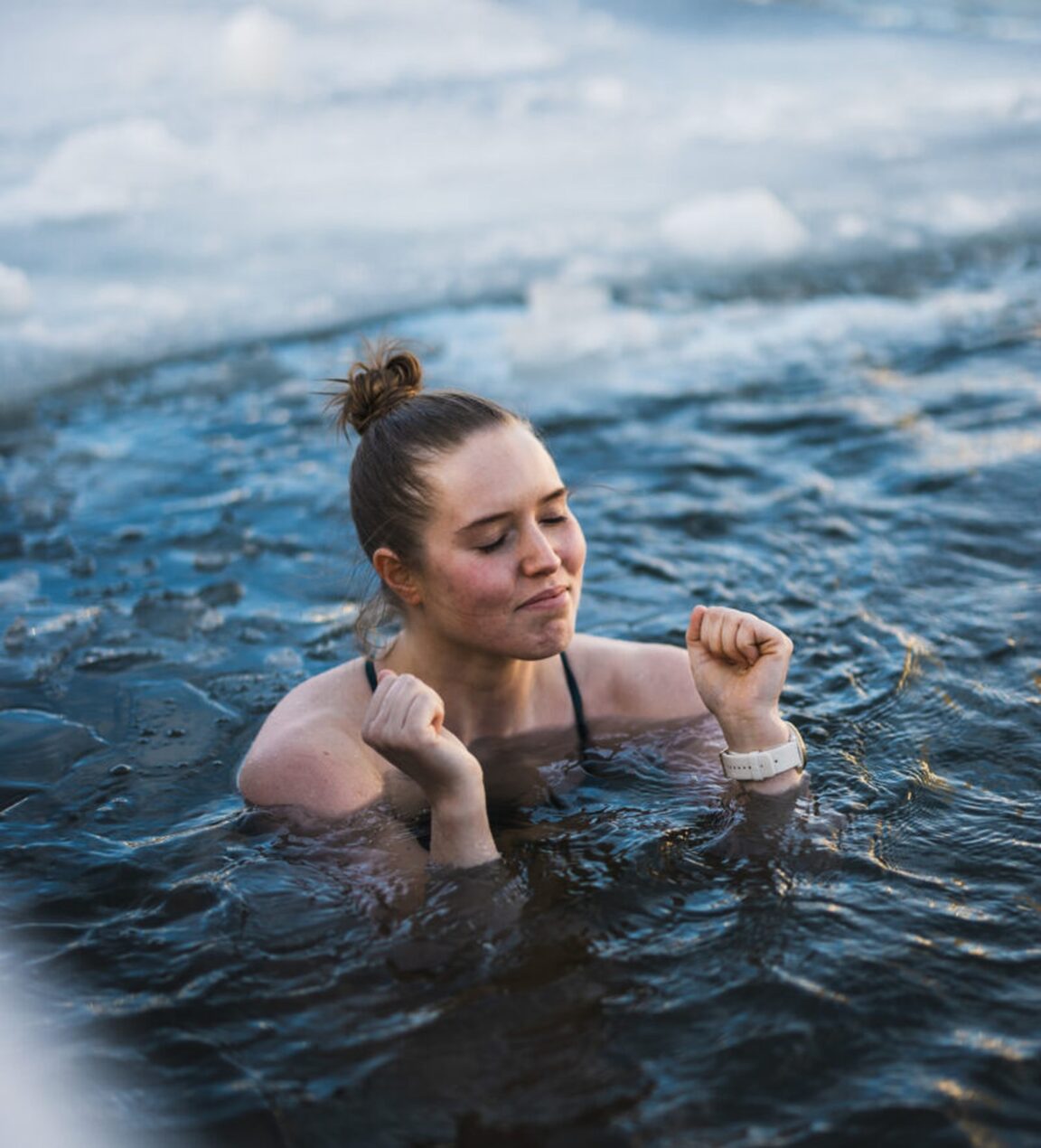
Featured image: A winter swimmer taking the cold plunge among the ice at Allas Pool, the harbour bathhouse beside Market Square in Helsinki. Photo from Allas Pool, the venue’s own official website (allaspool.fi), used with credit.