 Camille Baptiste
The Maya Train now runs the full loop it was promised as: 1,554 kilometres of track, 34 stations and five states, with the final southern sections between Palenque, Chetumal and Escarcega completing the circuit in December 2024. That means a traveller can board in Palenque, ride north through Campeche and Merida to Cancun, continue down the Caribbean coast through Tulum and Bacalar to Chetumal, and close the loop back to Escarcega without leaving the railway. The catch is that the train is only half the journey. Most stations sit outside the towns they are named for, frequencies are thin on the southern sections, and the class and fare you book change the trip more than the timetable suggests. Plan the loop as a sequence of train legs plus transfers, not as a single ride, and it works well.
Quick Facts
- The network: Tren Maya (Maya Train), 1,554 km and 34 stations across Chiapas, Tabasco, Campeche, Yucatan and Quintana Roo, operated through the official site trenmaya.gob.mx
- Full loop status: Complete and selling tickets. The last sections, Tulum to Chetumal and Chetumal to Escarcega, with the Palenque connection, opened in December 2024
- The seven sections: Palenque to Escarcega; Escarcega to Calkini; Calkini to Izamal; Izamal to Cancun; Cancun to Tulum; Tulum to Chetumal; Chetumal to Escarcega
- Classes on sale: Turista (Tourist) and Premier. The booking portal sells these two classes; the long distance P’atal sleeper described on the operator site is not on sale
- Fares: Set by distance and by traveller category (local, national, international and special concession categories). International visitors pay the highest tier and show a passport at boarding
- Tickets: Buy only through the official booking portal linked from trenmaya.gob.mx, the official app, or station ticket offices. One ticket covers one continuous journey; getting off ends that ticket
- Transfers: Budget a transfer at almost every station. Merida’s station is at Teya, about 14 km from the Plaza Grande; Campeche station is about 20 minutes by car from the historic centre
- Time zones: Quintana Roo runs one hour ahead of Yucatan, Campeche and Chiapas. Timetables cross the line, so check which zone a departure time uses
Is the full loop actually open, Palenque to Chetumal included?
Yes. The railway opened in stages from December 2023, and the sections that complete the loop entered service in December 2024: Tulum south to Felipe Carrillo Puerto, Bacalar and Chetumal, then west from Chetumal through Kohunlich and Nicolas Bravo to Escarcega, plus the Palenque end of the line in Chiapas. With those pieces in place, the seven sections form one continuous circuit, and the operator’s booking engine sells journeys across all of it. Two honesty notes matter for planning. First, a complete circuit does not mean a single train circles the loop; you will change trains at junctions such as Escarcega, Izamal or Cancun depending on the routing. Second, service frequency is uneven. The Cancun to Merida corridor carries the most trains, while the deep south sections run far fewer departures, so a loop itinerary is built around the southern trains first and filled in afterwards.
How does the loop break into rideable sections?
Think of the network as a western line and a coastal branch joined at Cancun. The western line runs Palenque to Escarcega, then north through San Francisco de Campeche, Merida Teya and Izamal to Valladolid, Chichen Itza and Cancun Airport. It serves the big colonial cities and the most famous archaeological zone on the route, and it is the half most travellers should start with. The coastal branch runs south from Cancun Airport through Puerto Morelos and Playa del Carmen to Tulum, then on through Felipe Carrillo Puerto and Limones Chacchoben to Bacalar and Chetumal Airport, near the Belize border. The closing link, Chetumal west to Escarcega through the Calakmul region, is the quietest and wildest stretch, passing stations built for jungle archaeological sites rather than cities. A full loop in either direction takes most travellers five to ten days once stops are added; riding it as a single endurance trip wastes what the train is actually good at, which is replacing long bus days between strong bases.
What is the real difference between Turista and Premier?
The split is simpler than the marketing suggests. Turista is the standard cabin: reclining seats arranged four across, air conditioning, luggage racks, toilets and access to a buffet car selling snacks and drinks. Premier is the same train with a wider seat arranged three across, more legroom, and on longer legs a meal included rather than bought on board. Both classes ride the same track at the same speed, up to 160 km per hour on the fastest stretches, and both use the same stations. The operator describes three train types: Xiinbal, the standard service travellers will actually ride on almost every route; Janal, a restaurant train concept; and P’atal, a long distance train with cabins. As of this check, the booking portal sells Turista and Premier seats on the standard service, and no sleeper or cabin product can be booked, so do not build an itinerary around an overnight train that is not on sale. For short coastal hops such as Cancun to Tulum, Turista is the sensible buy. For the longest legs, Palenque to Cancun or Chetumal to Cancun, Premier’s space earns its premium for many travellers.
How do station to town transfers actually work?
This is where Maya Train trips are won or lost, because the stations were built on greenfield sites outside town centres. At Merida, the station is Merida Teya, in Kanasin about 14 km east of the Plaza Grande. Two organised links cover it: the operator’s Tren Maya Conecta connecting bus, timed to trains and priced at 40 pesos on the latest published information, and the city’s IE-TRAM electric bus route 901 to La Plancha and Paseo 60, priced at 45 pesos and paid by card. Taxis and ride hailing cover the same gap door to door. At Cancun, the station serves the airport but is not inside a terminal, and a connecting bus links station and airport, so confirm the current boarding point before relying on a tight flight connection. Campeche’s station sits about 20 minutes by car from the walled historic centre, and Palenque, Valladolid, Tulum and Bacalar all need a taxi, colectivo or pre booked transfer for the last stretch to hotels and ruins. The working rule: add 30 to 60 minutes and a small cash or card budget to every arrival, and never schedule a ruin entry, tour or flight against the train’s arrival time. Travellers pairing the train with time in the capital region can plan food stops with our Mexico City food guide, and those extending into central Mexico should see our Puebla travel guide for the Talavera city that pairs naturally with a Yucatan loop.
How should you book, and in what order?
Book in this order. First, fix the scarce southern legs, Chetumal to Escarcega and Palenque departures, because few trains run them and a missed one can cost a day. Second, book the long western legs, Palenque to Campeche, Campeche to Merida and Merida to Cancun, choosing Premier only where the distance justifies it. Third, add the coastal hops, which have the most departures and the most flexibility. Buy through the official portal or app, or at station ticket offices, and treat any third party seller as a red flag. International visitors should expect the international fare tier and must carry the passport used for booking, since it is checked at boarding. Luggage is capped at three pieces and 50 kg per passenger on the operator’s published terms, and you carry your own bags. Finally, recheck your departures the day before travel on the official site, because schedules on the southern sections change more often than the headline corridor, and build your hotel nights in bases the train serves well: Palenque, Campeche, Merida, Valladolid, Tulum or Bacalar and Chetumal.
Frequently asked questions
Can you ride the entire Maya Train loop on one ticket?
No. Tickets are sold per journey between two stations, and leaving the train ends that ticket. A loop is a chain of separate tickets, which is why booking the low frequency southern legs first matters.
How long does the full loop take?
The longest single legs run about five hours, such as Campeche to Palenque, and Cancun Airport to Merida Teya takes about three and a half hours. Riding every section with sensible stops takes five to ten days; the pure rail time is only part of it, because transfers and thin southern frequencies set the pace.
Is there a sleeper train on the Maya Train?
Not on sale. The operator describes a long distance P’atal train with cabins on its website, but the booking portal offers only Turista and Premier seats. Plan hotel nights in towns along the route instead.
Which class should a first time visitor book?
Turista for hops under about two hours, where the cabins are effectively equal in journey time. Consider Premier for the longest legs, where the three across seating, extra space and included meal on longer runs make a real difference.
Do stations sit in the towns they are named for?
Usually not. Merida’s station is at Teya, about 14 km from the centre, Cancun’s serves the airport from outside the terminals, and Campeche, Palenque and Tulum all require a bus, taxi or transfer for the final stretch. Budget the transfer into every leg.
What does an international visitor pay?
The international tier, the highest of the fare categories, with the exact price set by route and class in the booking portal. As a guide from the operator’s published lists, Cancun Airport to Tulum was listed at 467 pesos in Turista and 560 pesos in Premier for international travellers, and Palenque to Cancun Airport at 2,226 pesos in Turista. Fares change with promotions, so confirm your date in the portal before budgeting.
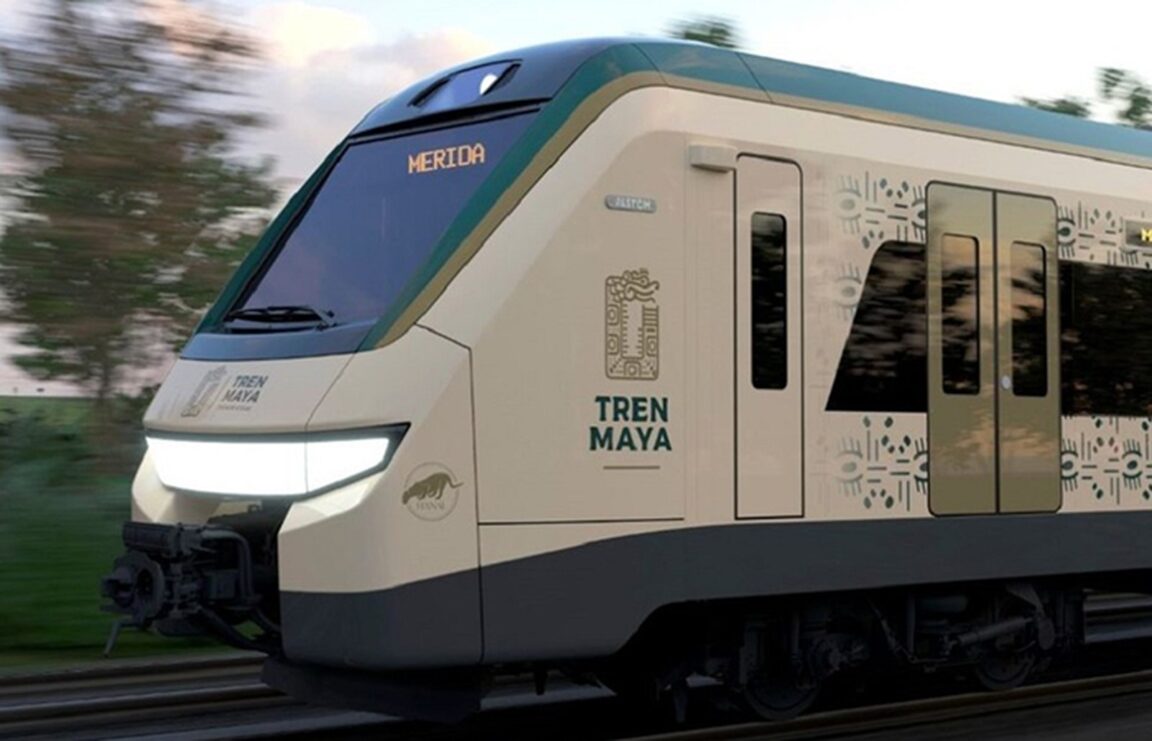
Featured image: A Tren Maya train in service, destination Merida, from the official Tren Maya website (trenmaya.gob.mx), Gobierno de Mexico. Used with credit.