 Kwame Mensah
Pack for Ireland in winter for horizontal rain, not for deep cold: a hooded waterproof shell and waterproof over trousers as the outer system, a warm mid layer and merino base layers under it, and two pairs of waterproof footwear rotated daily so one pair is always dry. That is the whole answer. Met Eireann puts the winter mean temperature at Dublin Airport at 5.2 to 5.5 degrees C from December to January, with rain on 17.7 to 18.6 days a month, and at Shannon Airport on the west coast the rain rises to 103.8 to 115.4 mm a month. The cold rarely bites. The wet soaks, the Atlantic wind pushes it sideways, and a bag built on waterproofing, a shoe rotation and one dry pub layer survives the trip intact.
Quick Facts
- The temperature: Met Eireann 1991 to 2020 averages for Dublin Airport give a mean daily maximum of 8.0 degrees C in January and 8.3 in December, with mean daily minima of 2.3 and 2.6 degrees C. This is a cool trip, not a freezing one.
- The rain in the east: Dublin Airport averages 61.8 mm of rain in January and 72.1 mm in December, falling on 17.7 and 18.6 days a month at 0.2 mm or more.
- The rain in the west: Shannon Airport averages 103.8 mm in January and 115.4 mm in December, on 21.3 and 21.0 days a month, with a yearly total of 1,019.7 mm against Dublin’s 772.5 mm. The west coast is the wetter half of any itinerary.
- The light: Mean daily sunshine is 1.7 hours in December at Dublin Airport and 1.5 hours at Shannon. Plan outdoor time for the middle of the day and evenings for pubs, music and indoor sights.
- The wind: Dublin Airport’s mean wind speed is 12.3 knots in January and 11.7 knots in December, with an average of 2.3 gale days in January. Wind chill, not air temperature, sets the layer count on the coast.
- The bag: Aer Lingus allows one 10 kg cabin bag at a maximum of 55 x 40 x 24 cm, plus a small personal item at 40 x 30 x 20 cm. The system below fits inside it, with the shell and boots worn to travel.
- Checked: Temperatures, rainfall, sunshine and wind verified against Met Eireann on 20 November 2026. Cabin bag limits verified against Aer Lingus on the same day.
Why is Ireland in winter a wet problem, not a cold problem?
Because the numbers say so. Ireland’s winter is a temperate oceanic winter: Met Eireann’s 1991 to 2020 climate averages put the national annual mean temperature at 9.8 degrees C and annual rainfall at 1,288 mm, and the station tables behind those averages show a winter that hovers just above freezing at night and reaches 8 to 9 degrees C by day. Snow is a minor character. At Dublin Airport, snow or sleet falls on an average of 3.2 days in January, and at Shannon on only 1.5 days. Rain is the main character, and it arrives at an angle. Atlantic systems cross the west coast first, which is why Shannon records close to double Dublin’s January rainfall, and why the same front that is a shower in Dublin is a soaking on the Cliffs of Moher, in Galway or along the Wild Atlantic Way. Pack for a North Atlantic rainstorm that lasts all week, at temperatures a good autumn jacket handles, and every other choice in this guide follows.
Do you really need waterproof over trousers in Ireland?
Yes, and this is the item most visitors leave behind and most regret. A waterproof jacket protects the top half. Horizontal rain, driven by a 12 knot mean wind and gusts well above it, hits the legs first and hardest, and it hits them while you are standing still at a viewpoint, waiting for a bus or walking a cliff path, exactly when you cannot step inside. Jeans and ordinary trousers, once wet, stay wet for the rest of the day and chill the whole body. The fix weighs almost nothing: lightweight waterproof over trousers, worn over your normal trousers, with side zips or wide legs so they go on over boots at a car park or a trailhead without a dance. Under them, pack trousers in synthetic or wool blends that dry overnight, two pairs rotated, and leave denim at home entirely. Cotton is the enemy fabric of this trip. It absorbs rain, dries slowly in heated but humid rooms, and turns a damp afternoon into a cold evening. The over trousers also solve the wind problem on the coast, because a waterproof membrane is a windproof membrane, and legs are half the surface the Atlantic is blowing at.
What is the right shoe rotation for wet cobbles and pavements?
Two pairs, both waterproof, rotated daily, and never two days in the same pair. Dublin, Galway, Cork, Kilkenny and Belfast all put visitors on cobbles, setts, stone flags and polished pavement that run slick when wet, which in winter is most days. The rotation is simple. Pair one is a waterproof walking shoe or light boot with a lugged sole and real tread, for coast paths, cliff viewpoints, Burren limestone and any day outside a city. Pair two is a waterproof ankle boot or smart waterproof shoe with a grippy sole, for city cobbles, museums, restaurants and the pub, smart enough to pass as evening footwear and tough enough for a wet walk home. Each night the off pair dries, stuffed loosely with newspaper or a hotel towel if it took a soaking, away from direct radiator heat, which cracks leather and warps adhesives. Each morning you start in dry shoes, which is the single biggest comfort difference on a seven day winter trip. Smooth leather soles, suede, canvas trainers and fashion boots with flat soles all fail the same test: the first wet cobbled slope. If a third pair tempts you, make it a pair of hotel slippers or light sandals for the room, not another outdoor shoe. Two outdoor pairs, properly rotated, beat three pairs worn at random, and the same rotation logic powers our Azores in autumn packing system, where Atlantic weather also changes four times before lunch.
How do you dress for Atlantic wind chill on the west coast?
By treating the forecast temperature as the starting point and the wind as the real temperature. A Shannon January day at 8.9 degrees C maximum feels mild in a sheltered street in Ennis or Galway. On an exposed headland, with the mean wind and a passing front, the felt temperature drops several degrees and the rain arrives horizontally, which is why the shell system matters more than a heavy coat. Build it in three parts. Next to the skin, merino or synthetic base layers, top and leggings for coast days, because they keep insulating when damp and dry overnight. In the middle, one warm layer, a fleece or light insulated jacket, worn under the shell. On the outside, the hooded waterproof shell and the over trousers, with the hood up, cuffs closed and no gaps at the neck. Add a warm hat, gloves and a neck gaiter for viewpoint time: standing still for photographs at a cliff edge is the coldest activity of the trip, colder than any walk, because you generate no heat while the wind strips it. A single heavy parka fails this test. It is too hot in a heated museum or a crowded pub, too bulky for a cabin bag, and once its insulation gets damp it stays damp. Layers you can add on a headland and strip in a cafe are the system, and it is the same principle, at a gentler temperature, as our Iceland in winter packing guide.
What is the pub dry layer, and why does it get its own cube?
It is the one complete dry outfit, top, trousers and socks, sealed in its own packing cube or dry bag, that never goes outdoors in the rain and is reserved for the evening. Winter days in Ireland end early, with December sunshine averaging under two hours and darkness by late afternoon, and the social centre of the trip moves indoors: the traditional pub, the music session, the long dinner. Arriving at that evening in the day’s damp layers ruins it, and there is no time to launder and dry a full outfit between a 4 pm soaking and a 7 pm session. So the bag carries a pub layer by design. A smart knit or shirt, the drier of your two trousers if the cube is tight, fresh socks and underwear, kept sealed against a wet shell sharing the same case. Everything else in the bag can be damp, drying or in rotation. The pub layer cannot. It is also the insurance outfit: if one day’s rain defeats the shell, soaks the rotation shoes and leaves the day clothes drying on a rail, the evening is still saved, warm and presentable. Pack it last, on top, so it is the first thing you reach when you check in.
How does the whole system fit in one cabin bag?
Inside the Aer Lingus limits, if the bulky items travel on your body. The airline’s cabin baggage rules allow a 10 kg bag at 55 x 40 x 24 cm and a personal item at 40 x 30 x 20 cm, which is enough for this trip precisely because winter Ireland needs coverage, not bulk. Wear the walking boots, the mid layer and the shell to fly. In the bag: the second waterproof pair, two rotating trousers, three tops, merino base layers, the over trousers rolled around the shell if the shell is not worn, hat, gloves and gaiter in a pocket, and the sealed pub layer cube on top. Underwear and socks for the week in merino or synthetic, washed in a sink and dried overnight, keep the count low. A small dry bag inside the case does double duty: it holds the pub layer on dry days and isolates soaked kit on wet ones, so one bad hour never contaminates the whole bag. Checked on 20 November 2026, those Aer Lingus dimensions include wheels and handles in the airport gauge, so measure the packed bag, not the empty one.
What do Ireland winter travellers pack wrong?
Four mistakes repeat. The first is an umbrella as the main rain plan: in a coastal wind it inverts or blows useless, and even in a city it protects neither legs nor bag. The shell and over trousers are the plan. The second is one pair of shoes, worn every day, damp by day three and miserable by day five. The rotation is not a luxury on a trip where Dublin records rain on more than half the days of a winter month. The third is dressing for Arctic cold that never comes: a expedition weight coat, snow boots and thermal everything, for a capital whose January mean minimum is 2.3 degrees C at Dublin Airport and whose west coast station at Shannon averages a 3.3 degree minimum in the same month. The fourth is cotton, in jeans, hoodies and socks, the fabric that turns Irish rain into an all day chill. Swap cotton for wool and synthetics and the same weather feels two degrees kinder.
Frequently Asked Questions
How cold does Ireland actually get in winter?
Mild by northern standards. Met Eireann 1991 to 2020 averages give Dublin Airport a mean temperature of 5.2 degrees C in January, 5.3 in February and 5.5 in December, with daytime maxima of 8.0 to 8.5 degrees C. Shannon Airport, for the west, averages 6.1 degrees C in January and 6.4 in December. Frost happens at night, snow is infrequent, and wind and rain, not temperature, are what to dress against.
Are waterproof over trousers really necessary, or is a long coat enough?
They are necessary for any itinerary that leaves the city, and useful in the city too. A long coat sheds rain onto the legs below the hem, and horizontal coastal rain bypasses a coat entirely. Shannon Airport averages 115.4 mm of rain in December on 21.0 days with rain, so a west coast trip will meet driving rain. Over trousers weigh little, pack small and keep the trousers under them, and the pub evening that follows, dry.
How many pairs of shoes should I take to Ireland in winter?
Two outdoor pairs, both waterproof, rotated daily: a lugged walking shoe or light boot for coast and country days, and a grippy waterproof ankle boot or smart shoe for city cobbles and evenings. Rotating gives each pair a full night to dry, which matters when rain falls on 17 to 21 days of a winter month depending on coast. Leave smooth soles, suede and canvas at home.
Can I do Ireland in winter with carry on only?
Yes. The Aer Lingus cabin allowance is a 10 kg bag at 55 x 40 x 24 cm plus a personal item at 40 x 30 x 20 cm, verified on 20 November 2026. Wear boots, mid layer and shell to travel, rotate two trousers and three tops, use merino layers that wash in a sink, and the waterproof system fits with room for the sealed pub layer. Travellers adding camera bodies, tripods or a second formal outfit should check a bag and keep the same rotation.
Is the west coast really that much wetter than Dublin?
Yes, by the official record. Shannon Airport’s yearly rainfall in the Met Eireann 1991 to 2020 averages is 1,019.7 mm against Dublin Airport’s 772.5 mm, and the winter gap is wider: 103.8 mm against 61.8 mm in January, and 115.4 mm against 72.1 mm in December. An itinerary that splits time between Dublin and the Wild Atlantic Way should be packed for Shannon’s numbers, not Dublin’s.
What should I wear for a pub evening after a wet day?
The sealed pub dry layer: a complete outfit, smart knit or shirt, dry trousers, fresh socks and underwear, kept in its own cube or dry bag and never worn in the rain. Winter evenings are the social heart of the trip, with darkness falling by late afternoon and December sunshine averaging 1.5 to 1.7 hours a day, so the dry change is what turns a soaked sightseeing day into a good night.
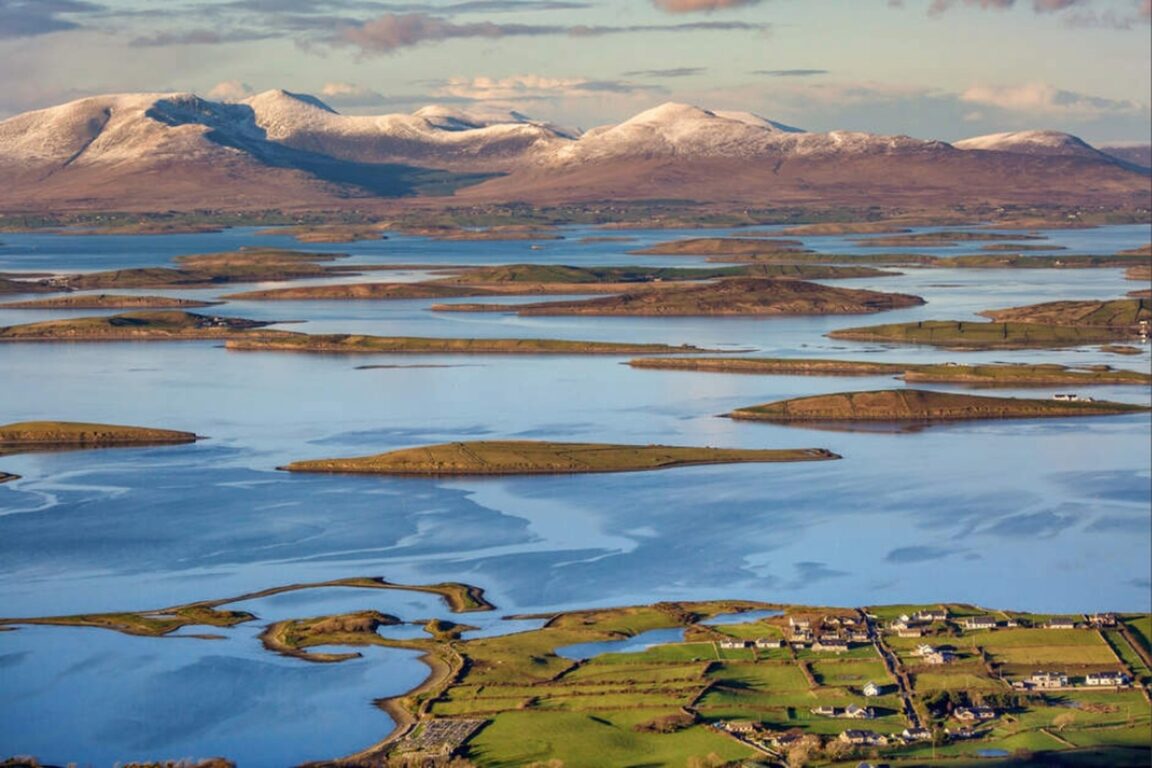
Featured image: Clew Bay in County Mayo, with its islands, green fields and snow capped mountains behind, the west coast winter the shell, over trouser and shoe rotation system in this guide is packed for. Photo: Ugnius Brazdziunas, via Ireland.com, Tourism Ireland, used with credit.